
Chandelier Installation Cost: Ceiling Box Ratings Explained
Key Takeaways
- Chandelier installation cost in the Twin Cities depends on labor ($80-$120 per hour), the condition of your ceiling outlet box, and whether a permit is required.
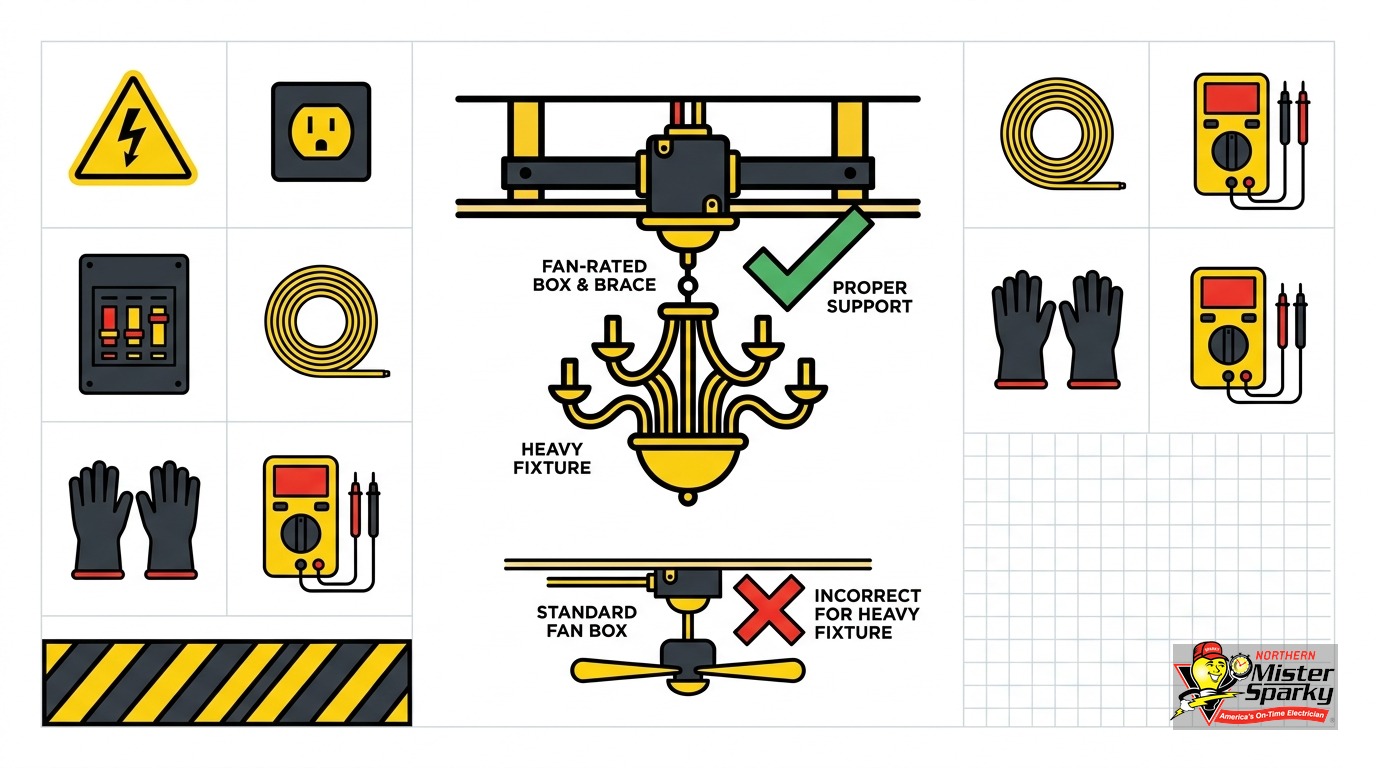
- NEC 314.27(A)(2) sets a 50-lb threshold for standard ceiling outlet boxes. Fixtures above that weight need independent structural support or a box specifically listed and marked for the weight.
- A fan-rated ceiling box is not a substitute for a heavy-fixture-rated box. These are two separate NEC code sections with two separate engineering standards.
- Minnesota adopted the 2026 NEC, effective Aug. 17, 2026. The code that applies to your project depends on when the permit is filed.
- The homeowner DIY exception in Minnesota is narrow. It does not cover condos, apartments, or any rental property.
- Our locally owned and operated team handles box assessment, structural support, wiring, and permit coordination.
What Does Chandelier Installation Cost in the Twin Cities?
Expect to pay $80-$120 per hour for a licensed electrician. Labor typically makes up 40-50% of the total chandelier installation cost. The fixture price, hardware, and permit fees account for the rest.
Licensed electricians in the Twin Cities charge $80-$120 per hour, with labor representing roughly 40-50% of the total bill. A straightforward fixture swap at a properly rated box may run one to two hours. A job that requires a new box, new structural support, or new wiring takes longer and costs more.
What drives that time difference is almost always the condition of the ceiling box. If the box is rated for the new fixture’s weight, the job is fast. If the box is undersized, cracked, or missing its weight stamp, the electrician needs to open the ceiling and fix the support situation before touching the new fixture.
Many Twin Cities homes built in the 1980s and 1990s were wired with standard outlet boxes suited for a 15-lb schoolhouse light. They were not designed for the 60-lb or 80-lb crystal chandelier you just ordered for the foyer. The box check is the first and most important step in any accurate quote.
When you call for an estimate, have the new fixture’s listed weight on hand. That number is on the box or in the product spec sheet. It lets the electrician tell you on the phone whether the box check is likely to be straightforward or whether the ceiling needs to be opened. It saves a trip.
What Is a Ceiling Outlet Box Rating, and Why Does It Affect Chandelier Installation Cost?
The box rating is the maximum weight the box is listed to support. The manufacturer stamps that number inside the box. If your fixture exceeds the rating, code requires independent structural support or a box specifically listed and marked for that weight. That scope change is what drives cost.
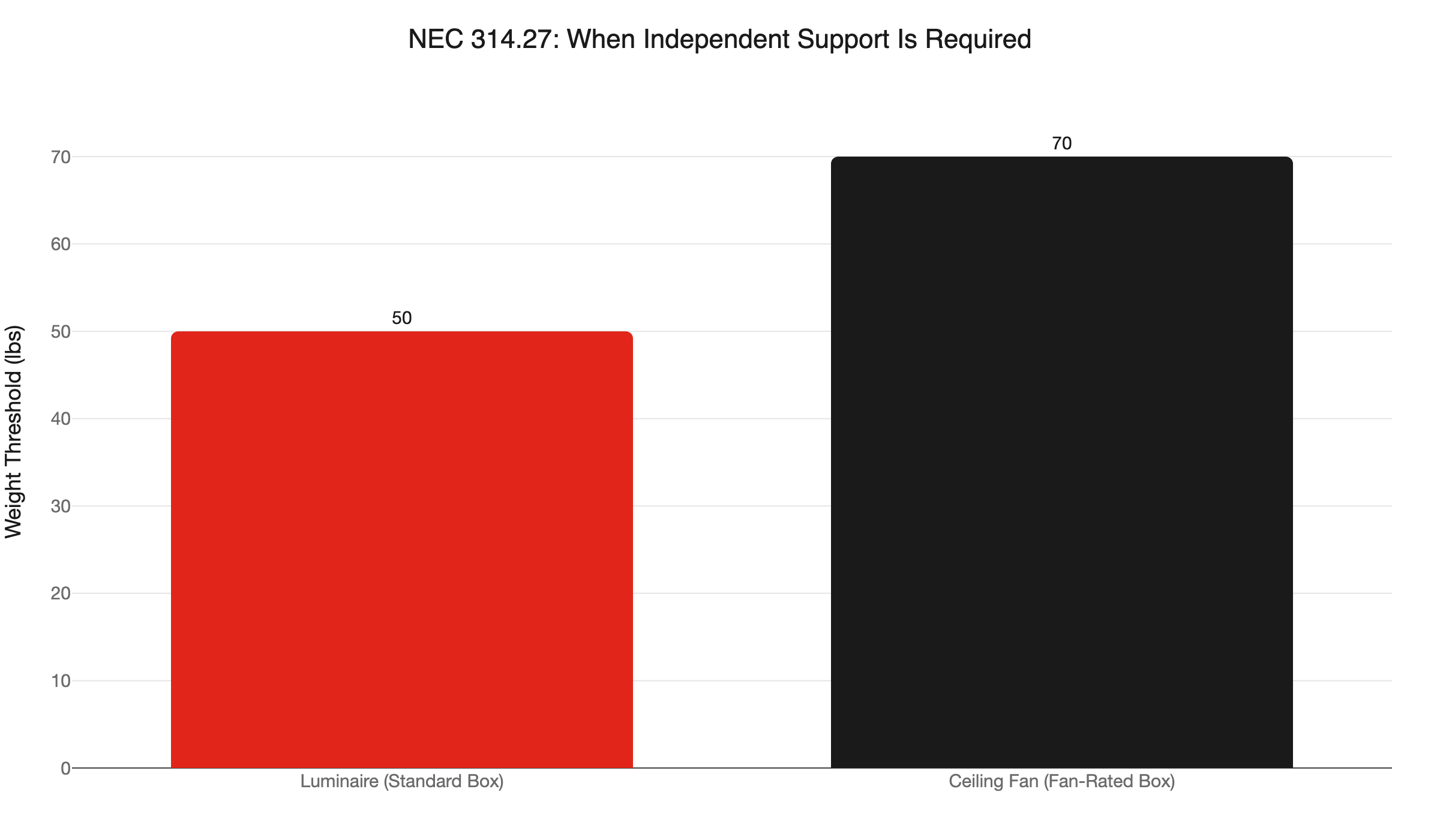
Every ceiling outlet box carries a rated maximum load. NEC 314.27(A)(2) sets the rule: a luminaire weighing more than 50 lbs must be supported independently of the outlet box, unless the outlet box is listed for that weight and the interior is marked by the manufacturer showing the maximum weight the box is permitted to support.
In plain language: if your ceiling box does not have a stamp covering your chandelier’s weight, the box cannot legally hold it. This is a National Electrical Code requirement, not a matter of installer preference.
The box check is the inflection point in any chandelier installation quote. Reading the stamp takes two minutes. If the stamp is inadequate, the electrician needs to open the ceiling, add blocking between joists, and install rated support hardware. That additional work runs one to three hours. That hour gap explains the difference between a basic swap quote and a full installation quote.
An electrician who skips the box check is cutting a corner that will eventually show up as a shifting fixture, a failed inspection, or worse.
Is a Fan-Rated Box the Same as a Heavy-Fixture Box?
No. Fan-rated boxes and luminaire boxes are governed by separate NEC sections. A fan-rated box handles the vibration and torque of a spinning motor. A chandelier’s static weight is a different engineering problem. One does not substitute for the other.
This is the most common misconception we encounter. A homeowner sees the fan-rated stamp inside their dining room ceiling canopy and assumes the new chandelier is covered. It is not automatically covered.
NEC 314.27(C) governs ceiling fan outlet boxes. These boxes are listed for the dynamic load of a rotating motor - vibration and torque. They can support fans up to 70 lbs. Fans over 35 lbs require the maximum weight stamped on the box.
NEC 314.27(A)(2) governs luminaire outlet boxes. A fan-rated box does not automatically satisfy the 50-lb luminaire threshold. A box can be perfectly listed for a ceiling fan and still be inadequate for a heavy chandelier, depending on its specific listing.
The Mike Holt forum discussion on NEC 314.27 covers exactly this distinction in practical detail. The short version: the box type is not the answer. The specific listing is the answer. Your electrician reads the listing, not just the box style.
What Happens When a Chandelier Weighs More Than 50 Lbs?
Either the existing box must be listed and stamped for that weight, or the fixture needs independent structural support from the ceiling framing. The outlet box continues to handle the wiring. The mechanical load transfers to the joist or blocking.
Many large foyer chandeliers weigh 60, 80, or more than 100 lbs. Crystal multi-tier fixtures and large wrought-iron designs frequently land well above the 50-lb threshold. Once you cross that line, the outlet box alone cannot carry the load unless the manufacturer specifically listed and marked it for that purpose.
Independent support transfers the fixture’s weight to the ceiling joist or blocking installed between joists. The electrical box still connects the wires. A mounting brace, threaded rod, or purpose-built chandelier support system carries the mechanical load.
The full weight includes more than the fixture body. Chain, rod, and canopy weight adds to the total. The electrician accounts for all of it before choosing the support method.
Getting to the ceiling framing requires access. In homes with an accessible attic directly above the installation point, the electrician can add blocking without touching the finished ceiling below. In homes with plaster ceilings or no attic access, a small access panel may be needed. Either way, the result is a fixture mounted to code and stable for the life of the home.
How Does Ceiling Height Affect the Job?
Higher ceilings add complexity in two ways. First, chandeliers scaled for tall spaces tend to be larger and heavier to fill the visual room. Second, reaching the ceiling box requires taller ladders or scaffolding, which adds setup time and labor cost.
Standard eight-foot ceilings with a smaller pendant or compact chandelier are the fastest installations. Vaulted ceilings in great rooms or dining areas with 14-16-foot peaks are a step up in complexity. Two-story foyer installations, where the box sits 18-22 feet above the floor, are the most involved jobs and require scaffolding or a pump jack as part of the scope.
The weight concern follows ceiling height directly. A chandelier scaled for a 20-foot foyer typically has a longer chain, larger canopy, and more tiers than a dining room fixture. More tiers means more weight. More weight raises the probability that the existing box does not support the upgrade. When you request a quote for a high-ceiling installation, bring the fixture’s full listed weight, including chain and canopy, so the electrician can assess the box before setting up any scaffolding.
Does Chandelier Installation Require a Permit in Minnesota?
It depends on scope. Replacing a fixture at an existing, properly rated box may not need a permit. Installing a new box or new wiring does. Local city and township rules can require more than the state baseline.
Minnesota requires an electrical permit when new wiring or a new electrical box is installed. The MN Department of Labor and Industry is the authoritative source on what triggers a permit requirement.
A permit serves a purpose beyond compliance. The inspector verifies that the box is rated for the fixture, the wiring is correct, and the support is adequate. That inspection creates documentation that your fixture was installed to code. That record matters when you sell the home, file an insurance claim, or need a lender to review remodel work.
Our team pulls the permit for the job, schedules the inspection, and is on site when the inspector arrives. You do not have to navigate the DLI permit process yourself.
What Are Minnesota’s Electrical Permit Fees?
Permit fees are set at the state level and are modest compared to labor cost. The minimum permit cost for a job involving new wiring starts around $93.
Current fees per the MN DLI electrical fee schedule:
- Base permit fee: $25 (M.S. 326B.37)
- State surcharge: $1 (M.S. 326B.148)
- Circuit or feeder fee: $12 per circuit (raised from $6 in the 2025 legislative fee update)
- Minimum inspection fee: $55 (raised from $35)
For a chandelier installation involving new wiring or a new outlet box, the minimum permit cost is approximately $93. These fees go to the state. We do not mark them up.
Permit fees are not optional. They are part of doing the work legally in Minnesota. The inspection is the documentation that protects you as the homeowner long after the job is done.
How Does Minnesota’s 2026 NEC Transition Affect My Project?
Permits filed before Aug. 17, 2026 must comply with the 2023 NEC. Permits filed on or after that date must comply with the 2026 NEC. The filing date determines which code applies, not the work date.
The Minnesota Board of Electricity adopted the 2026 NEC, effective Aug. 17, 2026. Electrician licensing exams transition to the 2026 NEC beginning Sept. 8, 2026.
For most chandelier installations, the core weight and support rules in NEC 314.27 carry forward across code cycles. The 2026 NEC refines language around box listings and marking requirements. If your project is scheduled near the August 2026 transition date, your electrician should note which code cycle governs the permit filing.
Our team is current on both the 2023 and 2026 NEC. If the permit falls before or after the transition date, the work meets the applicable code. This is a live local detail that no national cost-estimator article addresses.
Can I Install a Chandelier Myself in Minnesota?
Only if you own and occupy a homesteaded single-family home. The exception does not apply to condos, apartments, or any rental unit. DIY work still requires a permit and must pass inspection.
Minnesota electrical law requires all work to be performed by a licensed, bonded, and insured electrical contractor. The homeowner exception allows owner-occupants of homesteaded single-family properties to do their own electrical work, but only on that property, only under a permit, and only if the work passes inspection.
The exception does not apply if you rent out any portion of the home. It does not apply to a condo or townhome where you own the unit but not the structure.
The wiring on a simple chandelier swap is not complicated. The structural assessment is where most homeowners underestimate the job. Reading the box stamp correctly, confirming whether ceiling framing allows blocking, and verifying the circuit capacity for the new fixture’s wattage - those are the steps where getting it wrong creates a hazard.
A shifting fixture above a dining room table is not a minor inconvenience. A heavy chandelier that pulls free of an undersized box is a danger. If you are not certain your existing box is rated for the new fixture, call us before you start. That conversation is free.
What Does a Licensed Electrician Do During Installation?
A properly scoped chandelier installation covers box assessment, structural verification, circuit check, support installation, wiring, and permit coordination. Skipping any step creates a hazard or a code failure.
Here is what our team does on a typical job:
Box assessment. We open the canopy, remove the existing fixture, and read the stamp inside the outlet box. We confirm whether the box is fan-rated, luminaire-rated, or unrated. We compare the listing to the new fixture’s full weight.
Structural check. If the box is undersized or borderline, we evaluate the ceiling framing above it. Joist spacing, blocking options, and attic access all shape the right support solution.
Circuit verification. We confirm the circuit feeding the box is adequate for the new fixture’s load. We also confirm the circuit is not shared in a way that causes nuisance tripping when multiple lights run at once.
Support installation. If independent support is required, we install a rated chandelier brace or blocking secured to the joist. The canopy used is rated for the fixture’s full weight including chain and rod.
Wiring and mounting. Fixture wire to box wire, strain relief on the canopy, and a secure mechanical mount before power is restored.
Permit and inspection coordination. If the job requires a permit, we pull it, schedule the inspection, and make sure the work is code-ready before the inspector arrives.
One thing homeowners can verify after the job is complete: the canopy sits flush against the ceiling with no gap, the fixture does not rotate or pull toward one side, and the chain links align straight. If any of those are off, mention it before the electrician leaves. A quality install is stable from day one.
For more on what licensed fixture work involves, see our guide on light fixture installation and replacement cost.
Signs Your Existing Box May Not Support Your New Fixture
Check inside the canopy of your current fixture before your electrician arrives. Spotting a potential box issue early makes it easier to budget for the upgrade.
Look for these indicators:
- No weight stamp is visible inside the canopy area
- The current fixture is a lightweight flush-mount under 10 lbs
- The home was built before 1990 and the ceiling has never been opened
- The existing box is plastic, not metal
- A previous installation shows signs of DIY work or missing mounting hardware
Any one of these is a signal, not a certainty. The on-site assessment is the definitive answer. If you see two or more of these, include a box upgrade when you plan your budget for the new fixture.
A Note on Twin Cities Foyer Chandeliers
A large share of our chandelier calls come from homeowners in Woodbury, Plymouth, and Maple Grove. The homes are 1980s and 1990s two-story colonials with a dramatic two-story foyer. A chandelier hangs centered above the staircase. The original builder installed the cheapest outlet box available at the time.
Those boxes are 30-40 years old now. The original fixture weighed 12 lbs. The homeowner wants to install an 80-lb wrought-iron and crystal statement piece.
The ceiling box is almost certainly not rated for that upgrade. The right job involves: removing the old fixture, reading the box stamp, accessing the ceiling framing, installing blocking between joists, mounting a rated support brace, and then hanging the new fixture. Done right, that is a half-day job. Done with a skipped box assessment, it is a safety hazard. No malarky.
If you are planning a chandelier installation in the Twin Cities, we are ready to help. We serve Minneapolis, St. Paul, Bloomington, Plymouth, Maple Grove, Woodbury, Blaine, and Brooklyn Park. For larger fixture projects, ask about financing options when you call.
Call 763-200-5956 or schedule through our indoor lighting page.
For more related reading, see our guides on ceiling fan installation cost and tips and electrical permits in Minnesota.
Frequently Asked Questions
How much does chandelier installation cost in the Twin Cities? +
Can I install a chandelier myself in Minnesota? +
Does a fan-rated ceiling box work for a heavy chandelier? +
Does chandelier installation require a permit in Minnesota? +
Need an electrician now?