
100 Amp vs 200 Amp Electrical Service: A Twin Cities Guide
Key Takeaways
- 100 amp service is the NEC minimum for a single-family home. It is the code floor, not a target.
- 200 amp is the current standard for any home planning to add an EV charger, heat pump, induction range, or heat pump water heater.
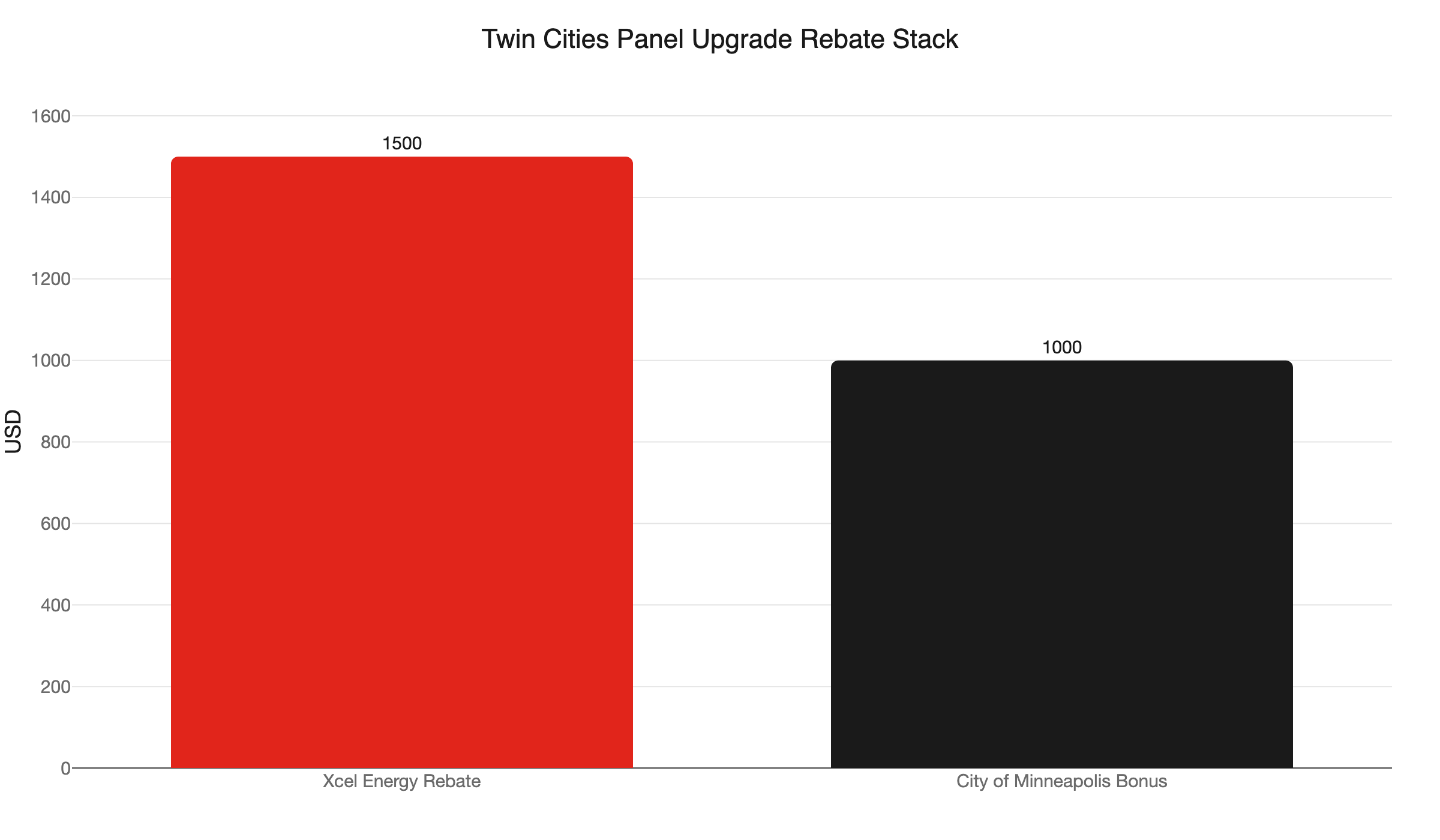
- Twin Cities homeowners can stack two rebates: Xcel Energy up to $1,500 and Minneapolis an additional $1,000 city bonus, for up to $2,500 combined.
- Most Twin Cities metro cities use local electrical inspection authority, not the state DLI. Your permit goes to your city, not the state.
- Minnesota adopted the 2026 NEC on August 3, 2026. The permit date on your project determines which code applies.
- The federal 25C tax credit for panel upgrades expired December 31, 2025. A new 2026 install does not qualify under current law.
What is the difference between 100 amp and 200 amp electrical service?
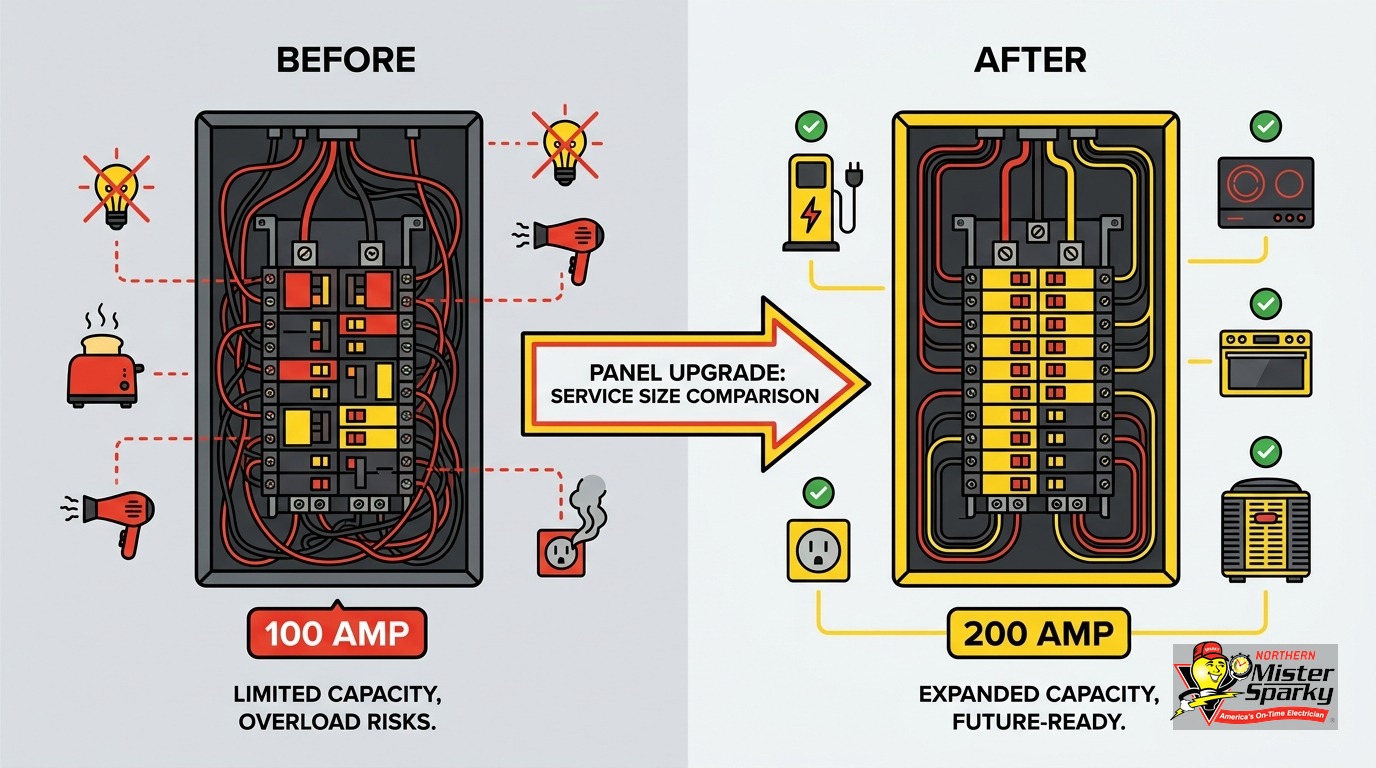
Quick answer: The number tells you how much electricity your home can draw at one time. A 100 amp service handles roughly 24,000 watts. A 200 amp service handles roughly 48,000 watts. Double the headroom, double the flexibility for simultaneous loads.
“Electrical service” refers to the supply line from the utility, the meter, and the main breaker panel feeding every circuit in your home. The amperage rating is the ceiling on simultaneous current draw. Exceed it and the main breaker trips.
A 100 amp panel typically has 20-24 breaker slots. A 200 amp panel usually has 40 or more. More slots means more circuits. More circuits matter when you start adding dedicated lines for high-draw appliances like dryers, ovens, and EV chargers.
Both sizes use 240-volt, single-phase service from the utility. The difference is capacity, not voltage.
Is 100 amp service enough for a Twin Cities home?
Quick answer: For a gas-heated home with no electrification plans, 100 amp may cover today’s loads. For any home planning an EV charger, heat pump, induction range, or heat pump water heater, 100 amp will likely run out of headroom. Even one of those additions can push you past capacity.
Here is the framing most guides miss. The National Electrical Code section 230.79 sets 100 amps as the minimum service size for a single-family dwelling. That is the code floor, not a recommendation. A home at 100 amps is legally compliant, not well-positioned.
A pre-1980 Twin Cities rambler or bungalow with gas heat and gas appliances might run fine at 100 amps today. The issue is not what the home is doing now. The issue is what it cannot do next.
If your furnace dies in three years and you face a replace-with-gas or electrify decision, a 100 amp panel will limit your options at the worst possible moment. The choice you thought you had disappears in January when the temperature drops and you need to decide fast.
Most online comparisons frame this as: “Do you need an upgrade right now?” The better question is: “What does your panel prevent you from doing later?”
The partial-electrification ceiling: what 100 amps cannot do
This is the concept every national comparison site skips entirely.
Research from Slipstream modeled real-home electrification scenarios and found that adding electric resistance heat backup to a heat pump will likely push a 100 amp home over capacity in most scenarios. Their modeling also showed that a 100 amp home that electrifies HVAC can typically add only two of three additional electric appliances: induction cooking, a heat pump water heater, or a heat pump dryer. Not all three.
That is the partial-electrification ceiling. You can start going electric. You just cannot finish.
Modern cold-climate heat pumps work in Minnesota. Units like the Mitsubishi Hyper-Heat and Daikin Aurora operate below 0°F, which matters here. A typical 3-ton unit requires a dedicated 30-40 amp double-pole breaker on a 240V circuit. Add that circuit to a 100 amp panel already running a dryer, electric oven, and water heater. Peak simultaneous load trips the main breaker.
The same logic applies to EV charging. A Level 2 home charger needs a dedicated 40-50 amp, 240V circuit. That single addition can consume nearly half of a 100 amp panel’s available headroom. Our guide to EV charger installation in the Twin Cities details exactly what that circuit requires and why a full panel assessment comes first.
200 amp service does not just add capacity. It unlocks optionality. Once it is in, you can add appliances over the years without re-engineering capacity each time. Slipstream identifies the 200 amp upgrade as the most cost-effective single step toward full home electrification.
One real-world data point: a Minneapolis homeowner going all-electric received a heat pump installation quote that included a $2,500 panel upgrade as a required line item. The electrician did not offer 100 amp as a path forward. It was not a sales tactic. It was physics.
What does a 200 amp panel upgrade cost in Minnesota?
Quick answer: Most panel upgrades in the Twin Cities run $1,500 to $4,000 depending on scope, complexity, and whether utility coordination is needed. That is before rebates. After stacking the available rebates described in the next section, out-of-pocket cost drops significantly.
That range is real but wide. Here is what moves the number.
Lower end ($1,500 to $2,500): A straightforward panel swap where the service entrance, meter base, and mast are already in good shape. Clean access, no utility complications.
Higher end ($2,500 to $4,000+): Jobs requiring a new service mast, meter base replacement, or utility coordination for a meter pull. Xcel Energy schedules meter pulls separately. That can add a day to the project timeline.
What does not affect the project cost directly: the rebates. Those come after the work passes inspection. You pay the invoice, then file for reimbursement.
If your panel is already showing the warning signs of trouble, the upgrade cost is not optional. For homeowners planning ahead, the rebate picture below makes the math considerably friendlier.
Can Twin Cities homeowners get rebates for a panel upgrade?
Quick answer: Yes. Xcel Energy offers up to $1,500 for eligible panel upgrades that increase amperage. Minneapolis homeowners can stack a $1,000 city rebate on top, for up to $2,500 combined. That covers a significant share of a typical project cost.
Here is how each piece works.
Xcel Energy rebate: up to $1,500
Xcel Energy’s panel upgrade rebate covers upgrades that increase amperage. A 100-to-200 amp upgrade qualifies. Requirements:
- You are a residential Xcel Energy customer
- The upgrade increases your service amperage (not a same-size panel swap)
- A licensed electrician performs the work
- The property is single-family or up to 4 units
- The upgrade passes inspection
City of Minneapolis bonus: up to $1,000
Minneapolis homeowners can stack an additional $1,000 on top of the Xcel rebate through a separate city program. Combined, that is up to $2,500 back. Other Twin Cities cities may have similar programs. A quick call to your city hall before you schedule is worth two minutes.
What about the federal 25C tax credit?
It has expired for new 2026 installs. IRS Energy Star guidance confirms that qualifying property had to be placed in service by December 31, 2025, to claim the credit. If you completed a panel upgrade in 2025, you can still claim it on a 2026 tax return using Form 5695. A new 2026 install does not qualify under current law.
No malarky: the federal credit is gone for now. The Xcel rebate is real and active today.
What permits does a panel upgrade require in Minnesota?
Quick answer: Panel upgrades require an electrical permit in Minnesota. In most Twin Cities cities, including Minneapolis and most first-ring suburbs, that permit goes to the city, not the state DLI. Filing with the wrong authority means your permit is invalid.
Minnesota has approximately 66 cities with local electrical inspection authority. In those cities, contractors pull permits through the city hall, not the Department of Labor and Industry. Minneapolis, St. Paul, Bloomington, and most first-ring suburbs fall into this category.
State-administered permits carry a $55 minimum inspection fee per trip, a $25 permit fee, and a $1 surcharge. City fees vary and are often higher.
Ask your electrician at quoting time exactly which authority issues your permit and who coordinates the inspection. An electrician who cannot answer that question clearly is a red flag.
A note on code timing: Minnesota adopted the 2026 NEC effective August 3, 2026. Permits filed on or after that date must comply with the 2026 NEC. Permits filed before August 3 follow the 2023 NEC. If your project is being quoted or permitted right now, confirm with your electrician which code applies to your specific permit date.
Our guide to electrical permits in Minnesota covers the DLI-versus-local-authority question in detail, including how to look up which jurisdiction covers your address.
How do you know if your home has 100 amp or 200 amp service?
Quick answer: Check the main breaker at the top of your electrical panel. The amperage rating is stamped on it. A “100A” label means 100 amp service. A “200A” label means 200 amp service. A licensed electrician can confirm during any service call if you are not sure.
A few other ways to verify:
Check the meter base outside. The meter base has a rating label. If it is rated for 100 amps, the full service is 100 amps regardless of what the panel says inside.
Count the breaker slots. A panel with 20-24 slots that are mostly full typically indicates 100 amp service. Panels with 40 or more slots usually indicate 200 amp service, though not always.
Look for a subpanel. Some older Twin Cities homes added a subpanel to get more breaker slots without upgrading service. A subpanel does not change the service size. It just spreads the same limited capacity across more circuits.
If you are buying a home and want a professional opinion on the electrical service, a pre-purchase inspection can catch this and other panel issues before you close. In older Minnesota homes, it is one of the most common items flagged.
Signs your home is ready for a 200 amp upgrade
Some of these are present-tense problems. Others are forward-looking signals. All of them point in the same direction.
Current problems to watch for:
- The main breaker trips when large appliances run at the same time
- Branch circuit breakers trip regularly on normal household use
- Your panel is full with no room to add a new circuit
- Lights dim when the HVAC or a large appliance kicks on
If you are already experiencing tripping breakers, our guide to why your circuit breaker keeps tripping walks through the most common causes and what each one signals about your panel.
Forward-looking signals:
- You plan to buy an EV in the next 1-3 years
- You are considering a heat pump for heating or cooling
- You want induction cooking or a heat pump water heater
- You are finishing a basement, adding a home addition, or building a garage with dedicated electrical needs
- You plan to sell in the next 3-5 years (buyers’ agents increasingly flag 100 amp service as a negotiation item in the Twin Cities market)
Any one of these warrants a conversation about your panel. More than one, and the conversation is short: 200 amp service is the right move.
What to expect when you schedule with us
We are locally owned and operated in the Twin Cities, backed by the training and resources of the national Mister Sparky franchise. Our team handles panel upgrades from initial assessment through permit coordination, inspection, and rebate documentation.
Here is how a typical panel upgrade goes:
- Assessment call. We confirm your service size, scope, and whether utility coordination is needed. We tell you upfront which authority issues your permit.
- Written quote. You get a clear number before any work starts. We flag rebate eligibility so you know what to file for after inspection passes.
- Permit filing. We pull the permit with your Authority Having Jurisdiction, whether that is your city or the state DLI.
- Install day. Panel replacement, utility meter pull coordination, and cleanup. Most residential panel upgrades take 4-8 hours.
- Inspection. The inspector approves the work and signs off. That sign-off is what triggers your Xcel rebate application.
- Rebate filing support. We provide the documentation you need to claim your Xcel Energy rebate and any applicable city rebate. You submit directly to Xcel.
For larger projects, a panel upgrade combined with an EV charger or heat pump circuit in the same season adds up. Ask about financing options when you call. Our full panel upgrade services page details what is included and what the process looks like from start to inspection.
Ready to get a clear answer on your service size and what upgrading would cost? Call us at 763-200-5956 or book online. We are America’s On-Time Electrician(R), and the UWIN(R) 100% satisfaction guarantee backs every job we do.
Frequently Asked Questions
Is 100 amp service enough for a modern Twin Cities home? +
What rebates are available for panel upgrades in the Twin Cities? +
Do I need a permit for a panel upgrade in Minnesota? +
How do I know if my home has 100 amp or 200 amp service? +
Need an electrician now?