
Home EV Charger Installation in the Twin Cities: Cost, Panel Capacity, and Rebates
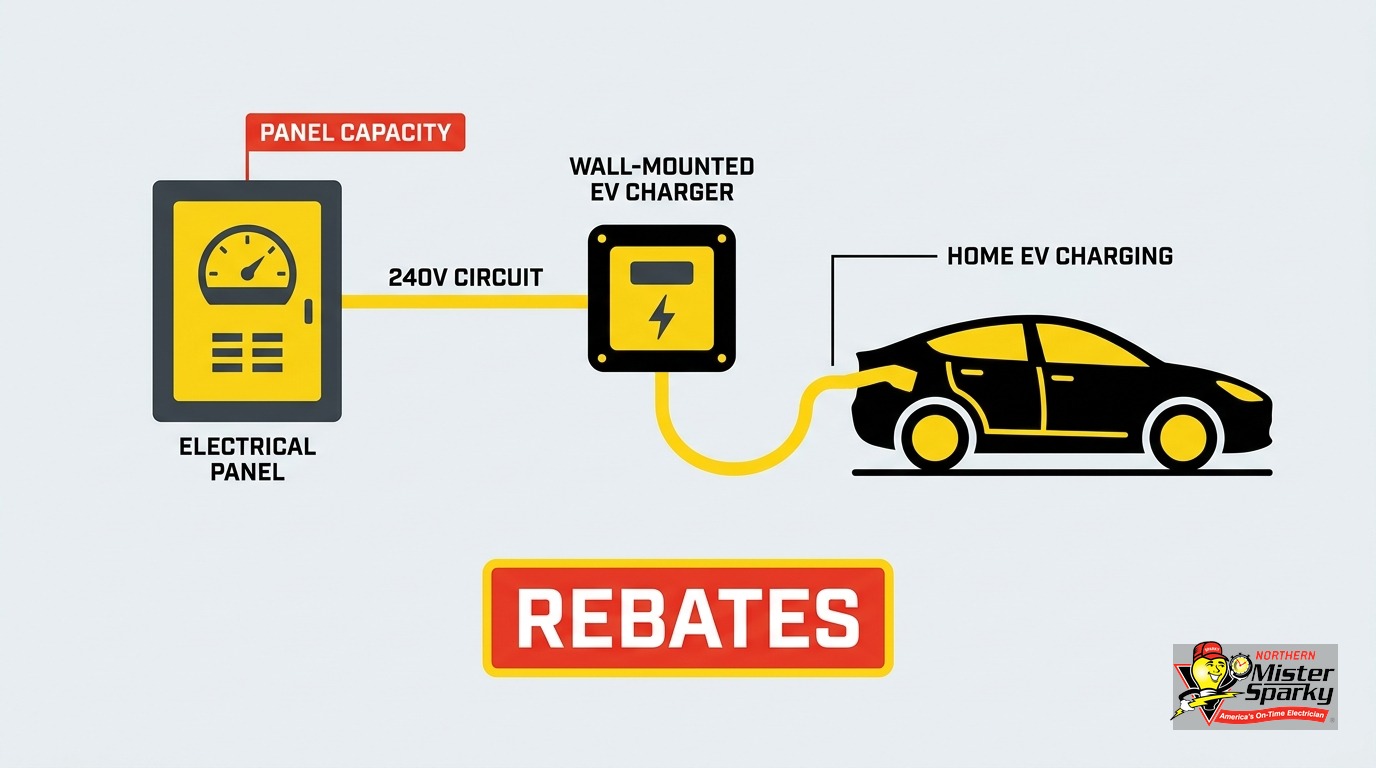
Key Takeaways
- A Level 2 home charger needs a dedicated 240-volt circuit. Most Twin Cities installs run $800 to $2,200 for labor, wire, and permit, with the charger unit sold separately.
- Your electrical panel is the deciding factor. Older 100-amp services often need a load calculation, and sometimes a panel upgrade, before a charger is safe.
- Minnesota rebates stack. Xcel Energy and several co-ops offer around $500, and a federal tax credit covers 30 percent of the install up to $1,000 through 2032.
- The work legally requires a permit and inspection in Minnesota. An unpermitted install can void your homeowner insurance and the charger warranty.
- Plan for one to two weeks start to finish. The physical install is a few hours, but permitting and inspection add days on either side.
You bought the electric vehicle. Now you want to wake up to a full battery in your own garage instead of hunting for a public charger in a January parking lot. That is what home EV charger installation delivers, and for most Twin Cities homes it means a Level 2 charger on a new 240-volt circuit that the house is not wired for out of the box.
We install these across Minneapolis, St. Paul, and the metro suburbs every week. The questions are almost always the same. What will it cost? Can my panel handle it? What money can I get back? This guide answers all three with real Twin Cities numbers, not national averages, so you can plan before you call.
What Is the Difference Between Level 1 and Level 2 Charging?
Level 1 charging uses a standard 120-volt outlet and adds about three to five miles of range per hour. Level 2 charging uses a 240-volt circuit and adds roughly 20 to 40 miles per hour, enough to fully recharge most EVs overnight. Almost every homeowner chooses Level 2.
Every EV comes with a Level 1 cord. You plug it into a standard outlet, and it works. The problem is speed. For a daily commuter, Level 1 may not recover the car’s range overnight, especially in winter when cold weather cuts EV range.
Level 2 runs on 240 volts, the same power your electric dryer or range uses. That is the difference between topping off and truly refueling at home. Level 3, or DC fast charging, is commercial equipment, so we will leave it out of this guide.
Can Your Electrical Panel Handle an EV Charger?
Maybe. A Level 2 charger is a large continuous load, so a licensed electrician runs a load calculation on your panel first. Modern 200-amp services usually have room. Many older 100-amp Twin Cities services do not, and may need a panel upgrade before a charger is safe.
Here is where a lot of online cost guides go quiet. Your main panel has a rated capacity, usually 100, 150, or 200 amps. A common 48-amp hardwired charger requires a 60-amp breaker, because the National Electrical Code requires charger circuits to be sized at 125 percent of the continuous load. That is a big draw to add to a panel already running your furnace, water heater, oven, and air conditioning.
That is why we perform a load calculation. It adds up your home’s square footage, fixed appliances, HVAC, and existing 240-volt circuits to find how much capacity is free. An example makes it clear. If your home’s calculated demand already sits near 76 amps on a 100-amp service, adding a 48-amp charger on a 60-amp breaker pushes you past the limit. In that case, the honest answer is that you need more capacity first.
That does not always mean a full panel upgrade. Sometimes a lower-amperage charger, or a charger with load-management features, solves it without touching the panel. When it does call for more capacity, our electrical panel upgrade service brings the home up to a modern 200-amp service. Many older Twin Cities homes were due for that anyway. If your panel still uses fuses or shows scorch marks, read our signs it is time to upgrade your panel before you add any large load.
The Circuit: What Actually Gets Installed
A code-compliant Level 2 install is a dedicated 240-volt circuit. Nothing else shares it. The main parts are the breaker, the wire, and the connection to the charger.
The breaker is a double-pole 240-volt breaker, sized to the charger. A 32-amp charger typically lands on a 40-amp breaker with 8-gauge wire. A 48-amp charger needs a 60-amp breaker with heavier 6-gauge wire. Matching wire gauge to breaker size is not optional. Undersized wire on a high-draw circuit is a fire risk, and it is exactly the shortcut we see on failed inspections.
The final connection is either a hardwired charger or a NEMA 14-50 outlet that the charger plugs into. Both are valid. Hardwiring is cleaner and slightly safer for the highest-amperage units. A 14-50 outlet lets you unplug and swap the charger later. We walk you through the tradeoff based on your charger and your garage. Our EV charger installation service page lays out the full process step by step.
How Much Does Home EV Charger Installation Cost in the Twin Cities?
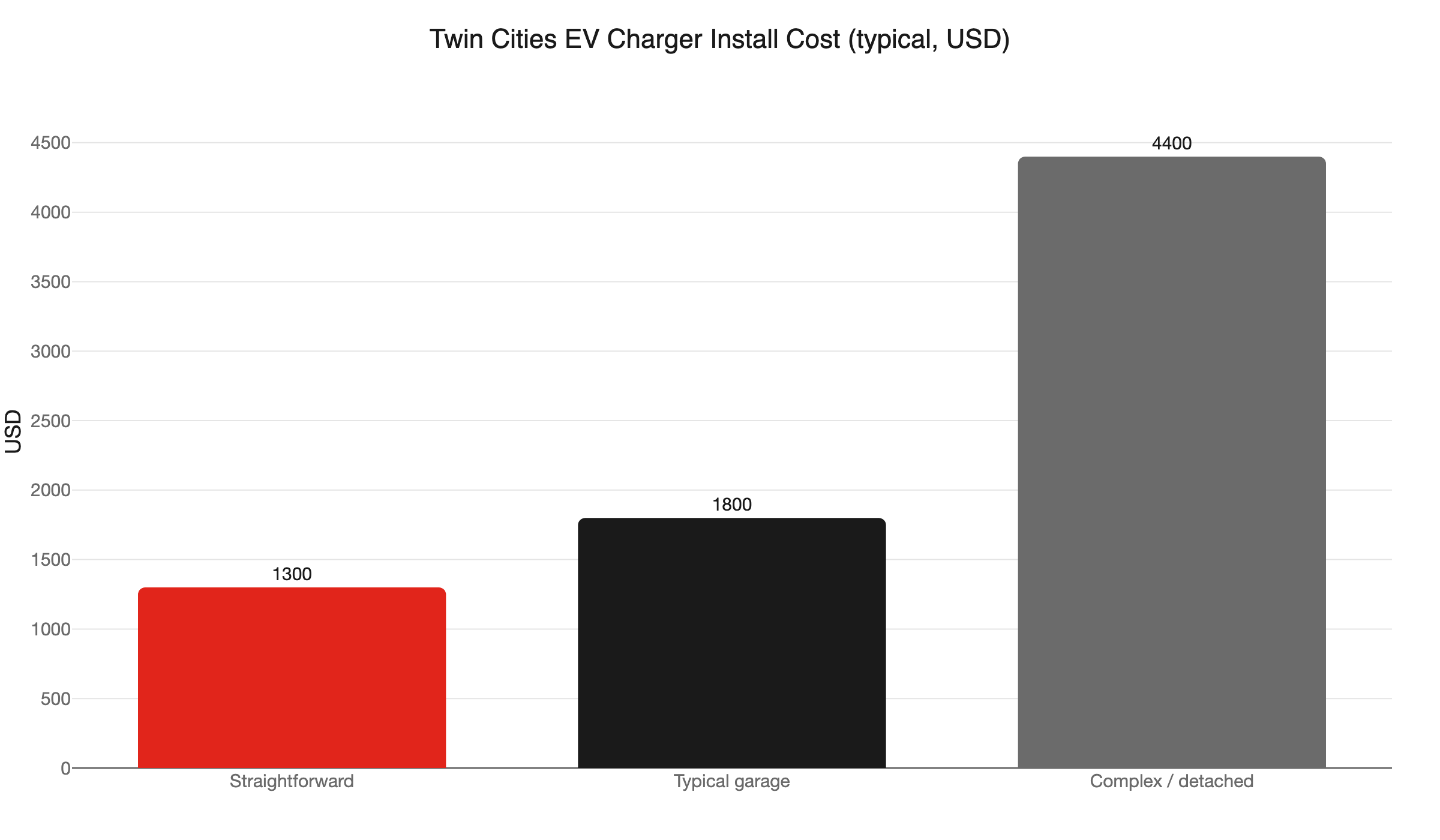
Most Twin Cities installs run $800 to $2,200 for labor, wire, and permit, with a common garage job landing around $1,400 to $2,200. The charger unit is a separate purchase. Long wire runs, detached garages, or a needed panel upgrade push the total higher.
Costs vary because homes vary. The single biggest variable is how far the charger sits from your panel and whether the panel needs work. Here are the ranges we see in the metro, separate from the price of the charger unit.
- Straightforward install: $800 to $1,800 for labor, wire, and permit. A garage charger with a short 15 to 30 foot run to a panel with spare capacity.
- Common Twin Cities job: $1,400 to $2,200. A typical garage-mounted charger with a moderate wire run.
- More complex install: $2,800 to $6,000. Long runs, finished walls to fish wire through, or a detached garage.
- panel upgrade, if needed: roughly $1,800 to $3,500 to go from 100 to 200 amps in the metro. It runs higher depending on the service entrance and meter work.
A detached garage is the classic budget surprise. Running power to a separate structure can mean trenching a line underground, which adds labor and sometimes a small subpanel. It is very doable. It is just not the same job as a charger 10 feet from the panel, and an honest quote will say so up front. No malarky on the pricing. You get a clear quote before we start.
Do You Need a Permit to Install an EV Charger in Minnesota?
Yes. Minnesota requires an electrical permit and inspection for EV charger installation. A licensed electrician pulls the permit and schedules the inspection as part of the job. Skipping it can void your homeowner insurance and the charger warranty, and it can surface as a problem when you sell.
This is not a formality. A 240-volt, high-amperage circuit is exactly the kind of work the code exists to govern, and the Minnesota Department of Labor and Industry treats EV charging circuits as permitted electrical work. When we install, the permit and inspection are part of the job, not a line item you chase.
Timeline matters for planning. Permit issuance usually takes one to three business days before we schedule the work. The physical install of a standard garage charger takes two to four hours. The post-install inspection is typically scheduled within three to seven business days. Start to finish, a standard job runs about one to two weeks. Panel upgrades take longer, and we give you a realistic date when we quote.
What EV Charger Rebates Are Available in Minnesota?
Minnesota rebates stack. A federal tax credit covers 30 percent of the install up to $1,000 through 2032. On top of that, Xcel Energy and several co-ops like Connexus, Dakota Electric, and Wright-Hennepin each offer around $500. Amounts change yearly, so confirm your utility’s current offer.
The federal incentive is the largest. The Alternative Fuel Vehicle Refueling Property Credit covers 30 percent of your installation cost, up to $1,000, and runs through 2032. You claim it with IRS Form 8911, which is one more reason to keep your permit and receipts.
On top of that, Minnesota utilities offer their own rebates:
- Xcel Energy offers about $500 for a residential Level 2 charger through its Accelerate At Home program.
- Connexus Energy, Dakota Electric, and Wright-Hennepin each offer around $500 for members.
- Several cities and co-ops add their own programs, with amounts that change year to year.
Because these programs change, we tell every customer to check their specific utility’s current offer before installing. The federal credit plus a utility rebate can knock four figures off the real cost of getting set up.
Charge for Less With Off-Peak Rates
Rebates lower the install cost. An off-peak charging plan lowers what you pay to actually charge, month after month.
Xcel Energy offers residential EV rate options that reward charging overnight, when demand on the grid is low. For most homeowners, an EV charges while they sleep anyway, so shifting to an off-peak plan is close to free money. Ask your utility about EV-specific rates when you set up the charger. Over the life of the car, the savings on electricity can rival the one-time rebate.
Pairing that with other efficiency moves compounds the benefit. If you are already thinking about your home’s energy use, our post on winter energy efficiency upgrades covers the changes that pay off fastest in a Minnesota climate.
Minnesota-Specific Considerations
A few things matter more here than they do in warmer states.
Cold cuts range. EVs lose range in deep cold, commonly 20 to 30 percent on the coldest days. A Level 2 charger matters more in Minnesota than almost anywhere, because you need to fully recover range overnight to start each winter morning with a real buffer. Many EVs also let you precondition the battery and cabin while still plugged in, which saves range and is far easier with home charging.
Garage installs are the norm. Most of our installs are in attached or detached garages, which keeps the charger and cable out of the snow and ice. A charger mounted in a heated or sheltered garage will simply last longer than one exposed to Minnesota weather.
Surge protection is worth a conversation. An EV charger is a significant piece of connected electronics tied to your home’s power. Minnesota storm season brings the kind of surges that damage sensitive equipment. Whole-home surge protection is an inexpensive layer of defense, and we often add it when we install a charger. Our surge protector service has the details.
Why Hire a Local Licensed Electrician
You can find a handyman who will wire an outlet. An EV charger is not that job. It is a large continuous load, a permitted circuit, and an inspection, on a system that already powers your whole house. Getting the load calculation or the wire gauge wrong is how installs fail inspection or, worse, overheat. Our post on the real dangers of DIY electrical work spells out the stakes.
We are locally owned and operated, and we live with the same winters you do. As America’s On-Time Electrician®, we show up when we say we will, we pull the permit, we size the circuit to code, and we back the work with the UWIN® 100 percent satisfaction guarantee. For larger jobs like a panel upgrade paired with a charger, we offer financing so the project fits your budget instead of your calendar.
Ready to Charge at Home?
Home charging turns your EV from a planning exercise into a car you just drive. The install is very doable in most Twin Cities homes, and the rebates make now a smart time to do it. The only real unknown is your panel, and a load calculation answers that in one visit.
Call Northern Mister Sparky at 763-200-5956 or book online, and we will assess your panel, quote the job with no surprises, and get you charging in your own garage. Locally owned, on time, no malarky.
Costs, rebate amounts, and program availability change over time and vary by address and utility. Figures here are estimates for planning. Contact us for a quote specific to your home, and confirm current incentives with your utility and a tax professional.
Frequently Asked Questions
Can I install a Level 2 EV charger myself? +
How many amps do I actually need for a home EV charger? +
Can an older Twin Cities home support an EV charger? +
Do I need a smart EV charger? +
Can you install an EV charger I already bought? +
Need an electrician now?