
20 Amp vs 15 Amp Outlet Difference: Know Before You Upgrade
Key Takeaways
- A 15-amp outlet has two straight vertical slots. A 20-amp outlet has a T-shaped left slot - that horizontal notch is the only visible difference.
- Wire gauge is what actually determines circuit capacity. A 15-amp circuit uses 14 AWG wire with white sheathing. A 20-amp circuit uses 12 AWG wire with yellow sheathing.
- Installing a 20-amp outlet on a 15-amp circuit is a code violation and a fire hazard.
- Kitchens, bathrooms, and laundry rooms all require 20-amp circuits under the NEC.
- Before spending anything, check the Romex sheath color at your panel. Yellow sheath means you may already have a 20-amp circuit - and no new wiring is needed.
- A swap on an existing 20-amp circuit costs about $15 in parts. Running a new circuit from the panel costs $300 to $800 or more.
- Any permit filed in Minnesota on or after August 17, 2026 falls under the 2026 NEC.
- Call 763-200-5956 to have a licensed electrician check your panel and wiring before you decide anything.
What Is the 20 Amp vs 15 Amp Outlet Difference?
The 20 amp vs 15 amp outlet difference comes down to three things: the slot shape you can see, the wire gauge behind the wall, and the breaker protecting that circuit. All three must match for the outlet to be safe and code-compliant.
Most explanations stop at the slot shape. That is the wrong place to start.
A standard 15-amp receptacle is the NEMA 5-15R. It has two vertical parallel slots. A 20-amp receptacle is the NEMA 5-20R. It has a horizontal notch on the left slot that forms a T shape. That T is a safety feature built into the system. A 20-amp plug has one blade rotated 90 degrees. It will not fit a 15-amp outlet. That physical lock keeps high-draw appliances off circuits that cannot handle them.
Most outlets in a typical Twin Cities home are NEMA 5-15R. You will only find NEMA 5-20R receptacles where the National Electrical Code or appliance specifications call for them.
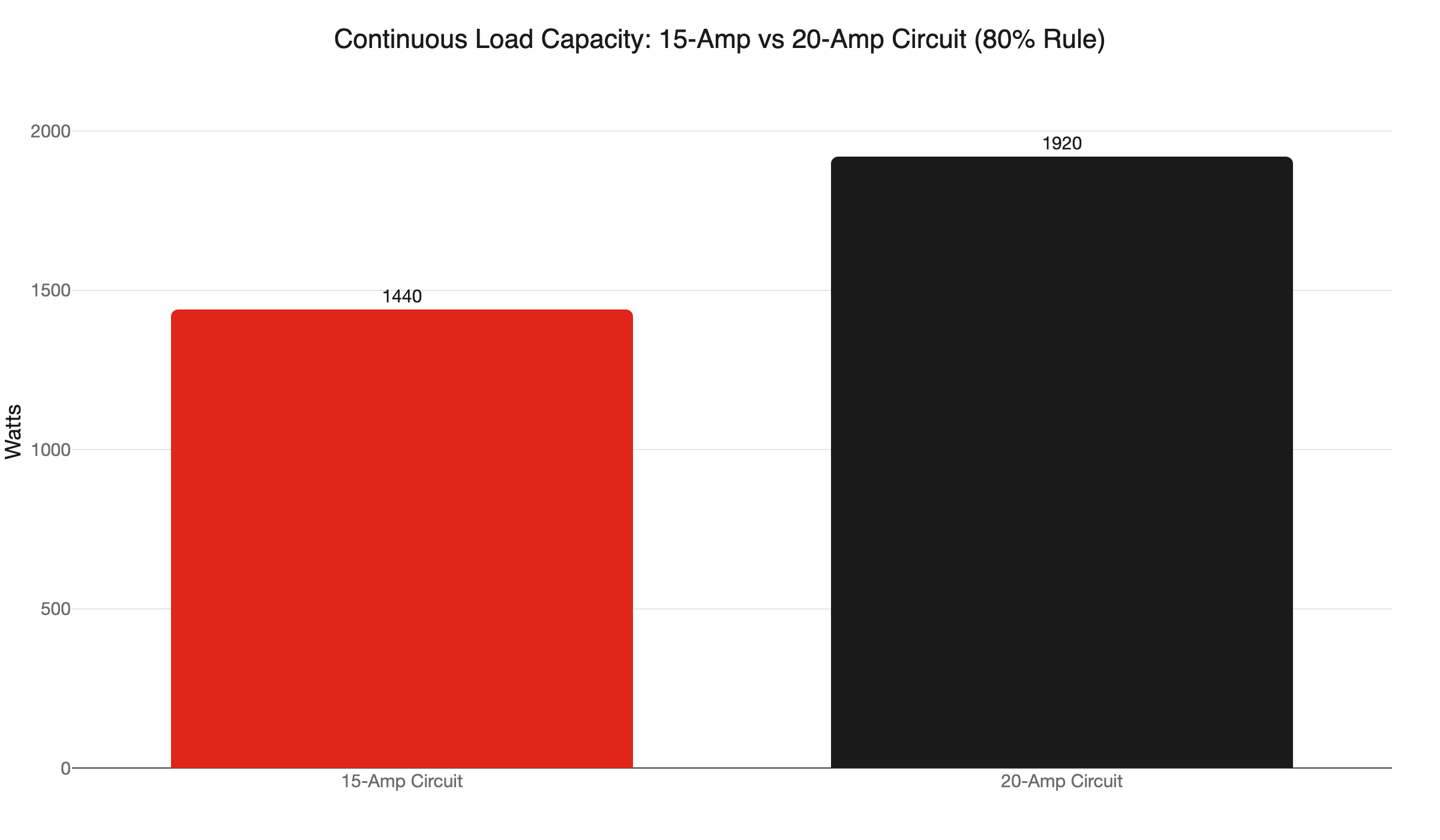
The 80% continuous-load rule helps explain why the distinction matters in daily use. A 20-amp/120V circuit delivers 2,400 watts at maximum capacity. The safe continuous limit is 1,920 watts. A 15-amp circuit maxes out at 1,800 watts, with a safe continuous limit of 1,440 watts. That 480-watt gap explains why a microwave and a toaster oven trip a 15-amp kitchen circuit but run without issue on a 20-amp circuit.
How Do You Tell Them Apart?
Look at the left slot of the outlet. A 15-amp outlet has two straight vertical slots. A 20-amp outlet has a horizontal notch extending from the left slot, forming a T shape. That T-shaped slot is the only visible difference from the front of the outlet.
If both slots are straight vertical lines, you have a 15-amp receptacle. If the left slot has a horizontal notch branching off it, you have a 20-amp receptacle. This is the clearest visual identification test, and it takes about two seconds.
After checking the outlet face, check your panel. Find the breaker feeding that circuit and read the number printed on it. “15A” means a 15-amp circuit. “20A” means a 20-amp circuit. Write both numbers down before you buy a single part.
The outlet face tells you what is currently installed. The breaker tells you what the circuit was designed to carry. Both matter, and they have to match.
Why Does Wire Gauge Matter More Than the Outlet?
The outlet is the face. The wire behind the wall carries the current. Swapping the outlet without confirming the wire gauge can create a fire hazard. Checking the wire sheath color in your panel is the single most important step before any outlet work.
A 15-amp circuit uses 14 AWG copper wire. In modern residential cable, that wire comes in white-sheathed Romex. A 20-amp circuit uses 12 AWG copper wire, which comes in yellow-sheathed Romex. The 12 AWG wire is thicker. It carries more current without overheating.
The danger of mismatching is real: putting a 20-amp breaker on 14 AWG wire means the wire can overheat to ignition temperature before the breaker ever trips. The breaker is sized for the wire. Increase the breaker without changing the wire and you remove the only protection that wire has.
You can check wire gauge without opening any walls. Open your panel door. Find the breaker feeding the circuit in question. Look at the Romex sheath color on that wire. Yellow means 12 AWG. White means 14 AWG. That one check determines whether you are paying $15 for an outlet or $300 to $800 for a new circuit run.
Our guide to wire gauge and breaker sizing for homeowners walks through the full range of wire sizes and what each supports.
What Happens If You Install a 20-Amp Outlet on a 15-Amp Circuit?
It is a code violation. The T-shaped slot invites 20-amp plugs onto a circuit that cannot safely carry the load. The 14 AWG wire on a 15-amp circuit can overheat before the 15-amp breaker trips, which creates a fire risk the breaker cannot prevent.
Under NEC Article 406, installing a 20-amp receptacle on a 15-amp circuit is prohibited. A home inspector will flag it in a presale inspection. If a fire ever traced back to a mismatched outlet, your homeowner’s insurance could push back on the claim.
The reverse is allowed. You can install a 15-amp outlet on a 20-amp circuit with no code issue. The circuit can still carry a 20-amp load through other outlets on the same run. The 15-amp outlet just cannot accept a 20-amp plug. For general-purpose locations, that is usually fine.
Where Does the NEC Require 20-Amp Circuits in Your Home?
The NEC requires 20-amp circuits in kitchens, bathrooms, and laundry rooms. These are the locations where appliance loads stack up fastest. Any permitted electrical work in those areas must meet these minimums under Minnesota’s adopted building code.
Here is the specific breakdown:
- Kitchen small-appliance circuits: At least two 20-amp small-appliance branch circuits must serve countertop receptacles under NEC 210.11(C)(1). Older kitchens often trip the breaker when a microwave and toaster oven run at the same time. One underpowered circuit cannot handle both.
- Bathroom receptacles: At least one 20-amp circuit is required for bathroom receptacle outlets under NEC 210.11(C)(3).
- Laundry area: One dedicated 20-amp circuit serving the laundry area is required under NEC 210.11(C)(2). No other outlets may share that circuit.
- Refrigerator: The NEC allows a refrigerator to share a kitchen small-appliance branch circuit or have its own dedicated 15-amp or larger circuit under NEC 210.52(B)(1).
These are minimums for new construction and any permitted work. If your home predates the modern NEC, you are not required to upgrade existing circuits unprompted. But any time you add, extend, or modify a circuit in these areas, the current code applies to that work.
Our post on kitchen electrical circuits and code requirements covers countertop outlet spacing rules in more detail.
Should You Upgrade to 20-Amp Outlets?
It depends on whether your existing circuit is already wired for 20 amps. If the wiring is 12 AWG on a 20-amp breaker, the outlet swap is a minor job. If the wiring is 14 AWG, you need a new circuit first. That changes the cost significantly.
There are two realistic scenarios for a Twin Cities homeowner:
Scenario 1: The circuit is already 20-amp. This is more common in homes built after roughly 1990. Outer suburbs like Maple Grove, Plymouth, Woodbury, Blaine, and Brooklyn Park saw a lot of new construction in that era. Builders often ran 12-gauge wire in kitchens and bathrooms because the NEC was trending that direction. If your breaker reads “20A” and the Romex sheath in your panel is yellow, you may already have a 20-amp circuit. Swapping the outlet face is a minor job. A licensed electrician can confirm it quickly and complete it in a single visit.
Scenario 2: The circuit is 15-amp. This is more common in Minneapolis, St. Paul, and inner-ring suburbs where the housing stock skews pre-1970. Running a new 20-amp circuit means new 12 AWG wire, a new breaker, and a permit. Cost typically runs $300 to $800 or more. The high end applies to longer runs, older homes with finished walls, or situations where the panel needs changes to fit the new circuit.
Skipping the wire-check step and just swapping the outlet face creates the exact hazard described above. Five minutes at the panel tells you which scenario you are in.
The Step Most Homeowners Skip Before Spending a Dollar
Most online explainers lead with the slot shape. The slot shape is the last thing to check. Start at the panel.
Open your panel door. Find the breaker for the circuit you want to upgrade. Look at the Romex sheath color connected to that breaker. Yellow sheath means 12 AWG and a likely 20-amp circuit. White sheath means 14 AWG and a 15-amp circuit. That single check tells you whether you are paying $15 for an outlet or $300 to $800 for a new circuit run.
The wire sheath color is the fastest diagnostic step available to any homeowner. Open the panel, read the sheath. If it is yellow on a 20-amp breaker, the upgrade is easy. If it is white, call for an estimate on a circuit run before budgeting anything else.
If your panel is not clearly labeled by room or circuit, add that to your project list. A readable panel saves time on every future project and every outage.
Twin Cities homes with panels from the 1960s and 1970s may also show other issues when you open the door: oversized breakers, aluminum branch wiring in older Minneapolis and St. Paul bungalows, or panels from brands that have been flagged for reliability problems. If anything looks unusual, close the panel and call a licensed electrician before doing any work yourself.
What Do Minnesota Permits Require for This Work?
A like-for-like outlet replacement typically does not require a permit. Adding a new 20-amp circuit or extending an existing one does. Any permit filed in Minnesota on or after August 17, 2026 falls under the 2026 NEC.
Minnesota adopted the 2026 NEC effective August 17, 2026, under Chapter 1315 of the State Building Code. Permits filed before that date use the 2023 NEC. Permits filed on or after use the 2026 NEC. If you are scheduling circuit work right now, confirm which code cycle your permit date falls under. Your contractor can tell you.
On the owner-DIY question: Minnesota allows owner-occupants of a single-family home they own and live in to pull their own permit and do the electrical work themselves. Condos, rental properties, and duplexes always require a licensed contractor. Family members who are not licensed electricians cannot legally assist with permitted work under Minnesota law.
Two inspections are required for any permitted circuit work: a rough-in inspection before walls close, and a final inspection after the work is complete. Skipping a permit can void your homeowner’s insurance and complicate a home sale. To find the right inspector for your specific address - either a city building department or the state DLI - use the lookup tool at dli.mn.gov.
What About AFCI and GFCI Requirements?
Adding or extending a circuit in a kitchen, laundry room, bathroom, bedroom, or living area triggers AFCI requirements under the 2026 NEC. Many of those locations also require GFCI. These are separate protections, and kitchens and laundry rooms often need both on the same circuit.
All 120V 15-amp and 20-amp branch circuits supplying outlets in kitchens, laundry areas, living areas, bedrooms, and hallways require AFCI protection under NEC 210.12(A). Arc fault circuit interrupters detect dangerous electrical arcing. A standard breaker responds to overcurrent. An AFCI breaker responds to the kind of arcing that causes wiring fires, which a standard breaker misses entirely.
Kitchens and laundry rooms also typically require GFCI protection. Ground fault circuit interrupters detect current leaking to ground. That protects people near sinks, appliances, and other water sources. The two protections serve different purposes. You often need both on the same circuit.
When you upgrade a 15-amp circuit to 20-amp in a kitchen or laundry room, you are not just running new wire. You may also need to install an AFCI breaker or a combination AFCI/GFCI breaker at the panel. A licensed electrician accounts for that scope in any estimate. Homeowners sometimes budget only for the wire run and are surprised when the breaker costs are added.
Our post on AFCI breaker requirements explains when AFCI protection applies and what to do when an AFCI breaker trips unexpectedly.
Minnesota Winters, Garages, and Why 15 Amps Falls Short
Cold Minnesota winters create a specific electrical demand that homeowners in other climates rarely face. An attached garage in January often runs a space heater for hours at a time. Add a power tool, an air compressor, or a car battery maintainer and the math gets tight fast.
A standard 1,500-watt space heater running continuously is already at 100% of the safe continuous load for a 15-amp circuit. The 80% continuous-load rule means a 15-amp circuit can safely deliver only 1,440 watts on a sustained basis. Run the heater at full draw and you have nothing left. Plug in a tool and you trip the breaker.
A 20-amp/120V circuit raises the continuous limit to 1,920 watts. That gives the heater full runtime with about 420 watts left over - enough for lighting or a small tool. Enough to stop tripping the breaker every cold night.
Current code already requires 20-amp GFCI-protected circuits in garages for new construction and permitted work. If your garage still runs on a single 15-amp circuit and you regularly run a space heater there, that is a practical reason to consider upgrading, not just a code question.
When to Call Northern Mister Sparky
If you have read this far and still are not sure which scenario describes your home, that is exactly the right moment to call. Guessing at wire gauge and getting it wrong creates a hazard that is not worth the savings.
We are locally owned and operated in the Twin Cities. We serve Minneapolis, St. Paul, Bloomington, Brooklyn Park, Woodbury, Blaine, Maple Grove, Plymouth, and the surrounding area. As America’s On-Time Electrician(R), we show up when we say we will.
Here is what we can do for you:
- Check your panel and identify the wire gauge on any circuit you want to upgrade
- Confirm whether your existing wiring supports a 20-amp outlet swap or needs a new circuit run
- Pull the permit, complete the work, and schedule both required inspections
- Handle AFCI and GFCI requirements that come with kitchen, bathroom, and laundry circuit upgrades
- Give you a clear, honest estimate before any work starts
The UWIN(R) 100% satisfaction guarantee backs everything we do. No surprises, no malarky.
Call 763-200-5956 or schedule through our outlet installation service page to get started.
Frequently Asked Questions
What is the difference between a 20 amp and 15 amp outlet? +
Can I replace a 15 amp outlet with a 20 amp outlet? +
Where does the NEC require 20-amp circuits in a home? +
Do I need a permit to upgrade to a 20-amp outlet in Minnesota? +
Need an electrician now?