
Wire Gauge and Breaker Size Chart: A Twin Cities Guide
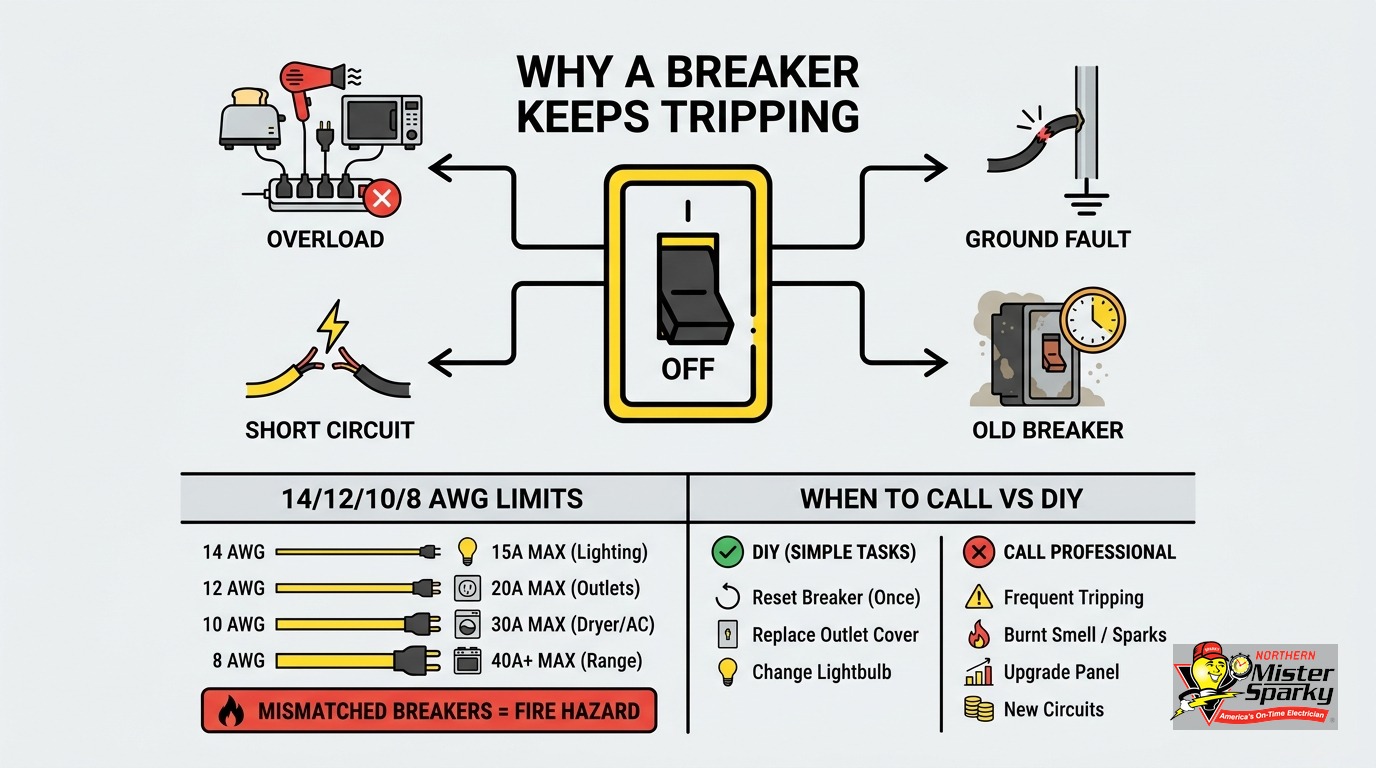
Key Takeaways
- 14 AWG copper wire: 15-amp breaker maximum (NEC 240.4(D))
- 12 AWG copper wire: 20-amp breaker maximum
- 10 AWG copper wire: 30-amp breaker maximum
- 8 AWG copper wire: 40-amp breaker maximum
- Breakers protect the wire, not the appliance - an oversized breaker is a fire hazard
- Any load that runs 3+ hours must not exceed 80% of the breaker’s rating
- Long runs in older Twin Cities homes may require upsizing one AWG gauge
- Aluminum wiring from the 1960s-70s requires completely different handling
- Minnesota adopted the 2026 NEC effective August 17, 2026
- Unpermitted electrical work can void your homeowner’s insurance in Minnesota
Wire Gauge and Breaker Size Chart
Every electrical circuit depends on two numbers matching: wire gauge and breaker amperage. When those numbers are paired correctly, the circuit works safely for decades. When they do not match, you have a fire hazard hiding inside your walls.
This is the complete guide to the wire gauge and breaker size chart for residential copper wiring. It covers the NEC rules that set the limits, the Minnesota-specific code details that affect any permit you pull in 2026, and a clear call-vs-DIY breakdown so you know where the line is.
Why Does the Breaker Protect the Wire, Not the Appliance?
The short answer: The breaker trips when current exceeds the wire’s safe carrying capacity, not when the appliance draws too much. An oversized breaker lets the wire overheat before it ever trips. That heat builds inside the wall and can ignite insulation or framing without any visible warning.
Most homeowners assume the breaker is there to protect the refrigerator or the microwave. It is not. The breaker is sized for the wire running behind your walls.
Here is what that means in practice. Every wire gauge has an insulation temperature rating. Push too much current through the wire, and resistance generates heat. When a breaker is oversized for the wire it protects, the wire overheats and can ignite insulation or surrounding material before the breaker ever trips.
The appliance does not affect this equation. A microwave does not know or care that the wire feeding its outlet is overloaded. The wire heats silently. The oversized breaker never reaches its trip threshold. Somewhere inside the wall, you have a slow-building fire hazard.
This is why the wire gauge and breaker size chart is not just an electrician’s technicality. It is basic fire prevention. Getting the pairing right is one of the few things you can do that directly reduces fire risk in a home where the wiring runs hidden for decades.
Copper Wire Gauge and Breaker Size Pairings
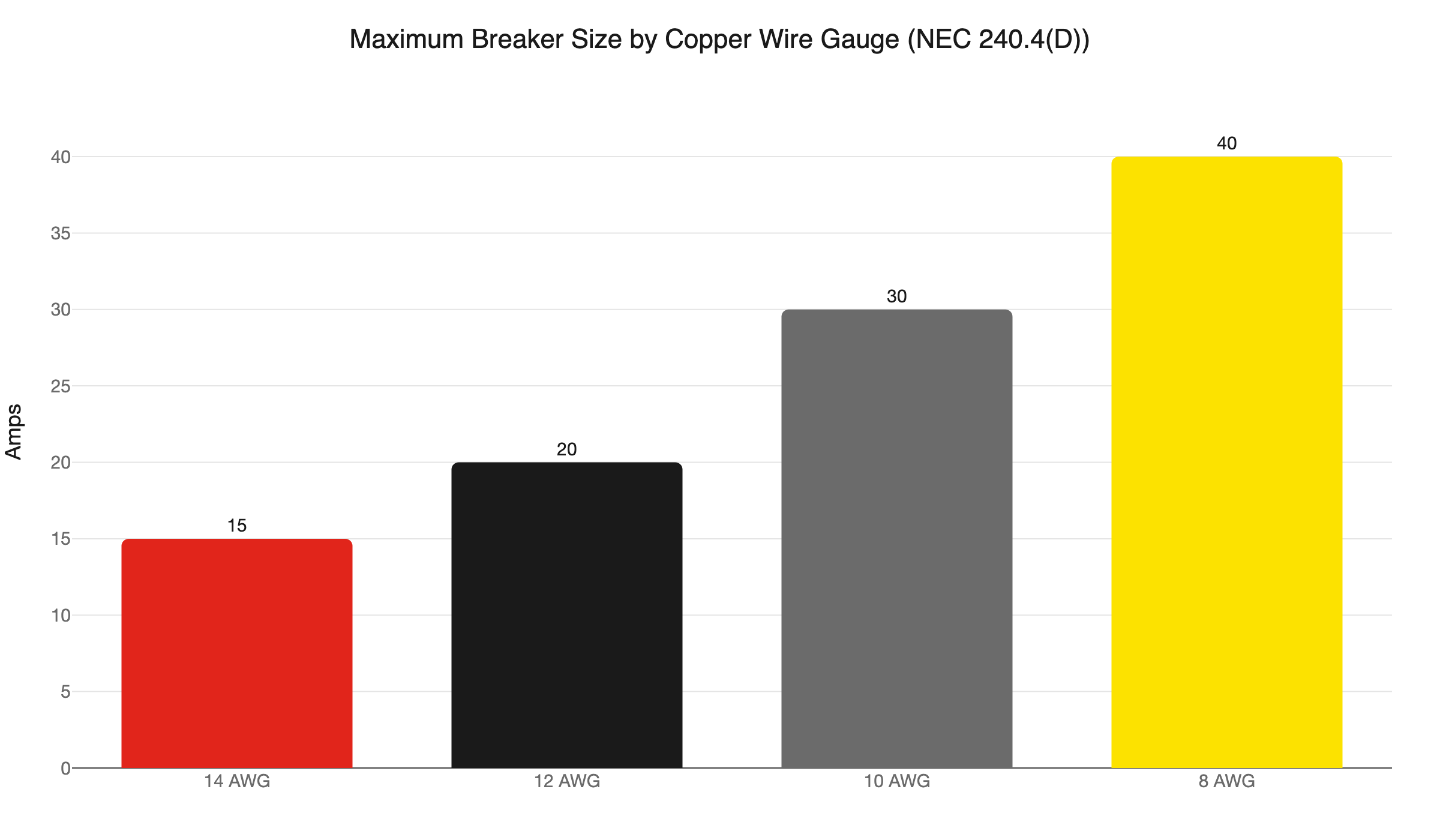
The “Small Conductor Rule” in NEC 240.4(D) sets hard maximums for overcurrent protection on copper conductors. These are ceilings, not targets.
14 AWG copper - 15 amps maximum
The most common wire gauge in homes built before the mid-1990s. It covers bedroom outlets, living room circuits, hallway lighting, and most general-purpose lighting circuits. A 15-amp breaker is the absolute ceiling. Swapping in a 20-amp breaker to stop nuisance tripping is one of the most common panel errors inspectors find in older Minneapolis and St. Paul homes.
12 AWG copper - 20 amps maximum
The current standard for most new residential branch circuits. Kitchen countertop receptacles, bathroom circuits, laundry receptacles, and general 20-amp circuits use 12 AWG. Use 12 AWG any time you expect moderate ongoing loads.
10 AWG copper - 30 amps maximum
Required for electric dryers, most electric water heaters, and air-conditioning condensers. A 10 AWG wire on a 30-amp breaker is the standard pairing for 240-volt appliance circuits in this power range.
8 AWG copper - 40 amps maximum
Used for electric ranges, large air-conditioning units, and some subpanel feeds. At this gauge, you are typically working with 240-volt circuits and higher-draw appliances.
A critical note on NM-B cable: Most residential Romex carries a 90°C jacket rating stamped on the outer sheath. That rating does not let you run a larger breaker. NEC 334.80 requires ampacity to be calculated at the 60°C column. Device terminals in outlets, breakers, and fixtures are only rated to 60°C. The jacket rating covers the cable itself. The system is governed by its weakest termination point.
What Happens When the Breaker Is Too Big for the Wire?
The short answer: The wire overheats silently. The breaker never trips because current does not hit its too-high threshold. Heat builds inside the wall. In the worst case, the insulation ignites and starts a fire in a place you cannot see or reach.
This is not a theoretical concern. Electrical wiring problems cause more than 40,000 home fires per year in the United States, averaging roughly 350 deaths and over $2 billion in annual property losses. Mismatched breakers are a significant contributor to that number.
The most common version of this problem looks like this: a breaker keeps tripping, so someone swaps in a larger breaker to make the tripping stop. The tripping was the circuit’s warning that it was overloaded. The swap silenced the warning. The overload is still happening. The wire now has no protection against it.
The right fix is to understand why the breaker was tripping and solve that root cause. Maybe the circuit needs a dedicated line for a high-draw appliance. Maybe the panel needs more capacity. Upsizing the breaker on the same wire is never the answer. Our post on why your circuit breaker keeps tripping covers the most common causes and their solutions.
What Is the 80% Continuous-Load Rule?
The short answer: Any circuit serving a load that runs for three or more continuous hours must be sized so that load does not exceed 80% of the breaker rating. A 20-amp breaker supports 16 amps of continuous load. A 15-amp breaker supports 12 amps. If your load exceeds those thresholds, you need a larger circuit.
This rule comes from NEC 210.19(A) and 210.20(A). It prevents wiring from running at its rated maximum for extended periods, which degrades insulation over time.
Continuous loads common in Twin Cities homes include:
- Electric space heaters running through a cold Minnesota night
- Chest freezers and refrigerators
- Sump pumps running during spring snowmelt
- Well pumps
- EV chargers (overnight charging is almost always a continuous load)
- Home offices with multiple monitors, computers, and chargers running together
The sizing math runs in reverse from what most homeowners expect. Say you need 18 amps of continuous draw for an EV charger. Divide by 0.80 and you need a circuit rated at 22.5 amps minimum. Round up to the next standard size: a 30-amp circuit with 10 AWG wire. Not a 20-amp.
This is one reason EV charger installations often surprise homeowners on circuit size. The charger may be rated at 32 amps. The continuous-load rule pushes the required circuit to 40 amps minimum. That means 8 AWG wire and a 40-amp breaker.
Does Wire Length Affect the Gauge You Need?
The short answer: Yes. Long runs lose voltage due to resistance in the wire. NEC recommends no more than 3% voltage drop on branch circuits and no more than 5% total. For runs where the math shows you are near that limit, you may need to upsize one AWG gauge.
This comes up in Twin Cities homes more than most homeowners realize. Older Minneapolis and St. Paul houses often have basement panels. Branch circuits run from there to second-floor bedrooms, home offices, or finished attic spaces. A run of 60 to 80 feet is common in a two-story home.
At 60 feet, a 12 AWG circuit at 20 amps may already approach the 3% voltage-drop limit, depending on the load. At 80 or 100 feet, it likely exceeds it. The result shows up as lights that dim when a large appliance kicks on or as appliances that underperform because they are not receiving full voltage.
The fix is moving up one gauge. A 10 AWG wire on that long run corrects the voltage drop. The breaker stays at 20 amps. Only the wire changes. An electrician can run the voltage-drop calculation for your specific run length and load before recommending a solution.
What About Aluminum Wiring in Older Twin Cities Homes?
The short answer: Aluminum wiring requires different ampacity tables. 10 AWG aluminum is limited to 25 amps, not 30 like copper. More critically, the 1960s-1970s aluminum branch-circuit wiring found in many Twin Cities homes is a documented fire hazard that requires professional evaluation, not a DIY fix.
The CPSC has documented this risk directly. Homes with aluminum wiring are 55 times more likely to have fire hazard conditions than homes with copper wiring.
Aluminum expands and contracts more than copper as it heats and cools with normal use. Over years of thermal cycling, aluminum connections loosen. Loose connections arc. Arcing connections start fires inside walls.
Aluminum was a standard residential wiring material from approximately 1965 to 1973. If your Twin Cities home was built during that period, you may have aluminum branch-circuit wiring. A licensed electrician can confirm it during an inspection.
Here is why it matters for the wire gauge chart: every copper recommendation on this page does not apply directly to aluminum. The ampacity table is different. Every connection point on aluminum branch wiring requires anti-oxidant compound and CO/ALR-rated devices. A standard copper approach fails on aluminum.
The call-vs-DIY line for aluminum wiring is firm. Do not work on it yourself. Read our full guide on aluminum wiring dangers and fixes before deciding how to proceed, then call a licensed electrician.
What Changed in Minnesota’s Electrical Code in 2026?
The short answer: Minnesota adopted the 2026 NEC effective August 17, 2026. Permits filed on or after that date must comply with the 2026 NEC. The most significant residential change is an expansion of required arc-fault circuit interrupter (AFCI) protection to virtually all 15-amp and 20-amp branch circuits in dwelling units.
The Minnesota Department of Labor and Industry manages the state’s electrical code adoption. The August 17, 2026 transition date is firm. If you are planning any electrical work - adding a circuit, finishing a basement, or upgrading your panel - the code your contractor must follow depends on when that permit is filed.
The AFCI expansion is the biggest change for typical homeowners. The change is significant for any new circuit work. The 2026 NEC requires AFCI protection on virtually every 15-amp and 20-amp branch circuit in a dwelling. AFCI breakers detect the electrical signature of arc faults. These are the hidden sparks inside walls that start fires without ever tripping a standard breaker.
This directly affects wire gauge decisions for new circuits. When you add a circuit under the 2026 NEC, you are not just selecting the right wire and breaker size. You are also specifying the right breaker type. AFCI breakers cost significantly more than standard breakers. That changes the budget for any project that requires a permit after August 17, 2026.
For a detailed look at where AFCI protection is required and what the breakers actually do, see our post on AFCI breaker requirements explained.
Can a Homeowner Do This Work in Minnesota?
The short answer: Minnesota homeowners may do their own electrical work on an owner-occupied single-family home. They must pull a permit, pass inspection, and personally perform all labor. Hiring a neighbor or handyman to do the work under a homeowner permit is not allowed.
Minnesota DLI outlines the homeowner electrical permit rules clearly. The homeowner exception does not apply to rental properties, duplexes, or homes you own but do not currently live in.
Before assuming you can pull your own permit, check whether your city handles its own permits. About 66 Minnesota cities are their own Authority Having Jurisdiction and issue permits locally. All other Minnesota addresses file with the DLI. Minnetonka, for example, issues permits through the city’s community development department, not the state. If you are unsure, your city’s website or a quick call to the building department can confirm which system applies to your address.
What happens if you skip the permit:
Unpermitted electrical work carries real consequences.
- Your homeowner’s insurance may deny a fire claim that originates in unpermitted work
- DLI can charge an investigation fee on top of normal permit costs when the work is discovered
- Unpermitted electrical work blocks home sales when a buyer’s inspector flags it
- You carry personal liability if the work causes injury or property damage
The permit is not bureaucracy for its own sake. The inspector’s review puts a second set of eyes on work that will be hidden inside your walls for the life of the home. That review has caught problems that would have been undetectable after drywall went up.
When to Call a Licensed Electrician
Some electrical work is within a careful homeowner’s reach. Most wire gauge decisions are not.
DIY is reasonable, with a Minnesota homeowner permit, for:
- Replacing a failed outlet on a correctly wired existing circuit
- Swapping a light fixture on an existing switch leg
- Replacing a breaker with the identical brand, type, and amperage rating
Call a licensed electrician for:
- Any work on aluminum wiring
- Adding a new circuit or extending an existing circuit
- Upsizing a breaker or doing any panel work beyond a direct like-for-like swap
- Running new wire for an appliance, EV charger, generator, or heating and cooling equipment
- Any job where you are not certain the existing wiring is code-compliant
- Any project involving 240-volt circuits or subpanel work
- Any work on a home built before 1975 where the wiring has not been evaluated
The core rule: if the job involves a wire gauge decision, it involves a code compliance decision. Code compliance decisions carry permit requirements and inspections in Minnesota. That is where a licensed electrician earns the call.
Trying to work backward - starting with the breaker size you want and then picking a wire to match - is the wrong direction. Start with the load, follow the NEC sizing rules, account for continuous loads and run length, and let that math determine both the wire and the breaker. If the answer surprises you, that is a signal to call before you start, not after.
Ready to Schedule?
Northern Mister Sparky is your locally owned Twin Cities electrician. We serve Minneapolis, St. Paul, Bloomington, Brooklyn Park, Woodbury, Blaine, Maple Grove, Plymouth, and the surrounding area. Our team knows Minnesota’s permit process, the 2026 NEC transition, and how to handle the aluminum wiring that turns up in so many Twin Cities homes built between 1965 and 1973.
If you need a circuit breaker replacement, want to add a circuit, or want someone to evaluate your panel and give you a straight answer about what is going on, call us at 763-200-5956 or book online. As America’s On-Time Electrician(R), we show up when we say we will, do the work right, and back it with the UWIN(R) 100% satisfaction guarantee. No malarky.
Frequently Asked Questions
What wire gauge do I need for a 20-amp circuit? +
Can I use a 30-amp breaker on 12 AWG wire? +
Do I need a permit to replace a circuit breaker in Minnesota? +
Need an electrician now?