
Tandem Breaker vs. Double Pole Breaker: Know the Difference
Key Takeaways
- A tandem breaker fits two independent 120V circuits into one panel slot. It does not create a 240V circuit.
- A double pole breaker occupies two panel slots and powers one 240V circuit. It includes a required common-trip mechanism.
- These two breaker types are not interchangeable. Using one in place of the other is a code violation and a real safety risk.
- Tandem breakers are only legal in CTL-designated slots specified on your panel’s label. Installing them elsewhere violates your panel’s UL listing.
- A panel packed with tandems is a diagnostic signal: your home’s electrical load has likely outgrown the original service.
- Minnesota is now under the 2026 NEC, effective August 17, 2026. Any permit pulled today must comply with that code.
- The right fix for a full panel is a subpanel addition or a service upgrade, not more tandem breakers.
What Is the Difference Between a Tandem Breaker and a Double Pole Breaker?
Quick answer: A tandem breaker puts two independent 120V circuits into one panel slot. A double pole breaker uses two slots to run a single 240V circuit. They serve completely different purposes and are not substitutes for each other.
Both devices live inside your electrical panel and protect circuits from overloads and short circuits. That is where the similarity ends.
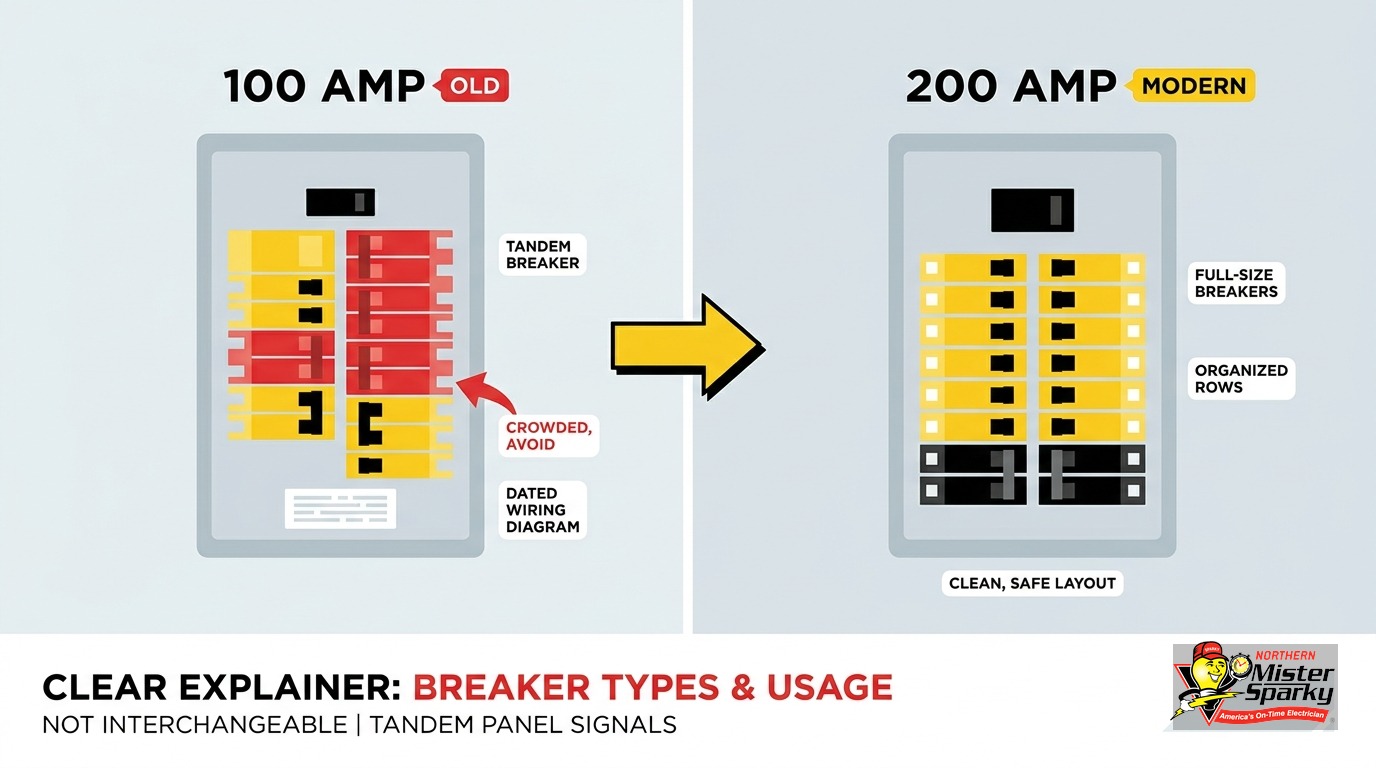
The tandem breaker. Some people call it a half-size breaker, a slimline breaker, or a twin breaker. You may also hear the term “cheater breaker.” That name overstates the danger when the device is used correctly, but understates the problem when it is not. A tandem breaker has two small switches side by side. Each switch controls its own separate 120V circuit. The two circuits are fully independent. A tandem breaker exists for one specific purpose: to add a circuit to a panel that is running low on physical slots.
The double pole breaker. This breaker has a wide single handle or two handles joined by a bridge. It occupies two adjacent slots in the panel. Its two poles connect to opposite legs of the 240V service entering your home from the utility. Together, those two legs deliver 240 volts to a single circuit. That is the voltage required for ranges, dryers, central air conditioners, EV chargers, and heat pumps.
The critical difference is the common trip mechanism. A double pole breaker’s two poles are mechanically linked. If either pole detects an overload or a fault, both poles trip together. They cut power to the full 240V circuit at once. NEC Section 240.15(B) makes this mandatory for all 240V branch circuits. A tandem breaker has no such link. Its two switches operate entirely independently. That is fine for two separate 120V circuits. It is dangerous for a 240V load.
Why Can’t You Use a Tandem Breaker for a 240V Circuit?
Quick answer: Because a tandem breaker has no common-trip mechanism. NEC 240.15(B) requires that both poles of a 240V circuit trip together when a fault occurs. Without that, one leg can stay live while the other trips. That is a shock hazard and a fire hazard.
Here is a concrete example. You want to add an EV charger in your garage. Your panel is full. Someone suggests linking two tandem breaker slots to create a 240V circuit. Electrically, you can reach 240 volts by pulling from both legs of the service. But when a fault occurs on leg one, only that tandem switch trips. Leg two stays energized. The charger may show an error or appear to be off, but the circuit is still live on one side. Anyone who touches the wrong spot is at risk.
This is not a hypothetical edge case the code writers invented to frustrate homeowners. It is the reason NEC 240.15(B) has required common-trip protection on 240V circuits for decades. The rule exists because the failure mode is real.
The same logic rules out “splitting” a 240V load across two separate tandem slots. The wiring configuration, the overcurrent protection, and the grounding requirements for a 240V circuit are all different from two parallel 120V circuits. When your panel is out of room for a double pole breaker, the answer is to create room, not to work around the requirement.
Our page on what to do when your electrical panel is out of breaker slots walks through the real options.
What Is a CTL Slot, and Does My Panel Have Any?
Quick answer: CTL stands for Circuit Total Limiting. Under NEC 408.54, every load center has a listed maximum number of overcurrent devices. Tandem breakers are only permitted in slots the panel’s own label designates as tandem-capable. Those are CTL positions. Not every slot qualifies, and not every panel has any.
Open your panel door and look at the label inside. Every residential load center carries one. That label is the panel’s UL listing. It specifies the panel’s ampacity, the maximum number of overcurrent devices it is approved for, and which physical slots may accept tandem breakers. Manufacturers typically mark CTL positions with a bracket or a note like “tandem breakers permitted in spaces 1 through 8.” If a slot does not appear in that list, it is not a CTL position, full stop.
Why does this limit exist? The NEC caps the total circuit count for a panel based on its design and testing. The limit is not arbitrary. It reflects the bus bar’s capacity and the physical space required for safe operation. When you exceed it, you violate both the panel’s UL listing and NEC 408.54. The panel is no longer installed as listed.
Here is what makes this practically important for Twin Cities homeowners. Many 1950s and 1960s-era 100-amp, 20-space load centers were installed with only a handful of CTL slots. Contractors discovered that tandems physically fit in other slots even though the label did not permit them. Over decades of additions, those non-CTL tandems accumulated. Today some panels we open have 30 or more circuits in a 20-space panel listed for 24 overcurrent devices. Every extra tandem in a non-CTL slot is a code violation.
One more detail worth knowing: tandem breakers are manufacturer-specific. Schneider Electric (Square D) makes tandem breakers only for their specific HomeLine and QO load centers, and each panel’s label specifies which models are approved for which spaces. A tandem from one manufacturer does not belong in another manufacturer’s panel. Mixing brands creates fit problems, thermal problems, and fault-interruption problems. It also voids the panel’s listing.
If your panel’s label is missing or illegible, treat no slots as tandem-approved until a licensed electrician can identify the panel model and pull the manufacturer’s slot map.
Which Appliances Require a Double Pole Breaker?
Any appliance running on 240V needs a double pole breaker. In a Twin Cities home, that list is long and getting longer:
- Central air conditioner: typically a 2-pole 30-60A breaker, sized to the unit’s nameplate
- Electric dryer: typically a 2-pole 30A breaker
- Electric range or oven: typically a 2-pole 50A breaker
- Level 2 EV charger: typically a 2-pole 40-50A breaker. The surge in EV adoption across the Twin Cities since 2024 has made this one of the most common panel requests we field.
- Heat pump: typically a 2-pole 30-60A breaker. Homes converting from gas furnaces to heat pumps almost always need a new 240V circuit.
- Tankless electric water heater: typically 2-pole 40-60A, and some units require two double pole breakers
- Garage heater (electric, 240V): typically a 2-pole 30-60A breaker
- Hot tub or spa: typically a 2-pole 50-60A breaker with GFCI protection required by code
- Welding outlet or large air compressor: typically a 2-pole 50A or larger
None of these loads can share a slot with something else or be served by a tandem. Each requires its own dedicated double pole breaker and wire gauge sized to that circuit. Our guide to 240V outlet installation for dryers and ranges covers the wiring specifics in more detail.
If more than one of these is on your project list, check your panel now. Each project needs an open double-pole slot. If the panel does not have them, plan for that conversation before you schedule the appliance install.
What Does a Panel Full of Tandem Breakers Signal?
Quick answer: It usually means the home’s original load center was pushed past its designed capacity over time. It can also indicate circuits were added without permits. Either way, it is a flag for a professional evaluation, not a prompt to add more tandems.
Minnesota’s housing stock is heavily concentrated with homes built between 1950 and 1980. Those homes typically came with 100-amp service and 20-to-24-space load centers. That was appropriate for the era. Central air conditioning was not yet universal. EV chargers did not exist. And the kitchen circuit requirements under today’s code were decades away.
Over time, circuit demand grew. Renovations added kitchen circuits, garage outlets, and new appliances. Contractors or homeowners reached for tandems to add capacity without replacing the panel. Done correctly, they used CTL-designated slots and stayed within the panel’s listed device count. Done carelessly, they did not.
A panel visually packed with slim side-by-side breakers tells a story. That story usually includes at least one of the following:
Load growth. The home’s current electrical demand has exceeded what the original service was designed for. Frequent tripping, lights dimming when large appliances start, and a panel that feels warm to the touch are additional data points.
Unpermitted work. Circuits added without permits have no inspection records. In a Minnesota real estate transaction, a home inspector who flags a panel full of tandems is often indirectly flagging unpermitted work. That has real consequences. An open or missing electrical permit can complicate or stall a home sale in Minnesota. Buyers negotiate on it. Sellers sometimes have to remediate before closing.
Future capacity problems. If an EV charger, heat pump, or any 240V circuit is on your roadmap, a full panel with no open double-pole slots is a problem you cannot solve with more tandems. It requires a real solution before the project can move forward.
The correct response to a panel full of tandems is an evaluation by a licensed electrician. They can determine whether a subpanel addition, a service upgrade, or both is the right path for your home and your load.
Minnesota’s 2026 NEC: What Twin Cities Homeowners Need to Know Right Now
Minnesota adopted the 2026 National Electrical Code on August 17, 2026. Any permit filed on or after that date must comply with the 2026 NEC. Permits filed before August 17 operate under the 2023 NEC. This is the code in force for any Twin Cities panel work today. No competitor article on tandem breakers is talking about this because it just changed.
The 2026 NEC carries forward and in some areas tightens the CTL requirements in Section 408.54 and the common-trip requirements in Section 240.15(B). Work inspected today is inspected against those current standards.
Minnesota also requires a permit for panel work, including adding breakers to an existing panel. You can review the requirements on the Minnesota DLI electrical permits page. Homeowners doing their own work on their own homes can pull their own permits, but the work must pass inspection before it is finalized. Work done without a permit has no inspection record. That becomes your problem if you sell.
One cold-climate note specific to Minnesota: in July 2026, Minnesota DLI published a bulletin on circuit breakers in low ambient temperatures. Breakers are rated for performance at 40°C (104°F) ambient. Unheated garages, detached outbuildings, and cold mechanical rooms in Minnesota can push breakers well outside that range in winter. Cold temperatures can affect trip accuracy. A breaker in a subfreezing garage may not trip at its rated current when it is coldest. If your panel or subpanel is in an unheated space, tell your electrician. This matters more here than it does in warmer states, and it is worth factoring into any panel discussion.
What Are Your Options When the Panel Is Full?
Quick answer: You have three real paths: add a subpanel fed from the existing panel, upgrade to a larger service panel, or replace an aging same-size panel with a new one that has more usable slots. The right answer depends on your current service ampacity, your actual load, and what you are planning to add.
Add a subpanel. A subpanel is a secondary breaker box fed by a large-capacity circuit from the main panel. It gives you new slots without replacing the main panel. This works well when your main service has capacity to spare and you simply need more physical space. A garage workshop or a basement finishing project is a common case. The subpanel goes where the work is, and the main panel stays as-is.
Upgrade the service panel. If your service is genuinely undersized, a 100A-to-200A upgrade is the more comprehensive fix. A new panel with 40-plus spaces has room for every double pole breaker you need now, plus room to grow. This is also the right call if your current panel is a known problematic brand or if the panel is aging toward the end of its useful life.
Replace with a same-size panel. Sometimes a 200A panel needs to be replaced because it is old, damaged, or simply out of legitimate CTL positions. A fresh 200A panel with 40 or more spaces resolves the slot shortage without changing the service entrance. Load stays the same; you just have room to work with again.
Adding more tandem breakers is not on this list because it is not a real option once you have used your CTL-approved slots. Our guide on signs you need an electrical panel upgrade will help you recognize where your current panel stands.
Ready to Sort Out Your Panel? Call Northern Mister Sparky.
If your panel is full, if you need a new 240V circuit, or if a home inspector just flagged your breakers, we can help.
We are locally owned and operated in the Twin Cities. As America’s On-Time Electrician(R), we show up when we say we will and give you a straight answer about what you actually need. No malarky. Every job is backed by our UWIN(R) 100% satisfaction guarantee, and we offer financing options for larger projects like panel upgrades and service changes.
Call 763-200-5956 or book online to get on the schedule.
Frequently Asked Questions
Can I use a tandem breaker instead of a double pole breaker? +
Are tandem breakers legal in Minnesota? +
What does it mean if my panel is full of tandem breakers? +
Need an electrician now?