
Open Electrical Permit Home Sale Minnesota: Seller's Guide
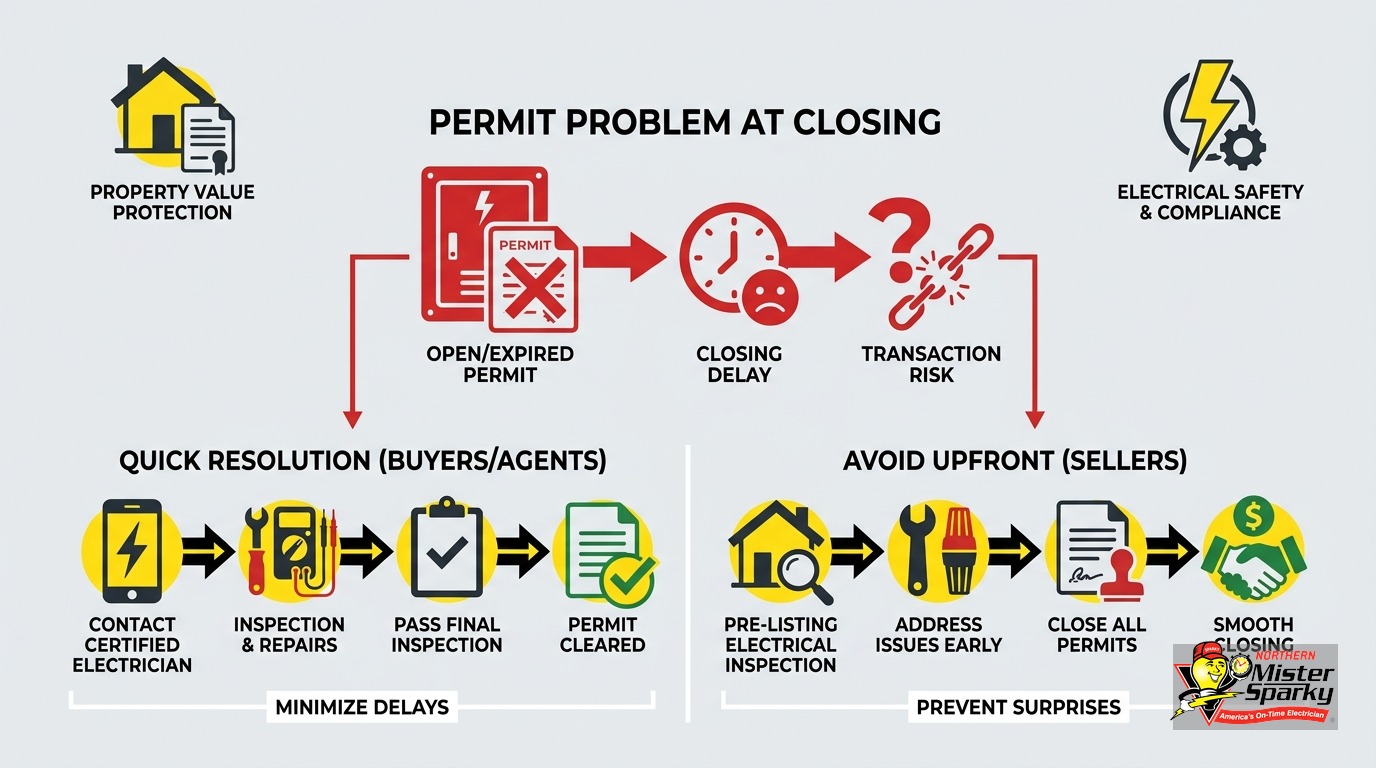
Key Takeaways
- An open electrical permit does not disappear at closing. It transfers to the buyer along with all fines, completion obligations, and inspection risk.
- Minnesota splits permit authority between the state DLI and roughly 66 local jurisdictions. Knowing which system holds your permit is step one.
- The 2026 National Electrical Code took effect in Minnesota on August 17, 2026. A lapsed permit re-pulled today is a 2026 NEC job, which can change the scope and cost of remediation.
- Three resolution paths exist: schedule the outstanding final inspection, hire a licensed electrician to bring the work to current code, or re-pull a new permit.
- Sellers can pull their own permit history before listing at ims.dli.mn.gov or through the local city building department. It costs nothing.
- Northern Mister Sparky can assess the original work, handle permit coordination, and help you reach closing.
What Is an Open Electrical Permit?
When a permit is pulled for electrical work but the required final inspection never happens, the permit stays open. It is an unfinished government record that says: electrical work was done here, and no inspector ever signed off on it. In Minnesota, state-track permits expire after 12 months when inspection fees total $1,000 or less - but “expired” does not mean “resolved.”
An expired permit is not a finaled permit. It still represents work that was never inspected and never approved. That distinction matters enormously when you sell.
How Does an Open Electrical Permit Affect a Home Sale in Minnesota?
An open permit can stop your closing. Permits attach to the property itself, not to the person who pulled them. When the sale closes, the buyer inherits the permit - along with any fines, completion costs, and the risk of failed inspection if the work does not meet code.
Title companies run permit searches as part of due diligence. When an open permit surfaces, the title company may recommend the buyer not close. Lenders may also object. Neither side wants to absorb a liability of unknown size.
For sellers, the practical fallout:
- Your closing gets delayed while you resolve the permit.
- The buyer uses the open permit as leverage to negotiate a price cut.
- Your deal collapses if the buyer walks.
There is a second risk beyond the sale itself. Unpermitted electrical work can void a homeowners insurance claim for fire or damage that traces to that work. A buyer who later discovers the work was unpermitted - and that their coverage is affected - has grounds for a serious dispute.
If you are on the buying side of this equation, our guide to electrical inspections when buying a home covers how to protect yourself before you close.
How Do You Find Out Which System Holds the Permit?
Start with the AHJ lookup. Minnesota splits electrical permit authority between the state DLI and roughly 66 local jurisdictions, including Minneapolis, St. Paul, Minnetonka, Eden Prairie, and Eagan. Which system holds your permit determines which office you contact first.
If your property is in one of those 66 cities, the permit lives in the city’s own building department system. All other addresses fall under state DLI authority, and the permit lives at ims.dli.mn.gov. The DLI’s electrical inspector directory, found at dli.mn.gov, can confirm your jurisdiction if you are unsure.
One recent change affects some Twin Cities addresses. As of January 1, 2026, Minnetonka stopped handling permits for Deephaven and Woodland. An older Minnetonka-issued permit for a property in those two cities may still exist in Minnetonka’s system, but any new permit must go through those cities’ own offices.
Once you know the right system, the lookup is straightforward. Search by address on the state portal, or call the city building department directly. Write down the permit number, the date it was filed, and the issuing authority. That information is the starting point for every resolution path below.
What Are Your Three Options to Resolve an Open Permit?
The path forward depends on whether the permit is still active and whether the original work meets current code. If the permit is active and the work is inspection-ready, schedule the final inspection now. If the work needs updating, hire a licensed electrician first. If the permit has lapsed, you are starting over under the 2026 NEC.
Here is how each path works.
Option A: Schedule the outstanding final inspection
If the original work was done correctly and the permit is still within its active window, the cheapest fix is booking the final inspection. For state-track permits, contact the DLI. For local AHJ cities, call the city building department.
If the original licensed electrician is still in business, they can request an ERVI (Electrical Remote Virtual Inspection) for qualifying work. A virtual inspection can close a permit faster than waiting for an in-person slot. That speed advantage matters when your closing is three weeks out.
Option B: Hire a licensed electrician to bring the work to code, then inspect
If you are not sure the original work is inspection-ready, do not guess. Hire a licensed electrician to assess the installation and correct anything short of current code before scheduling the inspection.
Our team can evaluate the work, identify gaps, and coordinate directly with the inspector once the installation is ready. Our pre-sale electrical inspection guide covers what that process looks like and what we commonly find.
Option C: Re-pull a new permit and start fresh
If the permit has lapsed past the 12-month window, you start over. The fees already paid are non-refundable and do not carry forward. A new permit means new fees, and as of August 17, 2026, a new permit also means 2026 NEC compliance.
Option C is the most expensive path. Before committing to it, have a licensed electrician assess the original work against current code. That assessment tells you the real cost - and whether updating the existing installation is cheaper than starting from scratch.
How Does the 2026 NEC Transition Affect a Re-Pull?
Any permit pulled on or after August 17, 2026 must meet the 2026 National Electrical Code. Minnesota adopted the 2026 NEC on that date. A permit originally filed under the 2020 or 2023 NEC gets no grandfather treatment when re-pulled. The inspector evaluates the installation against current code - full stop.
This matters most for older open permits. Suppose a bedroom circuit was roughed in several years ago without arc-fault (AFCI) protection under a prior code cycle. The permit lapsed. When you re-pull today, the inspector looks for 2026 NEC compliance. If AFCI protection is now required for that circuit - and in most bedrooms it is - you need the additional hardware before the permit closes.
The same logic applies to GFCI requirements. The 2026 NEC expanded GFCI scope in several locations. Work done under an older cycle may fall short.
Minnesota’s electrical code is uniform statewide. Local jurisdictions cannot weaken or modify it. Whether the property is in Minneapolis, Blaine, or Burnsville, a re-pulled permit means 2026 NEC compliance. Our AFCI breaker requirements guide has more background on what the current code requires and why.
If your open permit has lapsed, do not assume the original work will pass a modern inspection. Have a licensed electrician review the installation before you file anything.
What Happens If the Original Contractor Is Gone?
You can still resolve the permit. The contractor’s absence does not close the record or erase your obligation. Contact the building department directly, explain the situation, and ask about your options for scheduling the outstanding inspection. A permit expeditor or a licensed electrician can also manage the process on your behalf.
This scenario is more common than most sellers expect. A small electrical shop closes. A solo contractor retires. The homeowner never knew there was an open permit because the contractor said it was handled. Years later, a title search surfaces the record.
The building department - whether the DLI or a local AHJ city - has seen this before. They can walk you through the steps. In some cases, a new licensed electrician can take over the permit with the building department’s approval, particularly if the rough-in inspection was completed and only the final is outstanding.
Do not ignore an open permit because you cannot locate the original contractor. That is how sellers arrive at the closing table with no options and no time.
Can You Still Close If the Permit Is Not Fully Resolved?
Sometimes yes, through an escrow holdback. Buyer and seller negotiate an arrangement where the seller sets aside a defined amount in escrow to cover the resolution cost. Closing proceeds on schedule. The funds release once the permit is closed and the inspection is finaled. Title companies handle escrow holdbacks routinely in Minnesota.
This works best when:
- The remaining scope is clearly defined and you already have a contractor estimate.
- The closing timeline allows enough room to complete the inspection post-closing.
- The buyer’s lender approves the arrangement.
An escrow holdback does not work well for uncertain scope. If nobody has reviewed the original work against the 2026 NEC yet, the holdback amount is a guess. Both sides carry risk when scope is open-ended.
Talk to your real estate attorney or title company before counting on this option. Lender approval is not guaranteed, especially when the permit involves safety-critical electrical work.
How Can Sellers Get Ahead of This Before Listing?
Pull your own permit history before you list, at least 60 days out. For state-track properties, search by address at ims.dli.mn.gov. For local AHJ cities, call the building department directly. It costs nothing. A surprise found on your own timeline is manageable. A surprise found at due diligence is not.
The proactive checklist:
- Identify your jurisdiction. Is your property in one of the ~66 local AHJ cities, or does it fall under DLI authority? The DLI electrical inspector directory can confirm.
- Search by address. The state portal supports address-based permit lookups. Local AHJ cities may have their own online systems - call the building department if no public portal is available.
- Note any open or expired permits. Write down the permit number, date filed, and issuing authority. An expired permit is not the same as a finaled one.
- Schedule a pre-sale electrical inspection. A licensed electrician reviews the work covered by each permit and identifies whether it is inspection-ready before you are under contract. Our pre-sale electrical inspection guide walks through exactly what to expect.
- Check for unpermitted work too. If any electrical work was done in the last 10 to 15 years, verify that a permit was actually pulled. Our Minnesota electrical permit guide covers what requires a permit and who is eligible to pull one.
Sellers who do this 60 to 90 days before listing have time, options, and leverage. Sellers who skip it find out during due diligence - when they have none of those things.
Why This Problem Is So Common
Most sellers discover the open permit during the title search. They did not know the record existed. The original contractor pulled the permit, completed the work, and moved to the next job without scheduling the final inspection. The homeowner assumed “permit pulled” meant “permit complete.” It does not.
This is not a sign of bad faith on the seller’s part. It is, however, the seller’s problem to solve. The permit runs with the land.
The lesson for any homeowner doing electrical work: do not make the final payment to a contractor until you have confirmation that the permit was inspected and closed. Call the building department to verify. Ask for the inspection sign-off in writing. That takes 10 minutes and costs nothing - compared to sorting out an open permit mid-sale, often years later, when the clock is running.
What It Costs to Resolve a Permit
Resolution costs vary based on whether the permit is still active and whether the original work meets current code.
For an active permit still within its 12-month window, the main cost is the outstanding inspection fee. State-track base rates start at $55 per inspector trip, on top of the original $25 permit fee and $1 surcharge already paid. If the work passes on the first visit, permit-related costs are well under $100 - plus any electrician time for corrections the inspector flags.
For a lapsed permit that requires a re-pull, the original fees are forfeited. New permit fees apply, and any code updates required under the 2026 NEC add electrician labor on top.
For work that was started without a permit at all, an investigation fee applies in addition to normal permit and inspection costs under Minn. Stat. § 326B. The investigation fee is additive - it stacks on top of the permit cost, it does not replace it.
Get a clear-eyed cost estimate before committing to any resolution path. The cheapest option on paper is not always cheapest once the 2026 NEC scope is fully accounted for.
How Northern Mister Sparky Can Help
We are a locally owned and operated Twin Cities electrical company and America’s On-Time Electrician(R). When a permit issue surfaces on a property you are selling, here is what we can do:
- Review your permit history and confirm whether the DLI or a local AHJ city holds the record.
- Inspect the original electrical work against 2026 NEC requirements.
- Pull a new permit if a re-pull is required and handle all coordination with the DLI or the local city.
- Schedule and attend the final inspection.
- Provide documentation of the closed permit for your title company.
We serve the Twin Cities metro: Minneapolis, St. Paul, Bloomington, Brooklyn Park, Woodbury, Blaine, Maple Grove, Plymouth, and the surrounding communities. Every job is backed by the UWIN(R) 100% satisfaction guarantee. No malarky, no bill surprises.
Call 763-200-5956 or book online to schedule a pre-sale assessment. The sooner you move on an open permit, the more resolution options you have before closing day.
Frequently Asked Questions
What happens to an open electrical permit when you sell a home in Minnesota? +
How do I look up whether my home has an open electrical permit? +
Can I still close on my home if an open electrical permit exists? +
Does the 2026 NEC affect an old open permit that needs to be re-pulled? +
Need an electrician now?