
Buying a Home with Unpermitted Electrical Work in Minnesota
Key Takeaways
- Minnesota electrical permits are issued by the state Department of Labor and Industry (DLI). Cities do not handle residential electrical permitting. Minneapolis, St. Paul, and every other metro city defer to DLI.
- Minnesota Statute 513.55 requires sellers to disclose all known material defects before signing a sale agreement. Unpermitted electrical work qualifies as a material defect.
- Under Minnesota Statute 513.57, Subd. 2, buyers have two years from closing to pursue civil action if the seller failed to disclose.
- Any permit filed on or after August 17, 2026 must comply with the 2026 NEC. This may increase remediation costs versus earlier estimates.
- DLI offers Electrical Remote Virtual Inspections (ERVI), making retroactive permits more accessible than in most states.
- Panel upgrades to 200 amps or more that meet NEC requirements may qualify for the IRS Section 25C credit, up to $600.
If you are buying a home with unpermitted electrical work in Minnesota, you are not alone. Unpermitted work turns up regularly in Twin Cities home sales. Finished basements, garage subpanels, attic wiring added for heat tape: these circuits often skip the permit process entirely. Previous owners add them, skip the inspection, and move on. The question is not whether to walk away. The question is what you are actually buying and what remediation will cost.
This guide covers the risk assessment, the Minnesota-specific rules most buyers miss, and how to negotiate a credit based on real numbers. Whether you are buying in Minneapolis, Woodbury, Maple Grove, or Blaine, the same state authority governs your electrical permit. That changes the playbook.
Why Minnesota Handles Electrical Permits Differently Than Most States
Most states let cities and counties run their own electrical permit programs. Minnesota does not. Residential electrical permits are issued and enforced by DLI through its Board of Electricity. Minneapolis, St. Paul, Bloomington, and every other metro city defer to the state.
That matters for you as a buyer. If you discover unpermitted work after closing, you contact DLI. You do not call city hall. The permit application goes through the state portal. A city inspector has no jurisdiction over residential electrical work.
This also means the unpermitted work was not a city oversight. It was never submitted to the state authority. That is a different kind of problem. It carries state-level enforcement exposure.
One more thing to check: whether the contractor who did the original work was licensed. A licensed contractor is required for most residential electrical work in Minnesota. Verify at the DLI contractor license lookup. If the contractor was unlicensed, your negotiating position is stronger. The violation is both unpermitted and unlicensed, which compounds the problem for the seller.
What Are the Real Risks of Buying a Home with Unpermitted Electrical Work in Minnesota?
Unpermitted electrical work carries four categories of risk: safety hazards, financial liability, insurance complications, and resale difficulty. State penalties under Minnesota law can reach $10,000 per violation. Insurance claims tied to unpermitted work may be disputed. When you sell, you become the disclosing party.
Safety is first. Electrical work without a permit has never had an inspector check it. Undersized wire, missing arc fault protection, open splices inside walls, and overloaded panels can all hide until something fails. Fires and shock hazards are the real outcome of wiring no inspector ever reviewed.
Financial liability follows. Under Minnesota Statute 326B.082, Subd. 7, DLI can issue administrative penalties up to $10,000 per violation for unpermitted electrical work. Each day of continued violation after a compliance deadline counts as a separate violation. If DLI discovers the issue before you remediate, the penalties stack fast.
Insurance risk is quieter. Many homeowner’s policies exclude damage caused by work that did not comply with the building code. If unpermitted wiring causes a fire and an adjuster traces the cause to that work, the insurer may dispute the claim. Check your intended insurer’s position on unpermitted work before you close.
Resale risk is the long tail. When you sell this home, you fill out the seller disclosure form. What you buy now is what you disclose later.
How Do You Find Unpermitted Electrical Work Before Closing?
A standard home inspection does not substitute for a licensed electrical inspection. Home inspectors assess visible conditions. A licensed Minnesota electrician can identify code violations, trace circuit origins, and produce a written report that carries legal weight in the disclosure process. Schedule both before your inspection contingency expires.
Your home inspector’s report is the starting point. Home inspectors flag visible problems: open junction boxes, missing cover plates, double-tapped breakers, and panels with known safety histories. But a home inspector does not issue a code compliance determination.
For a buyer-side electrical inspection, hire a licensed Minnesota electrician. Ask them to note any work that appears unpermitted and any violations requiring correction under a retroactive permit. Get the report in writing.
That report serves two purposes. First, it gives you a cost estimate for your negotiation. Second, under Minnesota Statute 513.56, Subd. 3, a written report from a qualified third party provided to the buyer can satisfy the seller’s disclosure obligation for the items it covers. The exemption does not apply if the report contradicts facts the seller already knew.
Pay close attention to attic and crawl spaces. In Minnesota, these are high-risk zones for DIY electrical work. Previous owners frequently wire heat tape in attics and add sump pump outlets or garage heater subpanels in crawl spaces. That work rarely gets permitted.
Also flag homes built before 1978. Electrical remediation in a pre-1978 home may require a Lead Safe Certified contractor under Minnesota law. That narrows your contractor options and adds to the cost estimate.
What Does Minnesota Law Require the Seller to Disclose?
Under Minnesota Statute 513.55, sellers must disclose in writing all material facts they know that could adversely affect an ordinary buyer’s use and enjoyment of the property. Unpermitted electrical work the seller knew about is a material defect. Disclosure must happen before the sale agreement is signed.
The obligation attaches to what the seller knew. If the seller installed the wiring, they knew. If they commissioned the work, they knew. If a prior home inspection flagged unpermitted work and they did not remediate, they knew.
If a seller fails to disclose a known material defect, Minnesota Statute 513.57, Subd. 2 gives you two years from closing to bring a civil action and recover damages. That is a real legal remedy. But litigation is slow and expensive. Getting the facts before closing is always the better path.
Ask your real estate agent to request the seller’s disclosure statement early. Look for any mention of electrical work, upgrades, permits, or improvements. If the seller discloses renovations but cannot produce a closed permit, treat that as a signal worth investigating.
If your electrician finds clear evidence of unpermitted work but the seller claimed no knowledge, document everything: photos, the written electrician report, and a timeline of the work if known. That documentation supports a disclosure claim if the issue surfaces after closing.
How to Negotiate a Remediation Credit for Unpermitted Electrical Work
You have three tools: a licensed electrician’s written scope and cost estimate, a permit fee estimate from DLI, and the seller’s civil exposure under Minnesota’s disclosure statute.
Start with the electrician’s report. Get a written remediation estimate covering what it costs to bring the unpermitted work up to current code and close a permit. That number is the floor of your credit request.
Add the permit fee. DLI permit fees vary by job size and scope. Retroactive permits often include a surcharge. Ask your electrician to include the permit fee in the estimate, or request the fee schedule from DLI directly.
Frame your credit request around the total out-of-pocket cost you will carry. The seller’s alternative is to remediate before closing. That delays the sale and costs them the same money. Most sellers prefer a credit.
If the seller pushes back, reference the disclosure obligation. A seller who knew about unpermitted work and did not disclose it faces a two-year civil liability window. That context changes the dynamic.
If the remediation includes a panel upgrade to 200 amps, mention the IRS Section 25C credit as a buyer-side offset. That is not a reason to accept a smaller credit. But knowing it exists gives you a complete picture of your net cost going into the conversation.
What Happens When You Pull a Retroactive Permit in Minnesota?
After closing, you apply for an electrical permit through the DLI online portal. A licensed electrician performs or oversees any required corrections. DLI schedules an inspection, which can be a virtual inspection through ERVI. Once the inspection passes, the permit closes and the record is clean.
Minnesota makes this more accessible than most states. DLI’s Electrical Remote Virtual Inspection program lets an inspector review work via video. For buyers who close and want to move quickly, ERVI removes the scheduling bottleneck of an in-person visit.
The step sequence:
- Apply for the permit at the DLI portal. Homeowners can apply for permits on their own property. A licensed contractor must typically perform or oversee the actual work.
- Have the licensed electrician correct all violations identified in the pre-close inspection report.
- Request an inspection through DLI’s inspection scheduling system. Choose ERVI if it is available for your work type.
- If the inspection passes, the permit closes. If corrections are needed, the electrician addresses them and you schedule a re-inspection.
A closed permit on your property’s record is a clean signal to future buyers, title companies, and insurers. An open or unresolved permit is a flag you will eventually hand to the next owner.
Does the 2026 NEC Change the Cost of Remediation?
Yes, potentially. Minnesota adopted the 2026 National Electrical Code effective August 17, 2026. Any permit filed on or after that date must meet 2026 NEC requirements, regardless of when the original work was done. Some 2026 NEC requirements go beyond the 2023 NEC and can increase the correction scope.
This is the detail that almost no buyer or real estate agent knows. And it directly affects deals happening right now.
If your electrician estimated remediation costs before August 17, 2026, that estimate may have been based on the 2023 NEC. If you are filing the permit today, it falls under the 2026 NEC. Ask your electrician to confirm the estimate still holds. If costs have shifted, that information belongs in your negotiation. Get the updated scope in writing before closing.
This matters most for older work: ungrounded circuits, missing AFCI protection on bedroom circuits, and outdated panel wiring. Each can have a different remediation path under the 2026 NEC than under the 2023 version. For context on how recent NEC adoption cycles affect Twin Cities homeowners, see our post on Minnesota electrical code changes.
Can Tax Credits Offset Remediation Costs?
Yes, in some cases. The IRS Section 25C energy efficiency credit covers 30% of qualifying electrical panel component costs, up to $600 per item. The panel must meet NEC requirements and reach a capacity of 200 amps or more. The buyer who performs the remediation after closing can claim the credit on their federal return.
The credit applies to panelboards, sub-panelboards, branch circuits, and feeders that meet NEC standards at 200 amps or more. Confirm current eligibility with a tax professional. Credit windows are subject to legislative change.
If your remediation includes a panel upgrade from 100 amps to 200 amps, that upgrade qualifies. The $600 cap does not cover full remediation costs, but it offsets part of the panel work you would do regardless. For a breakdown of when a service upgrade makes sense, see our post on 100-amp vs. 200-amp electrical service.
Keep detailed records. The 25C credit requires documentation of the equipment, capacity, and NEC compliance. Your electrician’s invoice should itemize these specifics.
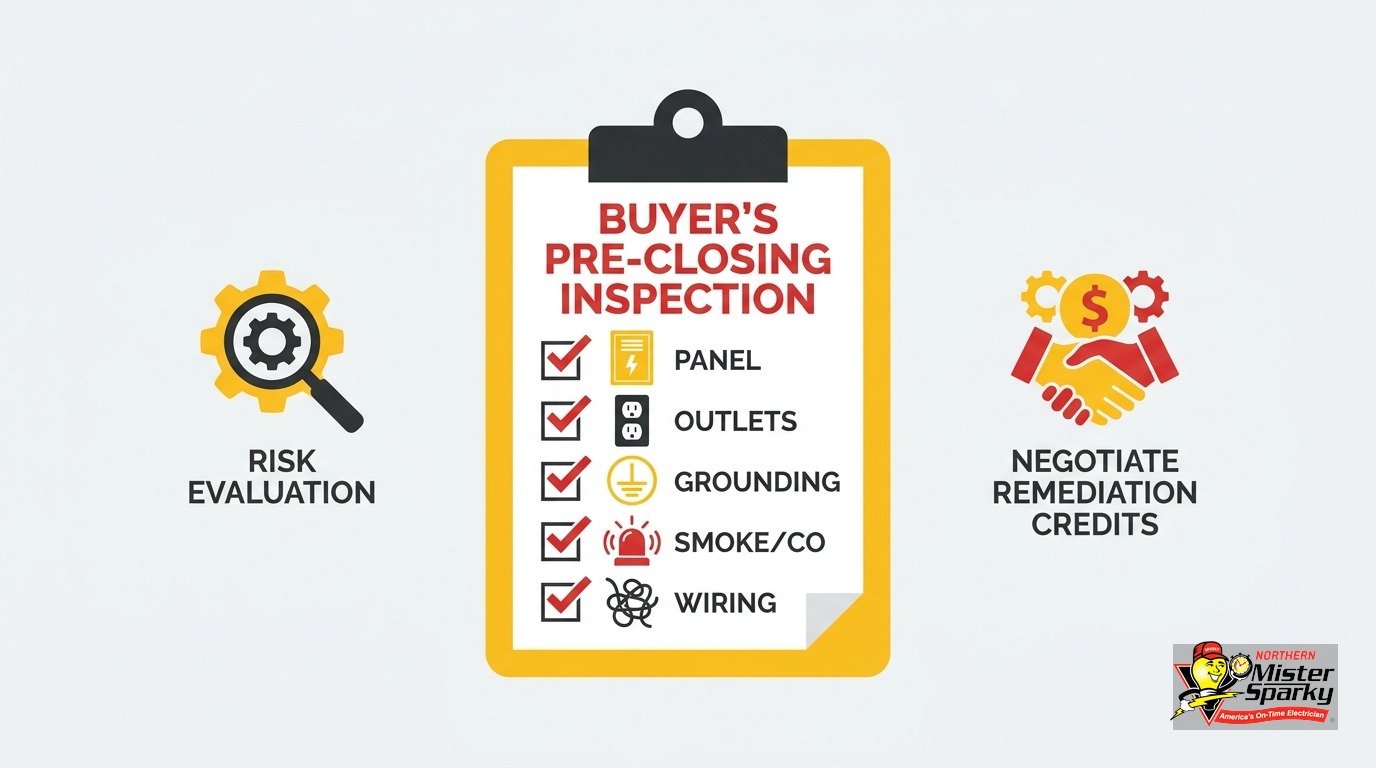
Your Pre-Closing Checklist: Unpermitted Electrical Work in Minnesota
Use this checklist when buying a home with unpermitted electrical work in Minnesota.
Before making an offer:
- Request the seller’s disclosure statement early. Look for any mention of electrical work, upgrades, additions, or permits.
- Search DLI permit records for the property address to see what electrical permits were pulled and closed.
- Note the year the home was built. Pre-1978 homes may require a Lead Safe Certified contractor for remediation.
During the inspection period:
- Hire a licensed Minnesota electrician for a separate electrical inspection, in addition to your home inspector.
- Ask the electrician to identify apparent unpermitted work and provide a written remediation estimate with permit fees included.
- Verify the original contractor’s license at the DLI contractor license lookup.
- Confirm the estimate reflects the 2026 NEC if you are pulling the permit on or after August 17, 2026.
- Check with your intended homeowner’s insurer about their position on unpermitted work before you close.
In negotiation:
- Request a credit equal to the full remediation cost plus permit fees.
- If the seller resists, reference the two-year civil liability window under MN Statute 513.57.
- Confirm whether a 200-amp panel upgrade is in scope. Flag the 25C credit as context for your net cost calculation.
After closing:
- Apply for the electrical permit through the DLI portal.
- Hire a licensed electrician to perform or oversee all corrections.
- Schedule an inspection through DLI. Choose ERVI if it is available for your work type.
- Keep closed permit documentation with your home records.
For the seller side of this transaction, our post on open electrical permits at the time of a home sale in Minnesota covers how open permits affect title and what sellers should do before listing.
We are locally owned and operated right here in the Twin Cities. When you need a buyer-side electrical inspection before your contingency expires, we give you a straight assessment: no malarky, no upsell, just a clear picture of what you are walking into. Call us at 763-200-5956 or book online to schedule. As America’s On-Time Electrician(R), we show up when we say we will, and we back every job with our UWIN(R) 100% satisfaction guarantee.
Frequently Asked Questions
Does the seller have to disclose unpermitted electrical work in Minnesota? +
Can a buyer pull an electrical permit after closing in Minnesota? +
How long does a buyer have to sue a seller for undisclosed electrical defects in Minnesota? +
How does Minnesota's 2026 NEC adoption affect retroactive permits? +
Need an electrician now?