
Buried Junction Box Electrical Code Violation: MN Homeowners
Key Takeaways
- NEC 314.29 requires every junction box to remain accessible without removing any permanent part of the building.
- Minnesota’s 2026 NEC took effect for permits filed on or after August 17, 2026. DLI lists Section 314.29 on its official single-family dwelling inspection checklist.
- MN Rule 3801.3770 places the cost of uncovering improperly concealed wiring on whoever covered it without a required inspection.
- Pre-1980 Twin Cities homes are disproportionately likely to have buried boxes, often paired with aluminum wiring from the same era.
- A buried box discovered at home inspection can delay or derail a real estate transaction.
- The fix is usually a licensed electrician’s half-day task: restore access, verify connections, install a listed cover plate, pull a permit if the original work was unpermitted.
What Is a Buried Junction Box Electrical Code Violation?
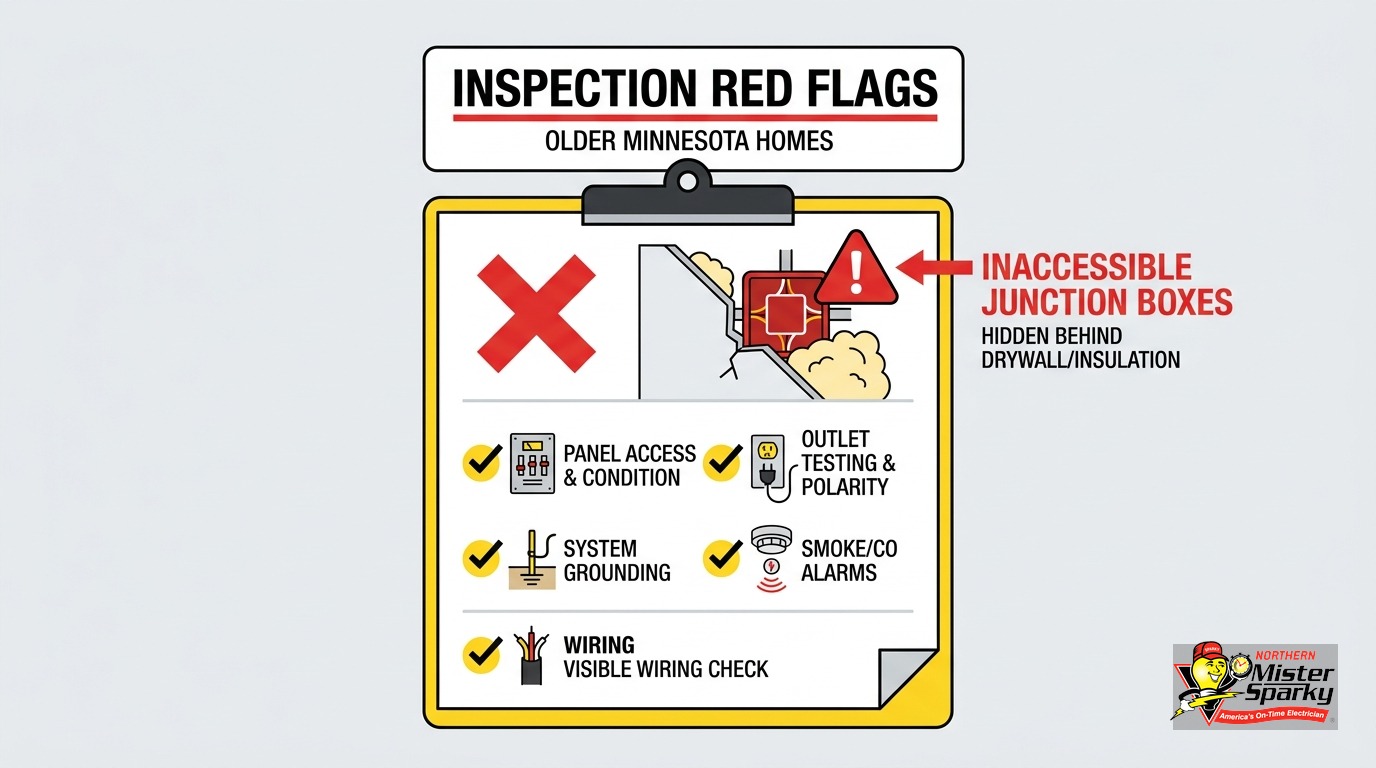
A buried junction box is a wire connection point that has been covered over so it cannot be reached without cutting into the building. It might be drywall in a finished basement, blown-in insulation in an attic, or a drop ceiling tile above a 1970s utility room. NEC 314.29 requires every junction box to stay accessible without removing any permanent part of the building structure or finish. In Minnesota, a buried box is a code violation that stays with the property until corrected.
That last point matters. The violation does not expire. It does not matter whether a previous owner did the work or how long ago. Whoever owns the property today owns the violation.
Minnesota adopted the 2026 NEC, effective for permits filed on or after August 17, 2026. Permits filed before that date follow the 2023 NEC. Both editions carry the same Section 314.29 accessibility requirement. The Minnesota Department of Labor and Industry lists it on the official single-family dwelling inspection checklist, which means it is not a technicality. It is a required sign-off item on every permitted electrical job in the state.
The rest of this post covers why the rule exists, what makes Twin Cities homes especially prone to this violation, what happens when an inspector finds one, and how to fix it.
Why NEC 314.29 Requires Every Junction Box to Stay Accessible
Junction boxes hold wire connections. Connections are the most failure-prone part of any electrical system. Wire nuts loosen over time. Conductors oxidize. Aluminum splices expand and contract with every heating cycle. These changes are invisible until something fails.
The NEC did not write the accessibility rule arbitrarily. It came from documented failures in real homes. A connection that was tight at installation can work loose in three years, five years, or twenty. Without accessibility, no one can check. Problems compound in the dark until there is smoke.
The City of Saint Paul lists NEC 314.29 as a required rough-in inspection item for dwelling units. The wall cannot close until an inspector signs off that every box is accessible. When a contractor or homeowner skips that inspection, the violation is built into the wall from day one.
The same requirement appears in Anoka’s electrical inspection checklist for dwellings. Junction boxes must be accessible without damaging the building structure or finish. This is not a local quirk. It is consistent enforcement of a national standard across every Minnesota municipality that runs electrical inspections.
What Does Minnesota Code Say Beyond the NEC?
Minnesota does not just adopt the NEC and stop. It layers additional requirements on top.
The key rule is MN Rule 3801.3770. All wiring must be inspected before it is concealed. Whoever covers wiring without scheduling and passing the required inspection bears the full cost of uncovering it for inspection later. This is a legally significant provision for homebuyers, not just a contractor compliance note.
If a previous owner finished a basement in 1978, buried three junction boxes, and never pulled a permit, the cost of uncovering those boxes belongs to whoever concealed the work. The violation and the cost exposure transfer with the property. You inherit the problem.
This also applies to work happening right now. If you are planning a basement finish or attic conversion, pull the permit. Schedule the rough-in inspection before any drywall goes up. Do not let a contractor skip that step to save a day on the schedule. If they skip it, you will pay to open the wall later.
Permit records in Minnesota are public. If you are buying a home, contact the city’s building department and ask whether permits were pulled for prior electrical work. Unpermitted electrical work in a home you are purchasing is a common and correctable problem. Catching it before closing is much cheaper than catching it after.
Why Are Buried Junction Boxes So Common in Twin Cities Homes?
Twin Cities homebuyers encounter buried junction boxes more often than buyers in newer-construction markets. The reason is the age and character of the housing stock here.
Neighborhoods like Longfellow, Nokomis, Northeast Minneapolis, and South Minneapolis are filled with pre-1980 homes. Many of those homes went through DIY basement finishes in the 1960s and 1970s. Homeowners framed walls, added circuits, and nailed up drywall without pulling a permit or calling an inspector. Junction boxes got covered and stayed covered for fifty years.
Attics followed a parallel pattern. Blown-in insulation became popular in the late 1970s and 1980s as energy costs rose. Boxes that were once visible in an open attic floor suddenly sat under six inches of cellulose. No one moved them and no one installed cover plates before the insulation went in. The boxes are still there.
Then there is the aluminum wiring factor. Homes wired with aluminum, standard in Twin Cities residential construction from roughly 1965 through the mid-1970s, are 55 times more likely to have fire-hazard conditions at connections than copper-wired homes. When those aluminum splice points are buried and inaccessible, there is no way to detect deterioration before it becomes a hazard.
This is not a rare edge case in a South Minneapolis bungalow or a Bloomington rambler from 1968. It is a likely scenario. A walk-through electrical inspection is the only way to know for certain what is behind your walls.
Does a Buried Junction Box Create a Real Fire Risk?
Yes. This is not a paperwork problem. A buried junction box is a genuine fire hazard, especially in a pre-1980 home with aluminum wiring.
A junction box cover is a containment device. If a connection fails inside a properly covered box, the cover slows the spread of heat and flame. A buried box may sit directly against wood framing, fiberglass batting, or cellulose fill. Those materials ignite.
The U.S. Fire Administration reports that residential electrical fires cause approximately 28,300 fires per year, 360 deaths, and $995 million in direct losses. Wiring and related equipment account for nearly half of those fires.
The risk has local history behind it. A 1976 investigation in Saint Paul tied improper aluminum wiring connections to three fatalities and more than $6 million in fire damage in a single summer. That outcome drove tighter inspection enforcement across Minnesota in the years that followed. It is why the DLI checklist carries the rule today.
A buried junction box will not fail in every case. Connections can hold for decades. The defining problem is that you have no way of knowing whether yours are holding. That uncertainty is precisely what the accessibility requirement eliminates.
What Happens When a Home Inspector Finds a Buried Junction Box?
A licensed home inspector will document a buried junction box as a deficiency and recommend correction by a licensed electrician before closing. Depending on the loan type and lender, the repair may be required before the transaction can fund.
A buyer can use the finding to negotiate. They may ask the seller to correct it before closing or reduce the purchase price by the estimated repair cost. For FHA and VA loans, property condition standards apply and code violations often trigger mandatory correction. The sale can stall while the repair is scheduled, completed, and verified.
Minnesota’s seller disclosure form includes a direct question about known electrical deficiencies. If an inspection reveals a buried junction box and you are now aware of it, answering “no” on a future disclosure creates documented liability. The violation is material and must be disclosed.
The better outcome is to catch and fix buried boxes before listing the property. A licensed electrician can inspect your basement, attic, and drop ceilings in an hour or two. That cost is far lower than a delayed closing, a renegotiated contract, or a post-sale dispute.
For a full picture of what surfaces during real estate electrical inspections, our post on what to expect from a pre-sale electrical inspection covers the process in detail. For context on what corrections typically involve, our guide on electrical code violations found at home inspection walks through the most common items and what fixing them requires.
What If Your Buried Box Contains Aluminum Wiring?
When a buried box is uncovered in a pre-1980 Twin Cities home, there is a meaningful chance it contains aluminum wiring connections. That changes the repair scope.
Aluminum expands and contracts at a higher rate than copper. Over years of heating and cooling cycles, aluminum connections loosen. Loose connections arc. Arcing generates localized heat. Heat against wood framing or insulation is how electrical fires start.
The CPSC found that homes wired with aluminum are 55 times more likely to have fire-hazard conditions at connection points than homes wired with copper. A buried junction box in an aluminum-wired home is a collection of connection points that may not have been examined since the Carter administration.
Opening the box and adding a cover plate is not sufficient. The electrician must evaluate every connection for signs of overheating, oxidation, or improper termination. The repair may require aluminum-rated wire connectors, anti-oxidant compound, or pigtailing with copper using COPALUM crimps or other listed aluminum-to-copper devices.
This is specialized work, not a generic cover-plate swap. For a full explanation of why aluminum wiring demands this attention and what the correct repair methods are, see our post on aluminum wiring dangers and fixes.
If your home was built between 1965 and 1975 and has never had a dedicated electrical inspection, the odds of having both buried boxes and deteriorating aluminum connections are higher than most homeowners expect.
How Is a Buried Junction Box Repaired?
The repair method depends on where the box sits and what covers it. Here is how each common scenario works.
Drop ceiling or suspended tile. This is the easiest case. Drop ceiling tiles are removable without tools. The electrician lifts a tile, verifies the connections inside the box, installs a listed cover plate, and replaces the tile. No drywall cutting, no patching.
Drywall over a wall or ceiling box. The electrician cuts a small access opening, examines the connections, corrects any deficiencies, and installs a listed cover plate. If the box must be relocated to stay accessible after the patch, additional wire running may be required. Drywall patching is typically a separate step.
Blown-in insulation over an attic box. The insulation is moved aside, the box is uncovered, connections are verified, and a cover plate is installed. If the box position makes it unreliable to locate and maintain in the future, the electrician may relocate it to a marked, accessible spot.
Splice in a wall cavity with no box at all. This is the most serious scenario. The NEC requires every wire splice to occur inside a listed junction box. A bare splice tucked into a wall cavity violates both the accessibility requirement and the containment requirement. The fix is a new listed box, a proper splice, a cover plate, and patching the opening.
In every case, if the original work was unpermitted, now is the right time to create a clean permit record. Correcting the physical violation is only half the job.
Can a Homeowner Fix a Buried Junction Box in Minnesota?
In narrow circumstances, yes. But the conditions are specific, and the margin for error is low.
Minnesota’s homeowner permit exemption allows a homeowner to perform electrical work on their primary residence without a licensed electrician, provided the work is permitted and passes inspection. The exemption does not apply to rental properties or investment homes. The homeowner must do the work personally, not direct an unlicensed helper.
For a simple drop-ceiling scenario with a copper-wired box and clearly legible connections, a competent homeowner who pulls the permit and passes inspection can handle the cover plate. But if you open the box and find aluminum conductors, discolored insulation, or any sign of heat damage, stop. The evaluation and correction of aluminum wiring requires specific materials and experience that most homeowners do not have on hand.
There is also a practical issue: you need to find the buried boxes before you can fix them. An electrician who has worked through hundreds of pre-1980 Twin Cities basements and attics knows where to look. Bringing one in for a scoping visit first is usually the faster and cheaper path, even if you plan to handle some of the work yourself.
Schedule an Inspection Before It Becomes a Bigger Problem
Buried junction box electrical code violations are among the most common deficiencies in older Twin Cities homes, and among the most fixable once they are identified.
The rule is clear. Every box must be accessible. The Minnesota DLI inspection checklist, Saint Paul’s rough-in checklist, and Anoka’s dwelling inspection checklist all say the same thing. The 2026 NEC, effective in Minnesota since August 17, 2026, carries the same requirement forward.
Northern Mister Sparky is locally owned and operated in the Twin Cities. Our team knows the pre-1980 housing stock in Minneapolis, Saint Paul, Bloomington, and the surrounding suburbs. We know what a 1970s DIY basement finish looks like and where the buried boxes tend to end up.
We back every job with the UWIN(R) 100% satisfaction guarantee. As America’s On-Time Electrician(R), we show up when we say we will and give you a straight answer on what you are dealing with - no malarky.
Call 763-200-5956 or book online to schedule an inspection today.
Frequently Asked Questions
Is a buried junction box a code violation in Minnesota? +
Who pays to fix a buried junction box discovered in an older home? +
Will a buried junction box fail a home inspection? +
Need an electrician now?