
Electrical Code Violations Found During Home Inspection
Key Takeaways
- Electrical code violations found during a home inspection range from urgent fire hazards to minor negotiating points. Not every flag stops a sale.
- Urgency tier determines your move: some violations must be corrected before a lender funds or an insurer binds. Others are price-adjust items.
- Minnesota adopted the 2026 NEC effective August 17, 2026. Any permit pulled today for an inspection-flagged repair falls under the new code.
- Many Twin Cities cities require a point-of-sale electrical inspection by a city official before a home can be listed. That is separate from the buyer’s home inspector.
- Minnesota law requires a licensed electrical contractor for panel work, new circuits, and any permitted repair. No DIY panel swaps.
- Federal Pacific Stab-Lok panels, Zinsco panels, and active knob-and-tube wiring can trigger insurance denial. They move on a faster clock than the negotiation.
What Are Electrical Code Violations Found During Home Inspection?
They are items the inspector flagged as not meeting current or past code - or as safety concerns. Some are active violations under today’s standard. Others were legal when installed but pose a documented risk now.
Home inspectors are generalists. They flag what they see. Their report does not tell you whether a flagged item is a $50 fix or a $10,000 panel replacement. That distinction is your electrician’s job, not the inspector’s.
Minnesota’s electrical standard is Chapter 1315 of the Minnesota State Building Code, which adopts the National Electrical Code (NEC) as the statewide baseline. All permitted residential electrical work requires a licensed contractor and a state inspection afterward.
The report is a starting point. A licensed electrician turns it into a scope of work with actual costs.
Why Do Twin Cities Sellers Face Two Different Electrical Inspections?
Many Twin Cities municipalities require a city-ordered point-of-sale electrical inspection before a home can be listed. This is separate from - and in addition to - the buyer’s home inspector. The consequences are different for each.
Cities including Bloomington and St. Louis Park are among those that mandate a point-of-sale electrical inspection by a city official. The city’s findings can require corrections before the sale can proceed. Compliance requirements vary by municipality - not every city requires the seller to make all repairs, but you need to know your city’s rules before you set a price.
Buyers: a seller’s compliance certificate covers what the city required. It is not a comprehensive safety review. Get your own inspection.
Sellers: find out your city’s requirements before you price the house or accept a timeline. A surprise correction order can push a closing date fast.
What Electrical Code Violations Show Up Most on Twin Cities Inspection Reports?
Double-tapped breakers, missing GFCI protection, open junction boxes, ungrounded outlets, and electrical panel defects top the list in Twin Cities resale homes - alongside smoke alarm placement and extension cords used as permanent wiring.
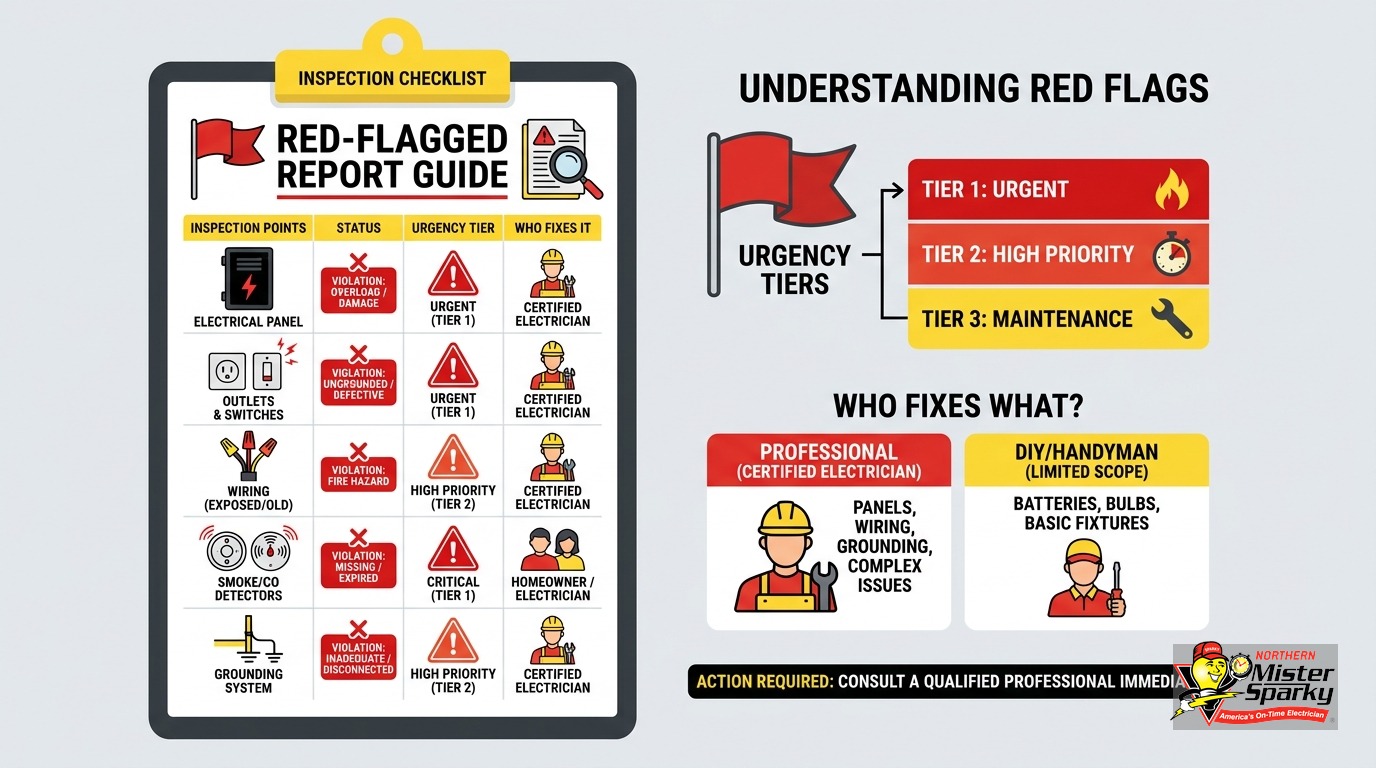
Here is how to read each one, sorted by urgency tier.
Tier 1: Correct Before Closing
These are violations lenders, insurers, or the city require to be fixed. The negotiation is not whether to fix them. It is who pays.
Double-tapped breakers. Two wires sharing one breaker terminal is one of the most common findings in metro-area homes. Each circuit needs its own breaker. A double-tap means two circuits share protection they should not share. The breaker may not trip under a fault on either one. The fix is a tandem breaker (if the panel allows) or expansion to a larger panel. Our guide to what to do about a double-tapped breaker walks through the options and what the repair involves.
Missing GFCI protection. Ground fault circuit interrupters are required in kitchens, bathrooms, garages, unfinished basements, crawl spaces, and outdoor locations. Homes built before the relevant code cycles often have none of these. A GFCI outlet installed as the first device on the circuit protects every outlet downstream. GFCI outlet requirements explained covers which locations need protection and what a proper installation looks like.
Open junction boxes. A junction box without a cover exposes live wiring and terminations. It is a code violation and a contact hazard. Covers cost a few dollars. This is one of the fastest fixes on any inspection list, but it still shows up in every tier of home.
Extension cords used as permanent wiring. An extension cord run under a rug or stapled to a baseboard is not a circuit. It is a fire risk. The fix is a properly run circuit with a code-compliant outlet - which requires a licensed electrician and a permit in most cases.
Smoke detector placement. Minnesota requires interconnected smoke alarms outside each sleeping area, inside each bedroom, and on every level including the basement. Inspectors flag missing or misplaced detectors, and lenders include smoke alarm compliance in their review. This one is easy to correct but cannot be skipped.
Tier 2: Insurer-Required or Financing-Blocking
These violations may not stop a city inspection. But they can stop a homeowner’s insurance policy or a mortgage.
Federal Pacific Stab-Lok and Zinsco panels. The breakers in these panels fail to trip under overload at a documented rate. That means the circuit protection is not working when you need it most. Insurers routinely decline to write new policies on homes with these panels. When an underwriter sees a Federal Pacific or Zinsco, the policy may be conditioned on panel replacement before the coverage binds. Our guide to dangerous electrical panel brands in Minnesota explains what these panels do and what replacement involves.
Active knob-and-tube wiring. Pre-1950 homes in Longfellow, Northeast Minneapolis, St. Paul East Side, and similar Twin Cities neighborhoods often still have some knob-and-tube in use. It is ungrounded, it cannot support modern electrical loads, and the insulation degrades with age. Insurers routinely refuse to write or renew policies on homes with active knob-and-tube. If the wiring is live and in use, a buyer may not be able to bind coverage before closing. That is a deal-killer, not a negotiating point.
Tier 3: Negotiate or Price-Adjust
These items are real issues. They do not typically stop financing or insurance on their own, but they belong in the offer or the addendum.
Ungrounded outlets. Two-prong outlets with no ground wire are common in mid-century Twin Cities homes. They offer no ground fault protection and can damage electronics. Options include running a ground wire (the correct fix), installing GFCI outlets with the required “No Equipment Ground” label (a code-allowed workaround), or a full rewire. Get a quote before deciding which path makes sense for the house.
Aluminum branch circuit wiring in homes built 1965-1973. Aluminum wiring expands and contracts more than copper, which loosens connections at devices over time and creates an arcing risk. The fix is co-WIRE connectors or pigtailing at every device - not a full rewire. It is a real job, but it is well-defined and well-priced. Get an estimate and factor it into the offer.
Missing AFCI protection. Arc fault circuit interrupters are required on branch circuits in bedrooms, living rooms, hallways, and closets in new construction under 2023 NEC 210.12. Existing homes are not required to retrofit retroactively unless a permitted repair on those circuits triggers the requirement. This is rarely a closing-blocker in a resale, but ask your electrician whether your repair scope creates an AFCI obligation.
Unlabeled or mislabeled panel. Missing or incorrect breaker labels signal deferred maintenance. It is a quick fix - under an hour for a licensed electrician - and worth including in the scope when you are already scheduling other work.
Closet lighting violations. Incandescent fixtures within 12 inches of stored material are a code violation. Swapping to a surface-mount LED fixture resolves it. This typically lands on a to-do list rather than a price negotiation.
Does Minnesota Require a Licensed Electrician for These Repairs?
Yes, for most of what appears on an inspection report. Panel work, new circuits, and any repair that requires a permit must be performed by a licensed electrical contractor. A state inspector signs off afterward.
Minnesota’s electrical code is clear on this. Homeowners can replace devices like outlets and switches under narrow circumstances in their own residence. But panel replacements, new circuit runs, and any work that requires pulling a permit must go through a licensed contractor and a state inspection.
This matters when a buyer and seller are negotiating a credit. A price reduction for electrical work is not the same as a permitted repair. If the buyer takes the credit and DIYs the panel, that work shows up as unpermitted at the next inspection. The problem just moves forward in time - and grows.
How Does Minnesota’s New 2026 Electrical Code Affect Your Repairs?
Minnesota adopted the 2026 NEC effective August 17, 2026. Any permit pulled today for an inspection-triggered repair falls under the new code - not the 2023 edition that applied before that date.
Permits pulled before August 17 required 2023 NEC compliance. Permits pulled on or after that date require 2026 NEC compliance. If your inspection report leads to panel work or a circuit repair and your electrician pulls a permit this week, the scope of that repair is governed by the new code. That can affect what else is required when the permit is open.
A licensed electrician knows which edition applies. When you call for an estimate, ask specifically whether they are quoting to the 2026 NEC. Any contractor working in Minnesota today should be.
No competitor guide published before August 17 covers this transition. If you are reading a checklist that does not mention the 2026 NEC, it is already out of date for Twin Cities homeowners.
Who Pays: Buyer, Seller, or Split?
It depends on urgency tier, lender requirements, and negotiation. Tier 1 items almost always land on the seller or become a price reduction. Tier 2 items can go either way. Tier 3 items are negotiating table items.
Here is how most Twin Cities transactions handle the electrical section:
- Seller corrects before closing. Standard for Tier 1 items and city point-of-sale requirements. The seller provides a permit and state inspection sign-off at the closing table. No permit, no credit.
- Price reduction or credit. Common when the seller does not want to manage the repair or when the buyer wants to choose their own contractor. Base the credit on a written estimate from a licensed electrician - not a round number someone guessed.
- Buyer takes as-is. Appropriate for Tier 3 items when the buyer has factored the risk into their offer. Confirm with the buyer’s insurer before waiving contingencies.
- Escrow holdback. Used when a repair cannot be completed before closing. A portion of proceeds is held until the permitted work is done and inspected.
For large jobs - panel replacement, knob-and-tube remediation, generator installation, or EV charger - ask about financing. Northern Mister Sparky offers financing options on larger projects.
Will Federal Pacific, Zinsco, or Knob-and-Tube Wiring Affect Your Insurance?
Yes, in most cases. These items are on insurance underwriters’ shortlists. A buyer who cannot bind a homeowner’s policy before closing does not have a closing.
Federal Pacific Stab-Lok and Zinsco panels have a documented failure rate that insurers have tracked for decades. When an underwriter reviews the inspection report and sees one of these brands, the policy may be declined outright or conditioned on panel replacement before the effective date. Active knob-and-tube wiring draws the same response.
The practical consequence: do not wait until after the inspection contingency deadline to check with your insurer. If the report shows a Federal Pacific or Zinsco panel, or active knob-and-tube, get an insurance quote immediately - before you waive anything. You need to know whether coverage is available before you commit to a closing date. The underwriting decision is not something your agent can negotiate around.
Read the full breakdown of knob-and-tube wiring and home insurance in Minnesota to understand what remediation options insurers will and will not accept.
What Should You Do After Getting the Inspection Report?
Get a licensed electrician to review the flagged items in person before you negotiate or waive anything. The inspector’s report is a starting point. A licensed electrician turns it into a scope of work with real costs and a permit-ready plan.
Here is the sequence that works:
- Isolate the electrical section. Separate it from plumbing, structural, and HVAC findings. Each trade is its own negotiation.
- Sort by urgency tier. Use the tiers above as your first pass. Know before you call whether you are dealing with a Tier 1 or a Tier 3 item.
- Call a licensed electrician for an in-person estimate. Not a handyman, not a general contractor. A licensed electrical contractor who pulls permits.
- Ask for a permit-ready scope. The estimate should reflect what a permitted repair costs under the 2026 NEC - the code that applies to any permit pulled in Minnesota today.
- Negotiate with a written number. A licensed electrician’s written estimate is the only figure worth putting in an addendum. Round guesses are not.
- Confirm insurance before waiving contingencies. Have your agent run the panel brand and wiring type past an underwriter. Do not assume coverage is available.
Northern Mister Sparky is locally owned and operated in the Twin Cities. We serve Minneapolis, St. Paul, Bloomington, Brooklyn Park, Woodbury, Blaine, Maple Grove, Plymouth, and the surrounding metro. We pull permits correctly so the paperwork holds up at your next sale. No malarky - we will tell you exactly what needs to be done and what does not. Call 763-200-5956 or book online to schedule an estimate.
Electrical code violations found during a home inspection are information, not a verdict. The difference between a deal-killer and a line-item negotiation comes down to urgency tier, Minnesota’s licensing requirement, and the insurance picture. Get those three things right and the rest is paperwork.
Northern Mister Sparky is America’s On-Time Electrician(R), backed by the UWIN(R) 100% satisfaction guarantee. Call 763-200-5956 or book online.
Frequently Asked Questions
Are electrical code violations found during a home inspection always a deal-breaker? +
Who is required to fix electrical code violations in Minnesota? +
What is the difference between a city point-of-sale electrical inspection and a buyer's home inspector? +
Does Minnesota's 2026 NEC adoption affect inspection-triggered repairs? +
Need an electrician now?