
Knob and Tube Wiring Home Insurance Minnesota: What to Know
Key Takeaways
- Many major Minnesota carriers - including State Farm and American Family - will not write new policies on homes with active knob and tube wiring.
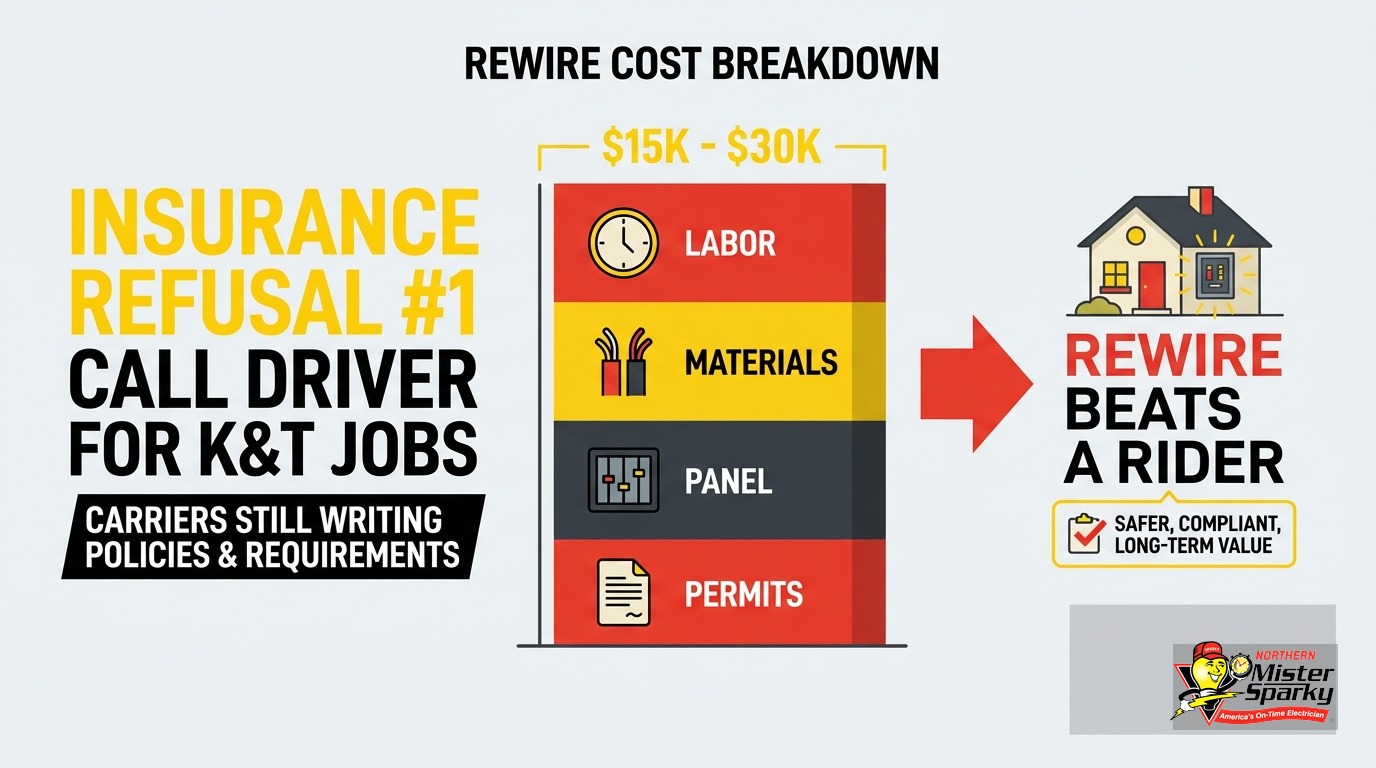
- Carriers that do bind coverage often attach a 30-60 day deadline rider. Many of those riders exclude electrical fire claims during the rider period, which is the risk K&T poses most acutely.
- A deadline rider can block FHA and conventional mortgage funding when lenders require a clean, unrestricted policy before closing.
- Excess and surplus (E&S) carriers write bridge policies at 2-3x standard premiums during a rewire transition, typically for a 3-6 month term.
- NEC Article 394.12 blocks attic insulation on any home with energized K&T, tying the rewire decision directly to heating costs and energy rebates.
- Permits pulled on or after August 17, 2026 fall under Minnesota’s new 2026 NEC. Permits pulled before that date comply with the 2023 NEC.
- After a rewire, insurers require a four-part documentation chain: scope of work, permit number, AHJ final inspection sign-off, and written confirmation of full de-energization.
If you have knob and tube wiring, home insurance in Minnesota is getting harder to find and harder to keep. Carriers are tightening underwriting on older electrical systems. Many homeowners do not discover how thin their protection is until after a claim is filed.
Can You Get Home Insurance With Knob and Tube Wiring in Minnesota?
Short answer: Yes, but your options narrow significantly. Most standard carriers will not write a new policy on a home with active K&T. Surplus lines carriers will bind coverage at 2 to 3x standard rates. If every standard and surplus carrier declines, the Minnesota FAIR Plan provides last-resort coverage.
The tier that matters most is the one that actually pays out if a fire starts in your walls. “Knob and tube wiring insurance” often means a policy with exclusions and riders attached rather than a clean standard residential policy. Understanding the difference between the three tiers - standard, surplus, and FAIR Plan - is the starting point for protecting yourself.
A licensed electrician’s inspection to certify the condition of your K&T system costs $200 to $500 and takes 2 to 4 hours. A clean inspection report may unlock specialty coverage without requiring a full rewire immediately. That gives you time to plan and budget while keeping mortgage compliance intact.
Why Knob and Tube Wiring Is a Home Insurance Problem in Minnesota
Knob and tube (K&T) is the wiring system found in most Minnesota homes built before 1950. It uses ceramic knobs to hold conductors away from framing and ceramic tubes to pass wires through joists and studs. The system has no ground wire. The cloth insulation on the conductors dries out and becomes brittle over decades. The circuits were sized for electrical loads that are a fraction of what a modern household draws.
Four specific conditions drive underwriting denials. According to Hixson and Malinowski Insurance Agency, those conditions are: no ground wire, brittle aging cloth insulation, circuits overloaded beyond their original design capacity, and unpermitted modifications by prior owners. Any one of these can trigger a denial. Most K&T homes have all four.
There is also a temperature rating mismatch. Original K&T conductors are rated for 60 degrees Celsius. Modern light fixtures and LED drivers require 90-degree-rated wire. When someone connects a modern fixture to K&T inside a junction box, the K&T insulation can melt without any visible warning at the fixture. Insurers underwrite this hazard as a category, not a case-by-case exception.
Which Minnesota Carriers Still Write Policies on Knob and Tube Homes?
Short answer: Very few standard carriers will. The carriers most commonly identified as declining K&T coverage in Minnesota include State Farm, American Family, Redwood County Mutual, Western Mutual, and Mid-Minnesota Mutual. The Minnesota FAIR Plan is available as a last resort, but typically only when an active permit documents that remediation is already underway.
If your current carrier is renewing your policy without comment, do not assume you are clear. Insurers often discover K&T during a post-claim investigation. That is the worst possible time to learn your coverage has conditions attached.
If you are buying a home with K&T, get written confirmation from the seller’s insurer that coverage will transfer in your name without conditions or exclusions. A seller’s existing policy does not guarantee the home is insurable for a new owner under the same terms.
Excess and surplus (E&S) carriers, including Lloyd’s of London syndicates, do write policies on K&T homes. These bridge policies typically run 3-6 months during a rewire project and cost 2-3x more per month than standard coverage. They exist to preserve mortgage compliance during the transition while the rewire is underway - not as a long-term solution. Expect deductibles in the $2,500 to $5,000 range and, often, a mandatory rewire deadline of 6 to 12 months built into the policy terms.
What Are Your Legal Rights When a Minnesota Insurer Non-Renews You for K&T Wiring?
Short answer: Minnesota law requires an insurer to provide two written notices before a non-renewal takes effect. Each notice must inform you of your right to complain to the Minnesota Commissioner of Commerce and your right to apply to the Minnesota FAIR Plan.
An insurer can non-renew a policy for a risk-increasing physical condition, and K&T wiring qualifies. But the non-renewal cannot happen silently. Under Minnesota law, both notices must include clear information about your next-step rights. An insurer that skips either required notice, or fails to include the rights language, has not issued a valid non-renewal.
If you receive a non-renewal notice, do not wait for the second one before acting. Use the time between notices to contact a licensed Minnesota agent about surplus lines options and FAIR Plan eligibility. Document every communication with your carrier in writing. If your carrier is demanding remediation without following proper notice procedures, you can file a complaint directly with the Minnesota Department of Commerce.
This two-notice requirement is Minnesota-specific. Most national articles about K&T and insurance skip it entirely. Knowing your rights changes the timeline you have to work with.
What Is the Minnesota FAIR Plan and What Does It Cover?
Short answer: The Minnesota FAIR Plan is last-resort property insurance available to any homeowner denied coverage or non-renewed by a standard carrier. Apply through any licensed Minnesota agent or call (800) 524-1640. Coverage is limited to actual cash value, not replacement cost.
The FAIR Plan homeowners form (HO-8) covers fire, lightning, internal explosion, extended-coverage perils, vandalism and malicious mischief, theft, and personal liability. The key limitation is that coverage is Actual Cash Value, not replacement cost. On a 1940s Twin Cities home, ACV can fall well short of what a full rebuild would cost today. Understand that gap before you rely on the FAIR Plan as your only coverage.
The dwelling fire form option removes theft and liability coverage entirely. The minimum deductible for owner-occupied dwellings is $500. The property must still meet minimum insurability standards - extreme deterioration can result in FAIR Plan denial even when no standard carrier will write the policy.
Use the FAIR Plan as a bridge while a rewire is underway, not as a permanent strategy. Once the rewire is complete and you have the full documentation package ready, your agent can help you move back to a standard HO-3 policy at standard rates.
What Does a Deadline Rider Actually Cover?
Short answer: Less than most homeowners expect. A deadline rider binds a policy but often excludes electrical fire claims during the rider period. That is exactly the risk K&T poses most acutely. The homeowner has a policy number but may not have coverage for the thing most likely to go wrong.
This is the part most explanations skip. A carrier that will “insure with a rider” sounds like a workable option. Read the rider language before accepting. Many K&T riders contain an exclusion for losses that originate in the knob and tube wiring itself. If a fire starts in your walls and the investigation identifies K&T as the source, the exclusion applies. A policy that excludes electrical fire during the deadline period is not providing the protection the homeowner actually needs.
The rider also imposes a hard deadline - typically 30-60 days - requiring documented full removal of the K&T system. Missing that deadline triggers cancellation or non-renewal. If you cannot schedule, permit, complete, and document a full rewire within 60 days, a deadline rider is not a stable solution. It is a countdown that may leave you uninsured.
Does an AFCI Breaker Satisfy Your Insurer?
Short answer: No. Most Minnesota insurers specifically reject AFCI breakers as a permanent fix for knob and tube wiring. An AFCI adds arc detection to the circuit, but it does not address the missing ground wire, the brittle aging insulation, the overloaded circuit capacity, or the NEC 394.12 prohibition on burying K&T under attic insulation.
Installing an AFCI breaker on a K&T circuit is a genuine safety improvement. But the underwriting risk profile does not change: ungrounded wiring, aged insulation, overloaded circuits, and the temperature mismatch between K&T conductors and modern fixtures. Insurers specifically reject AFCI alone as a permanent resolution.
Some carriers will accept partial upgrades as a short-term risk reduction measure. GFCI on water-adjacent circuits and AFCI on bedroom circuits can buy a homeowner more time with certain carriers. Most ultimately require full replacement, and partial measures are not a resolution. Do not rely on partial upgrades to permanently close an insurance gap.
How Can Knob and Tube Wiring Block a Mortgage Close?
Short answer: FHA and conventional underwriters typically require a clean, unrestricted insurance policy before funding a loan. A deadline rider that restricts or excludes coverage - especially electrical fire coverage - often fails that standard. The result is a delayed or failed close while the buyer scrambles for a rewire plan.
This scenario plays out regularly on Twin Cities homes changing hands. A buyer finds K&T during inspection. The seller’s agent says many homes in this neighborhood are insured just fine. The buyer’s lender orders an insurance binder. The binder comes back with a 30-day remediation rider attached. The underwriter flags it as a restricted policy and puts the close on hold.
Now the buyer needs a rewire quote, a permit, a licensed electrical contractor, and a scheduled completion - all within a closing timeline that was never designed to accommodate a $12,000-$35,000 project. Some closes survive with creative scheduling. Many do not.
If you are selling a Twin Cities home with K&T, the cleanest path is to address the wiring before listing. A pre-sale electrical inspection documents the scope of the K&T system and gives buyers and their lenders something concrete to underwrite against. That documentation often makes the difference between a clean close and a renegotiated contract.
Why Does NEC 394.12 Block Attic Insulation on Minnesota Homes With K&T?
Short answer: NEC Article 394.12 prohibits knob and tube wiring in wall, ceiling, or attic spaces where it will be surrounded by loose, rolled, or foamed-in-place insulation. Any home with energized K&T in the attic cannot legally receive blown-in insulation. Minnesota adopted this prohibition via both the 2023 and 2026 NEC.
Minnesota sits in ASHRAE climate zone 6. The Department of Energy recommends R-49 to R-60 attic insulation for this climate zone. That level of insulation is one of the highest-return energy investments available to Twin Cities homeowners. The catch: it is unavailable while K&T remains energized in the attic.
The relevant NEC article is the specific prohibition, and it is not a gray area. A contractor who blows insulation over active K&T is creating both a fire hazard and a code violation in one pass. Reputable insulation contractors in Minnesota will refuse the job.
The practical result: a K&T rewire unlocks the insulation upgrade. Homes in the Twin Cities commonly see $300-600 per year in heating cost reduction after proper attic air-sealing and insulation. Over a decade, that is $3,000-$6,000 in heating savings. When you evaluate the two projects together, that figure meaningfully reduces the net cost of the rewire.
What Documentation Do Insurers Require After a Rewire?
Short answer: Insurers require a four-part chain: scope of work from the contractor, permit number from the AHJ, final inspection sign-off from the local electrical inspector, and written confirmation that all K&T was removed or permanently de-energized - not just concealed behind new drywall.
“Concealed but energized” has resulted in denied claims. A contractor who covers K&T without de-energizing it has not resolved the insurance condition. The AHJ inspection sign-off is the document that matters to the carrier. It confirms that a licensed inspector reviewed the completed work and that it passed code.
In Minnesota, all electrical work requires a licensed electrical contractor to pull the permit. The Authority Having Jurisdiction (AHJ) is the local electrical inspector working under DLI oversight. Insurance carriers generally align their underwriting with local code compliance. That alignment means the permit-and-inspection chain is not a regulatory formality. It is the paper trail that closes the file with your insurer.
When assembling your post-rewire package, add dated photos of the new panel and circuits to the four required documents. Submit all five items to your insurer immediately after the final inspection. Do not wait for the carrier to request them - the faster the underwriter can close the K&T file, the sooner your policy normalizes.
Keep copies of everything. The permit, the inspection report, the contractor’s written scope and completion confirmation, and the photos all belong in a folder you can retrieve years from now if there is ever a claim question about the original remediation.
How Much Does a Full Rewire Cost in the Twin Cities?
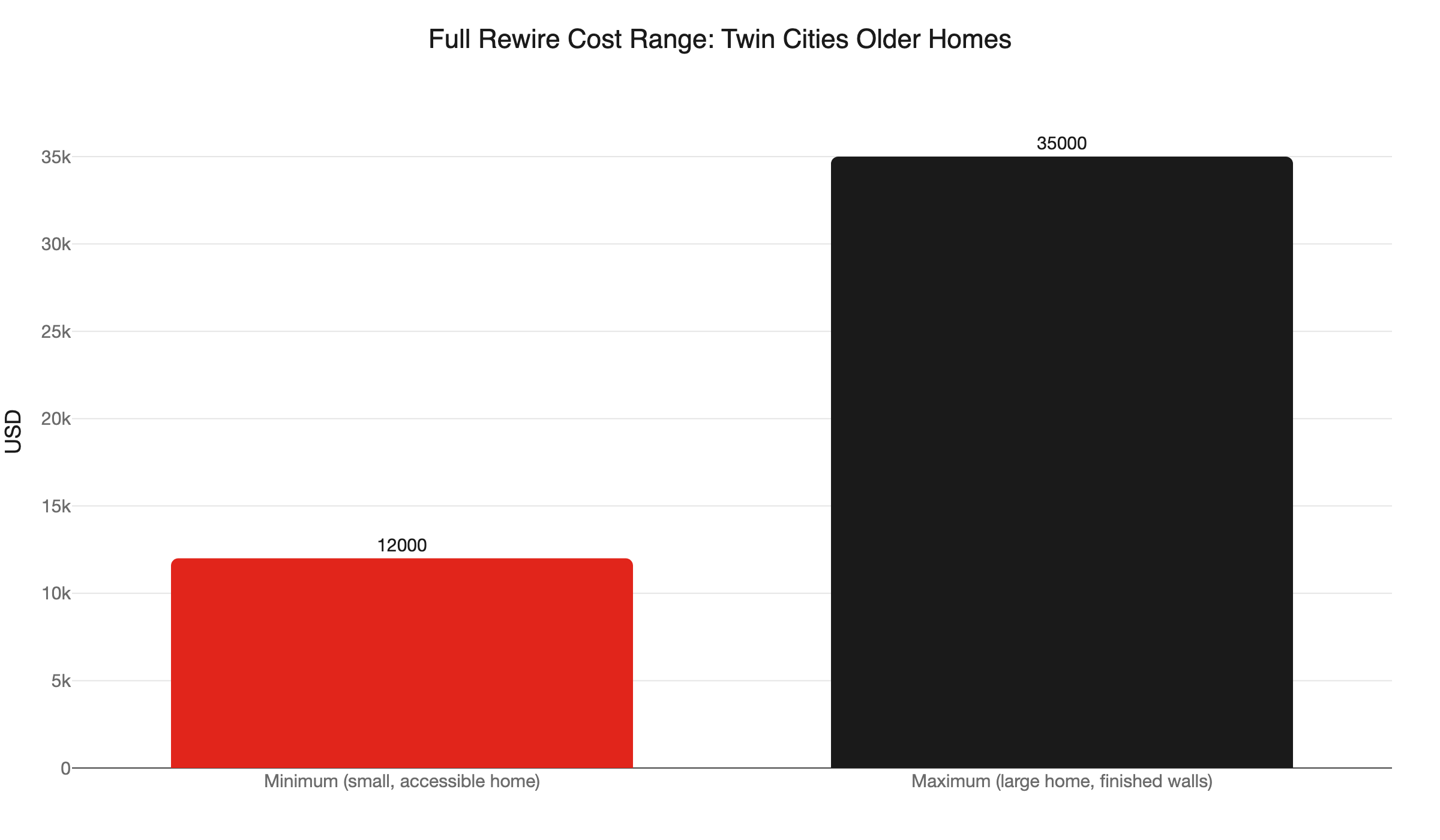
Short answer: Full rewiring of a typical older home runs $12,000-$35,000 depending on size, number of stories, and how accessible the walls are. Homes that require opening finished walls and ceilings land near the high end. Insurers do not cover these costs.
The range is wide because every home is different. For a 1,200 to 1,800 square foot single-story home, expect $8,000 to $15,000. Larger homes or those with harder-to-access walls typically run $15,000 to $30,000 or more. A single-story rambler with an unfinished basement and open attic costs significantly less than a two-story home with plaster walls on every level. Wall access is the single biggest cost driver after square footage.
Our cost to rewire a house in the Twin Cities guide explains what pushes cost up or down, what the permitting process looks like in Minnesota, and what to expect from the inspection timeline.
No federal tax credit currently covers residential rewiring costs. The Section 25C Energy Efficient Home Improvement Credit for electrical upgrades expired after December 31, 2025, and there is no equivalent credit available in 2026. That said, if your rewire includes a panel upgrade that increases your service amperage, Xcel Energy residential customers in the Twin Cities metro can claim a rebate through Xcel’s panel upgrade rebate program. The upgrade must increase amperage; a lateral replacement at the same amperage does not qualify. Submit your invoice and permit approval to Xcel after the work is complete; processing takes 6 to 8 weeks. Confirm current availability at xcelenergy.com before scheduling, since rebate programs change. Homeowners served by CenterPoint or a municipal utility are not eligible for this particular rebate.
After the rebate and the insulation work that typically follows, the net cost of a rewire looks different than the gross estimate. Ask your electrician about sequencing these two projects to capture as much of that value as possible.
The Minnesota NEC Code Transition: What It Means for K&T Permits Right Now
The Minnesota Department of Labor and Industry adopted the 2026 NEC with an effective date of August 17, 2026. Permits filed before August 17, 2026 must comply with the 2023 NEC. Permits filed on or after August 17 fall under the 2026 NEC. If you are scheduling a K&T replacement right now, your permit date determines which code applies.
For most K&T replacement projects, the practical difference between the two code versions is minimal. Both the 2023 and 2026 NEC carry Article 394.12’s prohibition on K&T in insulated spaces, and both require new circuits to meet current grounding and protection standards. But if your project spans the August 17 transition date, confirm with your electrician which code version governs your specific permit before the scope is finalized.
One detail that surprises many Twin Cities homeowners: Minneapolis and Saint Paul do not use the state DLI permit portal. Many cities in Minnesota have adopted their own local electrical inspection authority with their own permit forms and fee schedules. Minneapolis and Saint Paul are among them. If your property is in either city, your permit is filed with the city, not with DLI at ims.dli.mn.gov/ims. Confirm the correct filing authority with your electrician before the permit is pulled - filing in the wrong place delays the project.
Licensing exams for electricians transition to the 2026 NEC on September 8, 2026. This applies to new license applicants sitting for exams after that date. It does not affect licensed contractors currently in the field.
Why Does Rewiring Beat a Deadline Rider?
Short answer: A deadline rider with coverage exclusions is not insurance in any practical sense. If a fire originates in the K&T, the exclusion applies. You have a policy number attached to a condition the carrier already flagged as a risk. Rewiring removes that condition and restores a clean, standard residential policy without exceptions.
After a complete rewire, the countdown stops. The carrier closes the underwriting file. Your premium normalizes. The attic insulation work can proceed legally. And the electrical system can carry the loads your household actually places on it without the risks that come with 60-degree-rated conductors, absent ground wires, and circuits sized for a 1940s appliance set.
Our knob and tube wiring replacement guide covers the full process from initial inspection through final documentation. Read it alongside the signs you need an electrical panel upgrade post as well. Many K&T homes also have undersized 100-amp service. A rewire that leaves an insufficient panel in place may not fully satisfy underwriters and will not meet the load demands of a modern household.
Call Northern Mister Sparky Before the Deadline Hits
If your carrier has attached a deadline rider, the clock is already running. A licensed inspection identifies the full scope of the K&T system, documents which circuits are still active, and gives you a written estimate to share with your insurer and your lender.
We are locally owned and operated in the Twin Cities. We pull permits through Minnesota DLI-licensed contractors. The documentation chain your insurer requires starts with us and stays intact through the final inspection sign-off.
Call 763-200-5956 or book online. As America’s On-Time Electrician(R), we show up when we say we will. If your rider deadline is tight, tell us upfront - we will give you a straight answer on whether the timeline is workable. That is the no-malarky version of what we do, and it is backed by our UWIN(R) 100% satisfaction guarantee.
Frequently Asked Questions
Will my insurance company drop me because of knob and tube wiring in Minnesota? +
What documentation do insurance companies require after a knob and tube rewire? +
Does an AFCI breaker fix the insurance problem with knob and tube wiring? +
Can I still close on a mortgage if the home has knob and tube wiring? +
Need an electrician now?