
Replacing Old Hardwired Smoke Detectors: Minnesota Guide
Key Takeaways
- Hardwired smoke alarms have a rated service life of 10 years from the manufacture date stamped inside the cover.
- Working smoke alarms cut the risk of dying in a home fire in half. An aging system that does not respond correctly is not a working system.
- Replacing one old alarm often reveals a compatibility problem with the rest of the chain. Plan to replace the whole system at once.
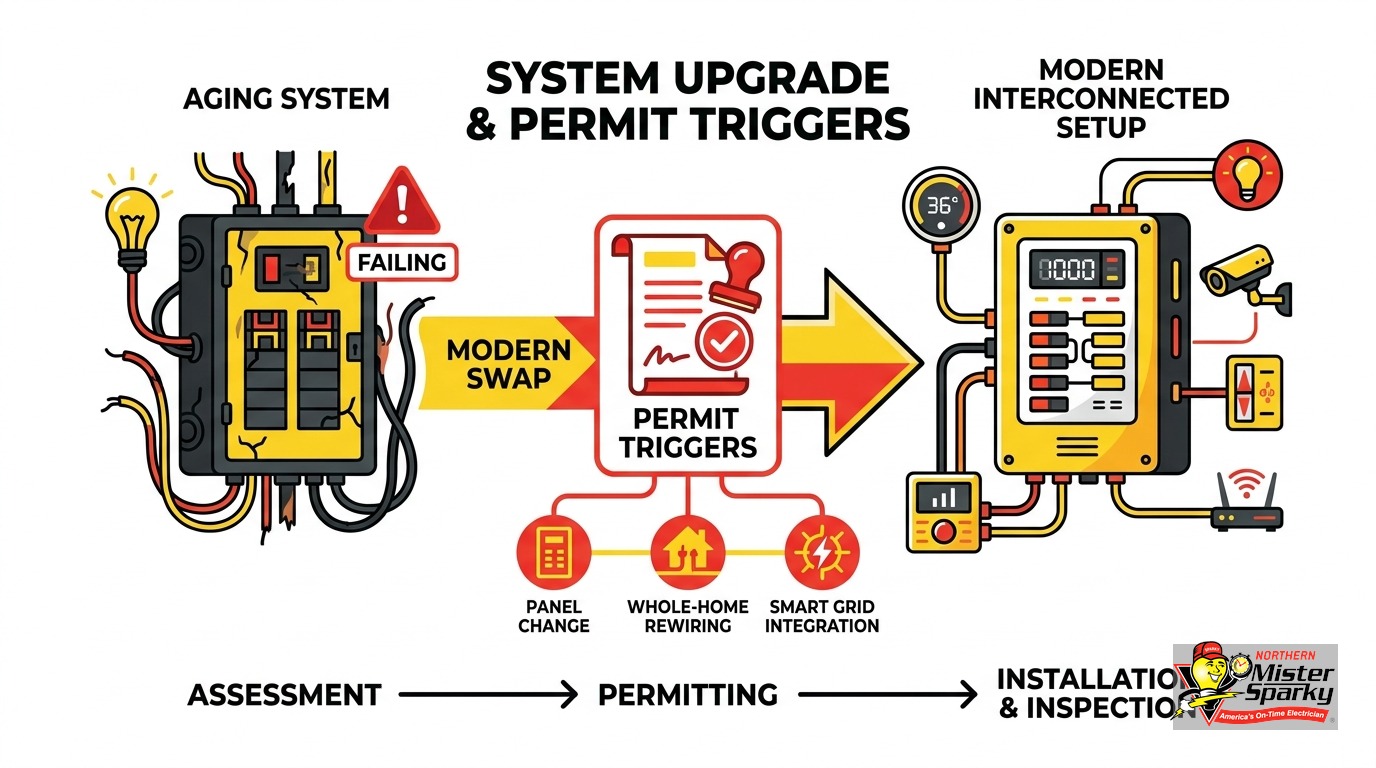
- A straight like-for-like swap at an existing hardwired box typically does not require an electrical permit in Minnesota. Adding locations or running new wire does.
- Most Twin Cities homes with a gas furnace are required by Minnesota Statute 299F.50 to have carbon monoxide alarms. Smoke alarm replacement is the natural moment to add combination units.
- UL217, updated in 2021, moved the industry away from ionization-only sensors toward photoelectric and dual-sensor technology.
- Different brands and generations of hardwired alarms often use incompatible interconnect protocols. Mixing old and new units on the same circuit can cause false alarms or silent failures.
Why Replacing Old Hardwired Smoke Detectors Is Not Optional
The numbers are stark. NFPA research shows 59% of U.S. home fire deaths occurred in homes with no smoke alarms or alarms that failed to operate. That failure category includes alarms that were present but too old or too degraded to trigger.
Replacing old hardwired smoke detectors is not a routine maintenance item. It is a life-safety issue with a clear expiration date.
The 10-year replacement standard comes from NFPA 72, the National Fire Alarm and Signaling Code. Sensor chambers collect microscopic debris over years of operation. Sensitivity degrades. An alarm that passes its weekly test button may no longer detect a slow-smoldering fire the way a new unit will.
For Twin Cities homeowners, the replacement conversation usually involves several moving parts: permit requirements, interconnect compatibility, CO detection, and updated sensor technology. This guide covers each one.
How Old Is Too Old for a Hardwired Smoke Detector?
Short answer: Any alarm that is 10 or more years past its manufacture date should be replaced. The date is stamped inside the cover. Age from manufacture, not installation, is the standard trigger.
NFPA 72 sets a 10-year rated service life for smoke alarms. To find the manufacture date on your units, remove each alarm from its mounting base and check inside the cover or on the back of the housing. The date is typically printed as a month and year.
There is an important nuance here. If the stamp says 2013, that alarm is past due regardless of when you installed it. An alarm purchased from distributor stock and installed in 2016 may have been manufactured in 2014. The 10-year clock started in 2014, not 2016.
Do not wait for a chirping alarm to prompt the conversation. Chirping signals a depleted battery backup, not a failed sensor. A sensor can degrade without triggering any alert at all. Act when the manufacture date reaches its limit, not when the alarm tells you something is wrong.
Signs you should not wait for the 10-year mark:
- The unit chirps persistently even after you replace the battery backup
- The alarm sounds randomly with no visible smoke source
- You cannot locate the manufacture date anywhere on the unit
- The housing has yellowed noticeably, a sign of plastic oxidation from heat exposure
- The alarm’s brand or model is discontinued and compatible replacement parts are unavailable
If any of these apply, start the replacement process now. For help diagnosing a chirping alarm before scheduling a full replacement, our post on hardwired smoke detector chirping troubleshooting walks through the most common causes.
What Is Actually Inside Your Hardwired Smoke Alarm System?
Short answer: Most homes wire alarms with three conductors: black (hot power), white (neutral), and red (interconnect). When any alarm detects smoke, the red wire signals every other alarm in the chain to sound at the same time.
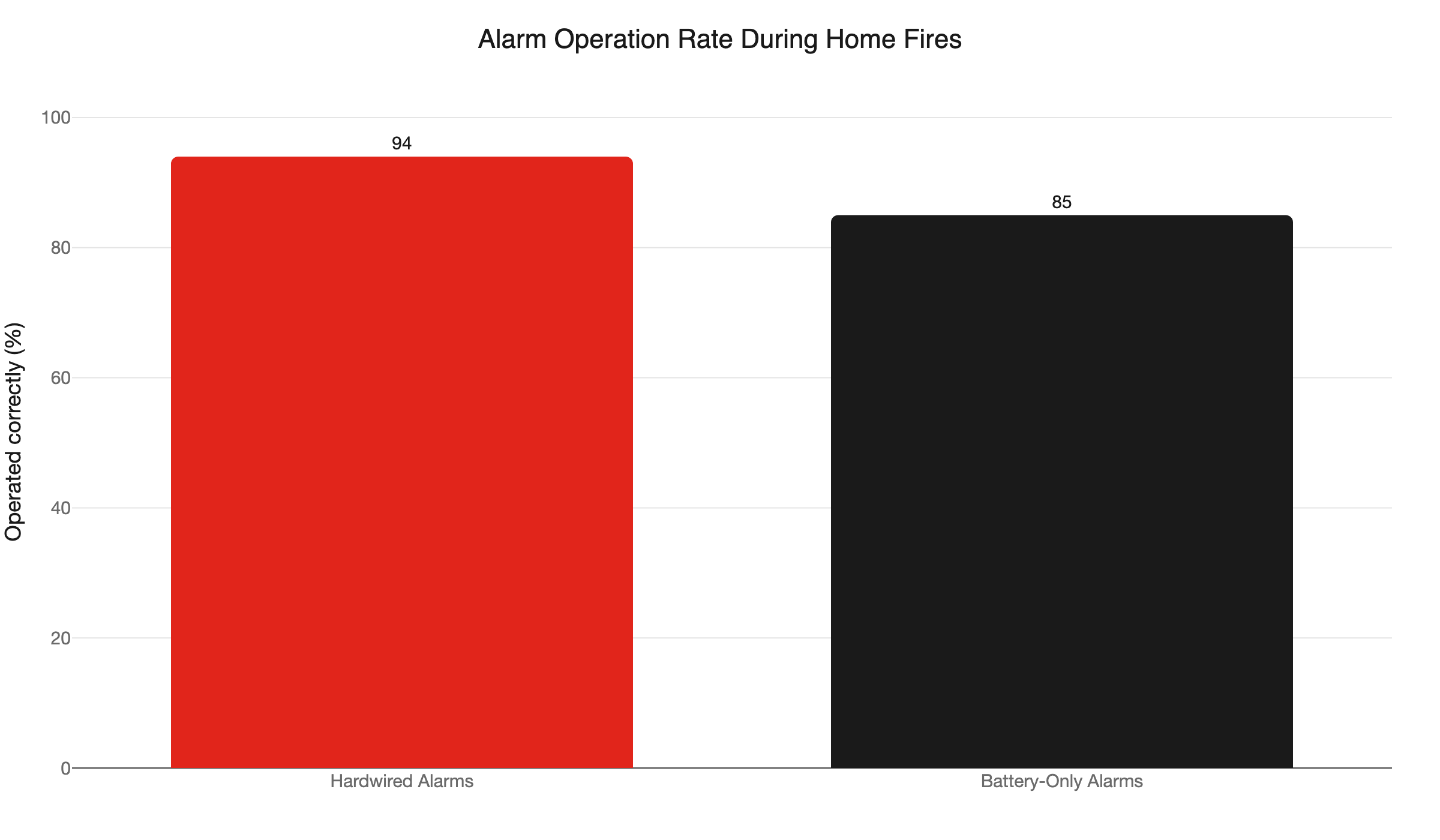
That interconnect is what makes hardwired systems so much more reliable than standalone battery alarms. NFPA data shows hardwired alarms operate correctly 94% of the time when a fire occurs. Battery-only units operate only 85% of the time. The interconnect also means a fire in the basement wakes everyone on the second floor. You are not relying on whoever is physically closest to hear it first.
Each alarm carries a battery backup. That battery keeps the alarm running during a power outage, which is often the exact moment a fire is most likely to start.
Minnesota’s adopted 2020 International Residential Code requires smoke alarms to be:
- Installed inside each sleeping room
- Installed outside each sleeping area, in the adjacent hallway
- Present on every story of the home, including the basement
- Interconnected, so activation of one alarm activates all
- Hardwired with battery backup in new construction and certain renovations
The red interconnect wire is where complexity lives when you mix brands and generations. It carries a low-voltage signal, but different manufacturers encode that signal differently. A new unit and a 10-year-old unit on the same red wire may not speak the same protocol. The result is either nuisance false alarms from signal misinterpretation, or complete silence from older units when the new one triggers. That compatibility problem is what makes replacing the whole chain at once the practical standard.
Does Replacing Old Hardwired Smoke Detectors Require a Permit in Minnesota?
Short answer: A like-for-like swap at an existing junction box, with no new wire and no added locations, typically falls under maintenance and does not require an electrical permit. Any scope beyond that requires a permit through the Minnesota DLI.
This is the question competitors who cover this topic never answer clearly. They treat the swap as purely mechanical. That omission creates real legal exposure for Minnesota homeowners who unknowingly do permit-required work without a permit.
Here is the practical line:
Likely no permit required:
- Replacing an old alarm with a new unit at the same existing hardwired junction box
- Using the same three-wire connection with no wiring changes
- Same location, no new boxes, no additional wire runs
Permit required:
- Adding alarm locations that did not previously exist
- Running new wire to a room that was never wired for alarms
- Upgrading to a panel-integrated or smart alarm system that requires new low-voltage wiring
- Any modification to the existing branch circuit that serves the alarms
The Minnesota DLI administers electrical permits for all covered electrical work statewide. Minnesota Statute 299F.362 establishes the underlying smoke alarm requirements for all dwelling units. The DLI electrical permit requirement applies alongside that statute any time the scope involves wiring work beyond a direct swap.
If you are unsure whether your project crosses the permit line, that is a question worth answering before any wire is touched. Our broader guide to electrical permits in Minnesota explains the threshold across different project types.
Working without a required permit creates problems at resale. Unpermitted electrical work must be disclosed on the seller’s disclosure form in Minnesota. It can trigger a reinspection requirement and delay closing. Our electricians pull all required permits and have the finished work inspected, which protects you at the next sale.
Why Replacing One Alarm Usually Means Replacing the Whole Chain
When one alarm ages out, the safety and practical case almost always points to replacing every unit in the chain at the same visit.
Compatibility. Different brands, and even different generations of the same brand, use distinct interconnect signaling protocols. The only guaranteed path to a reliable interconnected system is matching units of the same brand and generation throughout the chain. A compatibility test between old and new units is possible in theory, but it requires a licensed electrician to wire and verify the system either way. At that point, replacing the full chain costs only slightly more and removes the uncertainty permanently.
Age proximity. If one alarm in your home is at the 10-year mark, every other alarm in the system was almost certainly installed at the same time. Replacing the one that is chirping and leaving five other aging alarms in place is a partial fix. The rest of the chain is at the same degradation point. One more Minnesota winter cycle and the next unit in line will fail.
Labor efficiency. The cost for a licensed electrician to visit once and swap all six to eight alarms in a typical home is considerably lower per unit than two or three separate service calls over two years. Plan the replacement as a single project.
Code alignment. If your home does not already meet Minnesota’s current smoke alarm placement requirements, a full-chain replacement is the right time to correct any gaps. This applies if you have finished a basement, added a bedroom, or enclosed a previously open space since the original system was installed.
Should You Add Carbon Monoxide Alarms at the Same Time?
Short answer: In most Twin Cities homes, yes. Minnesota law requires CO alarms in homes with fuel-burning appliances, fireplaces, or attached garages. If your home has a gas furnace, you almost certainly fall under that requirement.
Minnesota Statute 299F.50 requires carbon monoxide alarms in all single-family and multi-family dwellings that have a fuel-burning appliance, a fireplace, or an attached garage. A gas furnace alone triggers the statute. So does a gas water heater, a gas range, or an attached garage, even if the garage has no fuel-burning equipment inside it.
If you are replacing a smoke-only hardwired chain, swapping in combination smoke-CO units adds meaningful protection with no additional wiring. Combination alarms use the same three-wire connection and the same mounting footprint as smoke-only units. In most existing setups, the physical swap is identical.
Modern combination alarms also clearly distinguish between the two threats. They use separate audio patterns and voice announcements, so the household knows whether to evacuate for smoke or for CO without having to guess under stress.
There is a practical argument beyond legal compliance. Carbon monoxide is colorless and odorless. A slow CO leak from a cracked heat exchanger or a misaligned flue produces flu-like symptoms: headache, dizziness, and nausea. Without a working CO alarm, those symptoms may not be connected to a CO source until the concentration reaches a more dangerous level.
Every aging smoke alarm replacement conversation in a Twin Cities home should include the CO upgrade discussion. Our team handles carbon monoxide detector installation as part of a full smoke alarm replacement or as a standalone service. We can assess your existing CO coverage and identify any placement gaps at the same visit.
For detailed guidance on where each detector type should be located, see our post on smoke and CO detector placement code.
What Changed in Smoke Detector Technology Since Your Old System Was Installed?
Short answer: Sensor type is the biggest shift. Most pre-2015 hardwired systems use ionization-only sensors, which miss slow-smoldering fires. Current standards favor photoelectric or dual-sensor units, which catch both fire types.
UL217, the standard that governs smoke alarm certification, was updated with an 8th edition effective in 2021. That update accelerated the industry’s transition away from ionization-only sensors toward photoelectric and dual-sensor technology. New products entering the market now meet that updated requirement.
Here is what the sensor difference means in practice:
Ionization sensors use a tiny amount of radioactive material to detect combustion particles. They respond well to fast-flaming fires with small particles. They are slower to detect slow-smoldering fires, which produce larger particles from materials like upholstered furniture, mattresses, and electrical insulation.
Photoelectric sensors use a light beam inside the sensing chamber. Smoke particles scatter that beam and trigger the alarm. Photoelectric sensors detect slow-smoldering fires earlier and produce fewer nuisance alarms from cooking steam or shower vapor.
Dual-sensor units combine both technologies. They cover the full spectrum of fire behavior.
If your home has ionization-only alarms from 2014 or earlier, you are missing sensor coverage for the fire type most likely to develop without visible warning. A slow smolder in a mattress or a wall cavity can produce dangerous smoke concentrations for many minutes before breaking into open flame. That is the window where an early-responding photoelectric sensor makes the critical difference.
The other meaningful shift since 2015 is connectivity. Many current hardwired alarm lines support wireless interconnect between units, smartphone monitoring, and voice alerts that identify which alarm triggered. These features do not require additional wire runs in most cases. They add meaningful situational awareness, especially in larger or multi-story homes.
Minnesota Cold-Climate Considerations
The Twin Cities winter creates one alarm stress factor that does not appear in any national installation guide: thermal cycling.
Alarms installed near unconditioned spaces cycle through extreme temperature swings every year. Minnesota attics can drop well below zero in January and exceed 130 degrees Fahrenheit in July. That range accelerates sensor degradation, battery failure, and plastic fatigue significantly faster than the same alarm sitting in a climate-controlled hallway.
Watch for accelerated aging in alarms located near:
- Attic access hatches or stairwells that share air with unconditioned attic space
- Garage ceilings that drop below freezing in winter
- Three-season porches that were later enclosed but still have minimal insulation
- Basement utility rooms against an uninsulated exterior foundation wall
These units deserve closer inspection and potentially earlier replacement than the 10-year manufacture date alone would suggest. If an alarm in one of these locations has yellowed, cracked, or discolored unevenly, replace it now rather than waiting.
Cold stress also affects wiring connections. Thermal expansion and contraction over many Minnesota winters can loosen conductors at junction boxes in unconditioned spaces. A loose connection on the red interconnect wire is the functional equivalent of a broken interconnect. The system appears intact at the unit level but will not propagate an alarm signal correctly.
This is a strong argument for having a licensed electrician perform the replacement rather than doing it yourself. An electrician inspects and retightens the wiring at every junction box while swapping each alarm. A DIY swap installs new hardware on top of aging connections without checking them.
When Should You Call a Licensed Electrician for the Replacement?
Short answer: Any time you are adding locations, running new wire, unsure about interconnect compatibility, or want the junction box wiring inspected at the same visit. The wiring inside a 15 or 20-year-old junction box deserves a professional eye before new hardware goes on top of it.
DIY smoke alarm guides make the physical swap look simple. Disconnect three wires, plug in the new harness connector, mount the base. For a same-brand replacement at a healthy junction box, that description is accurate.
Call us instead when:
- You do not know the existing chain’s brand or model and cannot verify interconnect compatibility with new units before buying them
- The alarms are more than 10 years past manufacture and you want the junction box wiring inspected at the same time
- You are adding combination CO detection and want to confirm placement meets Minnesota’s detection placement requirements
- You want to add alarm locations that were never wired, which crosses into permit territory
- You see any signs of wiring problems at existing boxes: scorch marks, loose conductors, or discolored wire insulation
- Your home has aluminum wiring from the 1960s or 1970s, which requires specific connector types at every junction
- You want a documented professional inspection record, useful when your home insurer asks about safety system updates
As America’s On-Time Electrician(R), we show up when we say we will. We stand behind the work with the UWIN(R) 100% satisfaction guarantee. For a whole-home smoke and CO alarm replacement, that guarantee matters. A system that is 90% correct is not good enough.
Ready to Replace Your Old Hardwired Smoke Detectors?
Working smoke alarms cut the risk of dying in a home fire in half. An aging interconnected system with degraded sensors and potential compatibility gaps is not a working system.
We are locally owned and operated in the Twin Cities. Our team serves Minneapolis, St. Paul, Bloomington, Brooklyn Park, Woodbury, Blaine, Maple Grove, Plymouth, and the surrounding metro.
Call 763-200-5956 or book online to schedule your smoke and CO alarm replacement. We will assess your existing system, match compatible combination units for your chain, and complete the full replacement in a single visit. Your home gets a modern, code-aligned alarm system. You get documented proof it was done right.
Frequently Asked Questions
How often should hardwired smoke detectors be replaced? +
Does replacing hardwired smoke detectors require a permit in Minnesota? +
Can you mix different brands of hardwired smoke detectors? +
Do Twin Cities homes need carbon monoxide alarms? +
Need an electrician now?