
Hardwired Carbon Monoxide Detector: What MN Code Requires
Key Takeaways
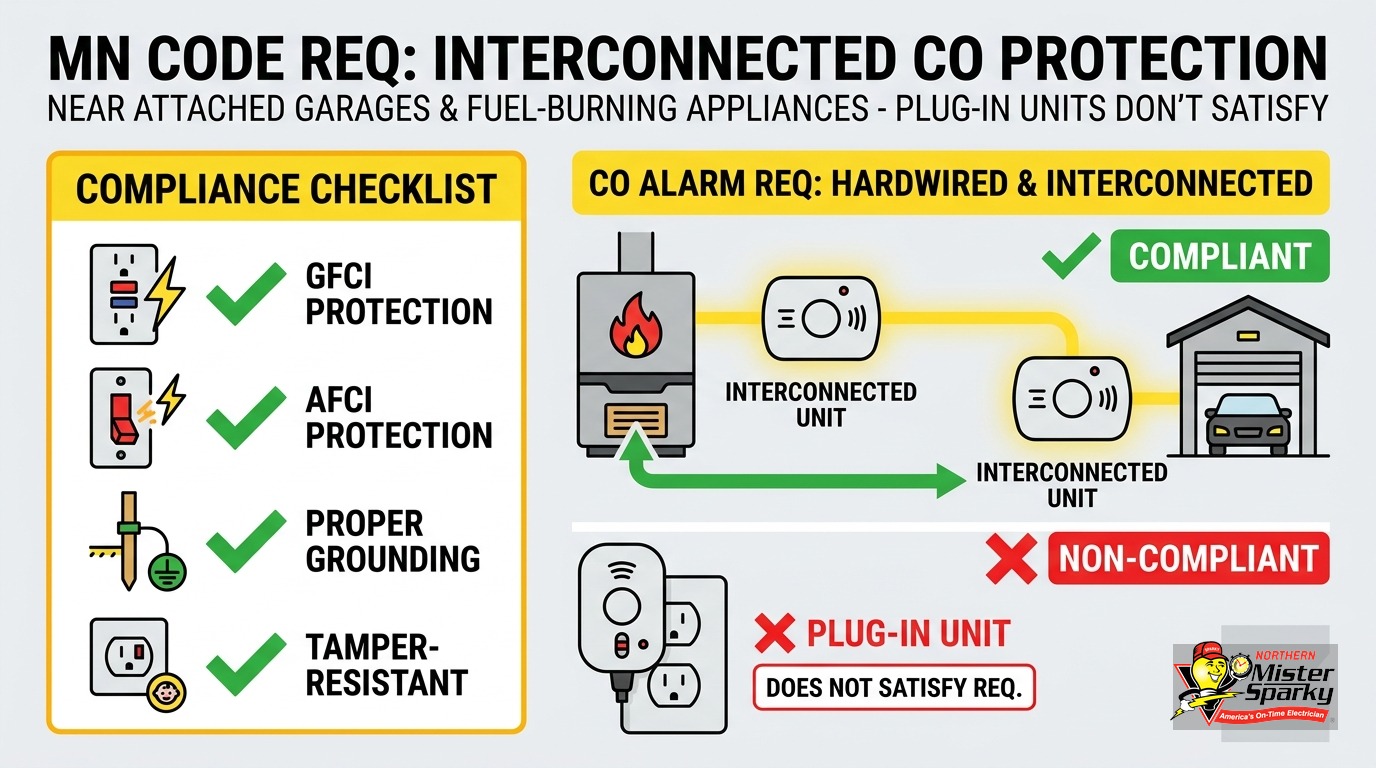
- Minnesota code requires hardwired, interconnected CO alarms in homes with an attached garage or a fuel-burning appliance. A plug-in outlet unit often doesn’t satisfy that requirement.
- “Interconnected” means when one alarm sounds, every alarm in the home sounds. This is mandatory in qualifying homes, not optional.
- Pulling a permit on any project in a qualifying home can trigger a CO alarm upgrade. The project doesn’t have to involve alarms.
- Minneapolis TISH evaluators check CO detector compliance at every home sale. Expired units fail the evaluation.
- CO alarms must be listed to UL 2034 in Minnesota. This standard has been in effect since August 1, 2024.
- There are no utility rebates for CO detector installation in Minnesota. Don’t spend time searching for one.
- Call 763-200-5956 or schedule your installation. We’ll confirm what your home requires and get compliant alarms installed in a single visit.
The $30 Plug-In Alarm Might Not Be Enough
You’ve seen them at the hardware store: a plug-in carbon monoxide alarm, around $30, no tools required. For some homes and some situations, it’s the right choice. For many Twin Cities homes, it isn’t.
Minnesota’s residential code draws a hard line based on two conditions: whether your home has an attached garage, and whether it has a fuel-burning appliance. If either applies, the code requires hardwired, interconnected CO alarms. A plug-in outlet unit doesn’t meet that standard.
The gap isn’t about brand quality or sensor accuracy. It’s about how the alarms connect to each other and to your home’s electrical system. A unit that runs only on outlet power has no hardwired interconnect. It doesn’t qualify.
We see this come up regularly in the Twin Cities. A homeowner installs plug-in alarms in good faith. Then a permit inspection flags them. Or a Minneapolis TISH evaluation flags them before a home sale. The fix is straightforward. But it’s easier to plan for when you know the rule before the inspector does.
What Are the Two Triggers That Require Hardwired CO Alarms in Minnesota?
If your home has an attached garage or any fuel-burning appliance, Minnesota’s residential code requires hardwired, battery-backed, interconnected CO alarms. Plug-in outlet units and standalone battery pucks don’t satisfy that requirement for new construction or permitted renovation work.
MN Statute 299F.51 sets the baseline for all Minnesota homes. Every single-family dwelling must have an operational CO alarm within 10 feet of each sleeping room. That’s the minimum floor.
MN Residential Code R315 is where the hardwired requirement lives. R315 activates on two specific conditions:
Trigger 1: Attached garage. If your garage shares a wall, floor, or ceiling with your living space, you have an attached garage. Nearly every suburban Twin Cities home has one. The garage-to-house boundary is a primary CO intrusion point. Exhaust from a running vehicle or gas-powered equipment can enter through gaps around doors, ducts, and utility penetrations.
Trigger 2: Fuel-burning appliance. A gas furnace, natural gas water heater, gas boiler, gas range, gas dryer, gas fireplace, or pellet stove counts. Most Minnesota homes have at least one. Many have three or four.
If either trigger applies, the code says: hardwired with battery backup, interconnected. Not “preferred.” Required.
One placement misconception is worth correcting here. Some online guides tell readers to keep CO alarms 10-15 feet away from furnaces and gas appliances to prevent nuisance trips. That guidance doesn’t reflect Minnesota code. R315 positions CO alarms relative to sleeping rooms, not appliances. Alarms must be within 10 feet of each bedroom door. The post on smoke and CO detector placement code covers the exact requirements in full.
What Does “Interconnected” Mean, and Why Does It Matter?
Interconnected means when one CO alarm activates, every alarm in the home activates simultaneously. This is mandatory in homes that meet either trigger. It turns a localized alarm into a whole-house alert, waking everyone regardless of which floor they’re on.
Here’s the problem interconnection solves: a furnace in the basement produces CO at night. A single alarm near the utility room beeps. The person asleep two floors up, behind two closed doors, may not hear it in time.
Interconnection eliminates that gap. When the basement unit detects CO above its threshold, a signal travels to every alarm on the network. All of them sound at once, at full volume, throughout the home.
Hardwiring is the standard method. The alarms share a common trigger wire that runs through the home’s electrical system. Because they use household current, they also require battery backup to stay functional during outages.
Wireless interconnect systems exist as an alternative. They use radio signals instead of a physical wire to trigger all units simultaneously. A licensed electrician can evaluate whether a wireless system meets the requirements for your home and jurisdiction. What matters is the outcome: one alarm trips, and the whole house knows.
Does Pulling a Permit Trigger a CO Alarm Upgrade?
Yes. Any permitted work in a Minnesota home with an attached garage or fuel-burning appliances requires CO alarms to comply with R315. The project doesn’t have to involve alarms. A kitchen remodel, panel upgrade, or basement finish all qualify as triggers.
This catches homeowners off guard more than almost any other code item. You’re adding a circuit for a home office. You’re upgrading your electrical panel to handle an EV charger. You’re finishing the basement. None of those projects are about CO alarms. But pulling the permit puts the whole home under inspection.
The building inspector checks CO alarm compliance as part of the permit closeout. Battery-only pucks and plug-in outlet units without hardwiring fail. Any alarm past its expiration date fails. The permit doesn’t close until the issue is corrected.
The practical fix: call us before you pull the permit. We inspect CO alarm setups regularly. We can tell you what you have, what the inspector will expect, and schedule hardwired installation as part of your permitted project. Getting ahead of it saves a hold on your timeline.
This permit-triggered upgrade pattern applies to AFCI breaker requirements in older homes as well. The post on AFCI breaker requirements explains how that same mid-renovation trigger works.
What Happens to CO Detectors When You Sell Your Minneapolis Home?
Minneapolis requires a Truth in Sale of Housing (TISH) evaluation before listing. Evaluators check CO detector compliance, including presence, function, and expiration date. Expired or missing units fail and must be corrected before the disclosure report clears.
The Minneapolis TISH process includes a CO detector inspection at every home sale. The evaluator verifies that alarms are present within required distance of sleeping rooms, that they sound when tested, and that they haven’t passed their expiration date. The homeowner is responsible for all three.
Most homeowners don’t track CO alarm expiration. The date is printed or embossed on the back of each unit, sometimes on a sticker, sometimes molded into the plastic. A four-year-old alarm may still emit a test beep and still register as expired. The test tone doesn’t override the printed date.
A TISH report with CO alarm violations stalls your listing. The home can’t list until the violations are corrected and re-evaluated. For sellers on a timeline, this is a real problem. It’s also a completely avoidable one.
Check your CO alarms before you contact a realtor. Look at the expiration date on the back of each unit. If any unit is within a year of expiration, replace it now. If your alarms are plug-in units in a home with an attached garage, call us before the evaluator does.
How Do You Know If Your Home Needs Hardwired CO Alarms?
If your home has an attached garage or any fuel-burning appliance, you almost certainly need hardwired, interconnected CO alarms under Minnesota code. Use the checklist below to confirm your current setup against what’s required.
Work through these questions:
- Does your garage share any wall, floor, or ceiling with your living space? That is an attached garage. It triggers R315.
- Does your home have a gas furnace, gas water heater, gas boiler, or gas range? What about a gas dryer, gas fireplace, or pellet stove? Any combustion appliance counts.
- Are your current CO alarms hardwired with battery backup? Check the back of each unit. A hardwired alarm has a wire connector. A plug-in unit plugs into an outlet. A battery puck stands alone.
- Are they interconnected? If one goes off, do the others sound? If you don’t know, they probably aren’t.
- Are they positioned within 10 feet of each bedroom door? Measure from the closest door to the nearest alarm.
- Are they within their listed lifespan? Check the expiration date on the back of each unit.
Most Twin Cities homes check two boxes automatically: attached garage and gas furnace. That means most Twin Cities homeowners need hardwired CO alarms and may not currently have them. If your setup consists of outlet-mounted units or standalone battery pucks, it is likely not code-compliant for your situation.
The fastest confirmation: call your local building department with your address, or call us. We check CO alarm setups regularly and can tell you within a few minutes what you have and what you need.
UL 2034: The Standard Your CO Alarm Must Meet After August 2024
Minnesota updated its CO alarm requirements effective August 1, 2024. All CO alarms must now be listed to UL 2034. Combination smoke/CO alarms are acceptable if they carry both UL 217 (smoke) and UL 2034 (CO) listings.
UL 2034 is the performance standard that governs concentration thresholds, alarm timing, and false alarm resistance. It determines whether a unit will reliably alert occupants without nuisance trips. Most current products from established manufacturers meet this standard. But if you’re buying older shelf stock or off-brand units, verify the listing before installation. The same applies to any alarm pulled from storage.
The UL listing appears on product packaging and typically on a label or sticker on the unit itself. If a unit doesn’t show a UL 2034 listing, it doesn’t meet the current Minnesota requirement.
Combination smoke/CO alarms are a practical choice for many homeowners. If you’re replacing both alarm types at the same time, a dual-listed unit simplifies installation. It also reduces the number of ceiling penetrations in the process. We stock UL-listed units for both applications.
What Does Hardwired CO Alarm Installation Actually Involve?
A licensed electrician surveys sleeping room locations, runs circuit wire to each alarm position, wires the interconnect line between all units, installs battery backup, and confirms placement within 10 feet of each bedroom door. In most Twin Cities homes, the job takes a few hours.
Here’s the sequence in practice:
Location survey. We map sleeping rooms and confirm required alarm positions per MN Statute 299F.51: within 10 feet of each bedroom door. We also identify the most efficient wire path through the home.
Circuit routing. Hardwired alarms tie into the home’s electrical system. We route from an existing circuit where possible and take the least invasive path through walls, ceiling cavities, or attic space.
Interconnect wiring. All units share a trigger wire. When any alarm detects CO, the signal travels through that wire and fires every unit on the network simultaneously.
Battery backup installation. Each hardwired unit has a battery compartment. The batteries maintain alarm function during power outages. We confirm each battery is fresh before we leave.
UL 2034-listed units. We install alarms that meet the current Minnesota standard.
Permit coordination. For standalone CO alarm work, we confirm whether your jurisdiction requires a permit. For CO alarm work bundled with a larger permitted project, we coordinate with your permit schedule. The inspector sees compliant alarms at the final walkthrough.
Most homes with three or four bedrooms on one or two levels are uncomplicated. Finished walls, tight attic access, or unusual floor plans add some time. We give you a realistic estimate before we start.
Many homeowners combine CO alarm work with smoke alarm replacement. Both share the same hardwired interconnect principle. The post on hardwired smoke detector replacement and interconnect upgrades covers the smoke alarm side if you’re addressing both at once.
Are There Rebates for CO Detector Installation in Minnesota?
No. Xcel Energy and CenterPoint Energy don’t offer rebates for CO detector installation. This is a safety and code-compliance item, not an energy-efficiency item. Don’t spend time searching for a rebate that doesn’t exist for this category.
Utility rebates in Minnesota focus on efficiency improvements: insulation, smart thermostats, high-efficiency heating equipment, and EV charging infrastructure. CO alarm installation falls outside every current rebate program because it doesn’t reduce energy use.
The MN DPS State Fire Marshal has distributed free CO alarms to fire departments in several Minnesota communities, primarily in greater Minnesota: Austin, Bemidji, Brainerd, Duluth, Red Wing, Rochester, Virginia, and Willmar. Twin Cities residents are not in the current distribution list.
The practical situation: hardwired CO alarm installation is not an expensive project. For most homes, materials and licensed installation together run a few hundred dollars. If you’re combining CO alarm work with a larger project, we offer financing on that work. A panel upgrade, whole-home generator, or basement finish all qualify. For CO alarm work alone, the cost is typically straightforward. Ask us for a specific estimate for your home.
Schedule Hardwired Carbon Monoxide Detector Installation in the Twin Cities
Minnesota winters seal homes tight from October through April. Furnaces run around the clock. Attached garages are standard on nearly every suburban Twin Cities property. That combination concentrates CO risk, and it’s exactly why Minnesota’s code requires hardwired, interconnected alarms in qualifying homes.
No malarky: if your home has an attached garage or a gas appliance, confirm your CO alarm setup now. Don’t wait for a permit inspection or a TISH evaluation to flag it.
We are a locally owned and operated Twin Cities electrical contractor. Our team serves Minneapolis, St. Paul, Bloomington, Brooklyn Park, Woodbury, Blaine, Maple Grove, Plymouth, and surrounding communities. As America’s On-Time Electrician(R), we back every job with the UWIN(R) 100% satisfaction guarantee.
Call 763-200-5956 or book your installation online. We’ll inspect your current alarms, confirm what your specific home requires, and install compliant hardwired units in a single visit.
Frequently Asked Questions
Does Minnesota require hardwired CO detectors? +
Do plug-in CO detectors meet Minnesota code? +
When does pulling a permit trigger a CO alarm upgrade in Minnesota? +
Need an electrician now?