
Failed Electrical Inspection: What to Do in Minnesota
Key Takeaways
- After a failed electrical inspection, the red tag you receive is a Field Correction Notice: a formal stop-work or stop-use order. The flagged system cannot be used or concealed until all cited violations pass re-inspection.
- Minnesota has a split AHJ system. Some jurisdictions use state DLI inspectors. Others use local city inspectors. Check the DLI inspector directory before filing anything or calling any office.
- Minneapolis and St. Paul each have separate inspection offices and scheduling phone numbers. Calling the wrong one costs days.
- Minnesota adopted the 2026 NEC effective August 17, 2026. Permits filed before that date follow the 2023 NEC.
- Electrical permits with inspection fees of $250 or less expire 12 months from filing. A lapsed permit means starting over with a new filing.
- The most common violations: missing GFCI and AFCI protection, double-tapped breakers, ungrounded outlets, and outdated panels.
- Call 763-200-5956 or book online. We correct the violations and coordinate the re-inspection for you.
What Is a Red Tag, Exactly?
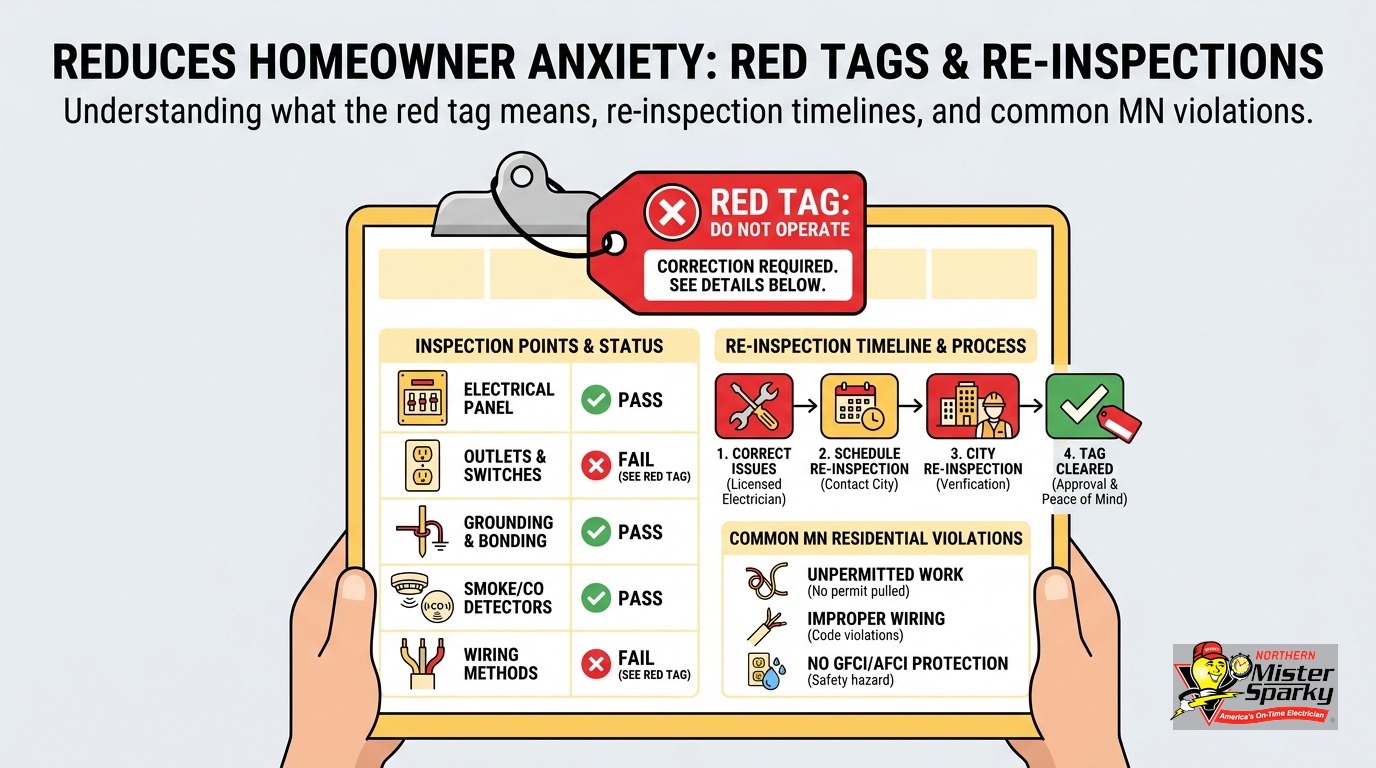
A red tag is a Field Correction Notice left on-site by the inspector after a failed inspection. It is a formal stop-work or stop-use order. The tagged system cannot legally be used or covered until every cited violation is corrected and a re-inspection passes.
The notice lists each violation by NEC section number. One copy stays with your permit card on-site. A second copy goes to the inspector’s office.
The tag is not an opinion. It documents specific code violations tied to specific sections of the National Electrical Code as adopted in Minnesota.
“Stop-work” and “stop-use” are not the same. Stop-work means you cannot continue construction on the flagged work. Stop-use means you cannot use the flagged system or space. Read your notice carefully. The restriction type matters for how you occupy your home during the correction period.
Not every failed inspection results in an immediate stop-use order. Minor violations sometimes allow continued occupancy while repairs are scheduled. Your inspector’s written notice will specify the restriction that applies to your situation.
Who Is Your Inspector in the Twin Cities?
Minnesota splits inspection authority between state DLI inspectors and local city inspectors. Which office handles your re-inspection depends entirely on where you live. You must check the correct directory before making any calls or filing anything.
This AHJ (Authority Having Jurisdiction) split is the detail that derails most Twin Cities homeowners navigating a failed inspection. Every out-of-state article about red tags ignores it entirely.
Here is how it works. The DLI inspector directory lists every Minnesota jurisdiction. Find your city or township. If the column reads “State,” your permit and re-inspection go through DLI. If it reads “Local,” you contact your city’s building department directly.
Minneapolis is its own infrastructure. It operates a separate electrical inspection system under Minneapolis Regulatory Services, with its own district contacts. The Minneapolis electrical inspection page has the current details for work done within city limits.
Suburbs including Bloomington, Maple Grove, Plymouth, Woodbury, Blaine, and Brooklyn Park each have their own designation in the directory. Check before you call anything.
Filing with the wrong office does not pause your permit expiration date. The 12-month clock runs regardless.
What Should You Do After a Failed Electrical Inspection?
Read the Field Correction Notice in full before you touch anything. Each violation cites a specific NEC section number. Understanding what failed, and under which code version, tells you precisely what corrections are needed before the re-inspection can pass.
Work through this sequence:
-
Read the entire notice. NEC Article 210.8 means GFCI protection. Article 210.12 means AFCI protection. NEC 230.70 means your service disconnect location. The section numbers map to the category and scope of each violation.
-
Check your permit date. Minnesota adopted the 2026 NEC on August 17, 2026. Permits filed before that date comply with the 2023 NEC. Permits filed on or after comply with the 2026 NEC. Share your permit date with your electrician before any work begins.
-
Confirm your AHJ. Use the DLI directory to determine whether your re-inspection goes to DLI or your local city. Do this before calling anyone.
-
Contact a licensed electrician. An electrician current on the 2026 NEC will correct every cited violation and check for anything adjacent that could generate a second red tag.
-
Schedule the re-inspection only after all corrections are complete. Inspectors do not do consultation visits on open permits. Call when the work is fully done.
How Long Do You Have to Fix a Failed Electrical Inspection?
Minnesota does not publish a single universal correction deadline. The clock you need to watch is your permit expiration date. Permits with inspection fees of $250 or less expire 12 months from the original filing date.
Under Minnesota statute 326B.36, a small-fee permit becomes void after 12 months whether the work is finished or not. If your permit lapses before the re-inspection passes, you must file a new permit for all remaining work and restart the inspection cycle.
Permits with higher inspection fees may carry different expiration terms. Review the conditions printed on your specific permit.
The practical point: do not treat a red tag as something to revisit in a few months. Contractor scheduling, parts availability, and everyday life push timelines out. An expired permit means additional filing fees and paperwork on top of the correction costs. Move promptly.
What Causes a Failed Electrical Inspection on Twin Cities Homes?
Twin Cities homes span a century of construction, from 1920s craftsman bungalows in south Minneapolis to postwar ramblers in the first-ring suburbs to new builds in Maple Grove and Woodbury. Each era brings its own pattern of violations.
Here is what inspectors flag most often:
Missing GFCI Protection (NEC Article 210.8)
Ground fault circuit interrupter (GFCI) protection is required in every wet or potentially wet location. That includes bathrooms, kitchens with countertop circuits within six feet of a sink, garages, outdoor outlets, unfinished basements, and crawl spaces. Pool and spa areas also require GFCI protection.
Missing GFCI protection is a top item on the DLI 2026 residential inspection checklist. Homes built before 1973 often lack it in several locations. The correction is installing GFCI outlets or a GFCI breaker on each required circuit. See GFCI outlet requirements explained for a full breakdown of where protection is required and which correction method fits each situation.
Missing AFCI Protection (NEC Article 210.12)
Arc fault circuit interrupter (AFCI) protection is required in bedrooms, living rooms, hallways, and most finished living areas. AFCI breakers are also a top-of-checklist item on the DLI 2026 NEC inspection checklist. Homes that have never had AFCI breakers installed will need them on each applicable circuit. See AFCI breaker requirements explained before your electrician visits so you understand the scope.
Double-Tapped Breakers
A double-tapped breaker has two conductors sharing a single terminal rated for one wire. The configuration causes arcing and is an automatic inspection fail. The fix is either a tandem breaker (if the panel manufacturer approves it for that slot) or a new circuit. There is no compliant workaround that keeps both conductors on the same terminal.
Two-Prong Ungrounded Outlets
Two-prong outlets have no ground path. They are a code violation on circuits where grounding is required. Three code-compliant corrections exist. You can run a grounded conductor to the outlet. You can install a GFCI outlet, which is code-compliant without a ground wire but requires “No Equipment Ground” labeling. Or you can run a separate grounding conductor back to the panel. See ungrounded outlets in older homes for how each option plays out in practice.
Service Disconnect Location (NEC 230.70)
The main service disconnect must be at a readily accessible outdoor location within 50 feet of the dwelling and visible from the building. Older Twin Cities homes frequently have the disconnect inside, installed before this location requirement existed. Correcting the location requires a licensed electrician.
Outdated or Failing Panels
Federal Pacific Stab-Lok panels and Zinsco panels are red flags on Minneapolis and St. Paul homes from the 1960s through the 1980s. Both brands have documented failure histories. An inspector who cites your panel brand is typically pointing toward a replacement, not a minor repair. Our post on dangerous electrical panel brands in Minnesota explains the documented risks and what replacement involves.
Unlisted or Improperly Installed Equipment
All electrical equipment must be listed by a Nationally Recognized Testing Laboratory (NRTL) and installed per the manufacturer’s instructions. This requirement appears in Minnesota Rules 3801.3620. Unlisted equipment is an automatic inspection fail. It turns up most often after DIY work using off-brand or uncertified parts purchased online.
Underground Wiring: The Minnesota Climate Factor (NEC 300.7)
This requirement is specific to Minnesota and absent from every out-of-state guide on failed inspections. Direct-buried cables and raceways must include expansion capability to prevent conductor damage from the freeze-thaw cycle. Underground service conductors also require a warning ribbon in the trench at least 12 inches above the installation.
Both requirements appear on the DLI 2026 NEC inspection checklist. Minnesota soil moves every winter. If you have underground conduit runs or buried cable, confirm both details are in place before calling for re-inspection.
What Changed with the 2026 NEC?
Minnesota adopted the 2026 National Electrical Code on August 17, 2026. Whether the 2023 or 2026 NEC applies to your red tag depends on when your permit was originally filed, not when the corrections are made.
The Minnesota Board of Electricity’s code adoption page has the full details. Permits filed before August 17, 2026, follow the 2023 NEC. Permits filed on or after that date follow the 2026 NEC. Licensing exams transitioned to the 2026 NEC on September 8, 2026.
This distinction matters when you are correcting violations. If your permit was filed in April 2026 and your inspection failed in September 2026, the 2023 NEC governs your corrections. Share your permit date with your electrician before any work begins. Both of you need to be working from the same code version.
The 2026 NEC expands AFCI and GFCI requirements, updates rules for service equipment, and adds provisions for EV charging infrastructure and energy storage systems. If a requirement your electrician names sounds new, ask which code version applies to your permit.
How Do You Schedule a Re-Inspection in Minneapolis or St. Paul?
The answer depends on your city, your permit type, and whether your correction requires its own permit. Minneapolis and St. Paul each use different offices and phone numbers. Use the right one or you lose days.
Here are the specific contacts:
Minneapolis — permit-required repairs: Call the state inspector listed on your permit. Alternatively, call 651-284-5064.
Minneapolis — TISH (Truth in Sale of Housing) re-inspections without a permit: Call your original licensed TISH evaluator. Or call Minneapolis Truth in Housing at 612-673-5840, Monday through Friday, 7:30 a.m. to 4:00 p.m.
St. Paul (Department of Safety and Inspections): Call 651-266-9003 between 7:30 a.m. and 9:00 a.m., Monday through Friday.
Source: Minneapolis re-inspections page and St. Paul DSI electrical permit guidelines.
DLI enforcement and red-tag questions, statewide: Call 651-284-5069 or email dli.contractor@state.mn.us.
For suburbs including Bloomington, Brooklyn Park, Woodbury, Blaine, Plymouth, and Maple Grove: look up your jurisdiction in the DLI directory first. The column will say State or Local, and that tells you exactly who to call.
What If You Fail the Re-Inspection?
A second failed inspection means corrections were incomplete, were done incorrectly, or the work introduced new violations. The path forward is the same: read the new Field Correction Notice, correct every item, and schedule another re-inspection.
In some jurisdictions, repeated failures trigger additional inspection fees. In Minnesota, persistent non-compliance with DLI electrical requirements can result in administrative orders and civil penalties through the DLI enforcement process.
After a second failure, have your electrician do a full review of all work performed before calling for another inspection. Small mistakes compound across a job. A thorough walk-through before the inspector arrives is far cheaper than a third re-inspection fee.
Do not call for re-inspection while corrections are still in progress. Inspectors schedule re-inspections for completed work, not work-in-progress consultations.
Should You Do the Repairs Yourself?
Minnesota homeowners can file their own electrical permits for their primary residence. The work still has to pass the same inspection a licensed electrician’s work must pass. That is the honest line.
For a simple, clearly defined correction, like swapping an unprotected outlet for a GFCI outlet on a straightforward accessible circuit, a skilled DIYer with the right tools can complete the work. For anything involving the panel, service entrance, underground runs, or AFCI circuits across multiple rooms, a licensed electrician is the faster and more reliable path.
Consider the full cost. A second re-inspection fee, the time lost rescheduling, and any new violations introduced during a DIY correction often exceed what you saved doing the work yourself. A licensed Twin Cities electrician working to the current Minnesota code knows what adjacent issues an inspector will flag. They handle the re-inspection coordination as part of the job.
We Handle the Corrections and the Re-Inspection
Got a red tag? Call Northern Mister Sparky at 763-200-5956 or book online. We will read the Field Correction Notice with you, correct every cited violation to current Minnesota code, and coordinate the re-inspection directly.
We are locally owned and operated, serving Minneapolis, St. Paul, Bloomington, Brooklyn Park, Woodbury, Blaine, Maple Grove, Plymouth, and surrounding Twin Cities communities. As America’s On-Time Electrician(R), we show up when we say we will and we communicate clearly throughout the job.
The UWIN(R) 100% satisfaction guarantee means we stand behind the work until it passes.
If your red tag uncovered a larger issue, such as an outdated panel, deteriorating wiring, or a service that is simply out of capacity, ask us about financing. Bigger projects should not sit unfinished while the problem grows.
Frequently Asked Questions
What is a red tag from an electrical inspection? +
How long do I have to fix a failed electrical inspection in Minnesota? +
Who schedules my re-inspection in Minneapolis vs. St. Paul? +
Can a Minnesota homeowner pull their own permit for electrical corrections? +
What are the most common violations on Twin Cities homes? +
Need an electrician now?