
GFCI Outlet Requirements for Twin Cities Homes (2023)
Key Takeaways
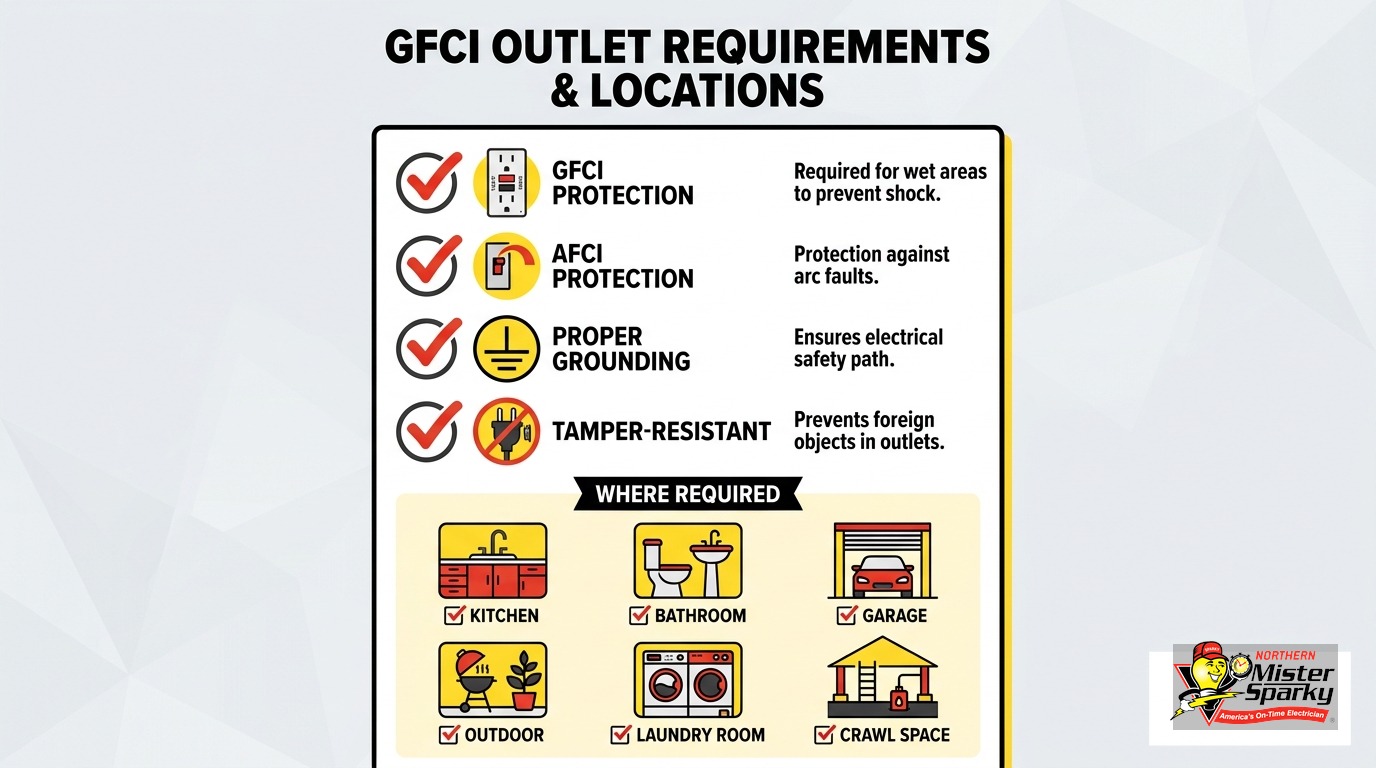
- GFCI outlet requirements protect you from shock in wet or grounded areas like baths, kitchens, garages, and outdoors.
- Minnesota adopted the 2023 code on July 1, 2023. It now requires GFCI on all kitchen receptacles, plus dryers, ovens, ranges, and microwaves.
- AFCI protects dry living spaces from arc-fault fires, and some rooms need both GFCI and AFCI.
- Existing wiring is usually grandfathered until you remodel, replace, or add a circuit.
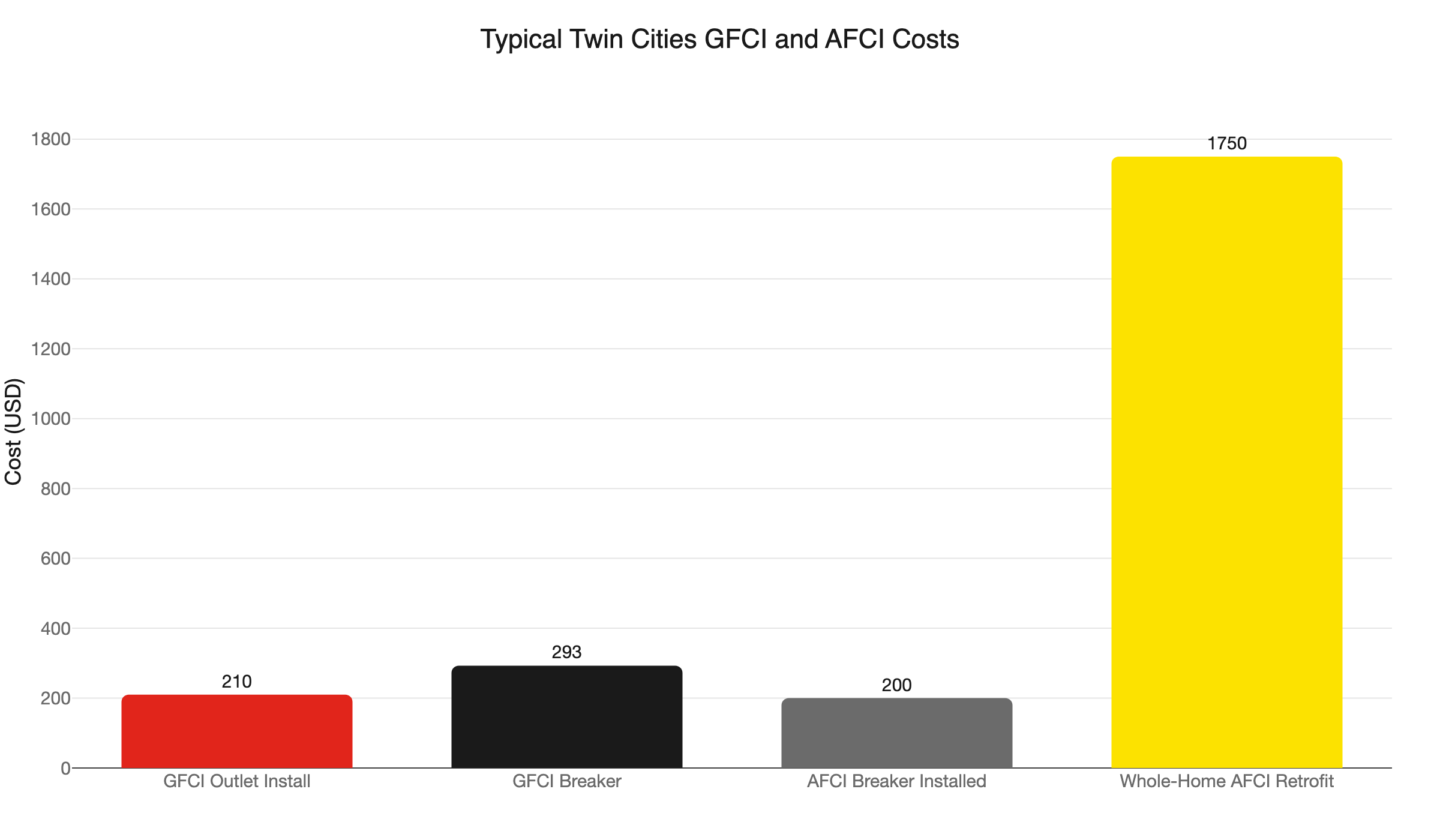
- A GFCI outlet install averages about $210. A whole-home AFCI retrofit runs $1,000 to $2,500 in labor.
- Minneapolis and St. Paul require a permit and inspection for panel and breaker work.
What changed in the 2023 code for Twin Cities homes?
Minnesota’s 2023 code reshaped GFCI outlet requirements for every home. Kitchen receptacles now need GFCI protection no matter how far they sit from the sink. Protection also reaches dryers, ovens, ranges, and microwaves. These rules apply to permits filed on or after July 1, 2023.
Minnesota adopted the 2023 National Electrical Code statewide, without amendment. Any electrical permit filed on or after July 1, 2023 must meet the 2023 code (Housing First Minnesota). Our state does not usually add its own changes. It uses the NFPA National Electrical Code as written (Minnesota DLI).
The kitchen saw the biggest shift. Every kitchen receptacle now needs GFCI protection, not just the plugs near water. The code also extends protection to clothes dryers, countertop cooking equipment, wall ovens, microwaves, and cord-connected kitchen appliances (Housing First Minnesota). Island plugs changed too. They must now be pop-ups installed in the countertop surface. Side-of-island placement is no longer allowed (Housing First Minnesota).
One local exception matters. Minnesota does not require GFCI protection for listed HVAC equipment until September 1, 2026. The state also added garages, accessory buildings, and boathouses to the outdoor GFCI requirement (Minnesota DLI FAQ).
We are locally owned and operated, so we track these Twin Cities rules closely. No malarky, just the code as it stands today.
What is a GFCI and how does it protect you?
A ground-fault circuit interrupter watches the current flowing out and back through an outlet. If it senses a small imbalance, around 4 to 6 milliamps, it cuts power in a fraction of a second. That fast trip stops a shock before it can harm you.
Here is the key difference from a normal breaker. A GFCI senses that 4 to 6 milliamp imbalance between hot and neutral, then cuts power. That level sits far below what a standard breaker needs to trip (Legrand). So a GFCI guards against shock, not overload. A regular breaker guards against overload, not shock. Your home needs both jobs covered, and the code makes sure they are.
Why do GFCI and AFCI rules matter for your safety?
GFCI and AFCI devices stop two of the most common home electrical dangers. GFCI cuts shock risk in wet areas where water and electricity meet. AFCI cuts fire risk from hidden arcing inside walls and cords. Together they cover both the shock threat and the fire threat.
Water lowers your body’s resistance, so a shock in a bathroom or kitchen can turn serious fast. A GFCI stops that shock almost instantly. Arc faults are quieter but just as dangerous. A loose wire or a pinched cord can arc for weeks before it sparks a fire. An AFCI catches that arcing early and cuts the circuit.
Older Twin Cities homes carry extra risk. Decades-old wiring, worn outlets, and crowded panels raise the odds of both shock and arc faults. If your lights flicker or your breakers trip often, do not wait. Those are early warnings that a circuit needs attention.
Where does code require GFCI outlets in your home?
NEC 210.8(A) requires GFCI protection in bathrooms, garages, outdoors, crawl spaces, all basement areas, kitchens serving countertops, laundry areas, and within 6 feet of any sink. Minnesota adds garages, accessory buildings, and boathouses to the outdoor rule. Wet and grounded areas carry the highest shock risk.
The full list under NEC 210.8(A) covers home receptacles in these spots: bathrooms, garages and accessory buildings at or below grade, outdoors, crawl spaces at or below grade, all basement areas, kitchens serving countertops, anywhere within 6 feet of a sink, laundry areas, boathouses, and indoor damp or wet locations (Electrical License Renewal).
The 2020 code widened the net. It expanded coverage from 125-volt, 15- and 20-amp outlets to all 125-volt to 250-volt receptacles on single-phase circuits rated 150 volts or less to ground. That means many 240-volt appliance outlets now need GFCI too (Electrical License Renewal). Think of the plugs behind your range or dryer.
What are the GFCI outlet requirements for kitchens now?
Under the 2023 Minnesota code, every kitchen receptacle needs GFCI protection, regardless of distance from water. The rule also covers clothes dryers, countertop cooking equipment, wall ovens, microwaves, and cord-connected appliances. Island plugs must be countertop pop-ups, not side-mounted units.
The old rule protected kitchen counter plugs within 6 feet of the sink. The 2023 code drops that distance test. Every kitchen receptacle now needs GFCI protection (Housing First Minnesota). Large appliances joined the list as well. Dryers, ranges, wall ovens, and microwaves all fall under the rule now.
If you plan a kitchen remodel, budget for these changes early. New or altered circuits must meet the current code. That includes the island pop-up requirement, which can change how your counters are built. A little planning up front saves you a redo later.
Where does code require AFCI protection instead?
The 2023 code, section 210.12(B), requires AFCI protection on 120-volt, 15- and 20-amp circuits that serve living spaces. That covers bedrooms, living rooms, dining rooms, family rooms, kitchens, hallways, closets, laundry areas, and finished basements. AFCI stops arc faults, a leading cause of home electrical fires.
AFCI stands for arc-fault circuit interrupter. It watches for the erratic arcing that damaged cords or loose connections create. NEC 210.12(B) requires AFCI on 120-volt, single-phase, 15- and 20-amp circuits that supply outlets and devices in kitchens, family rooms, dining rooms, living rooms, bedrooms, sunrooms, recreation rooms, closets, hallways, laundry areas, and similar living spaces, including finished basements (ExpertCE).
AFCI is generally not required where GFCI already governs. That includes bathrooms, garages, outdoors, and unfinished basements. Those concrete and masonry areas carry a lower arc-fire risk (Viox).
GFCI vs AFCI: which rooms get which?
GFCI guards wet and grounded areas against shock. AFCI guards dry living spaces against arc fires. Some rooms need both, like kitchens and laundry areas, which is why dual-function breakers exist. The table below shows the split room by room.
| Room or area | GFCI (shock) | AFCI (arc fire) |
|---|---|---|
| Bathroom | Yes | No |
| Kitchen | Yes | Yes |
| Bedroom | Only within 6 ft of a sink | Yes |
| Living, family, dining room | No | Yes |
| Laundry area | Yes | Yes |
| Garage | Yes | No |
| Outdoors | Yes | No |
| Unfinished basement | Yes | No |
| Finished basement | Wet areas only | Yes |
| Hallway or closet | No | Yes |
Where a room needs both, a combination AFCI/GFCI breaker covers the circuit in one device. That keeps your panel tidy and your protection complete. Our team can tell you which breakers your home needs after a quick look at your panel.
Do you have to retrofit existing outlets to meet code?
Usually no. Existing wiring is grandfathered and stays legal until you remodel, replace, or add a circuit. Once you alter or extend a circuit, that work must meet the current code. Bathrooms and kitchens are smart places to add GFCI protection even when it is not required yet.
Code changes apply going forward, not backward. Your existing circuits are generally legal until you touch them. When you remodel a room, replace a panel, or add a circuit, the new or altered work must meet the 2023 code. So a kitchen remodel triggers the new GFCI rules for that space.
We still suggest adding GFCI protection ahead of any requirement in wet areas. A single GFCI outlet or breaker can protect a whole string of outlets downstream. If your panel is old or full, a retrofit may point to a bigger need. Watch for the signs you need an electrical panel upgrade, and consider a circuit breaker replacement when breakers age out.
How much does it cost to meet GFCI outlet requirements?
A GFCI outlet install runs about $130 to $300, with an average near $210. A simple swap can cost as little as $100. GFCI breakers run roughly $185 to $400 installed. Whole-home AFCI retrofits often total $1,000 to $2,500 in labor.
Here is the retrofit reality in 2025 and 2026 numbers. A GFCI outlet install runs about $130 to $300, averaging near $210. A simple swap of an existing outlet to a GFCI can be as low as $100. The device alone costs $15 to $50 (HomeAdvisor).
A GFCI circuit breaker installed runs roughly $185 to $400 per breaker. The device itself typically costs $307 to $373 (Homewyse).
AFCI breakers cost $40 to $60 for the device, plus $100 to $200 in labor per breaker. A full-home AFCI retrofit commonly totals $1,000 to $2,500 in labor. Combination AFCI/GFCI breakers run $50 to $85 each, plus install (InstaElectricians).
Expect two more line items. Electrical permits usually cost $50 to $350. Most electricians also carry a $100 to $200 minimum visit charge (HomeAdvisor). For larger jobs, ask us about financing. A panel upgrade or a full AFCI retrofit is easier to handle over time.
Do Minneapolis and St. Paul require a permit for this work?
Yes. Both cities require a permit and inspection for panel and breaker work. Adding or changing circuits, swapping a panel, or installing breakers all need an inspector’s sign-off. A licensed electrician pulls the permit and schedules the inspection, so the job stays safe and documented.
Permit and inspection rules protect you and the next owner of your home. Panel and breaker work always calls for a permit in the Twin Cities. Our licensed team handles the paperwork and the inspection for you. That keeps your home records clean and your insurance solid.
This is also why do-it-yourself panel work is risky. Read about the real dangers of DIY electrical work before you open a panel. Then let a pro handle anything behind the cover.
Ready to meet your GFCI outlet requirements?
We are locally owned and operated, and we bring America’s On-Time Electrician(R) reliability to every visit. Our work is backed by the UWIN(R) 100% satisfaction guarantee. Whether you need one GFCI outlet or a full AFCI retrofit, we make it simple.
Call 763-200-5956 or book online today. We will check your home against the 2023 code, explain your options in plain language, and get the job scheduled fast.
Frequently Asked Questions
Are GFCI outlets required in bedrooms? +
Do I have to update my whole house to the 2023 code? +
When does the Minnesota HVAC GFCI exception end? +
How much does it cost to add a GFCI outlet? +
Need an electrician now?