
2023 Electrical Code Changes for Minnesota Homeowners
Key Takeaways
- Minnesota adopted the 2023 NEC on July 1, 2023. The 2026 NEC took effect August 17, 2026. Permits filed today must meet the newer standard.
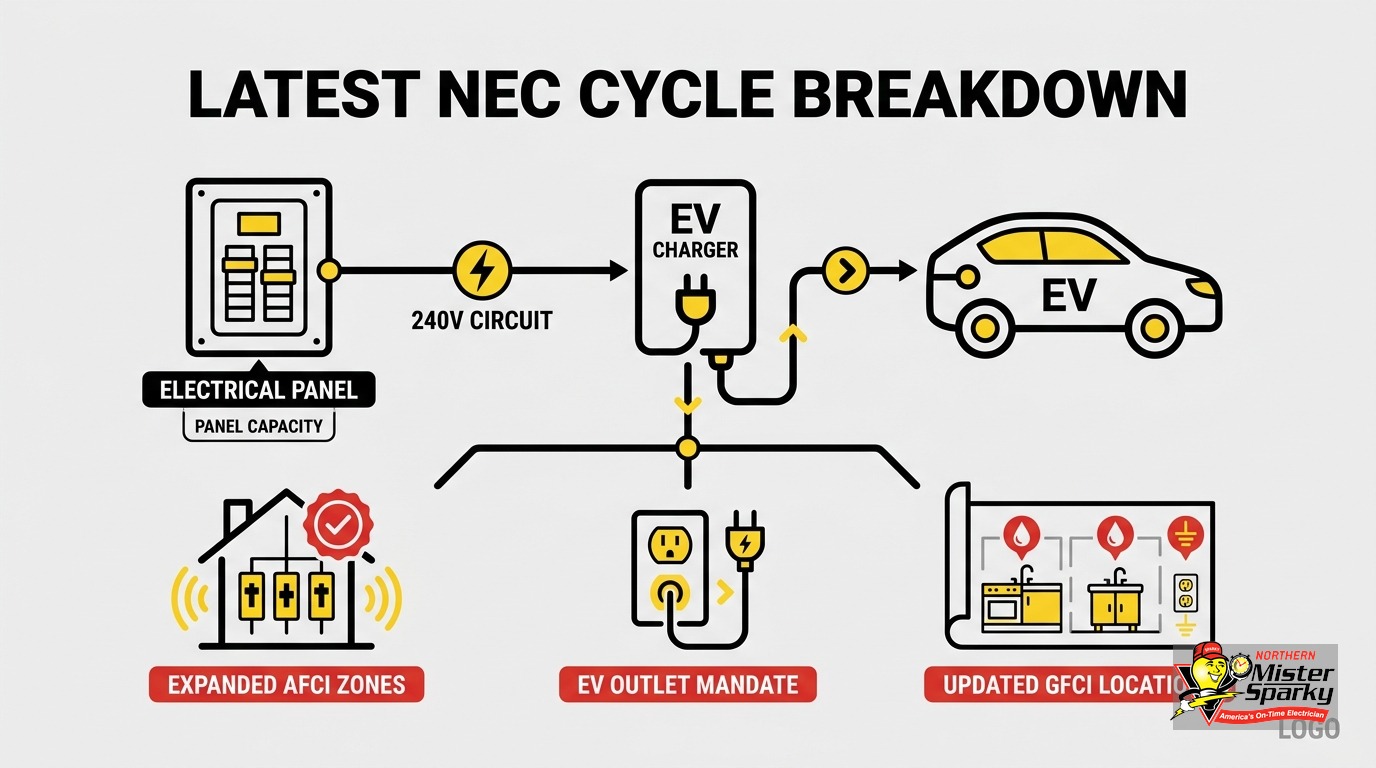
- AFCI protection now covers nearly every living area. Any circuit you modify in a bedroom, living room, kitchen, hallway, or laundry area triggers the requirement, even in a home built in 1960.
- GFCI protection expanded to include 240V outlets for dryers, ranges, and wall ovens when those circuits are new or modified.
- Kitchens and laundry rooms require both AFCI and GFCI protection. A dual-function combination breaker handles both from a single panel slot.
- The 240V EV outlet mandate in new construction is a 2026 NEC rule. The 2023 NEC actually relaxed EV charger requirements. Most competitor posts get this wrong.
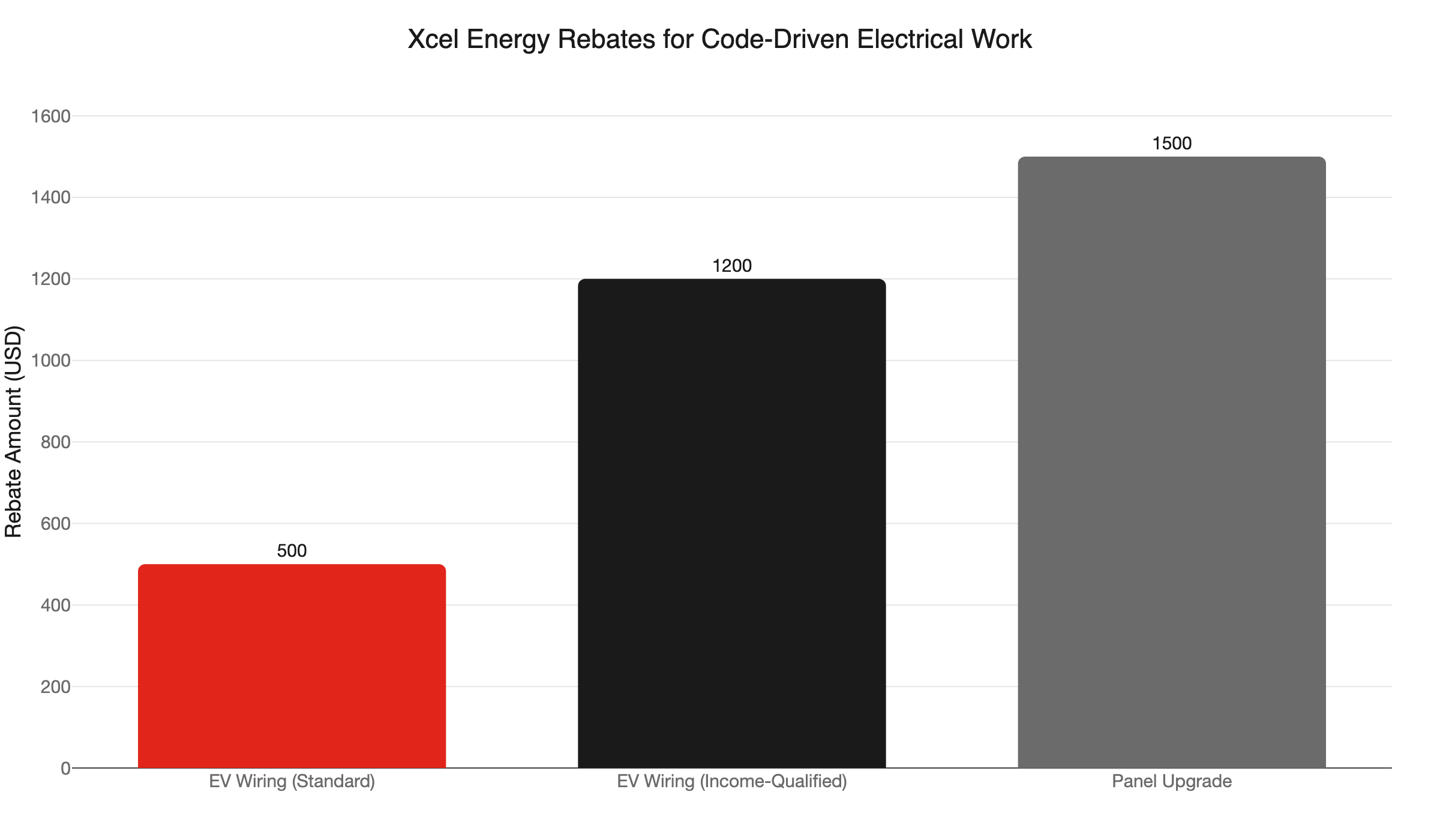
- Xcel Energy rebates can offset up to $2,000 on a combined EV wiring and panel upgrade project.
- The NEC is permit-triggered, not retroactive. Untouched circuits do not need retrofitting. Any circuit a licensed electrician modifies under a permit must meet the current code at inspection.
What Are the 2023 Electrical Code Changes Minnesota Homeowners Need to Know?
Minnesota adopted the 2023 NEC effective July 1, 2023, without state amendments. The core changes for homeowners: AFCI protection extended to nearly every room, GFCI required on 240V appliance circuits, and EV load calculations standardized. Any permit filed between July 1, 2023 and August 16, 2026 fell under these rules.
The NEC updates on a roughly three-year cycle. Each version adds safety requirements to spaces or devices that the previous cycle excluded. The 2023 cycle focused on two specific failure modes. Arc fault circuit interrupters (AFCI) detect the electrical signature of a fault that can ignite insulation inside a wall without ever tripping a standard breaker. Ground fault circuit interrupters (GFCI) detect current leaking to ground, which prevents shock near water and high-voltage appliances.
One thing the code does not do: force retroactive upgrades on untouched wiring. If your home was built in 1972 and the kitchen wiring has never been permitted, that circuit still operates under the code that governed when it was installed. The compliance trigger is a permit. The moment a licensed electrician files a permit for a circuit modification, that circuit must comply with the current standard at inspection.
The Minnesota DLI publishes the 2023 NEC Residential Inspection Checklist that inspectors use on every residential job. It lists every required AFCI and GFCI location by room. If you want to know exactly what your inspector will look for before a project starts, that checklist is the authoritative source.
This permit-trigger model shapes what renovations actually cost. A kitchen remodel completed in 2024 or 2025 will include AFCI and GFCI upgrades that did not apply on the same scope of work five years earlier. That is not an electrician padding the quote. That is what the inspector requires before signing off.
Which Rooms Require AFCI Breakers Now?
Under NEC 210.12, AFCI protection is required in bedrooms, living rooms, dining rooms, family rooms, hallways, closets, kitchens, and laundry areas, plus any similar spaces. Any circuit you modify, extend, or replace in those rooms triggers the requirement, even in a home built decades before this rule existed.
The short list of spaces that do not require AFCI under the 2023 NEC: unfinished basements, garages, and exterior circuits. Those areas carry their own GFCI requirements, but AFCI is not among them.
What “modify or extend” looks like on real jobs:
- You add a new outlet on a bedroom circuit. AFCI breaker required.
- You replace a section of damaged wire in the living room after a plumbing leak above the ceiling. AFCI breaker required.
- Your inspector finds a loose connection in a hallway junction box while closing a permit on a bathroom remodel. The repaired circuit needs AFCI protection.
- A kitchen circuit has never been permitted or touched. No retrofit required until a permit is pulled on it.
For most Twin Cities homeowners doing a room renovation in Minneapolis, St. Paul, or the suburbs, adding AFCI protection means one line item: a breaker swap at the panel. It is not a large stand-alone job. The complication comes in homes built before 1980 with multi-wire branch circuits. We cover that in detail below.
For a plain-language breakdown of how AFCI and GFCI protection differ and when each applies, see our post on arc fault vs. ground fault breakers.
What Does the GFCI Expansion Mean for Your 240V Appliances?
NEC 210.8(A) now requires GFCI protection on single-phase 125V-250V receptacles rated 150V or less to ground. In homeowner terms: the 240V outlet behind your dryer, electric range, or wall oven needs GFCI protection when that circuit is new or modified. Previous NEC cycles only required GFCI on 120V outlets near water.
This is a meaningful departure from earlier code cycles, where GFCI was mostly limited to 120V outlets near sinks, in bathrooms, and in garages. The 2023 cycle extended the same logic to higher-voltage appliance circuits. If a circuit is near water or carries enough current to cause serious harm, GFCI protection is now required when that circuit is touched.
The practical picture in the Twin Cities: a 1965 south Minneapolis rambler often has an unprotected 240V dryer outlet. That circuit can run for decades with no incident. The moment a homeowner finishes the laundry room, replaces flooring, or asks an electrician to add an outlet near the washer, the dryer circuit enters permit scope. The inspector will expect GFCI protection on that circuit before closing the permit.
Circuits covered by this expansion:
- Electric dryer outlets (NEMA 14-30 or 10-30)
- Electric range and cooktop outlets (NEMA 14-50 or 10-50)
- Built-in wall oven outlets
- Over-the-range microwave circuits wired at 240V
- Any single-phase 240V receptacle in a kitchen or laundry area rated 150V or less to ground
If you are planning a 240V outlet installation for a dryer or range, include a GFCI-type breaker in your quote conversation. It is a small add, and it covers you at inspection.
Do Kitchens and Laundry Rooms Need Both AFCI and GFCI?
Yes. Both AFCI and GFCI protection are required in kitchens and laundry rooms under the 2023 NEC. A dual-function combination breaker at the panel provides both protections from a single device and is the cleanest solution for new or modified circuits in those two rooms.
The dual requirement makes sense when you consider the environment. Kitchens have water at the sink, moisture under the dishwasher, and multiple high-current appliances running at once. Laundry rooms have water from the washer, appliance cords that develop insulation wear over years, and a dryer that runs hot. Both arc fault and ground fault failures are realistic in those spaces.
The alternative is separate protection devices: a GFCI outlet at the receptacle plus a standard AFCI breaker at the panel. That is code-compliant but adds complexity. Most Twin Cities electricians install the combination breaker for any kitchen or laundry circuit that needs both protections. It is cleaner, faster at inspection, and takes one slot in the panel.
One note for older homes: combination AFCI/GFCI breakers are not compatible with multi-wire branch circuits without additional panel work first. If your home was built before 1980, your electrician needs to assess the panel for shared neutrals before quoting the breaker swap.
What Did the 2023 NEC Actually Say About EV Charging?
Two specific changes - and neither is the EV outlet mandate you may have read about on other sites. Section 220.57 added a standardized load calculation method for EV equipment so electricians can accurately size a home’s electrical service for one or more vehicles. Section 625.40 removed the dedicated-circuit requirement for Level 1 (15/20A, 120V) chargers - a shared circuit is now code-compliant for slow overnight charging.
The second change is a relaxation of the previous requirement. If your garage already has a 120V outlet and you want to plug in a Level 1 charger overnight, you no longer need a dedicated circuit to do that legally. That is a useful option if you are not in a hurry to charge and want to avoid adding new wiring.
What the 2023 NEC did not require: a dedicated 240V EV outlet in new construction. Multiple contractor and trade websites state this as a 2023 requirement. It is not. That mandate belongs to the 2026 NEC cycle. If a blog post or quote summary you have read cites a required 240V EV outlet as a “2023 code change,” that information is incorrect.
The 2026 NEC Is Live in Minnesota: What Changed Next
Minnesota adopted the 2026 NEC effective August 17, 2026. Permits filed on or after that date must comply with the newer code. This affects anyone planning electrical work in the Twin Cities right now.
The headline item is Section 210.17: all new one- and two-family dwellings must include an EV-ready outlet in the garage or designated parking area. The requirement is a 240V NEMA 14-50 receptacle on a dedicated 50-amp circuit.
This is not a future rule. It is current law for new construction in Minnesota. If you are building a new home in Maple Grove, Woodbury, or anywhere in the Twin Cities today, your electrician must rough in that outlet or the project will not pass electrical inspection.
The rule does not apply retroactively to existing homes. Homeowners in older homes who want to add EV charging are not required to comply with Section 210.17. But as the next section covers, the economics often make a 240V EV circuit worth adding anyway, especially with Xcel rebates available.
If you are deciding between slow Level 1 and faster Level 2 home charging, our Level 1 vs. Level 2 EV charging guide walks through the practical trade-offs and which setup fits different households.
What Should Pre-1980 Twin Cities Homeowners Know?
Pre-1980 homes in Minneapolis, St. Paul, Bloomington, and the inner-ring suburbs often have multi-wire branch circuits (MWBCs). An MWBC runs two hot conductors on a single shared neutral wire. Modern AFCI and GFCI combination breakers are not directly compatible with MWBCs without additional panel work. This is the most common surprise cost in renovation projects on postwar homes.
Here is how it plays out on a real job. A homeowner decides to finish a bedroom in their 1968 Richfield split-level. Finishing the bedroom triggers the AFCI requirement. The electrician opens the panel and finds the bedroom circuit shares a neutral with another room. Installing a standard AFCI breaker on that MWBC causes nuisance tripping and does not fully protect the circuit. The code-compliant fix is either separating the neutrals onto individual circuits or installing a two-pole AFCI breaker that covers both conductors on the shared neutral. That is an added cost not in the original quote.
This is not an edge case. It applies to a large share of postwar homes in neighborhoods like Longfellow, Highland Park, Nokomis, and the first-ring suburbs of Bloomington and Richfield.
Other issues common in pre-1980 Twin Cities homes:
- Aluminum branch-circuit wiring, installed in many homes between 1965 and 1973, requires listed connectors and rated devices before AFCI breakers can be safely added to those circuits.
- Knob-and-tube wiring is not compatible with AFCI or GFCI protection technology. Full circuit replacement is the only code-compliant path for those circuits.
- 60-amp or undersized 100-amp panels may not have the physical space or capacity for the additional breakers the current code requires.
If your home was built before 1980 and you are planning permitted electrical work, ask your electrician to assess the panel for MWBCs before the scope is finalized. It avoids a change order mid-project.
Xcel Energy Rebates: Turn Code Work Into Savings
Code compliance costs real money. The Xcel Energy rebate program can offset a meaningful share of that cost for most Twin Cities homeowners doing EV charger or panel work.
Two rebates are available, and they stack on the same project:
- Charger and wiring rebate: Up to $500 for a licensed electrician installing a 240V Level 2 EV circuit, covering permit, materials, and labor. Income-qualified customers can receive up to $1,200 for the same scope.
- Panel upgrade rebate: Up to $1,500 for a service panel upgrade needed to support electrification. This rebate stacks with the wiring rebate on the same project.
A project that requires both a 240V EV circuit and a panel upgrade can receive up to $2,000 in combined rebates, or up to $2,700 for income-qualified customers. A typical 240V EV circuit plus panel upgrade in the Twin Cities runs $3,000-$5,000 depending on service size and the panel’s location in the home. The rebates reduce the out-of-pocket cost by 40% or more in many cases.
Both rebates require work completed by a licensed electrician under a pulled permit. That documentation matters beyond the rebate. It is the paper trail that holds up with your home insurer and the next buyer when you sell.
Our Xcel Energy rebates guide covers additional programs beyond EV charging, including panel upgrade rebates tied to heat pump installations and other whole-home electrification work.
Do the 2023 Electrical Code Changes Require Me to Act Right Now?
The NEC is permit-triggered, not retroactive. You are not required to bring every outlet and breaker up to the 2023 or 2026 standard simply because the code updated. Untouched circuits operate under the code that governed when they were installed. The compliance obligation starts when a licensed electrician pulls a permit to modify a circuit.
That said, some situations make acting now the better financial call, even without a permit trigger:
- Your panel is full or older than 25-30 years. Adding any new circuit requires space and capacity you may not have without an upgrade.
- You are planning EV charging and want to capture the Xcel rebate before the eligibility requirements change.
- Your home has no AFCI protection at all and older bedrooms have wiring from an era before insulation standards tightened.
- An inspector flagged something during a home purchase. Addressing it before you list prevents it from becoming a buyer negotiation point.
Minnesota permit fees are modest. The state sets a base fee of $25 with a minimum on-site inspection fee of $55, per Minnesota Statute 326B.37. A small residential job at the state level typically runs $80-$150 before any city fees are added.
The permit creates the official record. It matters to your insurer, your lender, and the next buyer. No permit means no inspection, no formal sign-off, and no clean paper trail on the work done.
Work With a Local Twin Cities Electrician Who Knows the Code
Northern Mister Sparky is locally owned and operated in the Twin Cities. Our electricians know both the 2023 and 2026 NEC cycles. We pull permits, schedule inspections, and tell you exactly what the code requires and what it will cost. No malarky.
If you are unsure whether your home has AFCI or GFCI protection where the code now requires it, we can check. If you are planning a kitchen remodel, a laundry room finish, or an EV charging installation, we will walk you through the requirements before any wire is touched.
The UWIN(R) guarantee means if the work is not right, we make it right. That is the America’s On-Time Electrician(R) standard, delivered locally.
Call 763-200-5956 or book online to schedule your visit.
Frequently Asked Questions
Does my older Twin Cities home need AFCI breakers in every room? +
Does the 2023 NEC require a 240V EV outlet in my garage? +
Can I stack the Xcel Energy wiring rebate with the panel upgrade rebate? +
Need an electrician now?