
AFCI Breaker Retrofit Cost Whole House: Twin Cities Guide
Key Takeaways
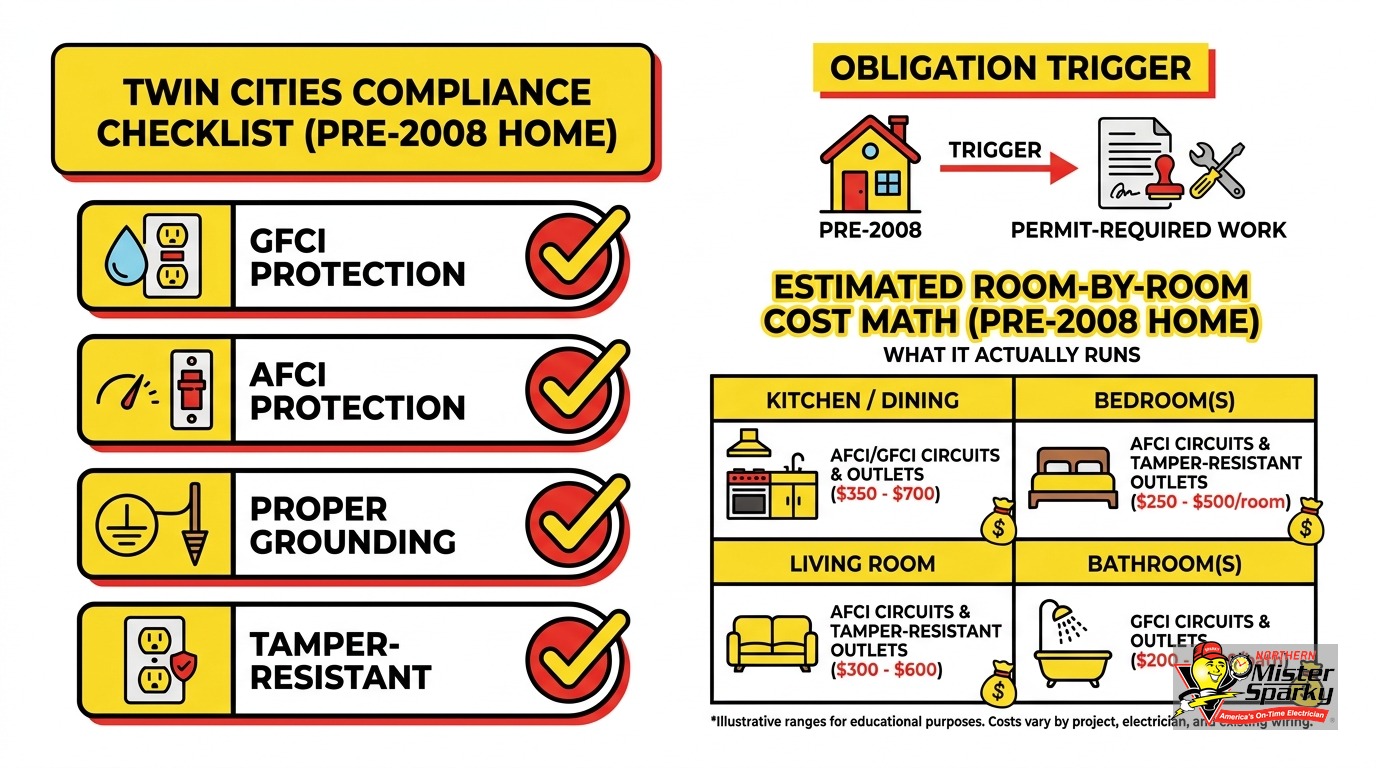
- A pre-2008 Twin Cities home almost certainly lacks AFCI protection outside of bedrooms. Many pre-2000 homes have none at all.
- Minnesota adopted the 2026 NEC on August 17, 2026. Any permit filed after that date must meet the full 14-room AFCI standard.
- No proactive retrofit is required. The code obligation attaches when you pull a permit on a circuit in a covered room.
- Bathrooms, garages, unfinished basements, outdoor circuits, and dedicated 240V appliance circuits are excluded. That exclusion removes four to eight circuits for most homes.
- Whole-house AFCI breaker retrofit cost typically runs $800-$2,500 for a Twin Cities home, depending on circuit count and panel condition.
- A lower-cost alternative exists for extension and modification work: an AFCI receptacle at the first outlet on a branch circuit can satisfy code in some scenarios.
If you own a pre-2008 Twin Cities home, understanding AFCI breaker retrofit cost for your whole house is worth doing before you pull your next permit. This guide gives you the room-by-room circuit math and permit trigger logic that no competitor article provides.
What Is an AFCI Breaker and Why Does It Matter?
An arc-fault circuit interrupter (AFCI) breaker monitors a circuit for the electrical signature of dangerous arcing. Unlike a standard breaker that trips on overload, an AFCI breaker trips when wiring itself is sparking. Arc faults can smolder for hours before a standard breaker notices anything wrong.
Standard breakers protect against overloads and direct short circuits. They do not detect a loose connection behind a wall. They do not detect a nail through a wire. They do not detect insulation that cracked from age and now allows two wires to arc against each other.
CPSC data attributes more than 40,000 residential fires per year in the United States to home electrical wiring. Those fires kill more than 350 people and injure over 1,400 annually. Arc faults are among the leading causes.
A Twin Cities home from 1985 carries its original wiring through decades of thermal cycling, renovation patching, and normal settling. For most circuits in that home, no arc-fault protection is in place.
How Did We Get Here? The NEC AFCI Expansion Timeline
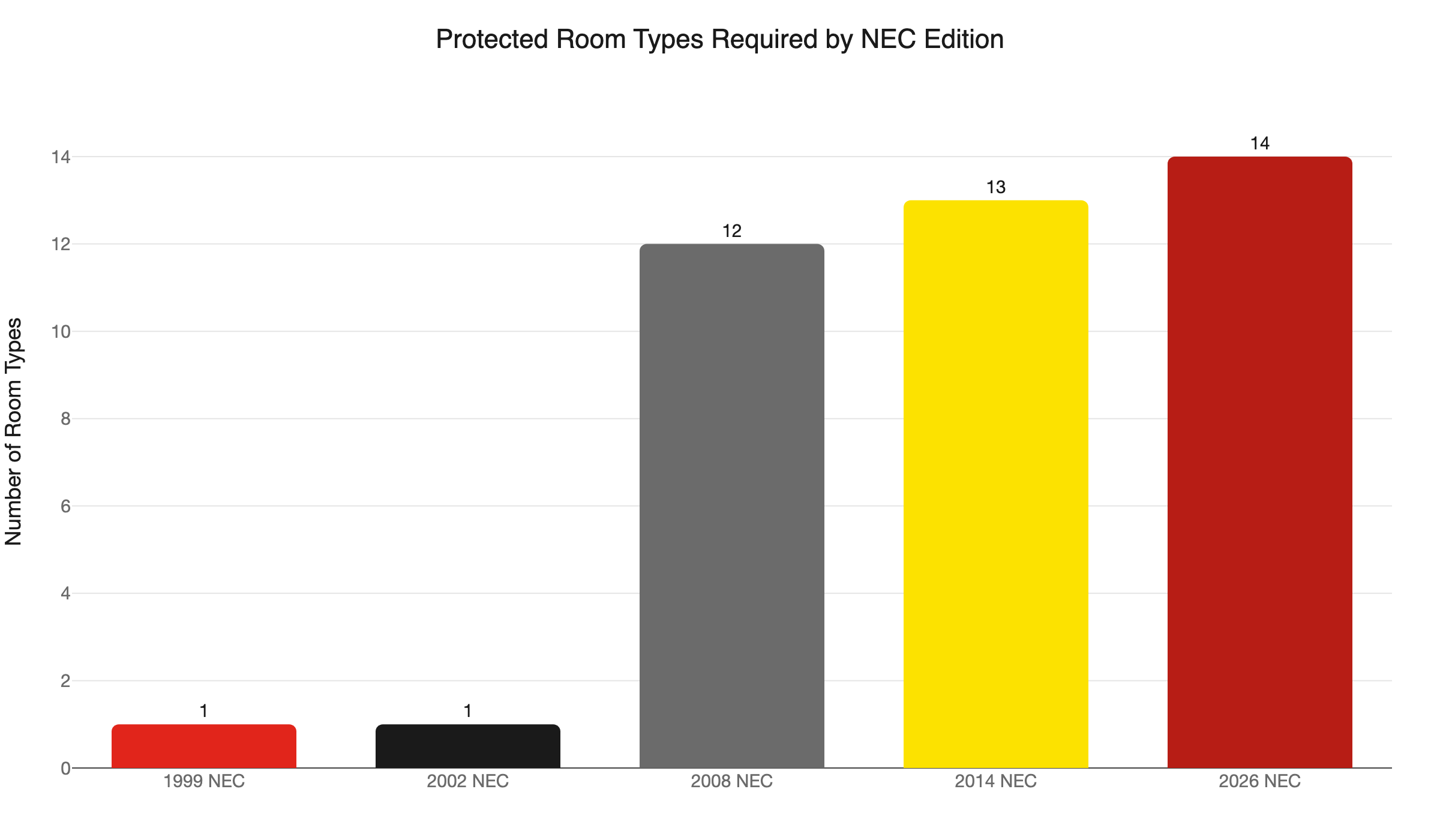
The NEC expanded AFCI requirements in four major stages between 1999 and 2026. A home permitted under the 1999 or 2002 NEC required AFCI only in bedrooms. The 2008 NEC added 11 more room types in a single code cycle. A pre-2008 home has a large compliance gap under current code.
The AFCI requirement has been broadening since its introduction in the 1999 NEC:
1999 NEC: AFCI required in bedroom circuits only. This was new technology, and the code started with the highest-risk sleeping area.
2002 NEC: Still bedrooms, but scope expanded from “receptacles” to “outlets.” That change added hardwired light fixtures, ceiling fans, and smoke detectors in bedrooms to the protected list.
2008 NEC: The significant expansion. Family rooms, dining rooms, living rooms, parlors, libraries, dens, sunrooms, recreation rooms, closets, hallways, and laundry areas were all added in one code cycle. A home built in 2003 might have bedroom AFCI and nothing else. Under today’s code, it has 11 more room types to address.
2014 NEC: Kitchens added. Given the number of circuits a kitchen carries, this was a meaningful addition.
2026 NEC: The current Minnesota standard as of August 17, 2026. Fourteen protected area types, plus “similar areas.” This is the full standard every permit filed in Minnesota must now meet.
A home built in 1990 likely has no AFCI at all. A home built in 2004 might have bedroom-only AFCI. Both face the same gap to close under today’s rules.
For a deeper look at current requirements, see our post on AFCI breaker requirements explained.
What Rooms Require AFCI Protection Under Current Code?
The 2026 NEC requires combination-type AFCI protection in 14 room types. These include kitchens, all major living areas, bedrooms, dining rooms, hallways, closets, and laundry rooms. That covers essentially every finished living space in a typical Twin Cities home. The full list is below.
NEC Section 210.12 defines both the required areas and the device specification. Minnesota adopted the 2026 NEC with no AFCI carve-outs. Permits filed on or after August 17, 2026 must comply.
The full required room list:
- Kitchens
- Family rooms
- Dining rooms
- Living rooms
- Parlors, libraries, dens
- Bedrooms
- Sunrooms
- Recreation rooms
- Closets
- Hallways
- Laundry areas
- Similar areas (finished attics, bonus rooms, home offices)
The “similar areas” clause gives inspectors some discretion. A finished attic used as a home office almost always falls under it. An unfinished utility area does not. Confirm scope with your inspector during the pre-permit conversation when the lines are unclear.
Which Rooms Are Excluded from AFCI Requirements?
Bathrooms, garages, unfinished basements, outdoor circuits, and dedicated 240V appliance circuits are all excluded. Those areas fall under GFCI rules instead. For many Twin Cities homes, this exclusion removes four to eight circuits from the AFCI scope and directly reduces the retrofit bill.
The exclusions are codified in NEC 210.12. Here is what each one means for your cost estimate:
Bathrooms: GFCI protection governs bathrooms. A dedicated bathroom circuit stays out of the AFCI calculation entirely.
Garages: Same logic. GFCI jurisdiction. One or two garage circuits on a typical home panel are not part of the AFCI scope.
Unfinished basements: The utility area - furnace, water heater, utility lighting - is not in the required list. Finish that space into a family room or recreation room, and the new circuits need AFCI. The original utility circuits do not, unless the work disturbs them.
Outdoor circuits: Exterior outlets and landscape lighting fall under GFCI rules, not AFCI.
Dedicated 240V circuits: Your electric dryer, range, water heater, EV charger, and HVAC equipment are on dedicated 240V circuits. None of them require AFCI. In a larger home, that can be four to six circuits you do not need to touch.
In a typical pre-2000 Twin Cities home with a 100A panel and 20-24 circuits, the AFCI scope might realistically cover 12-16 of them after exclusions. Every circuit you do not have to upgrade is roughly $85-$125 you do not spend.
What Actually Triggers the Upgrade Obligation?
Minnesota does not require a proactive AFCI retrofit on existing wiring that was never permitted under current code. The obligation attaches when you pull a permit for circuit work in an affected room. No permit, no upgrade required.
This is the most important fact in the whole discussion, and it is the one competitors never explain.
Here is how it plays out in practice:
Kitchen remodel with a permit: You are adding two circuits, replacing the lighting circuit, and adding a dedicated refrigerator circuit. Your authority having jurisdiction (AHJ) will require all affected kitchen circuits to meet 2026 NEC compliance. That means combination-type AFCI breakers on each one.
Basement finish: You are permitting a family room, a closet, and a laundry room. Every new circuit in those rooms needs AFCI. If the work routes wire through a hallway, the hallway circuit may also be pulled in. Confirm scope with the inspector during the pre-permit walkthrough.
Single outlet addition in a living room: You are pulling a permit to add one outlet. That circuit needs an AFCI breaker at the panel.
Minnesota splits permit authority between the state and local jurisdictions. Minneapolis and St. Paul operate their own inspection offices and are the authority having jurisdiction in those cities. Suburbs typically fall under the state Department of Labor and Industry. Permit fees differ by jurisdiction. The underlying 2026 NEC requirements are the same everywhere in the state.
For more detail on the permit process, see our guide to electrical permits in Minnesota.
AFCI Breaker Retrofit Cost Whole House: The Room-by-Room Math
This is the breakdown no competitor article provides. Your total cost depends on three things: how many circuits need upgrading, whether your panel has space for combination-type breakers, and whether the job is done all at once or circuit by circuit over time.
Hardware cost
Current code requires combination-type AFCI breakers. These meet the UL 1699 standard and detect both series arcing and parallel arcing. Older branch-type AFCI breakers detect only one arc type and fail inspection under current code. Combination-type units run $35-$75 each at retail. Budget $50-$60 per breaker as a working number for most standard residential panel brands.
Labor cost
Licensed electricians in Minnesota run $50-$130 per hour, with a $100-$200 service-call fee for the first hour. A panel breaker swap takes 20-30 minutes when done as part of a batch job. Scheduling a whole-house retrofit as a single visit compresses the per-circuit labor significantly. That is very different from triggering AFCI swaps one at a time across separate permits.
Per-circuit estimate on a batch job:
- Hardware: $50-$65
- Labor (prorated across the batch): $35-$60
- Per-circuit total: roughly $85-$125
Room-by-room circuit counts
How many circuits does each covered room carry? Counts vary by home age, panel capacity, and past renovations. Here are common figures for pre-2008 Twin Cities construction:
- Bedroom (single): 1-2 circuits (lighting and receptacles, sometimes on one circuit)
- Living room or family room: 2-3 circuits
- Dining room: 1-2 circuits
- Kitchen: 3-6 circuits (lighting, two small-appliance circuits, dedicated dishwasher, microwave, sometimes a separate refrigerator circuit)
- Laundry area: 1-2 circuits (lighting and receptacle circuits; 240V washer or dryer circuits are excluded)
- Hallways and closets combined: 1-2 circuits for the floor
- Sunroom or recreation room: 1-3 circuits depending on size
Total estimates by home profile
| Home Profile | AFCI Circuit Count | Estimated Retrofit Cost |
|---|---|---|
| 3-bed / 1-bath, built pre-1990 | 8-12 circuits | $850-$1,500 |
| 3-bed / 2-bath, built 1990-2007 | 12-16 circuits | $1,100-$2,100 |
| 4-bed / 2+ bath, built 2000-2007 | 16-22 circuits | $1,500-$2,800 |
These estimates assume a clean, accessible panel with available breaker slots. If your panel is full, you may need a panel upgrade before or alongside the AFCI retrofit. That is a common finding on 100A service homes in the Twin Cities. A panel upgrade typically adds $1,200-$2,000 to the project scope.
One more variable worth knowing: if your panel uses tandem (piggyback) breakers and is at capacity, combination-type AFCI breakers may not fit in those positions. That is a conversation to have during the estimate, not after the job starts.
Does the Type of AFCI Breaker Matter?
Yes. Current code requires combination-type AFCI breakers, which detect both series arcing and parallel arcing. Older branch-type AFCI breakers detect only one arc type. Installing a branch-type unit fails inspection, even if the homeowner sources it independently.
All major panel manufacturers - Square D, Eaton, Siemens, Leviton - make combination-type AFCI breakers. Your electrician will verify compatibility with your specific panel model before ordering hardware. If you have an older panel brand with known compatibility complications, that conversation happens during the estimate. It does not surface as a surprise mid-job.
Is There a Lower-Cost Option for Modification Work?
Yes, in limited situations. NEC 210.12(D) allows an AFCI receptacle at the first outlet on a branch circuit to satisfy the requirement when modifying or extending an existing circuit rather than replacing it. Hardware cost is $25-$45 versus $50-$65 for a panel breaker.
This option can work when:
- You are adding an outlet to an existing branch circuit in a covered room
- You are extending an existing circuit rather than replacing it from the panel
- The panel is difficult to access or already at capacity
The tradeoff is important. An AFCI receptacle protects wiring from that first outlet forward. The branch run between the panel and the first outlet remains unprotected. For a proactive whole-house retrofit, panel-level combination breakers give broader protection and a cleaner inspection outcome. The receptacle path is a targeted solution for specific modification scenarios, not a substitute for full retrofit.
Are There Any Rebates or Tax Credits?
No. AFCI upgrades are not covered by Xcel Energy’s residential rebate program or the IRS energy-efficient home improvement credit (Section 25C). AFCI protection is a code-compliance safety measure, not an energy-efficiency improvement. There is no financial help available for this work.
This makes the permit-trigger timing strategy more useful. Plan AFCI work to coincide with a remodel where the cost is already in the budget. The hardware and labor are the same whether the work is bundled into a kitchen remodel or done as a standalone project. The project management overhead is smaller when it is part of a larger job.
If AFCI upgrades are part of a broader panel upgrade that also includes energy-efficiency improvements, ask your electrician whether any portion of the larger project qualifies for separate incentives. The AFCI line item itself will not.
Should You Do a Proactive Whole-House AFCI Retrofit?
It depends on your home’s age and your remodel timeline. If you own a pre-1990 home with original wiring and no planned remodel, the safety case for acting now is strong. If a remodel is coming in the next one to two years, bundling the retrofit into that project saves money.
Here is the practical framing:
Remodel coming soon: Get an estimate that shows both the partial retrofit (remodel-triggered circuits only) and the full whole-house number. The incremental cost of doing the rest of the house at the same time is usually small. You pay one service call, one panel opening, and one inspection instead of two or three.
No remodel planned, older home: A 1975 Twin Cities home with original wiring has arc-fault risk in circuits that no future permit will ever touch. Those circuits are grandfathered under current code. They are also 50 years old. Proactive AFCI protection there is a genuine safety investment, not just a compliance exercise.
Home sale in the next few years: Buyers today are more likely to request electrical inspections before closing. Updated AFCI coverage is a positive item on an inspection report. An older panel with no AFCI protection is a negotiating point.
There is no malarky about the tradeoff. The right answer depends on your house, your plans, and your timeline. What we can do is walk through your panel, give you a circuit-level count, and show you both scenarios with firm numbers.
If you already have AFCI breakers and they trip unexpectedly, that is a separate issue from retrofit cost. See our guide on AFCI breaker nuisance tripping troubleshooting for the common causes and fixes.
Get Your AFCI Breaker Retrofit Cost Estimate
AFCI breaker retrofit cost for a whole house is not a number you can reliably read off a generic cost article. It depends on your actual circuit count, your panel brand and capacity, and whether a panel upgrade belongs in the same project scope.
As Northern Mister Sparky, locally owned and operated in the Twin Cities, we walk through your panel, give you a circuit-level scope, and deliver a firm estimate before any work starts. No surprises. That is what being “America’s On-Time Electrician(R)” means here, and the UWIN(R) 100% satisfaction guarantee backs every job we do.
Call us at 763-200-5956 or book online. We serve Minneapolis, St. Paul, Bloomington, Brooklyn Park, Woodbury, Blaine, Maple Grove, Plymouth, and the surrounding Twin Cities area.
Frequently Asked Questions
How much does a whole-house AFCI retrofit cost in the Twin Cities? +
Am I legally required to retrofit my existing home with AFCI breakers? +
Which rooms do NOT require AFCI breakers? +
What is the current Minnesota AFCI code requirement? +
Need an electrician now?