
Why AFCI Breaker Nuisance Tripping Happens in Older Homes
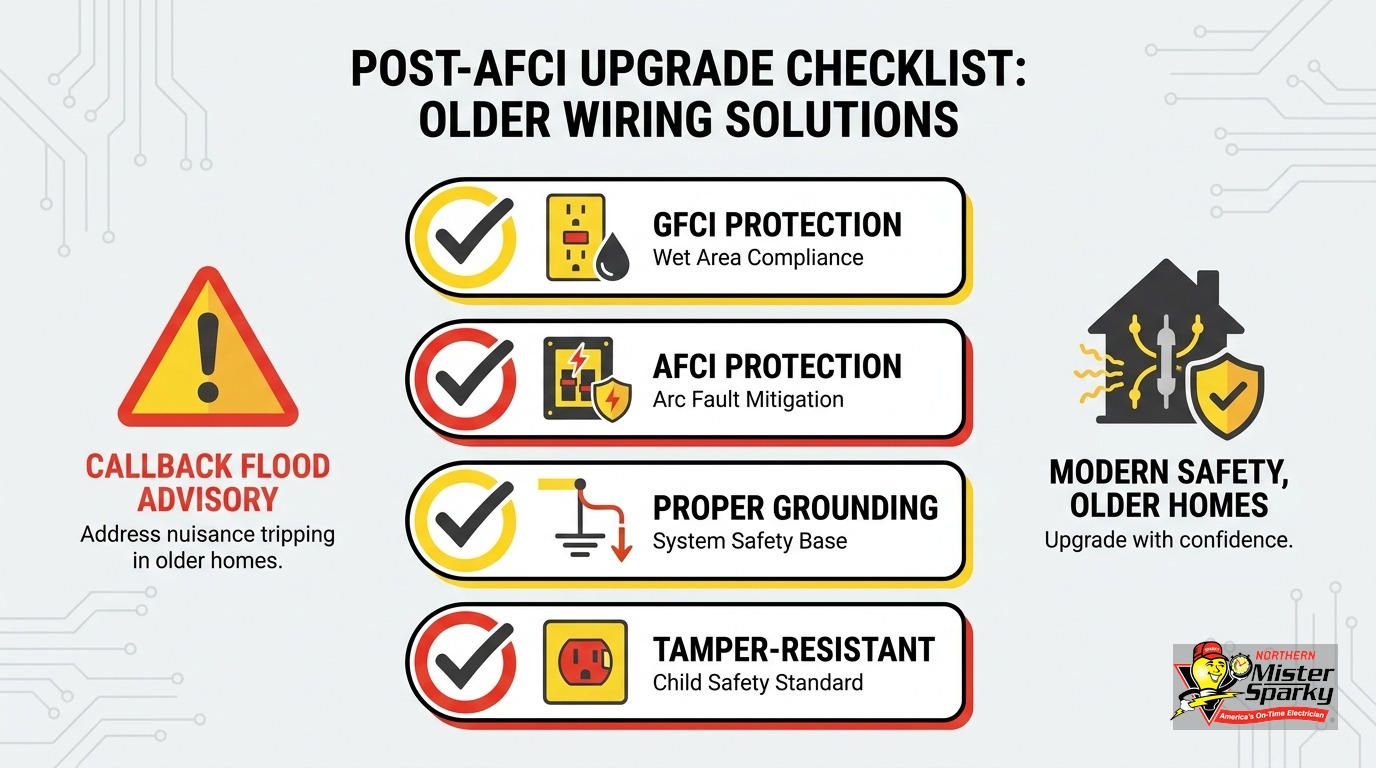
Key Takeaways
- AFCI breakers detect arc faults, not just overcurrent. A trip is never random.
- Instant tripping when a load is applied points to a real wiring fault. Call before resetting again.
- Persistent random tripping after 30 days suggests a false positive or an unresolved wiring configuration.
- One to three trips in the first month is within normal range in pre-1970 Twin Cities homes.
- The two most common causes are shared-neutral (multi-wire branch) circuits and incompatible devices like older dimmers.
- Aluminum branch wiring, common in 1960s-1970s Twin Cities construction, requires approved connection hardware before and after AFCI installation.
- Minnesota permits filed on or after August 17, 2026 fall under expanded 2026 NEC AFCI requirements covering nearly every room in a dwelling.
What Causes Nuisance Trips With Arc Fault Breakers?
Arc fault breakers trip because of multi-wire branch circuits in pre-1980 homes (the most common cause in the Twin Cities), electrical noise from older dimmers or aging LED drivers, or genuine wiring faults the previous breaker was never detecting. House age and wiring era determine which cause applies.
AFCI breaker nuisance tripping is the most common callback after a panel upgrade in the Twin Cities. Your electrician did not install the breaker incorrectly. The technology is working as designed. The problem is that the wiring it is now protecting was installed before the technology existed.
Arcing faults start more than 28,000 home fires annually in the United States, killing and injuring hundreds and causing over $700 million in property damage. AFCI breakers exist to catch those fires before they start. A standard breaker only trips on overcurrent - too many amps. An AFCI breaker monitors the waveform of electricity moving through the circuit and looks for the high-frequency signature of arcing: the kind that ignites wall insulation years before your amps ever spike.
Here is what the top search results rarely say clearly: some trips that feel like nuisances are not false positives at all. A loose termination in a 1968 outlet box generates a genuine arc signature. The AFCI is doing exactly what it was designed to do. The previous breaker was missing that connection failure for years. That loose wire is a fire hazard, not a false alarm - and the AFCI trip is the first sign it exists. If you have a pre-1980 home and an AFCI is tripping consistently on the same circuit, do not assume sensitivity is the problem. Have the circuit inspected before resetting again.
The wiring configurations that produce actual false positives - circuits the AFCI misreads as faulted when nothing is wrong - are a different problem. They are real, they are common in older Twin Cities homes, and they have specific fixes.
In Minnesota, more than half of all homes were built before 1979, and nearly half of all owner-occupied homes nationally share the same vintage. In the Twin Cities, the housing stock tilts heavily toward pre-1970 construction: craftsman bungalows in South Minneapolis and St. Paul’s Mac-Groveland neighborhood, Cape Cods and ramblers in Bloomington and Richfield, split-levels in Brooklyn Park, Blaine, and Plymouth. That cohort is exactly the era of multi-wire branch circuits, aluminum branch wiring, and knob-and-tube remnants in attic spaces. If you are in one of those homes and you just had AFCI breakers installed, the chances of hitting at least one wiring condition that causes tripping are high.
This article gives you the decision tree the top search results skip: how to tell a real hazard from a false positive, what the main causes look like in an older Twin Cities home, and what the fix for each one requires.
Is the Breaker Finding a Real Problem or a False Alarm?
The timing of the trip tells you which conversation you are having. Instant tripping on any load means the breaker found a real wiring fault. Persistent random tripping after a 30-day shakedown period is more consistent with a false positive from an incompatible device or wiring topology. The two patterns need different responses.
Instant trip on load - You apply a load, the breaker trips within seconds. You reset it; it trips again before anything gets warm. A few possible causes:
- A ground-to-neutral short somewhere on the circuit
- Severely degraded wire insulation that reads as continuous arcing
- A shared-neutral multi-wire branch circuit the single-pole AFCI cannot reconcile
Do not keep resetting. Call an electrician and describe the timing precisely. Instant tripping under any load, even with most devices unplugged, is a red flag that warrants hands-on diagnosis before the breaker is reset again.
Persistent random tripping, same circuit, 30-plus days post-install - The breaker trips unpredictably. Sometimes in the middle of the night with no obvious load running. Sometimes when a specific lamp or appliance is on. This pattern points toward a false positive: a device generating noise that mimics an arc signature, or a wiring configuration creating a current imbalance the breaker misreads as arcing.
You have time to run the isolation sequence below before calling. The tripping is still a signal worth investigating, but you are not in emergency territory.
Two patterns call for a different approach before you start that sequence. If your home has active knob-and-tube wiring, treat any AFCI trip as a likely real fault rather than a nuisance. The wiring age and condition make genuine arc detection more probable than false-positive sensitivity. If you have aluminum branch wiring and trips increase in winter or after the first hard cold snap, thermal cycling at connection points is the more likely cause than device noise. The knob-and-tube and cold climate sections below explain both.
What Is the 30-Day Shakedown Period?
In older Twin Cities homes, one to three AFCI trips in the first month after installation is within normal range. The breaker is encountering decades of accumulated wiring quirks for the first time. That window does not mean the trips are harmless - it means they warrant documentation and tracking, not panic.
Pre-1970 Minneapolis and St. Paul homes have layers. Knob-and-tube remnants survive in attic spaces where no one has been since the Eisenhower administration. Multi-wire branch circuits run the kitchen and dining room off a shared neutral installed in 1958. Aluminum branch wiring feeds the bedrooms added in 1967. Each condition can generate a trip in the first month as the AFCI adjusts to what the circuit’s electrical environment looks like at rest and under load.
The baseline to use: one to three trips in month one is a watch-and-log situation. More than three trips in the first month, or any trip that occurs the instant a load is applied, moves into intervention territory regardless of the calendar.
What to log before calling: which circuit, which device was running (or whether nothing was running), and whether the trip was instant on load or happened after the circuit had been running. That record cuts service call diagnostic time in half.
Does Knob-and-Tube Wiring Cause AFCI Nuisance Tripping?
In knob-and-tube circuits, AFCI trips are more often real arc events than false positives. The wiring is ungrounded and has no path to redirect fault current away from a failing connection. The original cloth and rubber insulation has been deteriorating for 70 to 100 years. Cracked or compressed insulation is a live arcing hazard. When the breaker trips on one of these circuits, it is likely detecting something real.
Knob-and-tube wiring is still present in a significant share of Twin Cities homes built before the 1950s, and most of those homes were never fully rewired. The wiring may have been buried under blown-in insulation during an energy-efficiency project, which creates a separate hazard: the Minnesota Center for Energy and Environment notes that insulation contractors will not insulate spaces with active knob-and-tube wiring because the system requires air circulation to dissipate heat. Covering it traps heat and accelerates insulation breakdown.
Installing an AFCI breaker on a knob-and-tube circuit does two things at once. It provides detection that was never there before, and it immediately starts reporting what that wiring has been doing for decades. The result looks like nuisance tripping. It is closer to a diagnostic readout. Each trip is the breaker reporting that a fault exists somewhere on the circuit.
This changes how you should respond. With a newer copper-wired circuit and no obvious device culprit, the isolation sequence in the diagnosis section below is the right first step. With a knob-and-tube circuit, that sequence is not the right path on your own. The faults are often inside walls, above ceilings, or in junction boxes that have not been opened since the original installation. A licensed electrician should inspect and trace the circuit rather than you resetting and retrying.
If your panel upgrade revealed knob-and-tube on circuits you were not aware of, ask your electrician to document which circuits are affected and assess the condition of the wiring. That inventory is the starting point for a remediation conversation. Knob-and-tube is not automatically disqualifying for AFCI installation, but it does change what trips mean and how you should act on them.
Why Do Multi-Wire Branch Circuits Cause AFCI Nuisance Tripping?
A multi-wire branch circuit shares one neutral conductor between two hot legs. An AFCI breaker monitors current leaving on the hot and returning on the neutral. When two circuits share one neutral, return current splits between them. The breaker reads the imbalance as an arc-fault signature and trips. The fix is a two-pole AFCI breaker that monitors both hot legs and their shared neutral simultaneously.
This is the dominant cause of persistent AFCI tripping in Twin Cities homes built before 1980, and competitors routinely understate how common it is. Multi-wire branch circuits were standard electrical practice from the late 1940s through the early 1980s. They saved wire, they were cost-effective, and they met the code of the day. Every split-level in Blaine, every rambler in Richfield, and every craftsman in South Minneapolis that was wired to code in 1965 likely has at least one. When a homeowner replaces a panel with AFCI breakers and a single-pole breaker lands on a shared-neutral circuit, the tripping begins the same day and does not stop until the configuration is corrected. No amount of resetting changes that.
As AFCI breakers entered wider use, electricians also discovered neutral conductors for different circuits spliced outside the panel - a practice that had never been code-compliant but had caused no problems with older breakers. AFCIs flagged it immediately.
The wiring in a standard MWBC configuration is not necessarily a fire hazard on its own. But it is incompatible with a single-pole AFCI breaker monitoring only one side of the shared circuit.
Fix options:
- Replace the two individual single-pole AFCI breakers with one two-pole AFCI breaker. The two-pole unit monitors both hot legs and the shared neutral as one system. The current imbalance disappears from the breaker’s perspective.
- Run a dedicated neutral for each circuit. More labor-intensive, but sometimes necessary if the panel does not have adjacent slots for a two-pole unit.
Our AFCI breaker requirements explainer covers which circuit types require protection under Minnesota code and how the 2026 NEC expansion changes the scope for new permits.
Does the Age of Your AFCI Breaker Affect How Often It Trips?
Yes. AFCI discrimination algorithms improved significantly through the 2017 and 2020 NEC product generations. Newer breakers distinguish better between a genuine arc signature and the noise a motor, dimmer, or aging LED driver produces. An older-generation AFCI installed during a recent upgrade will trip on false positives more often than a current-generation unit would on the same circuit.
The technical distinction matters here. Early AFCI breakers installed before the 2008 NEC requirements were “branch-only” or “feeder” type units. They protected from the panel to the first outlet on the circuit, but not from that outlet to devices or along cord sets. Current “combination-type” AFCIs protect the entire circuit from the panel to every outlet and device, including cords and fixture wiring. The combination type also uses improved arc discrimination algorithms that filter known appliance noise patterns more reliably.
Manufacturers continuously update breaker firmware to log appliance-specific noise signatures and filter known false-positive patterns. A breaker built to the 2014 NEC product standard does not have the same catalog of known-good appliance signatures as one built to the 2020 standard. It will trip on devices the newer unit would recognize and ignore.
Appliance signatures from vacuum cleaners, treadmills, and brushed electric motors are logged into device memory so the breaker can distinguish those electrical signatures from real arc conditions. A branch-only unit from 2006 or 2007 predates this approach entirely.
This matters in two situations:
Recent panel upgrade with an older-stock breaker. If your electrician installed a breaker that had been sitting in inventory for several years, it may not include the latest discrimination improvements. This is uncommon, but worth asking about if tripping continues after other causes are ruled out.
Original AFCI install from 2005 to 2012. Early AFCI breakers had broader sensitivity thresholds. They tripped on some motor loads, older refrigerators, and certain vacuum cleaners that current-generation units handle without issue. If you have first-generation AFCI breakers and persistent nuisance tripping, upgrading to a current-generation combination-type unit is a reasonable diagnostic step - but do this after wiring configuration issues (shared neutrals, aluminum connections) are addressed first. Swapping the breaker without fixing the underlying wiring accomplishes nothing.
Does Aluminum Wiring Make AFCI Nuisance Tripping Worse?
Yes, and the concern goes beyond nuisance tripping. Aluminum-wired homes are 55 times more likely to have fire-hazard conditions at connections than copper-wired homes. Connecting an AFCI breaker directly to aluminum wire without approved connection hardware can create an overheating hazard at the breaker terminal itself, turning a safety upgrade into a new risk.
CPSC data on aluminum branch wiring documents that 55-times elevated risk at connection points. The mechanism is straightforward: aluminum expands and contracts more than copper under electrical load. Over time, that movement loosens connections. Loose connections arc. An AFCI on an aluminum circuit will catch arcing at a failing connection. That is the breaker doing its job. But catching the arc is not fixing the connection. The underlying hazard remains and will continue to degrade.
Twin Cities homes built between the mid-1960s and late 1970s frequently used aluminum for branch-circuit wiring. Split-levels in Blaine, Plymouth, and Woodbury. Ramblers in Roseville and Richfield. Copper prices had risen sharply and aluminum met the electrical code of the day. The problem surfaced later as connections began to fail.
Minnesota’s climate amplifies this. The seasonal temperature swing from -30°F in winter to 95°F in summer means connections in an aluminum-wired home cycle through roughly 125 degrees of expansion and contraction every year. The cold climate section below covers what to watch for as a seasonal tripping pattern.
The correct approach for aluminum-wired circuits:
- Use AlumiConn connectors or COPALUM crimp splices at every device, fixture, and receptacle on the circuit. These are the two CPSC-approved connection methods for aluminum branch wiring.
- Remediate the connections before the AFCI breaker is installed, not after.
- Installing the breaker without addressing the connections is not a safe fix. It adds detection without removing the hazard.
If your home has aluminum wiring and you are experiencing AFCI trips, our aluminum wiring dangers and fixes guide covers what proper remediation looks like and what it typically costs in the Twin Cities.
Does Minnesota’s Cold Climate Affect AFCI Tripping?
Yes, and this is a cause of genuine arc events that no amount of breaker sensitivity adjustment will fix. Minnesota’s temperature range - roughly -30°F in winter to 95°F in summer - produces approximately 125 degrees of seasonal temperature swing. Metal connections expand with heat and contract with cold. Every outlet box, switch, junction box, and panel lug in an older Twin Cities home goes through that cycle year after year, decade after decade.
The result is connections that work loose over time without anyone touching them. A loose connection generates a real arc signature. Not a false positive, not a nuisance trip - an actual arc fault the previous breaker was unable to detect.
Aluminum wiring amplifies this effect significantly because it expands and contracts at a higher rate than copper under electrical load. A home with aluminum branch wiring in Blaine or Plymouth that has gone through 50 Minnesota winters has connections that have cycled through far more thermal movement than a comparable home in a mild climate. But this is not only an aluminum-wiring problem. Copper connections in pre-1970 outlet boxes with original push-in wire connectors can also loosen through thermal cycling. The connection type matters, not just the wiring material.
A pattern worth paying attention to: if an AFCI breaker trips more frequently in January and February than in July and August, and the trips are on the same circuit, that is a thermal cycling signal. Cold contraction may be opening the connection just enough to arc under load. Resetting the breaker does not fix the connection. Warmer weather may reduce tripping temporarily as the connection expands back into contact - which can make the problem seem resolved when it is not.
What to tell your electrician: note whether tripping started or worsened after the first hard cold snap of the year, and which circuit is involved. That pattern, combined with the presence of aluminum wiring or older outlet hardware, helps narrow the inspection to likely failure points before any panels are opened.
Why Do Dimmers and LED Drivers Trigger AFCI Breakers?
Older dimmers chop the AC voltage waveform to control brightness. That chopping generates radio-frequency noise. Aging LED drivers amplify the noise. An AFCI breaker reads the noise signature as an arc fault and trips. The fix is replacing the dimmer with an AFCI-rated model and, where needed, replacing aging LED bulbs or drivers.
Older dimmers and aging LED drivers produce electrical noise that closely mimics arc-fault signatures. The AFCI breaker cannot reliably distinguish between the two. It responds the only way it knows how.
This is the easiest nuisance-tripping cause to resolve:
- AFCI-rated dimmers filter their own switching noise before it reaches the breaker. Hardware cost is typically $20 to $50 per dimmer.
- Aging LED bulbs with failing drivers generate more noise as they degrade. Replacing the bulb resolves the noise source at minimal cost.
- If a specific dimmer circuit trips reliably when a particular set of lights runs, that is your candidate. Swap the dimmer first. If trips stop, the dimmer was the cause.
For a closer look at which replacement dimmer types work with which LED drivers before you buy, our LED dimmer switch compatibility guide walks through what to look for.
Can Utility Line Equipment Cause AFCI Nuisance Trips?
In rare cases, yes. AFCI breakers can detect arc signatures from switching activity on the utility distribution system. Reclosers, switched capacitor banks, and other line protection equipment produce transients that enter a home’s wiring and look like arc events to a sensitive breaker.
If a home sits near utility distribution equipment and experiences intermittent AFCI trips on circuits with no identifiable device load, the utility should be contacted to inspect nearby line protection devices. This is not a common scenario, but it is one that in-home wiring inspection and device isolation will not resolve, because the source is outside the house.
Signs this may be the cause:
- Trips are completely random and span multiple circuits, not isolated to one.
- Trips happen at night with no devices running on any affected circuit.
- Neighbors report power quality issues or flickering lights at similar times.
Contact your utility - Xcel Energy for most of the Twin Cities metro, or your rural electric cooperative if you are outside the core service area - and ask for a power quality log. If switching events on their system correlate with your trip timestamps, that is your answer. The fix is on their side of the meter.
How Do You Diagnose AFCI Nuisance Tripping?
Work through a five-step isolation sequence: identify which circuit is tripping, document when it trips relative to load, unplug devices one by one to isolate the source, inspect connections at every device on the circuit, and note whether a shared neutral may be present. That log cuts diagnostic time on a service call significantly. Swapping the breaker comes last, not first.
Step 1: Identify the circuit. Which breaker is tripping? If your panel is unlabeled, that is the place to start. A labeled panel makes every future troubleshooting conversation faster and cleaner, not just this one.
Step 2: Document the timing. Does the trip happen the instant a load is applied, or after the circuit has been running for a while? This single data point shapes everything that follows. Write it down with a time stamp.
Step 3: Isolate the load. Unplug everything on the circuit. Reset the breaker. Add devices back one at a time, running each for a few minutes before adding the next. If a specific device triggers the trip, that device is the most likely cause: an incompatible dimmer, an aging LED driver, or a motor load such as a vacuum, power tool, or older appliance.
Step 4: Inspect connections. If the breaker trips with everything unplugged, the fault is in the wiring, not a device. Every receptacle, switch, and fixture on the circuit is a candidate for a loose termination or nicked wire insulation. Also check for neutral-to-ground contact at any receptacle or junction box. These are hands-on inspections - if you are not comfortable pulling devices, this is where to call an electrician rather than continuing on your own.
Step 5: Note whether a shared neutral may be present. Two breakers in adjacent slots sharing one neutral wire going to the neutral bus is a multi-wire branch circuit. You will not be able to confirm this without pulling the panel cover - do not do that yourself. But noting that the two circuits serve adjacent areas of the house is useful context for an electrician.
If the breaker trips instantly with everything unplugged, stop the sequence and call. A breaker tripping on zero load has found a wiring fault inside the walls that requires hands-on diagnosis. The breaker itself is the last thing to swap - only after wiring configuration issues and device-level causes are ruled out completely.
What Changed With the 2026 Minnesota Electrical Code?
Minnesota adopts the NEC as published by NFPA with no AFCI-specific state amendments. Permits filed on or after August 17, 2026 fall under the 2026 NEC, which expands AFCI requirements to virtually every habitable room in a dwelling. If you are scheduling a panel upgrade, room addition, or remodel right now, confirm with your electrician which permit date governs your specific project.
The 2026 NEC Section 210.12 requires AFCI protection on all 120-volt, 15- and 20-amp branch circuits supplying outlets or devices in bedrooms, living rooms, family rooms, dining rooms, kitchens, hallways, laundry rooms, closets, bathrooms, and more. Previous versions covered a narrower set of spaces, primarily bedrooms. The 2026 expansion - which adds bathrooms to the required list for the first time - is the most significant broadening of AFCI requirements since the standard first entered the NEC in 1999. Minnesota’s adoption of the 2026 NEC took effect August 17, 2026, applying the bathroom requirement immediately to all permitted work filed on or after that date.
The retrofit trigger is the part most homeowners doing any electrical work right now need to understand. NEC 210.12(D) requires AFCI protection whenever an existing branch circuit in a covered area is modified, replaced, or extended - regardless of when the home was built. If your electrician adds a receptacle to a bedroom circuit, extends a kitchen branch circuit, or replaces wiring in any covered space under a new permit, AFCI protection is required on that circuit. House age does not create an exemption. Many homeowners first encounter AFCI trips after a simple receptacle swap, because that repair triggered an AFCI upgrade on the entire circuit. The only narrow exemption is for extensions under six feet that add no new outlets or devices. Short patch work and minor tap connections within that limit do not trigger the requirement. Any work beyond that threshold - and any project in a newly covered space like a dining room, living room, or bathroom - requires AFCI protection under the 2026 NEC.
The NFPA recommends AFCI protection in all dwellings, not only new construction, because cord damage and hidden wiring faults occur regardless of a home’s age. The 2026 NEC expansion moves code requirements closer to that recommendation. For older Twin Cities homes, this means that any permitted electrical work - not just a full panel upgrade - is increasingly likely to trigger an AFCI requirement on the affected circuits.
Minnesota’s electrical code is Chapter 1315 of the State Building Code, which adopts the NEC directly. The 2026 expansion applies exactly as written, without state carve-outs.
St. Paul homeowners can reference the DSI AFCI protection guidance document for city-specific context on how the requirements apply locally.
The August 17 permit cutoff has practical consequences right now. If your contractor pulled the permit before that date, your project runs under the prior code. Permits on or after that date require the expanded room-by-room coverage, including bathrooms. The scope difference is significant. Ask specifically, not generally.
When to Call a Licensed Electrician
Call before resetting the breaker again if any of these are true:
- The breaker trips instantly when any load is applied, even with most devices unplugged.
- Your home has aluminum branch wiring and the AFCI is tripping on an aluminum circuit.
- Your home has active knob-and-tube wiring and the AFCI has tripped on that circuit.
- The breaker has tripped more than three times in the first month.
- You have identified a shared-neutral circuit and need the two-pole AFCI replacement confirmed and installed.
- The breaker trips while the circuit is idle and no devices are running.
- You notice a burning smell, hear buzzing from the panel, or see scorch marks near any breaker.
The last set of symptoms is not a nuisance-tripping situation. Shut off the affected circuit and call immediately. Do not reset.
For everything else - confirmed dimmer incompatibility, identified shared-neutral circuit, aluminum wiring that needs connection remediation - the fix is usually one service call. We carry two-pole AFCI breakers and AFCI-rated dimmers on our trucks, and we know the wiring configurations common to Twin Cities homes because we work in them every week.
We are Northern Mister Sparky, locally owned and operated in the Twin Cities. Every job is backed by the UWIN(R) 100% satisfaction guarantee. If your AFCI breaker keeps tripping after our visit, we come back. No malarky.
Call 763-200-5956 or book online to schedule. If your project involves a larger panel upgrade or new circuits, ask about financing options when you call.
Frequently Asked Questions
Will AFCI breaker nuisance tripping stop on its own? +
Can I replace a breaker myself to fix AFCI nuisance tripping? +
How much does it cost to fix AFCI nuisance tripping in the Twin Cities? +
Do AFCI breakers protect against overloaded circuits? +
Need an electrician now?