
Level 1 vs Level 2 EV Charger at Home: Which Do You Need?
Key Takeaways
- Level 1 (120V) adds roughly 3-5 miles of range per hour. It works for drivers who commute under 40 miles daily and park for 8 or more hours overnight.
- Level 2 (240V) adds roughly 10-30 miles per hour, depending on the EVSE output and your car’s onboard charger. It is the right fit for longer commutes, large-battery EVs, and Minnesota winters.
- Minnesota’s average January low sits near -3°F. Cold weather cuts lithium-ion battery capacity by 20-40%. A Level 1 setup that handled your fall commute may come up short in January.
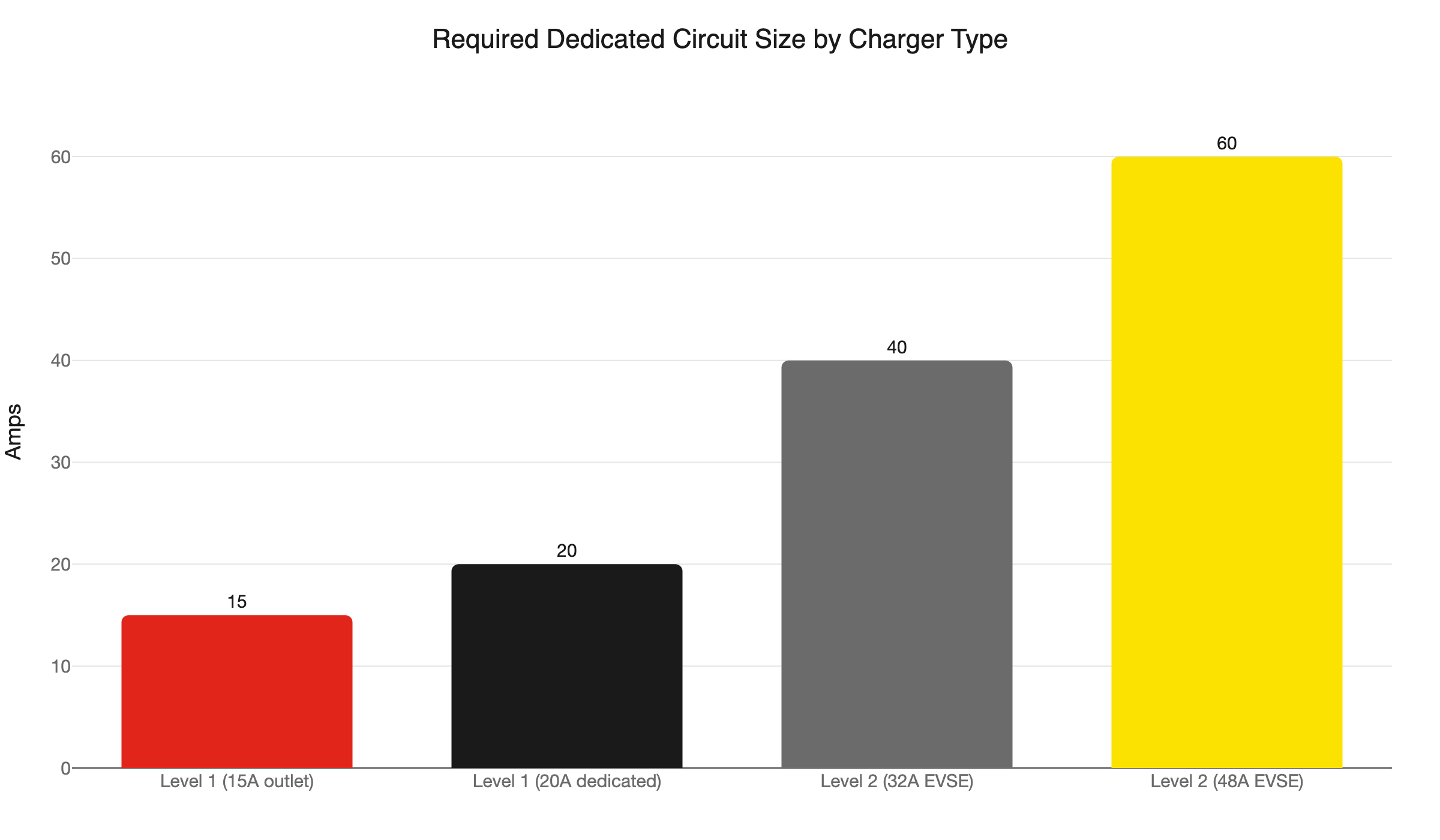
- NEC 625.42 requires EV charging circuits to be rated at 125% of the charger’s continuous draw. A 32-amp EVSE requires a 40-amp dedicated circuit. A 48-amp unit requires 60 amps.
- The label on your panel is a starting point, not a verdict. Only a load calculation tells you whether your service has room for a new EV circuit.
- All residential EV charger installations in Minnesota require a permit and a licensed electrical contractor. No exceptions.
- The federal 30C tax credit was restricted in 2022. Most Twin Cities metro addresses no longer qualify based on census tract location.
- Check your utility’s EV rate program before your install. Off-peak overnight charging can reduce your operating cost in ways a one-time rebate never could.
The level 1 vs level 2 EV charger home decision looks straightforward on paper. Speed numbers are easy to find. The harder questions get far less coverage. Does your panel have room? Does a Minnesota winter change the calculation? Does the federal tax credit still exist? We are Northern Mister Sparky, locally owned and operated in the Twin Cities. EV charger installations are a regular part of our work, and we run a load calculation on every one.
What Is the Difference Between Level 1 and Level 2 EV Charger at Home?
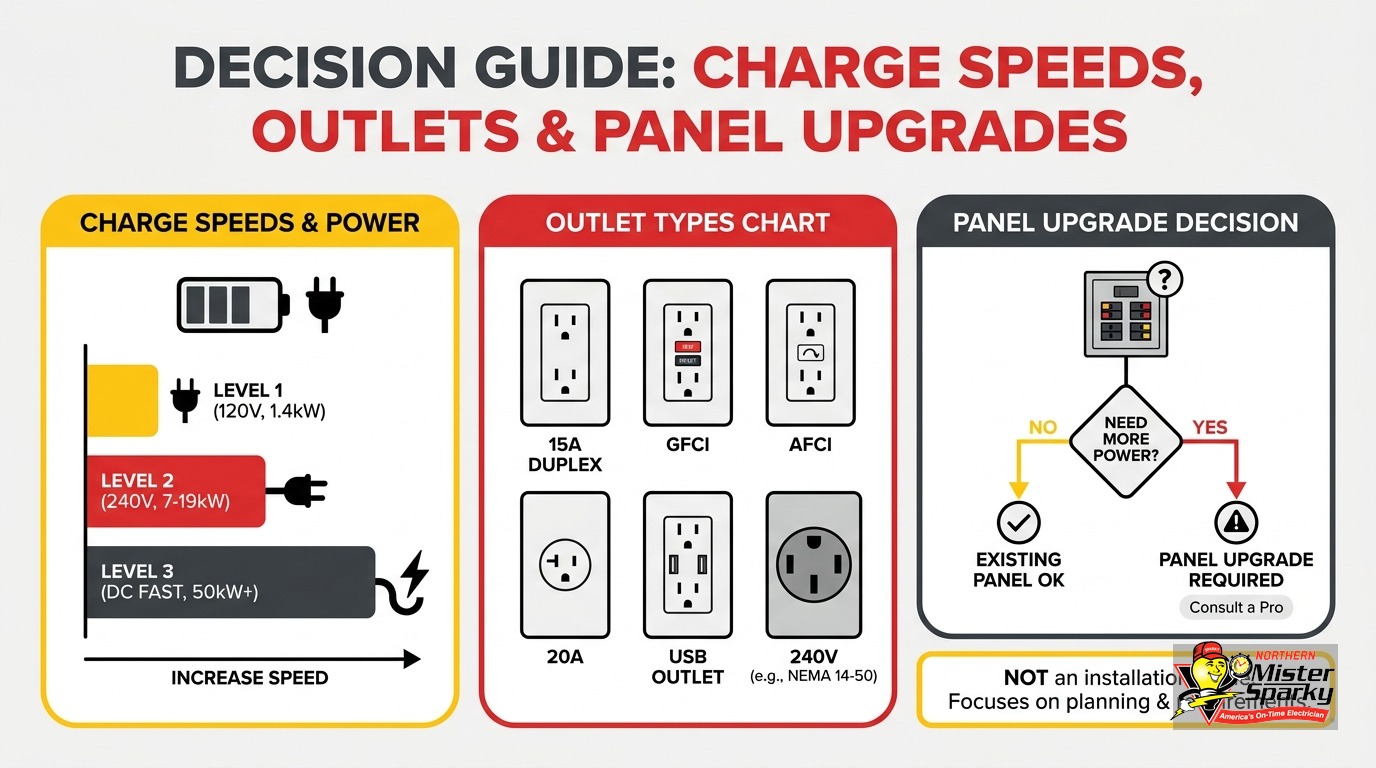
Level 1 uses a standard 120V outlet to add about 3-5 miles of range per hour. Level 2 uses 240V to add 10-30 miles per hour. Both charge the same battery. The difference is voltage, circuit requirements, equipment, and what your car’s onboard charger can actually accept.
According to the U.S. Department of Energy’s Alternative Fuels Data Center, Level 1 charging requires only a standard household outlet on a dedicated branch circuit. No new 240V wiring. No wall-mounted EVSE unit beyond the cord that shipped with your car. Simple, low-cost, and slow.
Level 2 requires a 240V circuit, a wall-mounted EVSE unit, and a dedicated circuit sized to that unit. The most common residential EVSE draws 32 amps and needs a 40-amp circuit. Higher-output units drawing 48 amps require a 60-amp circuit. The EVSE typically mounts in the garage and connects through a NEMA 14-50 outlet or is hardwired directly.
The speed ceiling on Level 2 depends on two variables: how much power the EVSE outputs, and how much the car’s onboard charger can accept. Most EVs accept 7.2 kilowatts on Level 2, which translates to roughly 20-25 miles of range per hour. Some accept 11 kilowatts or more. A few accept only 3.3 kilowatts.
This distinction matters when comparing EVSE quotes. A higher-amperage unit delivers no speed benefit if your car cannot use the extra power. Confirm your vehicle’s onboard charger rating before sizing up.
Is Level 1 Charging Fast Enough for Your Daily Drive?
If your daily round-trip is under 40 miles and you park overnight for 8 or more hours, Level 1 is likely sufficient. If your commute is longer, your battery exceeds 60 kWh, or your schedule is unpredictable, Level 2 is the practical answer.
A standard 10-hour overnight Level 1 session adds roughly 40-50 miles of range. That covers the average Minnesota commute with room to spare. For a homeowner who drives 18 miles each way, parks in an attached garage every night, and plugs in before 10 p.m., Level 1 may be entirely adequate.
Battery capacity changes the equation quickly. A small plug-in hybrid with a 12 kWh battery reaches a full charge on Level 1 in under three hours. A midsize EV with a 65 kWh battery needs 13 or more hours on Level 1 to recover from empty. A large-battery EV truck carrying 200 kWh of capacity needs more than two full days on Level 1 to charge from empty.
Schedule matters just as much as battery size. If you return home late on some nights and need a full charge before an early departure, Level 1 leaves almost no margin. Level 2 compresses that recovery window. A 65 kWh battery goes from empty to full in roughly 5-7 hours on a standard Level 2 setup.
Future-proofing is also worth considering. Many households will add a second EV, replace a plug-in hybrid with a full EV, or move to a larger-battery vehicle over the next few years. A Level 2 circuit handles all of those scenarios without additional work. Level 1 becomes a workaround the moment your situation changes.
One thing that often gets missed: Level 1 still requires a dedicated circuit. Running an extension cord from a shared household outlet violates code and creates a fire risk. A licensed electrician should install the dedicated circuit regardless of which level you choose.
Does Minnesota Winter Change the Level 1 vs Level 2 EV Charger Decision?
Yes, and significantly. Cold weather reduces battery capacity by 20-40%. Battery pre-conditioning on Level 1 can offset overnight charging gains entirely. For Minnesota homeowners, winter is one of the strongest arguments for Level 2.
DOE cold weather EV range data confirms that temperature is one of the biggest variables in real-world EV performance. At 0°F, some EVs lose nearly half their rated range. Twin Cities winters push into that territory regularly, with January lows averaging near -3°F and multi-day stretches well below that.
Cold weather also triggers battery pre-conditioning. Most modern EVs warm the battery pack before departure to restore capacity and performance. Pre-conditioning draws continuous power from the outlet while the car is plugged in. On Level 2, the charger delivers enough power to handle that draw and still add charge. On Level 1, pre-conditioning can draw as much as or more than the charger adds. The battery ends up no better charged than when you plugged in, sometimes worse.
The pattern repeats every winter. A homeowner charges on Level 1 all summer, drives 35 miles a day, never has a problem. January arrives. The math stops working. They call us in February to add a Level 2 circuit. It is one of the most preventable requests we see.
If you park outdoors or in an unheated garage in Minnesota, Level 2 is not a comfort upgrade. It is the baseline for reliable winter charging.
Does a Level 2 EV Charger Require a Panel Upgrade?
Not automatically. A 200-amp panel usually has sufficient capacity. A 100-amp panel often does not. A load calculation is the accurate answer. The number on your panel is the starting point, not the conclusion.
This is the question most homeowners actually need answered, and the one most spec-comparison articles sidestep.
NEC Article 625 classifies EV charging as a continuous load. NEC 625.42 requires the branch circuit to be rated at 125% of the EVSE’s continuous draw. A 32-amp EVSE needs a 40-amp dedicated circuit. Add that to your home’s existing calculated demand and compare it against what your service can deliver.
A load calculation is not a lengthy process. An electrician documents the rated loads for each circuit, compares the total against your service capacity, and tells you exactly how much room remains before adding the EVSE circuit. The on-site portion takes less than an hour. The result is a clear answer, not a guess.
For a 200-amp panel in a typical Twin Cities home, the comparison usually works in your favor. Not always. A home running central air conditioning, an electric range, a dryer, and a water heater may already be using a large share of that capacity. Still, 200-amp service handles a Level 2 circuit in most residential scenarios.
For a 100-amp panel, the math gets harder. Many Twin Cities homes built before 1980 still carry 100-amp service. If that panel is also running central AC, a range, and a dryer, the existing load may leave little room. Adding a 40-amp EVSE circuit often exceeds the available capacity in those cases.
In the Minneapolis metro, a panel upgrade to 200-amp service typically costs $2,000-$4,500. The range depends on service entrance conditions and local permit fees.
Our post on 100-amp vs 200-amp electrical service covers the capacity question in depth if you want more context before calling.
If a full upgrade is not the right move right now, a load management device may bridge the gap. These controllers monitor your home’s total draw and limit the EVSE when other large loads are running. Our EV load management guide breaks down when that approach makes more financial sense than a panel upgrade.
What Outlets and Circuits Does Each Charger Level Require?
Level 1 needs a dedicated 15- or 20-amp 120V circuit with a standard outlet. Level 2 most commonly uses a NEMA 14-50 outlet on a 50-amp 240V circuit, or is hardwired directly. Both require a Minnesota permit.
Level 1 outlet options:
- NEMA 5-15: standard 15-amp 120V outlet. Accepts the cord that ships with most EVs.
- NEMA 5-20: 20-amp 120V outlet with a T-shaped slot. Slightly faster than the 5-15, and accepted by most EV charging cords.
- Either must be on a dedicated circuit, not shared with any other load.
Level 2 outlet and wiring options:
- NEMA 14-50: 50-amp 240V outlet, 4-prong. This is the standard for residential Level 2 installs. Most EVSE units ship with a NEMA 14-50 cord.
- NEMA 6-50: 50-amp 240V, no neutral prong. Accepted by many EVSEs and code-compliant, but less common in new installs.
- Hardwired: the EVSE connects directly to the panel with no outlet. Some municipalities require this for outdoor installations. Also required when the EVSE rating exceeds what a NEMA 14-50 outlet can safely handle.
Our NEMA 14-50 outlet installation post covers what that specific job typically costs in the Twin Cities.
Minnesota law requires a permit and a licensed electrical contractor for all residential EVSE work. The Minnesota Electrical Act, enforced by the Department of Labor and Industry, makes this mandatory. We file the permit and schedule the inspection as part of every install. Skipping the permit creates liability at resale and can affect your homeowner’s insurance coverage on the work.
What About the Federal Tax Credit?
The 30% federal EV charger tax credit was restricted in 2022. It now applies only to properties in qualifying low-income or non-urban census tracts. Most Twin Cities metro addresses do not qualify.
Before the Inflation Reduction Act, the Alternative Fuel Vehicle Refueling Property Credit let nearly any homeowner claim 30% of their EVSE installation cost, up to $1,000. That changed in 2022.
Section 13404 of the IRA added a census tract restriction. The credit now applies only if the EVSE is placed in service at a property in a low-income community census tract or a non-urban area. Most addresses in Minneapolis, St. Paul, Bloomington, Maple Grove, Woodbury, and other Twin Cities suburbs do not meet that test.
IRS Form 8911 is still the filing form, but eligibility now turns on census tract, not just installation cost. Use the IRS census tract lookup tool or check with your tax professional before building the credit into your project budget.
This is not obscure fine print. It is a change that most homeowners, and some electricians who do not track tax law updates, still do not know about. We flag it at every EV charger consultation.
Minnesota Utility Incentives Worth Checking
The federal credit gap does not mean there is no financial help. Several Minnesota utilities offer EV-specific programs that reduce ongoing charging costs.
The AFDC Minnesota incentives page lists active programs from Connexus Energy, Dakota Electric Association, Great River Energy, Lake Region Electric Cooperative, McLeod Cooperative Power, Minnesota Power, and others. Program types range from equipment rebates to time-of-use rate plans.
Xcel Energy’s EV program in Minnesota centers on time-of-use discounts for off-peak charging, typically overnight from roughly 9 p.m. to 9 a.m. Charging Level 2 during those hours on Xcel’s EV rate can reduce your per-mile cost meaningfully compared to Level 1 at standard daytime rates. Verify current program terms and any rebate amounts directly at Xcel’s website, as program details change.
The practical upshot: if you are on Xcel and you install Level 2 with smart scheduling, your overnight operating cost can come in below what you would pay for Level 1 at peak hours.
Check program eligibility with your utility before the install. Some programs require pre-enrollment or a smart EVSE with data-reporting capability. Getting that detail right before your installation date saves a second service call.
The Decision: Level 1 vs Level 2 EV Charger at Home
Use this as your starting framework. A load calculation confirms the panel side.
Level 1 is sufficient when all of these apply:
- Your daily round-trip is under 40 miles
- You park overnight for 8 or more hours, consistently
- Your battery is under 60 kWh
- A dedicated 120V outlet already exists near your parking spot
- You park in a heated or attached garage through Minnesota winters
Level 2 is the right call when any of these apply:
- Your daily commute exceeds 40 miles round-trip
- Your battery is 65 kWh or larger
- Your return time varies and you need charging flexibility
- You park outdoors or in an unheated garage in Minnesota
- You anticipate a second EV in the household
- You want to participate in your utility’s off-peak EV rate program
A panel upgrade is required when:
- Your load calculation shows less than 40 amps of spare capacity after existing loads
- You have 100-amp service and your existing load is already near capacity
- A load management device is the only alternative and a permanent upgrade is the better long-term investment
The panel spec is the starting point. The load calculation is the answer.
Schedule Your EV Charger Consultation
If you have decided on Level 2, or if you are not sure whether your panel can handle it, a site visit and load calculation is the right first step.
Our team handles EV charger installation in the Twin Cities from start to finish: load calculation, circuit planning, permit filing, installation, and inspection coordination. One contractor, one call. Financing is available if a panel upgrade is part of the project.
Call us at 763-200-5956 or book online to schedule your visit. As America’s On-Time Electrician(R), we show up when we say we will. Every job is backed by the UWIN(R) 100% satisfaction guarantee. Locally owned and operated, Twin Cities homes are what we know.
Frequently Asked Questions
Do I need a licensed electrician to install an EV charger in Minnesota? +
Will a 100-amp panel support a Level 2 EV charger? +
Does the federal 30C tax credit still apply to home EV charger installations? +
Need an electrician now?