
NEMA 14-50 Outlet Installation: Twin Cities Cost Guide
Key Takeaways
- A NEMA 14-50 is the standard 50-amp, 240-volt receptacle for RV shore power and plug-in Level 2 EV chargers. One outlet, correctly placed, serves both.
- Minnesota requires a permit for any new 240-volt circuit. Permit fees start at $55 and run roughly $110 with two inspections.
- A NEMA 14-50 in a garage requires a GFCI breaker by code. Budget $100 to $200. A hardwired charger is exempt from this requirement.
- A 48-amp Level 2 charger cannot run on a NEMA 14-50 receptacle. The NEC continuous-load rule caps a 50-amp circuit at 40 amps of continuous draw. A 48-amp charger needs a 60-amp hardwired circuit.
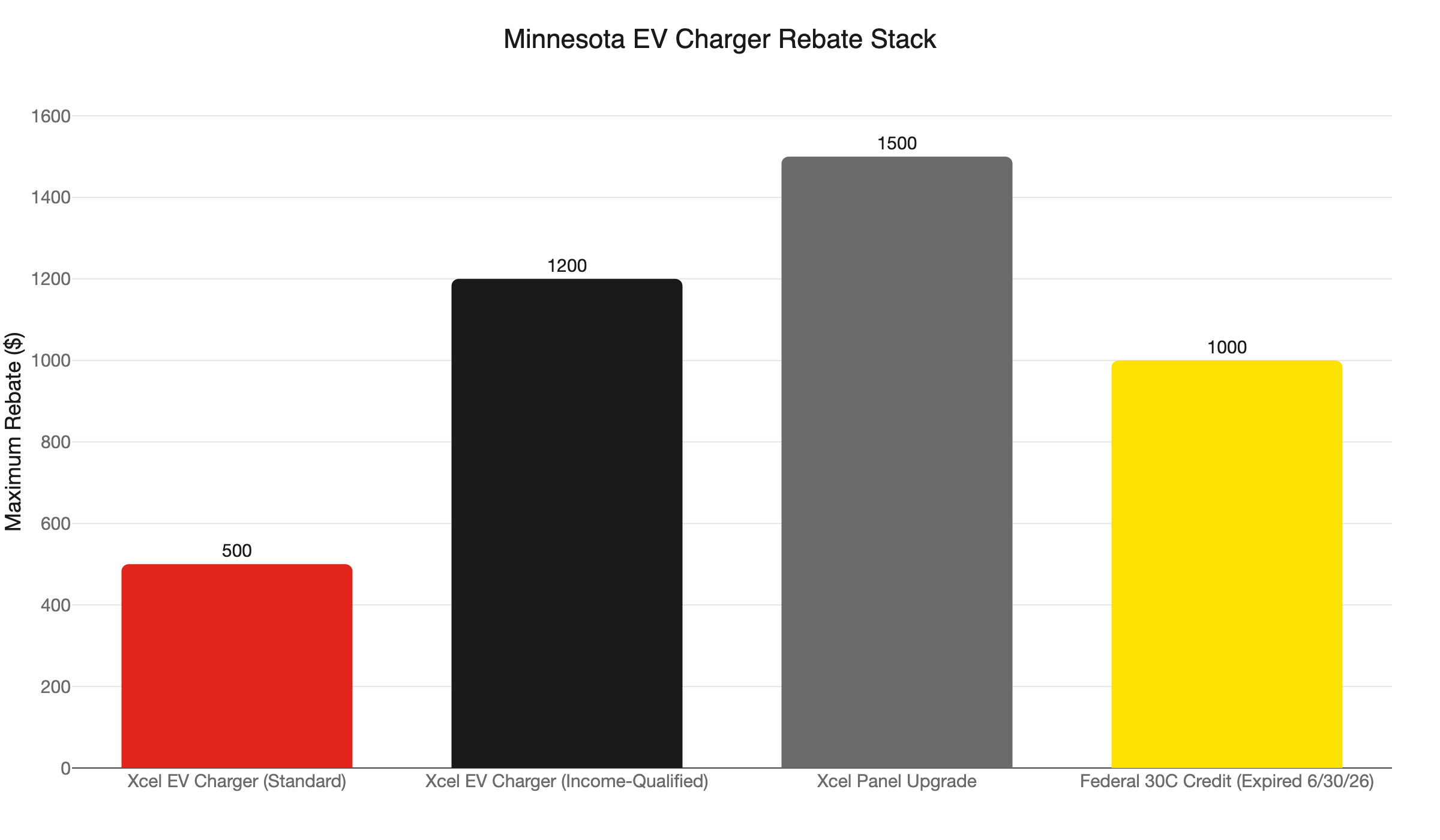
- Xcel Energy offers up to $500 (or $1,200 for income-qualified households) for a Level 2 charger and wiring installation. A panel upgrade stacks an additional $1,500. Pre-approval before work starts is required, or the rebate is void.
- At -20 degrees Fahrenheit, a hardwired 48-amp charger restores 44-plus miles of range per hour. A 40-amp plug-in on a NEMA 14-50 adds 30 to 38 miles per hour. That gap matters overnight in a Minnesota winter.
One Outlet for the Camper in May and the EV in January
NEMA 14-50 outlet installation is the project that covers two needs most homeowners do not connect until they are standing in the driveway: an EV that needs overnight charging and a travel trailer that needs shore power. In the Twin Cities, a lot of families have both.
A fifth-wheel parked beside a Chevy Equinox EV. A single NEMA 14-50 handles both. It is the universal 50-amp, 240-volt receptacle used for North American RV shore power and for most plug-in Level 2 EV chargers. One circuit, properly permitted and installed, covers both use cases.
This post covers everything a Minnesota homeowner needs before calling an electrician: what the outlet is, what the rough-in looks like, where the NEC code lands on GFCI requirements, what Minnesota permitting costs, and how to stack Xcel Energy rebates without voiding them. If you installed before the June 30, 2026 federal credit deadline, the Form 8911 section matters to you, too.
What Is a NEMA 14-50 Outlet?
Short answer: A NEMA 14-50 is a 50-amp, 240-volt, four-prong receptacle with two hot legs, a neutral, and a ground. It is the standard shore-power connector for 50-amp RVs and the plug type on most Level 2 EV charging cables. It is one of the most versatile 240-volt outlets a homeowner can add.
The name decodes simply. NEMA is the National Electrical Manufacturers Association standard. The “14” describes the four-prong configuration: two hot legs, a neutral, and a ground. The “50” is the amperage rating. You see this outlet in garages, on driveway pedestals, at RV pads, and in workshops across Minnesota.
It looks like a large dryer outlet, but it is not the same thing. A dryer outlet is a NEMA 14-30, rated at 30 amps. The NEMA 14-50 runs on a 50-amp breaker and carries a heavier load. The plug shapes are different, so there is no cross-plugging between the two by accident.
The wiring behind a NEMA 14-50 is typically 6 AWG copper for standard garage runs. For wire runs longer than 50 feet, some installers step up to 4 AWG to compensate for voltage drop. Your electrician will calculate the correct gauge for your specific run length. Do not assume the gauge from an online guide; the actual distance from your panel to the outlet location drives that decision.
One more detail worth knowing: the NEMA 14-50 is a receptacle, meaning a device plugs into it. That distinction matters a great deal once you get into charger selection, and the rough-in difference section below explains why.
Does a NEMA 14-50 Outlet in a Garage Require a GFCI Breaker?
Short answer: Yes, always. Two separate NEC rules apply simultaneously. NEC 210.8(A) requires GFCI protection for all 125-to-250-volt receptacles in garages. NEC 625.54 independently requires GFCI on any receptacle used for EV charging, regardless of location. Both apply to a NEMA 14-50 in a garage. A GFCI breaker runs $100 to $200 and is not optional.
This is the code detail most national cost-estimate pages gloss over or omit entirely. The GFCI breaker is a real line item, not an add-on. Some homeowners worry about nuisance tripping: the GFCI trips during normal charging because a Level 2 charger’s internal electronics leak a small amount of current, which some breakers read as a fault. It is a documented and frustrating phenomenon. Ask your electrician about GFCI breakers rated specifically for EV circuits. Some models are designed to tolerate the normal leakage current a charger produces without nuisance trips.
The code is cleaner on the hardwired side. A hardwired EVSE is exempt from NEC 625.54. The charger’s internal UL-listed protection satisfies the code requirement. No GFCI breaker is needed at the panel, and nuisance tripping is not a concern.
If you are on the fence between a plug-in charger on a NEMA 14-50 receptacle and a hardwired charger, the GFCI exemption is one more point in the hardwired column, alongside the higher amperage ceiling discussed below.
Do You Need a Permit for NEMA 14-50 Outlet Installation in Minnesota?
Short answer: Yes. A new 240-volt circuit is inspectable electrical work in Minnesota. Homeowners on owner-occupied single-family homes may pull their own permit, but the exemption voids the moment a licensed electrician performs any part of the work. Permit fees start at $55 and run roughly $110 with two inspections.
Working without a permit is not a minor oversight in Minnesota. It can surface as a material defect when you sell the home. It can also void your homeowner’s insurance in the event of a fire or electrical damage claim if unpermitted work is found to be a contributing factor.
Minnesota adopted the 2026 NEC. The state DLI publishes a residential inspection checklist for the current code cycle that inspectors work from on every visit. Minnesota’s permit authority for most residential electrical work is the state DLI, not your local city building department. Your licensed electrician handles the permit filing. Confirm this is happening before scheduling work.
There are two inspection visits: a rough-in inspection before drywall covers the wiring, and a final inspection after everything is complete and the circuit is live. The permit fee covers both.
Our post on electrical permits in Minnesota covers the full process, what each inspection covers, and how to handle permits when buying or selling a home.
What Is the Rough-In Difference Between a Receptacle and a Hardwired EVSE Circuit?
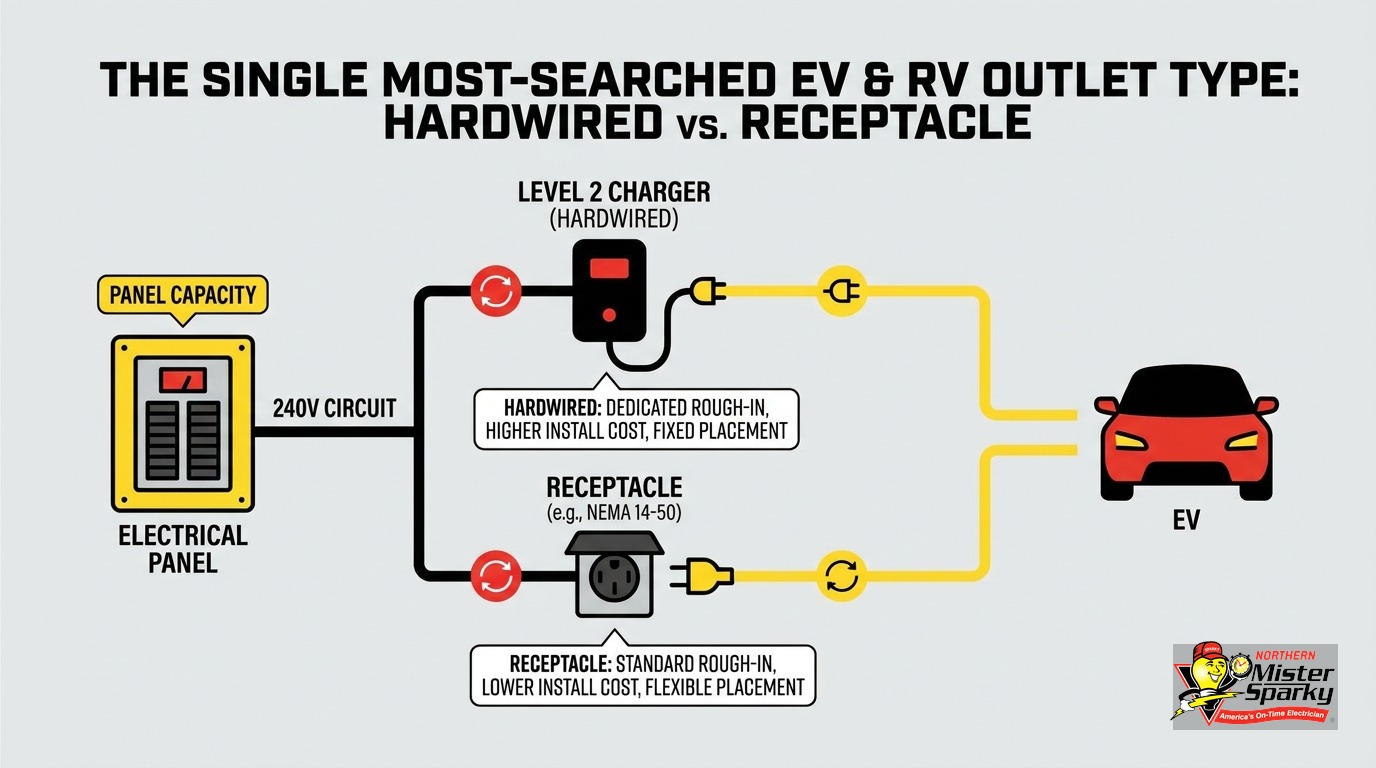
Short answer: The receptacle circuit uses a 50-amp breaker, requires a GFCI breaker, and terminates in an outlet box with the NEMA 14-50 receptacle installed. The hardwired circuit uses a 60-amp breaker, skips the GFCI breaker, and runs conduit directly to the charger’s wiring compartment. No box, no receptacle. The wire gauge is often the same for typical garage runs.
Here is the practical breakdown of what goes into each:
NEMA 14-50 receptacle circuit:
- 50-amp, two-pole breaker in the panel
- GFCI breaker (either a combined GFCI/breaker or a separate GFCI device) at the panel
- Wire run from the panel to the outlet location, typically 6 AWG copper
- A box mounted to the wall or stud at the outlet location
- The NEMA 14-50 receptacle installed in the box
- A weatherproof in-use cover if the outlet is outdoors or in a wet location
Hardwired 48-amp EVSE circuit:
- 60-amp, two-pole breaker in the panel
- No GFCI breaker required
- Wire run from the panel to the charger location, also typically 6 AWG copper on standard runs
- Conduit terminating at the charger’s wiring compartment
- No outlet box, no receptacle at the charger end
The wire gauge is often identical on both circuits for a standard garage run. What changes is the breaker size, the presence or absence of a GFCI breaker, and whether the run terminates in a box or goes directly into the charger. These are not cosmetic differences. You cannot add a receptacle to a hardwired circuit after the fact. You cannot plug a 48-amp charger into a NEMA 14-50 receptacle. And you cannot convert one circuit type to the other without returning to the panel and changing the breaker.
The practical question is: which do you want? The answer depends on the charger you are buying and how much range recovery speed you need. The next section explains the math.
Why Can a 48-Amp Charger Not Use a NEMA 14-50 Receptacle?
Short answer: The NEC continuous-load rule. NEC 625.41 and 625.42 classify EV charging as a continuous load, which requires overcurrent protection rated at 125% of the load. On a 50-amp circuit, that math limits continuous draw to 40 amps. A 48-amp charger exceeds the limit. It requires a 60-amp breaker and a hardwired installation.
The calculation is straightforward: 50 amps multiplied by 0.8 equals 40 amps of allowable continuous draw. A charger pulling 48 amps continuously on a 50-amp circuit violates NEC code. The charger spec sheets that say “requires hardwired installation” are reflecting this rule, not a manufacturer preference.
For most Twin Cities homeowners charging a single EV after a typical workday commute, a 40-amp plug-in on a NEMA 14-50 is sufficient. A full overnight charge on most EVs works out fine at that rate. The hardwired 48-amp option matters most in three situations: a large-battery vehicle, a long daily commute that requires maximum overnight recovery, or a Minnesota January where cold weather is already eating into range.
Our full EV charger installation guide for the Twin Cities covers charger selection, circuit sizing, and what to expect from an installation visit if you want to dig into the options before calling.
Can One NEMA 14-50 Outlet Serve Both an RV and an EV Charger?
Short answer: Yes. The NEMA 14-50 is the standard 50-amp shore-power connector for North American RVs and the plug type on most plug-in Level 2 EV chargers. One outdoor-rated outlet with a weatherproof in-use cover handles both. One permit, one circuit, two use cases.
This is one of the strongest arguments for choosing a NEMA 14-50 receptacle over a hardwired EV charger, especially for homeowners who camp. A fifth-wheel, travel trailer, or motorhome with 50-amp service plugs directly into the NEMA 14-50. The plug-in Level 2 EV charger does the same. The outlet does not care which one is connected.
Placement details matter here. For garage wall mounting, 48 inches from the floor is the standard height. For outdoor installations, the outlet must have a weatherproof in-use cover rated for wet locations. The “in-use” designation is important: a standard flip-lid cover only protects when nothing is plugged in. An in-use rated cover keeps rain and snow out while a cord is inserted. That distinction is code-required outdoors and practically important when an RV is sitting plugged in during a Minnesota rainstorm.
One permit covers both uses. The inspector cares about the circuit, not what you plug into it.
For the full walkthrough on outdoor installation and placement options, see our post on RV hookup outlet installation at home.
Does Minnesota Cold Weather Change the EV Charging Math?
Short answer: Yes, meaningfully. At -20 degrees Fahrenheit, a realistic Twin Cities January low, lithium-ion EV batteries lose 30 to 40 percent of their rated range. A hardwired 48-amp Level 2 charger can restore 44-plus miles of range per hour. A 40-amp-capped NEMA 14-50 plug-in adds 30 to 38 miles per hour. That difference accumulates overnight.
For most homeowners with a typical daily commute, the 40-amp plug-in is adequate even in winter. The math shifts in three situations: a large-battery vehicle, a long daily drive that leaves the battery well depleted, or a morning departure that does not allow a full overnight window.
Garage placement and heating interact with this in a practical way. An EV parked in a heated or semi-heated garage charges more efficiently because the battery management system does not have to work as hard to warm the cells before accepting a charge. If you are planning both a heated garage and an EV charger circuit at the same time, run both through your electrician in a single visit. The load calculation for the heater and the charger together will tell you whether your existing panel handles both or whether a service upgrade makes sense before you add either circuit.
The cold-weather range loss is a concrete, local reason to consider a hardwired 48-amp charger rather than a plug-in on a NEMA 14-50 receptacle. It is not a reason to avoid the NEMA 14-50 entirely, especially if the RV use case applies to you. It is a reason to understand the tradeoff clearly before choosing.
What Rebates Are Available for NEMA 14-50 Installation in Minnesota?
Short answer: Xcel Energy residential customers receive up to $500 for a Level 2 charger and 240-volt circuit installation, or up to $1,200 for income-qualified households. A panel upgrade that increases amperage stacks an additional $1,500. Pre-approval before work starts is required for both programs, or the rebate is forfeited.
Here is how the stack works:
Xcel EV charger and wiring rebate: Xcel Energy offers up to $500 for a Level 2 charger and 240-volt circuit installation for standard residential customers. Income-qualified households reach $1,200. You must enroll in a qualifying EV charging rate program first, then apply with a licensed electrician invoice showing the completed work. The program is first-come, first-served and can close early in a given year.
Xcel panel upgrade rebate: If your EV charger project also requires a panel upgrade to a higher amperage service, Xcel offers up to $1,500 toward the project cost. Replacing a failed panel at the same amperage rating does not qualify. The upgrade must increase your service size.
The pre-approval rule: Both programs require pre-approval before any work begins. Starting work before approval is granted voids the rebate entirely. This is the most common way homeowners lose rebate money. Tell your electrician upfront that you are pursuing Xcel rebates. A good installer knows this sequencing and will not schedule the rough-in before the approval is in hand.
Federal Section 30C credit: The 30% residential EV charger credit, worth up to $1,000 per port, expired June 30, 2026. If you completed your installation before that date, you can still claim it on your 2026 federal return via Form 8911, provided the property is in an eligible census tract. Check with your tax preparer. A missed Form 8911 filing is a straightforward way to leave up to $1,000 on the table.
The Xcel rebates stack with each other. A standard residential customer who needs both a charger circuit and a panel upgrade can recover up to $2,000 from Xcel programs alone. The pre-approval step is the only gate between you and that money.
Schedule Your NEMA 14-50 Installation in the Twin Cities
Northern Mister Sparky is locally owned and operated in the Twin Cities. Our team knows Minnesota DLI permitting, Xcel Energy rebate sequencing, and the NEC code details that actually govern this work: GFCI requirements for receptacle circuits, continuous-load sizing rules, and the concrete differences between a receptacle rough-in and a hardwired 48-amp circuit.
We pull the permit, coordinate the inspections, and show up when we say we will. That is the America’s On-Time Electrician(R) standard. If the work is not right, the UWIN(R) 100% satisfaction guarantee covers it.
Call 763-200-5956 or book your installation online. If a panel upgrade may be part of the picture, say so when you call. We will help you sequence the Xcel pre-approval before any work starts so the rebate stays intact.
Frequently Asked Questions
Does a NEMA 14-50 outlet in a garage require a GFCI breaker? +
Can I use one NEMA 14-50 outlet for both my RV and my EV charger? +
Do I need a permit for NEMA 14-50 outlet installation in Minnesota? +
Is the federal EV charger tax credit still available? +
Need an electrician now?