
EV Charger Pre-Wiring Cost Twin Cities: Save $500-$1,050
Key Takeaways
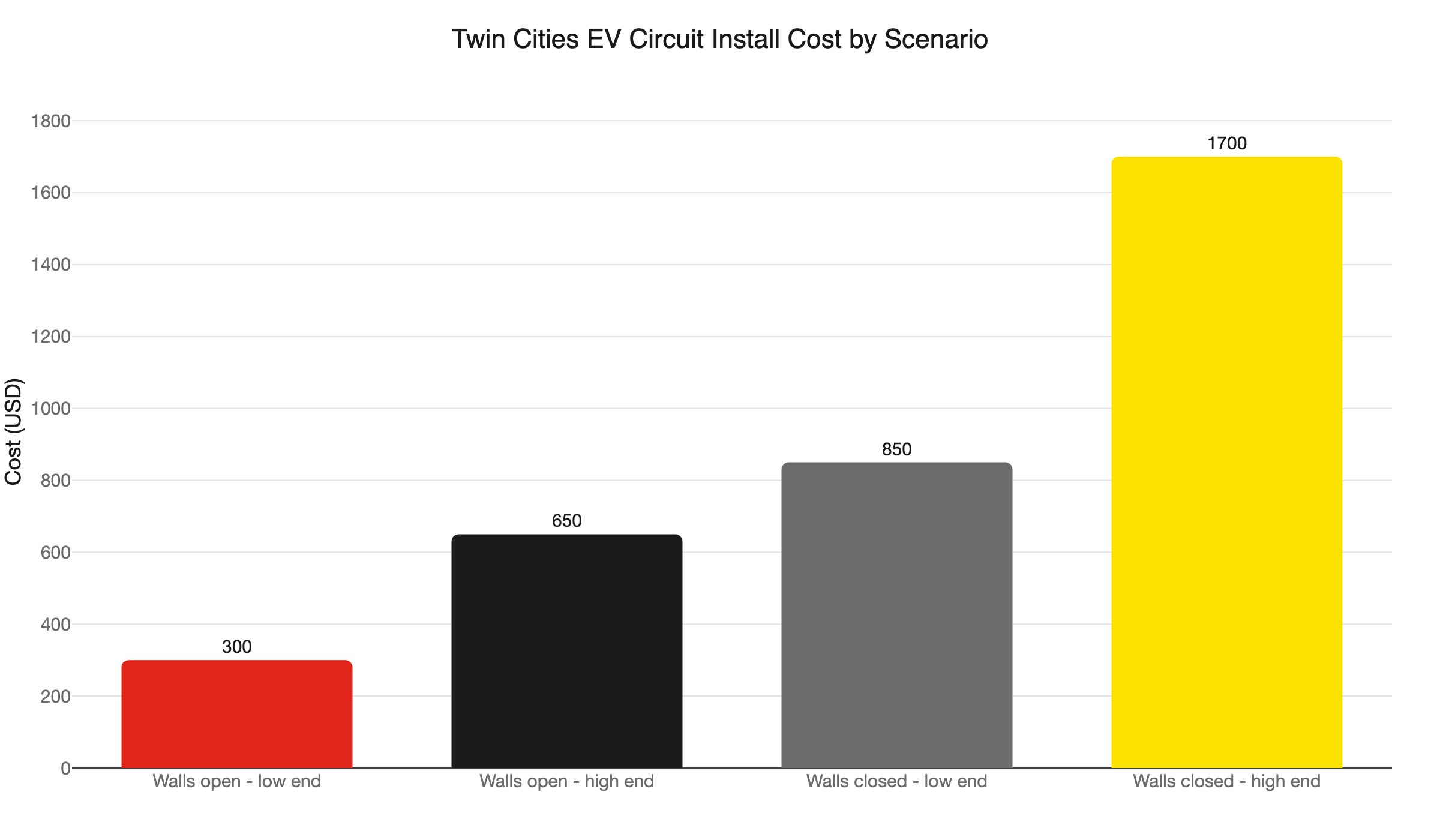
- The EV charger pre-wiring cost in the Twin Cities is $300-$650 during a remodel or open-wall project. The same work through finished walls runs $850-$1,700. Timing the job right saves $500-$1,050.
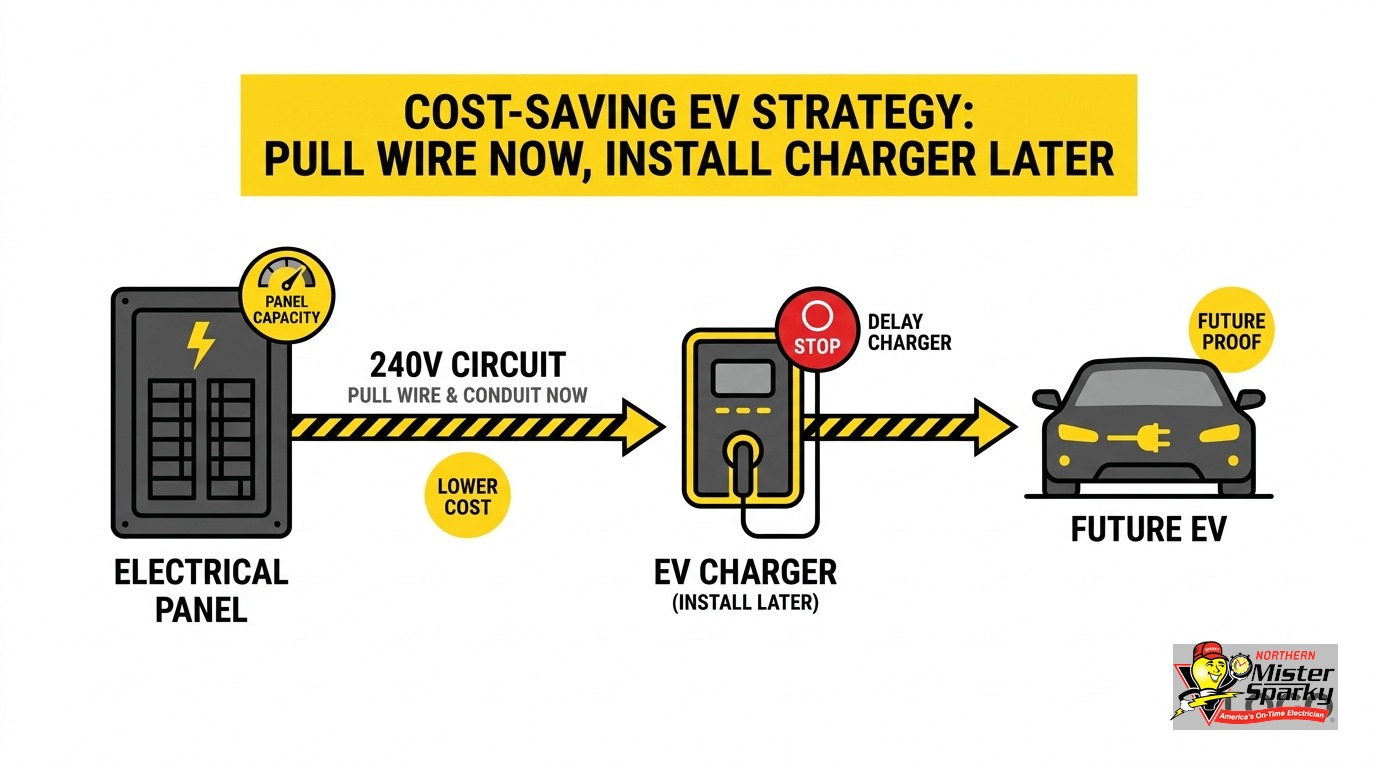
- Pre-wiring means running the circuit, conduit, and breaker now. You cap the far end near the parking space. The charger connects in under an hour when it arrives. No drywall repair needed.
- Minnesota has adopted the full 2023 NEC. EV-ready circuits must be dedicated, rated minimum 8.3 kVA, labeled “For EVSE,” and terminate within 3 feet of the parking space.
- The federal 30C tax credit ended June 30, 2026. It is gone for most readers.
- The live incentive is from Xcel Energy: up to $500 for a charger and/or 240V circuit wiring. Income-qualified customers can get up to $1,200. A separate panel upgrade rebate adds up to $1,500 and can stack.
- Many Twin Cities homes built before 1990 have 100-amp service. Pre-wiring forces that panel conversation before a car purchase deadline creates pressure.
What Is EV Charger Pre-Wiring in the Twin Cities?
Pre-wiring means running conduit and pulling a circuit to the garage now, before you own the EV or the charger. The breaker lands at the panel on one end. The conduit terminates near the parking space on the other, capped and ready. When the charger arrives, the connection takes under an hour. There is no drywall to repair.
Most Twin Cities homeowners treat EV charging as a problem to solve after signing the car purchase paperwork. That sequence is understandable. It is also the expensive one.
Pre-wiring flips the order. You make the electrical decision while something else is already open: a panel project, a garage remodel, a basement finishing job, or a new build. The electrician is on-site. The walls are already framing-only. Adding an EV circuit at that moment costs roughly one-third to one-half of what a standalone retrofit costs later.
This strategy works especially well in three situations:
- You are remodeling a garage or finishing a basement. Walls are open and labor is already on-site.
- You are upgrading your electrical panel. The electrician is at the panel. Adding a dedicated circuit costs far less than a return trip.
- You are in a new build or addition. Rough-in during framing is the cheapest possible moment to add the circuit.
No major Twin Cities competitor currently frames this as a decision made before the EV purchase, for a homeowner planning ahead. That is the gap this post fills.
Our EV charger installation service covers both scenarios: rough-in now and full installation when you are ready to connect the charger.
How Much Does EV Charger Pre-Wiring Cost in the Twin Cities?
A 240V circuit rough-in during a remodel costs $300-$650 in the Twin Cities. The same circuit pulled through finished walls runs $850-$1,700. The gap, $500-$1,050, is entirely a function of timing, not the circuit itself.
ChargeRight’s detailed breakdown of EV charger costs during renovation identifies three factors that produce those savings:
- Shared labor. When the electrician is already on-site for another project, trip cost and setup time are split across the job.
- Open walls. No drywall to cut, patch, or repaint. The electrician drills through exposed framing and runs conduit in a clean line.
- Shared permit. Adding the EV circuit to an existing permitted project avoids a standalone permit fee and often simplifies the inspection schedule.
Several variables shift cost within each range:
Distance from panel to parking space. A 20-foot run in an attached garage with an unfinished ceiling costs less than a 60-foot run through finished walls and a fire-rated assembly. More wire, more conduit, more labor.
Panel capacity. If your panel is at capacity or has 100-amp service, you need a breaker slot or a service upgrade before the circuit can land. That is a separate cost. See our guide on 100-amp vs. 200-amp electrical service to know what you are likely working with.
Conduit type and routing. Exposed conduit in an unfinished garage is the cheapest installation. Surface-mounted conduit along finished walls costs more. A conduit run that passes underground to a detached garage is the most expensive scenario.
Permit and inspection fees. Minnesota requires two inspections for any new circuit: rough-in before walls close and a final once the charger is installed. Each carries a minimum $55 fee. Budget at least $110 for inspections in any scenario.
The charger itself is a separate line item, typically $300-$900 for a Level 2 unit. Pre-wiring separates that purchase from the labor window. You buy the charger when you are ready, at the amperage your car requires, without time pressure.
If the project involves a panel upgrade alongside the EV circuit, ask about financing options. Both jobs together are a meaningful investment, and financing can spread the cost across the project timeline.
Why Does Timing Cut EV Charger Pre-Wiring Cost So Much?
Open walls mean the electrician drills through clean framing and runs conduit without cutting drywall or patching afterward. That single difference accounts for most of the $500-$1,050 gap. Minnesota winters and insulated wall assemblies make the retrofit scenario more involved here than in warmer climates.
Walk through what a retrofit requires in a typical Twin Cities home:
- Find a routing path from panel to garage that avoids fire blocking, insulation, and finished surfaces.
- Cut drywall at intervals to reach framing and drill through it.
- Fish wire or pull conduit through each opening.
- Patch every cut and match existing texture or paint.
- File a standalone permit, schedule a rough-in inspection, then schedule the final.
Step 4 alone can add $200-$500 if a drywaller is needed. Step 5 adds time, because a standalone permit requires its own scheduling window separate from any other project you have open.
In Minnesota, step 1 is harder than in other regions. Attached garages typically have a fire-rated wall assembly between the garage and the living space. That assembly includes drywall, sometimes double-layered. Finished basements add a dropped ceiling or finished wall to the routing problem. In January, those walls contain dense-pack insulation that slows drilling and fishing considerably.
None of those factors apply when framing is exposed. Pre-wiring during an open-wall project removes the entire retrofit cost structure from the equation.
What Goes Into a Pre-Wiring Rough-In?
A complete EV pre-wiring rough-in installs the dedicated circuit, conduit, and breaker while walls are open. The far end is capped near the parking space with a pull string inside the conduit. When the charger arrives, the connection takes under an hour: mount the unit, land the wires, turn the breaker on.
Here is what each component of the rough-in includes:
Dedicated circuit and correct sizing. Most Level 2 chargers run on a 50-amp double-pole breaker with 6 AWG copper wire. If you want headroom for a 48-amp hardwired charger, size up to 60-amp with 4 AWG wire. Your electrician will confirm sizing based on charger specs and panel capacity.
Oversized conduit with a pull string. Best practice is to size conduit one trade size larger than the minimum required. If the wiring technically needs 3/4-inch conduit, install 1-inch. Leave a nylon pull string inside. If you ever want to upgrade wire gauge for a higher-amperage charger, you pull new wire in an afternoon rather than running new conduit.
Limiting bends. The NEC allows up to 360 degrees of total bends between pull points. Keeping runs straight, or limiting them to one or two 90-degree bends, makes future wire pulls significantly easier.
Panel landing. The double-pole breaker installs at the panel now. The far end of the conduit terminates within 3 feet of the planned parking space, capped and labeled.
Labeling. Under the 2023 NEC, EV-ready circuits must be labeled “For EVSE.” That is a code requirement, not a suggestion.
Rough-in inspection. Minnesota requires a rough-in inspection before walls close. This inspection confirms the conduit routing, wire gauge, and breaker sizing. It is the visit that locks in the pre-wiring work. The final inspection happens when the charger is operational and the connection is complete.
What Minnesota Code Requires for EV-Ready Circuits
Minnesota adopted the 2023 NEC in full under MN Statute 326B.35. The 2023 NEC inspection checklist from the Minnesota Department of Labor and Industry defines specific requirements for EV-ready branch circuits:
- Dedicated circuit, no shared loads on the same breaker
- Minimum rating: 8.3 kVA (roughly 34 amps at 240V)
- Must terminate within 3 feet of the designated EV-ready space
- Must be labeled “For EVSE”
- GFCI protection required for cord-and-plug EVSE connections (NEC 625.54)
Two inspections are required for any new branch circuit in Minnesota: rough-in before walls close, and a final once the circuit is operational. Each carries a minimum $55 fee.
About 66 cities in Minnesota operate as their own Authority Having Jurisdiction. That means permit filings go to the city, not to the state Department of Labor and Industry. Your electrician files the permit and handles inspection scheduling. Requirements are consistent at the NEC level but can carry supplemental local requirements depending on the municipality.
Looking ahead: the 2026 NEC will require a 240V NEMA 14-50 outlet in the garage of all new one- and two-family dwellings. Minnesota has not yet adopted the 2026 NEC, but the direction is clear. Pre-wiring now means your garage is already ahead of a requirement that is coming.
Can You Still Get a Rebate for EV Charger Pre-Wiring?
The federal 30C tax credit ended June 30, 2026, and is gone for most readers. The Xcel Energy rebate is the live option: up to $500 for a charger and/or 240V circuit wiring, or up to $1,200 for income-qualified customers. A separate panel upgrade rebate adds up to $1,500 and stacks with the charger rebate.
The federal Alternative Fuel Vehicle Refueling Property Credit (30C) was cut from December 31, 2032 to June 30, 2026 by the One Big Beautiful Bill Act (P.L. 119-21). Per IRS Instructions for Form 8911 (12/2025), the credit requires the charger to be placed in service within the claim period. Pre-wiring alone almost certainly does not qualify even under the old rules, because the charger itself must be operational. With the deadline now passed, the 30C credit is not a factor for most readers.
The IRS maintains a reference page on the 30C credit for those who need to review prior-year eligibility. It is not available for property placed in service after June 30, 2026.
The live incentives for Twin Cities homeowners come from Xcel Energy:
Xcel Energy charger and wiring rebate: up to $500 for a qualifying Level 2 charger and/or 240V circuit wiring. Income-qualified customers can receive up to $1,200. The program is first-come, first-served and subject to funding availability.
Xcel panel upgrade rebate: up to $1,500. This is a separate program from the charger rebate and can stack with it. If a panel upgrade is the precondition for the EV circuit, combining both rebates offsets a meaningful share of the total project cost.
Two things to confirm before scheduling work:
- Xcel rebates apply to completed, installed equipment. Pre-wiring with a capped conduit may not qualify until the charger is connected and operational. Confirm the qualifying event with Xcel before filing.
- Xcel territory covers most of the Twin Cities metro. If you are on a different utility, contact them directly for equivalent programs.
For a full inventory of available rebates, see our guide to Xcel Energy electrical rebates in Minnesota.
What About a Detached Garage?
A detached garage is the most expensive EV charger scenario in the Twin Cities, at $2,800-$6,000 for a full install. If any work is already planned on your detached garage, adding EV pre-wiring at the same time is the highest-ROI electrical decision in this guide.
Running power to a detached garage requires a trench, underground conduit, and typically a subpanel inside the garage. The trench is the dominant cost driver. In Minnesota, frost depth requirements affect how deep outdoor conduit must be buried, which means more excavation than in warmer states.
When garage work is already on the schedule, the trench is open anyway. Adding EV pre-wiring at that point costs a fraction of what opening a new trench later costs. The same logic applies to a new detached garage build: rough-in the EV circuit during framing and the cost drops into the same range as an attached-garage rough-in.
A detached garage subpanel usually has capacity for additional circuits: a 240V welder outlet, a garage heater circuit, or a compressor circuit. Planning those loads alongside the EV circuit means one trench, one permit, and one set of inspections for everything. That is where the real long-term savings stack up.
For the full picture on detached garage electrical work, see our guide on EV charger installation for a detached garage.
Is Pre-Wiring Worth It If You Don’t Own an EV Yet?
Yes, if walls are already open for any reason. The cost at that moment is low and the benefit is permanent. Pre-wiring also forces the panel conversation early, so you learn about any service upgrade requirement before a car delivery deadline creates pressure.
Here is what pre-wiring delivers before you own an EV:
You control the timeline entirely. Most EV purchases come with urgency: a delivery date, a lease expiration, or a commitment to charge from day one. Pre-wiring means none of that urgency touches the electrical job. The circuit is done. The charger installs in an hour.
You surface the panel issue early. Twin Cities homes built before 1990 commonly have 100-amp service. Upgrading to 200-amp runs $3,000-$7,000 in Minnesota. That is a real budget line. Learning about it during a planned remodel is a manageable discovery. Learning about it two days before a car is delivered is a stressful one. Pre-wiring forces the conversation at the right moment.
You are ahead of where code is heading. The 2026 NEC will require EV-ready outlets in new construction garages. Minneapolis explored requiring EV rough-in in residential garages before landing on incentives instead. The direction of both code and city policy is consistent.
The circuit has other uses. A 240V circuit in the garage works for a welder, a large compressor, a garage heater, or heavy workshop equipment. Even if you never buy an EV, the circuit is not wasted.
One more point worth saying directly: if you are planning a garage remodel, basement finishing, or panel upgrade in the next 12 months, pre-wiring is almost certainly the right call. The incremental cost when walls are open is low. The cost to add it after walls close is $500-$1,050 higher.
Ready to Pre-Wire? Here Is What Happens Next.
The best time to run conduit for an EV circuit is while something else is already open: a panel project, a garage remodel, a basement finishing, or a new build. The second best time is before any of those projects closes off the easy path.
Northern Mister Sparky is locally owned and operated in the Twin Cities. We are backed by the national Mister Sparky franchise and the UWIN(R) 100% satisfaction guarantee. Our team handles the permit, the rough-in inspection, conduit sizing, breaker installation, and the final connection when your charger arrives. We can also walk you through the Xcel rebate requirements before we start.
Call 763-200-5956 or schedule through our EV charger service page to book. As America’s On-Time Electrician(R), we will show up when we say we will and give you a straight answer on what your panel can support before any work begins.
Frequently Asked Questions
How much does EV charger pre-wiring cost in the Twin Cities? +
Can I still get a tax credit for an EV charger installation? +
What does EV charger pre-wiring actually include? +
Is pre-wiring worth it if I don't own an EV yet? +
Need an electrician now?