
Pre-Drywall Electrical Inspection Checklist for Minnesota
Key Takeaways
- Minnesota adopted the 2026 NEC in August 2026. Permits filed before that date follow the 2023 NEC. Permits filed on or after follow the 2026 NEC.
- Bathrooms now require both AFCI and GFCI protection under the 2026 NEC. Most online pre-drywall checklists predate this change.
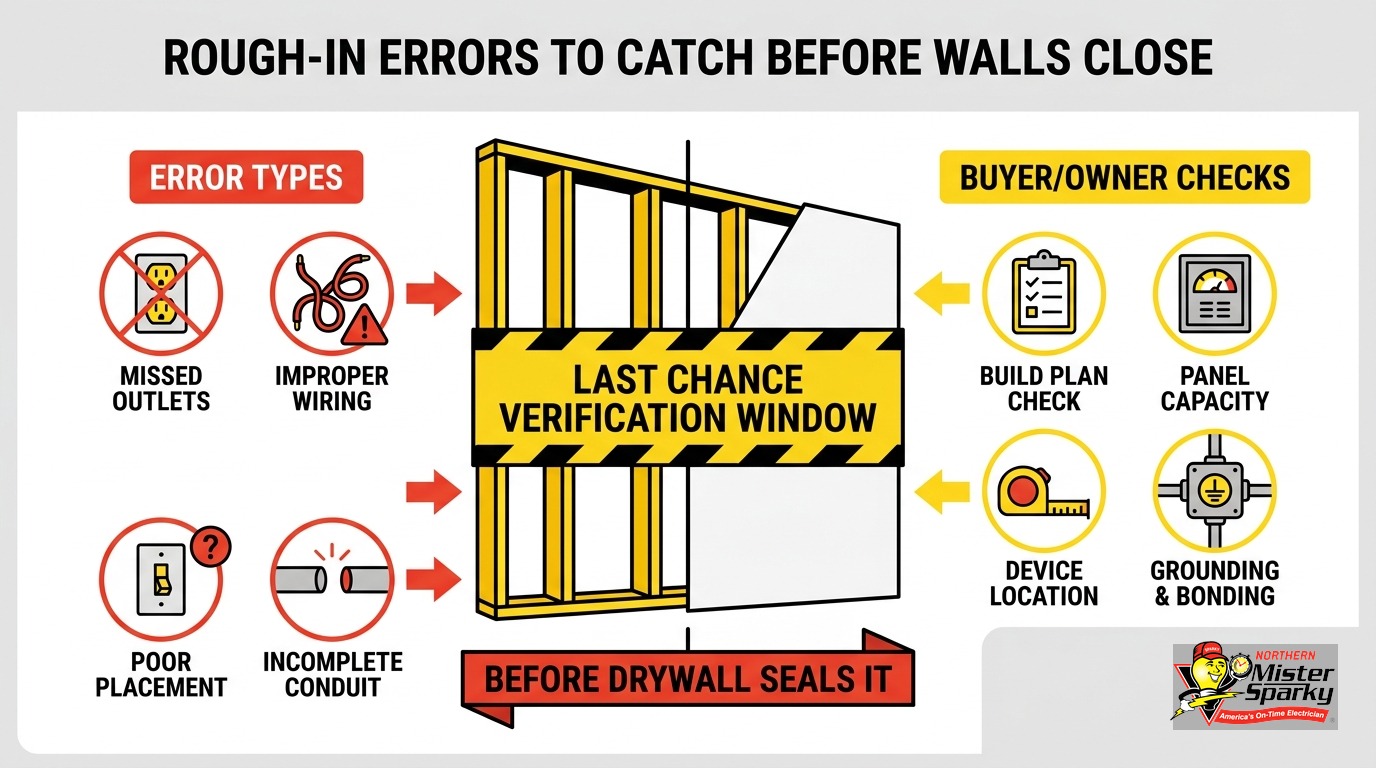
- The DLI rough-in checklist requires all wiring to be visible before inspection. If you conceal wiring before it passes, you pay to uncover it.
- Box fill is a common rough-in failure. Every conductor, device yoke, and clamp counts toward the box’s allowable volume.
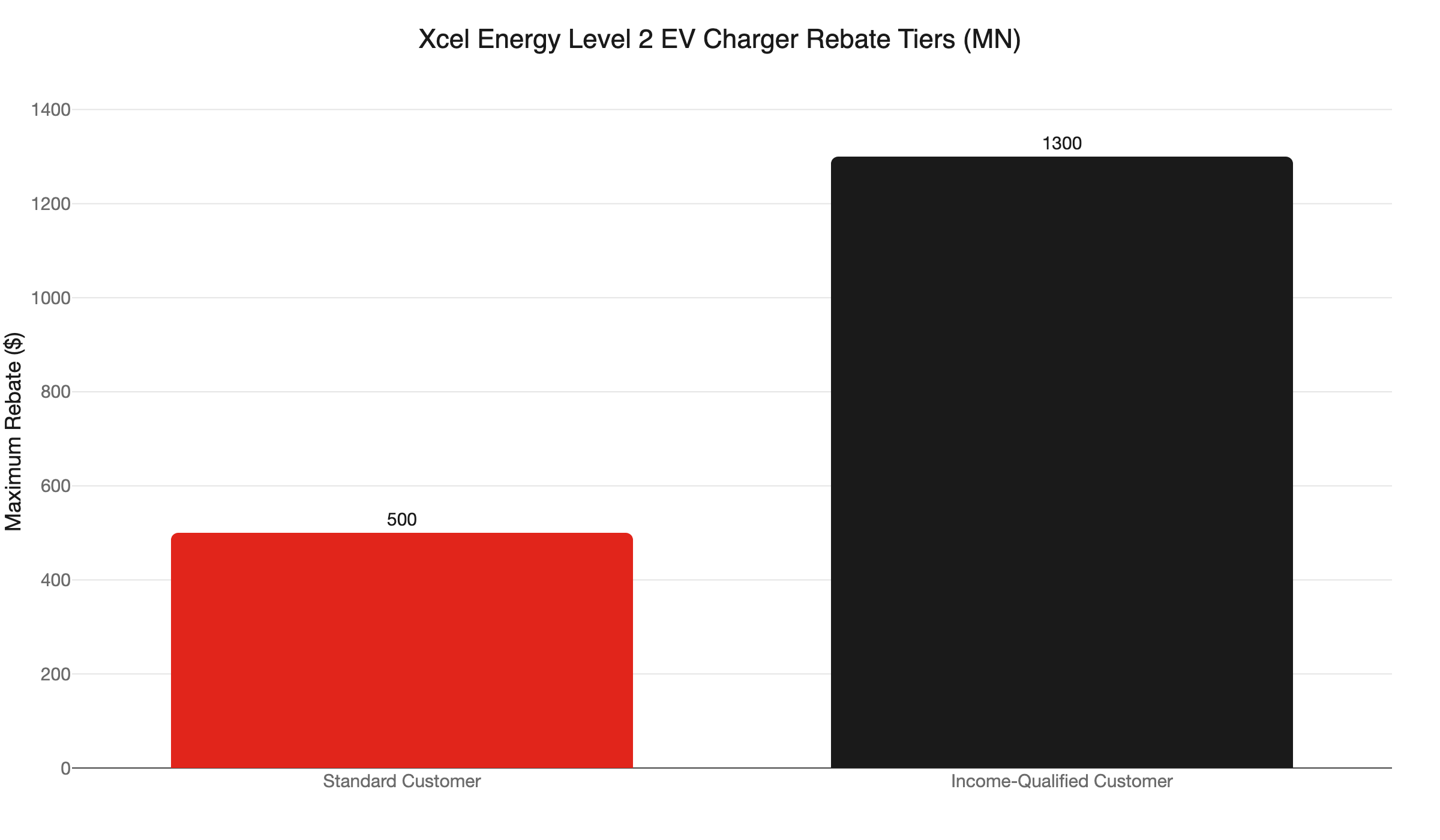
- Xcel Energy’s Level 2 EV charger rebate pays up to $500. You must enroll before the electrician runs the circuit.
- Minnesota owner-builders face a 12-month permit clock. Permits of $250 or less expire if not finaled within that window.
What Is a Pre-Drywall Electrical Inspection?
Short answer: It is the rough-in inspection Minnesota requires before any wiring is covered by insulation, drywall, or paneling. The inspector reviews every wire run, box location, and circuit assignment. It is the last chance to catch errors without tearing open walls.
A rough-in inspection captures the full electrical skeleton of the home. The DLI inspector, or the local authority having jurisdiction (AHJ), verifies box locations, circuit assignments, protection types, and cable support before any wall coverings go up.
Once drywall goes up, all of that is hidden. Fixing a missed AFCI breaker before drywall is a half-hour job. Fixing it afterward costs drywall, paint, and labor on top of the electrical work.
Most online pre-drywall checklists treat electrical as one checkbox in a longer new-construction walkthrough. They tell you to verify outlet locations against your floor plan and move on. That advice is not wrong. But it leaves out the inspection layer entirely: what the DLI inspector actually checks, and what causes a rough-in to fail.
This post covers that layer. It is written for Twin Cities new-build buyers and Minnesota owner-builders preparing for rough-in. The questions below are the ones that determine whether your rough-in passes or fails. Read them before you schedule your inspection.
Which NEC Edition Applies to Your Minnesota Build?
Short answer: Permits filed before August 17, 2026 are on the 2023 NEC. Permits filed on or after that date are on the 2026 NEC. The two editions differ on AFCI scope and how load calculations are performed.
Minnesota adopted the 2026 NEC effective August 2026. For a project currently in framing, the permit date determines which rulebook governs the rough-in inspection.
This matters more than most homeowners expect. The 2026 NEC added bathroom AFCI requirements that did not exist in 2023. The load calculation method changed too, moving into new Article 120 with different formulas. A contractor who pulled a permit in July and one who pulled the same permit in September are inspected against different standards.
This straddling-date question came up frequently this summer. A project framed in June with a July permit may be on 2023 NEC rules even if drywall does not go up until fall. Do not let a late drywall schedule lead you to assume the newer code applies.
Confirm the permit date with your general contractor or the DLI before scheduling rough-in. If the permit date is close to August 17, ask the inspector which edition applies.
About 66 Minnesota cities handle their own electrical inspections as the AHJ. All others file with DLI at (651) 284-5026. If you are building in Minneapolis, St. Paul, Bloomington, or Woodbury, check with the city directly.
What Does the DLI Rough-In Inspector Actually Check?
Short answer: The DLI rough-in inspection checklist covers box fill, cable support, nail plate protection, grounding, AFCI and GFCI circuit assignments, dedicated circuit counts, and service sizing. None of these can be corrected without opening walls after drywall goes up.
Here is what the inspector verifies on a one-family dwelling rough-in.
Cable installation and support
Per the 2026 NEC inspection checklist, cable must be stapled within 12 inches of every box and at least every 4.5 feet in between. Metal nail plates are required wherever wiring passes through framing within 1.25 inches of the framing edge. The inspector walks the framing and checks both.
Boxes and grounding
Ground wires in every box must be spliced and pigtailed at rough-in. Do not install devices (switches or receptacles) until after the rough-in passes. Installing devices before inspection can trigger a correction order.
AFCI and GFCI protection assignments
The inspector verifies that every circuit requiring AFCI or GFCI protection is correctly assigned. A wrong breaker type on a bedroom circuit is a rough-in failure, not a final-inspection catch.
Service sizing and load calculations
The inspector checks that the service size is supported by the load calculation. Under 2026 NEC Article 120, the optional method drops general lighting to 2 VA per square foot. That is down from 3 VA in the 2023 NEC. A Level 2 EV charger adds at least 9,000 VA to the calculated load. All-electric homes with heat pumps and electric baseboard heat are common in Minnesota. These loads can push a standard 200A service to its limit. If your build includes electric heat and a planned EV charger, verify the load calculation with your electrician before rough-in.
Tamper-resistant receptacles
All 15A and 20A, 125V and 250V receptacles in dwelling units must be tamper-resistant (TR-rated) per NEC 406.12. Box placement is confirmed at rough-in. The actual devices are verified at final inspection.
If any item fails, the inspector issues a correction order. You cannot schedule drywall until rough-in passes.
Did the 2026 NEC Change AFCI or GFCI Requirements for Minnesota Homes?
Short answer: Yes, for bathrooms. The 2026 NEC requires bathrooms to have both AFCI and GFCI protection simultaneously. Under the 2023 NEC, bathrooms required GFCI but not AFCI. GFCI scope held steady everywhere else.
Under NEC 210.12, combination-type AFCI protection is required on all 120V, 15A and 20A branch circuits in bedrooms, kitchens, living rooms, dining rooms, family rooms, hallways, laundry areas, closets, and similar spaces. Minnesota’s NEC adoption added bathrooms to that list.
Bathrooms now carry a dual requirement: AFCI and GFCI at the same time. A dual-function AFCI/GFCI breaker handles both in one device. See our post on how combination AFCI/GFCI breakers work for when these are the right choice and how they differ from standard breakers.
Kitchens and laundry areas already required both AFCI and GFCI under the 2023 NEC. Bathrooms are the new addition under 2026.
GFCI scope held steady in 2026. The locations requiring GFCI protection did not expand between the 2023 and 2026 NEC. A 2026 NEC GFCI coverage review notes that is the first time in roughly 30 years the scope held steady between editions. GFCI remains required in kitchens (every receptacle, not just those within 6 feet of the sink), bathrooms, garages, outdoors, crawl spaces, all basement areas, laundry areas, and within 6 feet of any sink.
For a deeper look at AFCI protection and what it guards against, see our AFCI breaker requirements guide.
Does Your Kitchen Have Enough Dedicated Circuits?
Short answer: The NEC requires at least two 20A small-appliance circuits for kitchen receptacles, plus a separate 20A circuit for the laundry. These must be confirmed at rough-in. Adding them after drywall means opening walls.
NEC sections 210.11 and 422.12 set the minimums. The DLI inspection checklist verifies them at rough-in.
Two 20A circuits for kitchen counter receptacles is the code floor. Many modern kitchens, with an induction range, a wall oven, and a coffee station running simultaneously, need more. Pre-drywall is the time to add capacity. Do not assume the code minimum is enough for how the kitchen will actually be used.
Other circuits the inspector checks for proper assignment at rough-in:
- Refrigerator: dedicated circuit
- Dishwasher: dedicated circuit
- Garbage disposal: dedicated circuit
- Over-the-range microwave: dedicated circuit (standard practice)
Outside the kitchen, confirm the laundry room has its 20A circuit. Large appliances (electric dryer, electric water heater, chest freezer) each need their own circuits. These cannot be added after drywall without cutting into walls.
Why Does Box Fill Get Flagged at Rough-In?
Short answer: Every conductor, device yoke, fitting, and clamp inside a box takes up volume. If the box is too small for its contents, it fails the rough-in. The inspector counts the wires and computes the fill before approving.
Box fill is governed by NEC 314.16. Per NEC Table 314.16(B), each 14 AWG conductor counts as 2.0 cubic inches, each 12 AWG as 2.25 cubic inches, and each 10 AWG as 2.5 cubic inches. Each device yoke (a switch or receptacle) counts as two volume allowances for the largest wire in the box. All equipment grounding conductors together count as one allowance.
The 2026 NEC explicitly added push-in splicing connectors (such as Wagos) to the exclusion list. They do not count toward box fill. That ended an ambiguity that existed under the 2023 NEC.
The failure pattern is predictable. A box specified for a single switch gets a three-way configuration added late in framing. Wire count grows. Box size does not. The inspector flags it, the electrician replaces the box, and drywall scheduling slips.
The fix is always to install larger boxes early. Catching a box fill violation before drywall is a 20-minute swap. After drywall, it involves cutting, patching, and repainting.
Does the Xcel EV Charger Rebate Require Enrollment Before the Electrician Starts?
Short answer: Yes. Xcel Energy’s rebate pays up to $500 for a Level 2 charger and 240V circuit installation. You must enroll in an Xcel program before the electrician begins work. Installing the circuit first disqualifies the rebate entirely.
This is the most commonly missed step in new-build EV planning. The buyer and the general contractor focus on framing and rough-in scheduling. No one flags the Xcel enrollment requirement until after the circuit is already run.
The solution is a single conversation before rough-in begins. Decide whether you want a Level 2 circuit in the garage. If yes, enroll in one of Xcel’s qualifying programs (Optimize Your Charge, EV Accelerate at Home, or Time of Day - Separate Meter) before the electrician runs the wire. Do not install first and enroll later. That sequence forfeits the rebate with no exception.
For circuit sizing, permit requirements, and how the rebate process works end to end, see our EV charger installation guide for the Twin Cities.
Owner-Builder Rules and the 12-Month Permit Clock
Minnesota homeowners may self-permit electrical work on a single-family home they own and personally occupy. The requirement is simple: sign an affidavit stating you will personally perform all the work. A general contractor cannot do the work under a homeowner permit. Neither can an unlicensed helper.
Two inspections are required: rough-in (before walls close) and final (before occupancy or energizing). Both must pass before the work is considered complete.
The detail most owner-builders overlook is the permit expiration clock. Permits expire 12 months after issuance if they have not been finaled. Phased owner-builds in the Twin Cities, where someone finishes one room at a time over 18 months, routinely hit this deadline. A voided permit means starting the permit process over.
Build the 12-month deadline into your project schedule from day one. Schedule rough-in inspection before walls close. Set a hard calendar reminder for the final inspection deadline. If your build is ongoing and the permit is approaching the one-year mark, contact DLI proactively. Renewal options may exist, but the window to act is before expiration, not after.
See our Minnesota electrical permit guide for the full permit process, including which cities handle their own inspections and which file with DLI.
What Happens If Walls Are Closed Before Rough-In Passes?
Short answer: The person who concealed the wiring is responsible for all costs to uncover and re-cover it after inspection. There is no exception. The inspector will not approve wiring they cannot see.
The DLI inspection checklist states this plainly: all wiring must be inspected before it is concealed by insulation, sheetrock, or paneling. If drywall goes up before rough-in approval, someone pays to remove it.
On a framing crew schedule, drywall can follow rough-in by just a few days. That compressed timeline is exactly when corners get cut. The electrician says rough-in is ready. The GC schedules drywall. Then the inspection does not happen before the drywall crew arrives.
The safest buffer is a minimum of five business days between the rough-in inspection request and drywall start. Two business days is the absolute minimum. DLI scheduling and inspector availability can make even five feel tight during busy build seasons in the Twin Cities.
Schedule Your Rough-In Walkthrough With Northern Mister Sparky
Once drywall goes up, the code compliance of your rough-in is locked in. Fixing anything after that means opening walls.
We are locally owned and operated in the Twin Cities. No malarky: we know the DLI inspection checklist, the August 17, 2026 code-flip, and the Xcel rebate enrollment timing. Our team can walk your rough-in before the inspector arrives. We flag anything that misses the 2026 NEC and fix it before drywall goes up.
For panel sizing or all-electric builds, we can run the load calculation up front. That way you know before rough-in whether a 200A service is enough for your planned loads.
Call 763-200-5956 or book online. Ask about financing options for larger projects.
Frequently Asked Questions
Can I cover my wiring before the rough-in inspection in Minnesota? +
What is the Xcel Energy rebate for an EV charger in Minnesota? +
Do bathrooms need AFCI breakers in Minnesota under the 2026 NEC? +
Need an electrician now?