
Combination AFCI GFCI Breaker: What Minnesota Requires
Key Takeaways
- “Combination AFCI” and “dual-function AFCI/GFCI” are two different devices. Know which term applies before you order anything.
- Minnesota adopted the 2026 NEC effective August 17, 2026. Permits pulled today fall under the new code.
- Kitchens and laundry areas required both AFCI and GFCI under the 2023 NEC. Bathrooms join that list under the 2026 NEC.
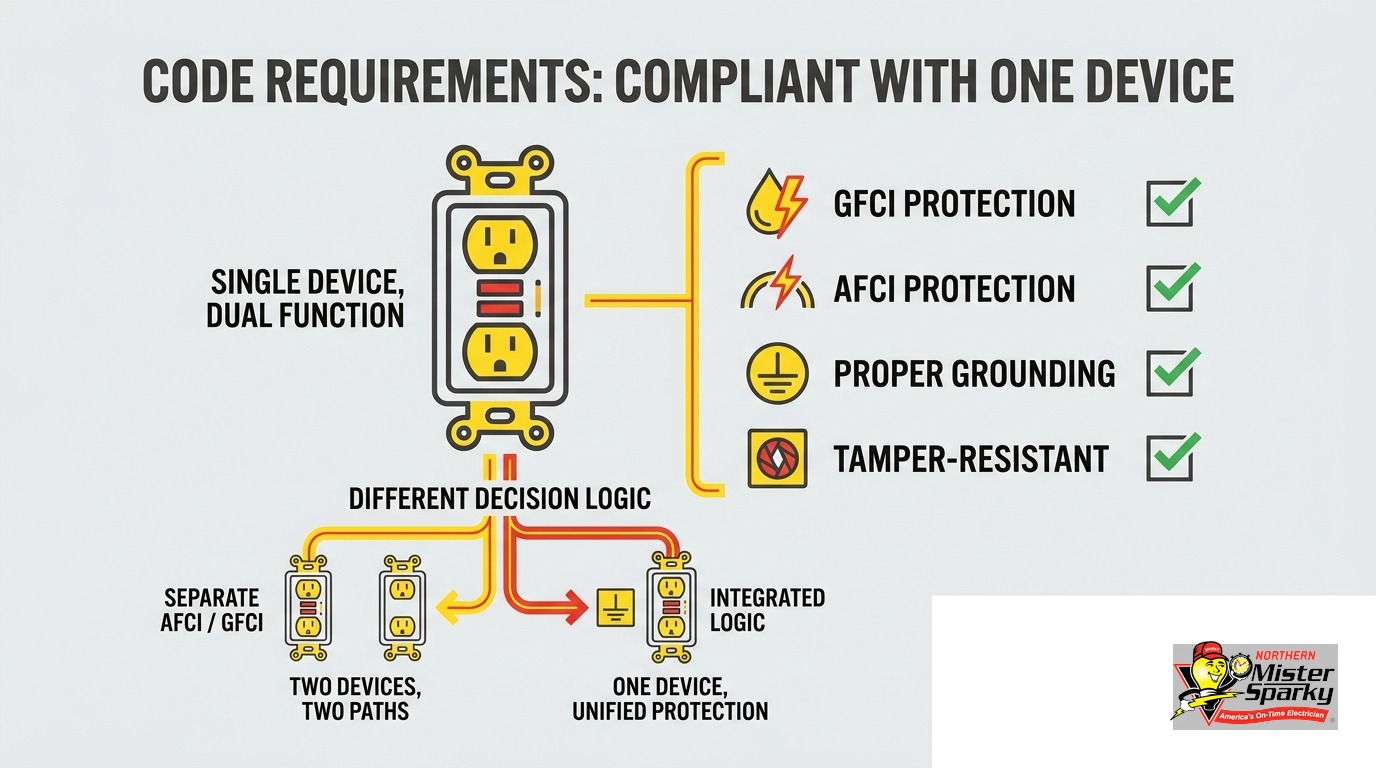
- A dual-function AFCI/GFCI breaker is the cleanest single-device answer where both protections overlap.
- Pre-1980 Twin Cities homes often have multi-wire branch circuits that are incompatible with AFCI/GFCI breakers. Check your panel before buying hardware.
- Minnesota requires a licensed electrical contractor to pull permits. Homeowners cannot self-permit circuit work.
- Call 763-200-5956 or book online to schedule with Northern Mister Sparky.
What Is a Combination AFCI GFCI Breaker?
Quick answer: A dual-function breaker - the device most homeowners are asking about when they search “combination AFCI GFCI breaker” - provides arc-fault and ground-fault protection in one breaker slot. It replaces a standard breaker and protects every outlet and fixture on that circuit from both fire-causing arcs and shock-causing ground faults.
Here is what each protection type actually does.
Arc-fault protection (AFCI) targets the kind of electrical fire that starts quietly inside a wall. A damaged wire, a staple through insulation, or a loose connection behind an outlet can generate an arc. An arc is essentially a small lightning bolt jumping a gap in the circuit. The heat builds, the insulation smolders, and a fire starts. A standard breaker will not trip because the current draw is technically within normal limits. An AFCI breaker detects the arc’s electrical signature and shuts the circuit down before it ignites anything.
Ground-fault protection (GFCI) targets electrocution. Current is supposed to travel out from the panel, through your device, and back on the neutral. If it finds another path to ground - through water, a damaged cord, or a person’s body - the result is a shock. A GFCI breaker measures the difference between outgoing and returning current continuously. If even a small amount is leaking, it trips in milliseconds. That response time is fast enough to prevent cardiac arrest in most cases.
A dual-function breaker handles both jobs from the panel. You install one breaker, and every device on that circuit gets both protections.
”Combination AFCI” and “Dual-Function AFCI/GFCI” Are Not the Same Device
This terminology distinction catches homeowners - and sometimes contractors - off guard.
According to JADE Learning, “combination AFCI” on a breaker label refers to arc detection capability only. Specifically, it means the breaker detects both series arcs (a loose connection creating a high-resistance gap) and parallel arcs (two conductors in contact with each other). A “combination AFCI” breaker has no GFCI function whatsoever.
A “dual-function” breaker is the product that does both AFCI and GFCI in a single unit.
The practical risk is real. If you go to a supply house and ask for “a combination breaker,” you may walk out with an AFCI-only device. It will not satisfy GFCI requirements. Your inspector will flag it, and you will be opening the panel again.
When talking with your electrician or the building department, use the specific term: dual-function AFCI/GFCI breaker. It removes all ambiguity.
Where Does Minnesota Code Require Both AFCI and GFCI?
Quick answer: Under the 2023 NEC, kitchens and laundry areas require both AFCI and GFCI protection on the same circuits. Under the 2026 NEC - now in effect in Minnesota since August 17, 2026 - bathrooms join that list. Those three room types are where a dual-function breaker makes the most sense.
The NEC governs protection requirements through two code sections. NEC 210.12 covers AFCI. NEC 210.8 covers GFCI. Rooms appear on one list, the other, or both. The overlap is the zone where a dual-function breaker becomes relevant.
Under the 2023 NEC
NEC 210.12 and 210.8 create overlap in two locations:
Kitchens require AFCI on all 120V, 15A-20A branch circuits. They also require GFCI on all receptacles, including the range, oven, microwave, and dishwasher circuits added in the 2023 NEC update.
Laundry areas require AFCI on all 120V, 15A-20A branch circuits. They also require GFCI on receptacles.
Every other room on the AFCI list - bedrooms, living rooms, hallways, closets, dining rooms - does not require GFCI. A standard AFCI breaker covers those. Every other GFCI location - bathrooms, garages, outdoors, crawlspaces, unfinished basements - does not require AFCI under the 2023 NEC. A GFCI outlet or standard GFCI breaker is sufficient there.
Under the 2026 NEC
AFCI now applies to all 120V branch circuits in a dwelling unit. Bathrooms previously needed GFCI only. Under the 2026 NEC, they need AFCI too. That is the change with the biggest everyday impact for Twin Cities homeowners right now.
| Room | AFCI Required | GFCI Required | Use Dual-Function Breaker? |
|---|---|---|---|
| Kitchen | Yes | Yes | Yes |
| Laundry area | Yes | Yes | Yes |
| Bathroom (2026 NEC) | Yes (new) | Yes | Yes |
| Bedroom | Yes | No | No - AFCI breaker only |
| Living room | Yes | No | No - AFCI breaker only |
| Garage | No | Yes | No - GFCI only |
| Outdoors | No | Yes (up to 60A) | No - GFCI only |
For the full NEC 210.12 room list covering AFCI-only circuits, see our post on AFCI breaker requirements.
What Changed When Minnesota Adopted the 2026 NEC on August 17?
Quick answer: Minnesota adopted the 2026 NEC effective August 17, 2026, without state amendments. AFCI now covers all 120V branch circuits in homes. Bathrooms are the most common new addition to the dual-function breaker list. Outdoor GFCI now applies to circuits up to 60 amps. One Minnesota-specific carve-out protects existing HVAC equipment replacements from new GFCI requirements.
Here is the residential change summary:
AFCI expands to all 120V branch circuits. Every room in the dwelling unit is now covered. Bathrooms, previously covered only by GFCI, now require AFCI protection too. This is the change you will encounter most often on permits filed today.
GFCI expands outdoors. Outdoor circuits rated up to 60 amps now require GFCI protection. The 2026 NEC also introduces Special Purpose GFCIs for HVAC and EV charging circuits. These are designed to allow ground-fault protection on large motor loads without the nuisance tripping that plagued standard GFCI breakers on those circuits.
Minnesota carve-out for HVAC replacements. Per the Minnesota DLI 2026 NEC FAQ, MN Statute 326B.38(4) means DLI will not require GFCI on existing HVAC equipment being replaced. If you are swapping out an AC condenser or furnace, the existing wiring does not automatically need GFCI added as part of that project.
Permit timing governs which code applies. Permits pulled before August 17 finish under the 2023 NEC. Permits pulled August 17 and later fall under the 2026 NEC. An inspector will check against the code in effect on the permit date.
For a deeper look at how arc-fault and ground-fault protection differ mechanically, see our post on arc-fault vs. ground-fault breakers.
Where a Dual-Function Breaker Is the Right Answer
A dual-function AFCI/GFCI breaker is the cleanest solution in four specific situations.
New kitchen construction or a full remodel. When you are running new circuits from scratch, installing a dual-function breaker at the panel is simpler than wiring a GFCI outlet at the first receptacle in the run and adding a separate AFCI breaker. One device per circuit. Clean permit. Done.
Bathroom circuits under the 2026 NEC. This is the most common new scenario in Twin Cities homes right now. Bathrooms previously only needed GFCI. Adding AFCI protection is easiest at the panel, with a single dual-function breaker covering the entire circuit. You do not need to touch any of the outlets in the room. The breaker handles both requirements from the panel box.
Laundry area circuits. Same overlap as kitchens. A dual-function breaker in the panel covers the washer circuit cleanly with no additional outlet work required.
Panel replacements or upgrades. When a panel is being replaced or upgraded, the labor cost to install every breaker is already in the scope of work. Adding dual-function breakers to the slots that need them is minimal incremental labor. The material cost difference is real but applies only to specific circuits, not the whole panel. If you are weighing whether a panel replacement is warranted at all, our post on signs you need an electrical panel upgrade walks through the decision.
Where a Dual-Function Breaker Is NOT the Right Answer
A dual-function breaker is not always the correct solution, even where both AFCI and GFCI protection are required.
When downstream GFCI outlet coverage already exists. Most kitchen circuits run through a first GFCI outlet that protects all downstream outlets on the same circuit. If your kitchen already has that protection in place and you only need to add AFCI, a standard AFCI breaker is the right call. No reason to install a $30-50 dual-function breaker when a $5-10 AFCI breaker covers the remaining gap.
Multi-wire branch circuits. This is the complication that matters most to older Twin Cities homes. A multi-wire branch circuit (MWBC) runs two hot conductors on a shared neutral wire. That was a common wiring practice before 1980. It reduced material in new construction and was entirely code-compliant at the time.
Single-pole AFCI and GFCI breakers do not work on MWBCs. The shared neutral creates an apparent imbalance that causes nuisance tripping. The breaker trips repeatedly even when nothing is actually wrong. On a MWBC, your options include a two-pole dual-function breaker, separating the shared neutral into two dedicated circuits, or an assessment to determine what makes sense for your specific panel layout. None of these options is plug-and-play.
Do not buy any hardware before knowing whether your home has MWBCs. An assessment visit is far cheaper than returning breakers and opening the panel twice.
What About Older Twin Cities Homes?
Quick answer: Pre-1980 homes throughout Minneapolis, St. Paul, Bloomington, and the suburbs very likely have multi-wire branch circuits. Many also have 100-amp service panels with limited capacity. Both issues affect whether dual-function breaker installation is a straightforward swap or a more involved project.
Multi-wire branch circuits are the more common problem. Single-pole AFCI/GFCI breakers will nuisance-trip on these circuits without additional work. Identifying which circuits in your panel are MWBCs requires a hands-on look at the wiring. Our technicians can spot them during an assessment and map the most cost-effective path to compliance.
100-amp service panels are standard in older Minneapolis and St. Paul housing stock. Adding dual-function breakers to several circuits can push a panel near its rated capacity. If your panel is already running at or near full, you may need a panel upgrade or a subpanel before the circuit-level work can be completed. That changes both project scope and cost in a meaningful way.
Neither situation is a dead end. But both mean the right first step is a professional look at your panel - not a hardware run and a DIY attempt. A licensed electrician can tell you in one visit what you actually need and what it will cost.
How Much Does a Dual-Function Breaker Cost?
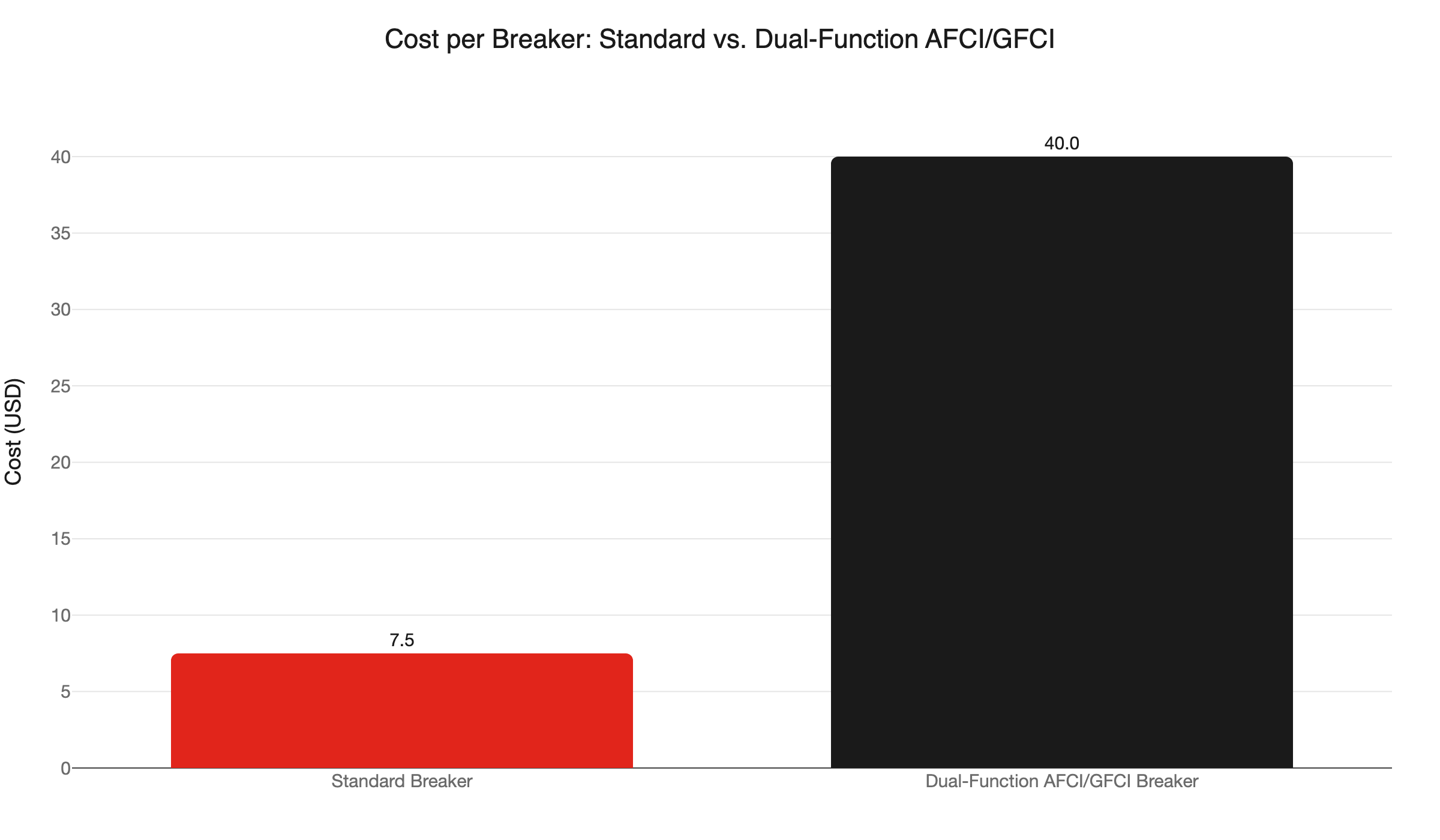
Quick answer: The breaker itself runs $30-50, compared to $5-10 for a standard breaker. The premium is manageable on a single circuit. Upgrading a full panel with dual-function breakers in every required slot can add $500-800 in material costs over standard breakers.
According to VoltFlow, dual-function AFCI/GFCI breakers run $30-50 per unit. Standard breakers run $5-10 each. That is a $25-40 material premium per circuit.
For a single bathroom circuit brought into 2026 NEC compliance, the additional material cost over a standard breaker swap is roughly $30-40. Labor to pull and replace a breaker is typically 30-60 minutes. For one or two circuits, this is a manageable, bounded cost.
The math shifts on a full-panel replacement. If 15-20 circuits need dual-function breakers, the material premium across those slots adds up to $375-800 over standard breakers. If the panel replacement is already happening for another reason, the labor is already in the scope. The per-circuit cost is just the breaker price. If you are adding dual-function breakers as a standalone upgrade on an existing panel, factor in a separate service call.
One practical note: if the total project is a panel replacement, a multi-room remodel, or an EV charger installation bundled with circuit upgrades, ask your Northern Mister Sparky technician about financing. We can walk through options where the job size warrants it.
Do I Need a Permit for This Work in Minnesota?
Quick answer: Yes. Under Minnesota Statute 326B.33, a licensed electrical contractor must pull the permit for new circuit work. Homeowners cannot self-permit circuit additions or modifications in this state.
That requirement is not ambiguous or subject to interpretation. It applies to adding new circuits, swapping breakers in a way that changes circuit protection type, or running new wiring in any of the rooms on the AFCI or GFCI lists.
Three reasons this matters beyond legal compliance:
Code inspection. A permit guarantees an inspector verifies the work against current code. For jobs permitted today, that means the 2026 NEC. You have documentation that the work was done correctly.
Insurance. Homeowner’s insurance policies typically exclude damage caused by unpermitted electrical work. If a fire starts in a circuit modified without a permit, coverage can be denied. That is not a theoretical risk - it comes up in claims.
Resale. Unpermitted electrical work is a disclosure obligation in Minnesota. It complicates home sales and can reduce your offer. Permitted work becomes part of the home’s documented record and supports its value.
Our post on getting an electrical permit in Minnesota covers what the permit process looks like from start to finish.
No malarky on this one: we pull permits for every applicable job. It protects you and it stands behind our work.
Ready to Schedule? Northern Mister Sparky Can Help
As a locally owned and operated Twin Cities electrical contractor, we know which circuits in your specific home actually need dual-function breakers - and which do not. That distinction matters when you are managing cost across a remodel or a panel replacement.
We are current on Minnesota electrical code, including the 2026 NEC that took effect August 17. Whether you need one bathroom circuit brought into compliance, a full kitchen remodel wired to code, or an aging panel replaced entirely, our team will assess your home and tell you exactly what the job involves.
Every job is backed by the UWIN(R) 100% satisfaction guarantee. And as America’s On-Time Electrician(R), we will be there when we say we will.
Call 763-200-5956 or book online to schedule your appointment.
Frequently Asked Questions
What is a combination AFCI GFCI breaker? +
Where are dual-function AFCI/GFCI breakers required in Minnesota homes? +
Can I install an AFCI GFCI breaker myself in Minnesota? +
How much does a dual-function AFCI GFCI breaker cost? +
Need an electrician now?