
GFCI Breaker vs GFCI Outlet: Which One Do You Need?
Key Takeaways
- A GFCI outlet ($15-30) protects itself and every outlet wired through its LOAD terminals. One device can cover a full bathroom or kitchen counter run.
- A GFCI breaker ($45-90) protects everything on the circuit, including hardwired appliances, from the panel outward.
- The outlet wins on cost for a single location or a short chain of accessible outlets.
- The breaker wins when the protected device is hardwired (dishwasher, sump pump), when outlet locations are buried in cabinets, or when motor inrush current causes nuisance tripping on a GFCI outlet.
- Minnesota adopted the 2026 NEC on August 17, 2026. Any permit pulled on or after that date must comply with the new code.
- Pre-1965 Twin Cities homes can upgrade ungrounded 2-prong outlets to GFCI outlets under NEC 406.4(D)(2). No rewiring required. A GFCI breaker cannot serve this role.
What Is the Difference Between a GFCI Breaker and a GFCI Outlet?
Both devices detect ground faults and cut power within about 1/40th of a second. A GFCI outlet protects at the point of use. A GFCI breaker protects every device on the circuit from the panel outward. The outlet costs less. The breaker covers more without requiring multiple devices or daisy-chaining.
A ground fault happens when electricity finds an unintended path. That path might be through water, a damaged cord, or a person. Both GFCI device types monitor the difference between current flowing out on the hot wire and returning on the neutral. When that difference reaches about 5 milliamps, the device trips.
A GFCI outlet replaces a standard receptacle in the wall box. It has two sets of terminals: LINE (the incoming feed) and LOAD (the downstream run). Wire standard outlets to the LOAD terminals and they receive protection too. One GFCI outlet can protect an entire daisy-chained run of standard outlets on the same circuit.
A GFCI circuit breaker replaces a standard breaker at the panel. Every outlet, light, and hardwired device on that circuit is protected from that point out. Nothing to daisy-chain. The tradeoff: the reset button lives at the panel, not near the device that tripped.
Both devices do the same fundamental job. The decision is where they do it and what they are protecting.
The Cost Math: Outlet Chain vs. One Breaker
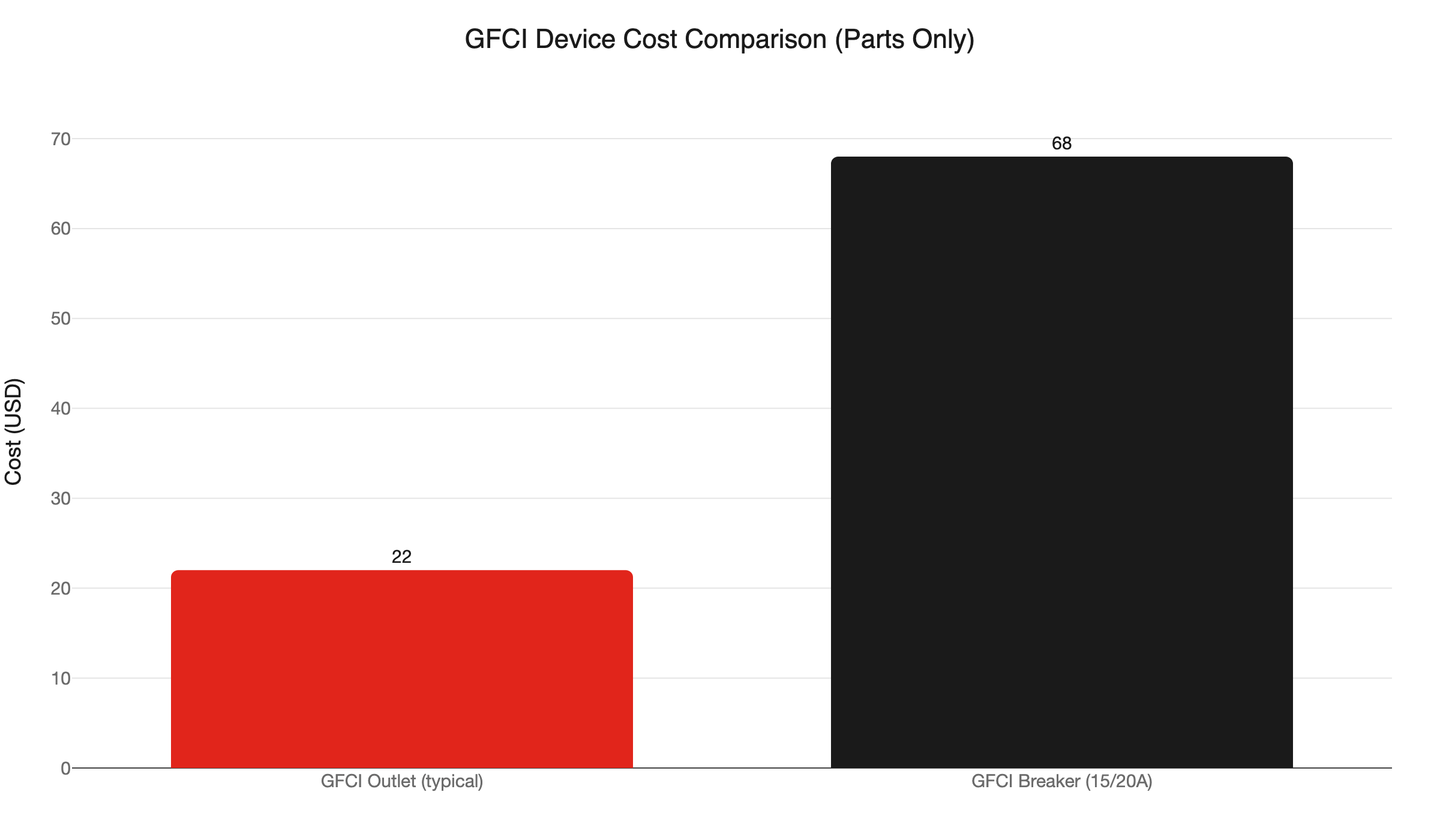
The numbers are clear. A GFCI outlet runs $15-30 per device at retail. A GFCI breaker for a 15- or 20-amp residential circuit runs $45-90, depending on brand and amperage.
For one outlet location, the outlet wins. Parts cost is $15-30 versus $45-90. No spreadsheet needed.
Now extend the circuit. Say your garage has six outlets spread across three walls. You have two paths.
Option one: Install one GFCI outlet at the head of the run. Wire the five downstream outlets through its LOAD terminals. All six are protected. Parts cost: $15-30.
Option two: Install a GFCI breaker in the panel. One device, $45-90, protects all six from the panel out.
On parts alone, the outlet chain wins again. But the outlet chain assumes the head-of-run location is accessible. If it sits behind a workbench, inside a cabinet, or under a utility sink, the labor to reach it can flip the economics. When an electrician is already on site doing panel work, the incremental cost of a GFCI breaker often pencils out better than running wire to an accessible outlet head.
The crossover point is not device count. It is access and appliance type.
When Does a GFCI Outlet Win?
A GFCI outlet wins at a single location or a short, accessible run of outlets. One bathroom vanity, a kitchen counter segment, a crawl space receptacle, an outdoor outlet - anywhere you can reach the reset button and the outlet box is exposed. For these jobs, $15-30 in parts beats a $45-90 breaker every time.
The clearest wins for the outlet:
- Single wet-area outlet. One bathroom vanity receptacle, one outdoor outlet, one crawl space receptacle. The GFCI outlet protects itself and you are done. Cost stays at $15-30.
- Multi-outlet run with exposed locations. Three kitchen counter outlets on the same circuit. Wire the first as a GFCI outlet and feed the remaining two from its LOAD terminals. One device protects all three.
- Ungrounded 2-prong circuit upgrade. Pre-1965 homes wired without an equipment ground. NEC Article 406.4(D)(2) allows a GFCI outlet as the code-compliant replacement for a 2-prong receptacle on an ungrounded circuit. No rewiring required. The outlet must carry a label reading “No Equipment Ground.” This is the only tool for this specific job - a GFCI breaker cannot serve this role.
- Reset near the device. When you want the reset button next to the bathroom vanity or under the kitchen counter rather than at the panel in the utility room, the outlet puts it where it belongs.
For a full rundown on where GFCI outlets are required by code, see our guide on GFCI outlet code requirements.
When Is a GFCI Breaker Worth the Extra Cost?
A GFCI breaker earns its cost when the protected device is hardwired, when outlet locations are buried or inaccessible, when motor inrush current causes nuisance tripping on an outlet, or when one reset point at the panel is more practical than hunting through an outlet chain.
Here are the situations where the breaker is worth the premium.
Hardwired appliances with no outlet to swap.
A dishwasher connects directly to its circuit. There is no receptacle to replace. NEC 2023 Section 210.8(D) added a GFCI requirement for dishwasher branch circuits precisely because there is no outlet-based solution. A GFCI breaker is the only practical compliance path.
The same applies to hardwired sump pumps on dedicated circuits, inline exhaust fans, and hardwired under-cabinet lighting.
Long wire runs with capacitive leakage.
Longer wire runs carry more capacitance. That capacitance creates a small amount of leakage current even on a perfectly healthy circuit. If accumulated leakage pushes past the 5-milliamp threshold, the GFCI trips with no real fault present. One GFCI breaker means one reset at the panel instead of tracking down which outlet in a long run fired.
Sump pumps and other motor loads.
This matters in Minnesota. Sump pumps draw high inrush current the moment the motor starts. That inrush can trip a GFCI outlet in the same instant the pump kicks on, even though nothing is wrong. If your sump pump’s GFCI outlet trips at 2 a.m. during a heavy spring rain, you may wake to water on the basement floor.
NEC Article 210.8(A) requires GFCI protection on receptacles in unfinished basements, which is where most sump pumps connect. A dedicated circuit with a GFCI breaker is the more reliable solution for a motor load. See our guide on sump pump dedicated circuit requirements for the full breakdown.
Outdoor circuits with continuous-leakage loads.
Heat tape is a common Minnesota installation. It wraps pipes or roof edges to prevent freezing and draws a small continuous current that never fully stops. A GFCI outlet monitoring that constant leakage can develop nuisance tripping as the tape ages. A GFCI breaker on a dedicated heat-tape circuit isolates the load so a trip is easier to diagnose and does not kill unrelated outdoor outlets.
Inaccessible outlet locations.
Garage circuits often terminate at boxes mounted high on walls, tucked behind shelving, or inside finished cabinetry. A GFCI breaker keeps the reset point at the panel where you can always get to it.
For context on nuisance-tripping behavior in a related device type, see our post on AFCI breaker nuisance tripping.
Four Scenarios: Picking the Right Device Every Time
Run your situation through these four decision points before you buy anything.
Scenario 1: Single wet-area outlet.
Bathroom vanity, laundry room sink outlet, outdoor receptacle on its own home run. The GFCI outlet wins. Parts run $15-30. The reset button sits where you need it. No panel work. This is the clearest call on the list.
Scenario 2: Multi-outlet circuit, all locations needing protection.
Whole garage, full unfinished basement run, outdoor circuit with three or four outlets. Check whether the head-of-run location is accessible. If it is, one GFCI outlet at $15-30 covers the entire downstream chain. If the outlet locations are buried, spread across a large garage, or require a licensed electrician to reach them anyway, the $45-90 GFCI breaker is often the cleaner choice in total installed cost. Heated garages with circuits serving a heater, tool outlets, and a door opener are a common example - a GFCI breaker per circuit is often cleaner than chaining outlets across a wide layout where half of them are behind a chest freezer.
Scenario 3: Hardwired appliance on the circuit.
Dishwasher, dedicated sump pump circuit, hardwired under-cabinet lights. There is no outlet to swap. The GFCI breaker is the only option. The appliance type has already made the decision for you.
Scenario 4: Ungrounded 2-prong circuit upgrade.
Pre-1965 home with two-wire circuits and no equipment ground. Install a GFCI outlet at each receptacle location. Label each one “No Equipment Ground.” NEC 406.4(D)(2) explicitly permits this as the code-compliant path with no new ground wire required. A GFCI breaker is not a substitute here. The outlet is the right tool for this specific job.
What About Ungrounded Circuits in Older Twin Cities Homes?
A GFCI outlet is the code-approved replacement for a 2-prong receptacle on an ungrounded circuit. Label it “No Equipment Ground” and you are compliant under NEC 406.4(D)(2). No new wiring required. This is the right call for most pre-1965 Minneapolis bungalows and St. Paul row houses not undergoing a full rewire.
The Twin Cities has dense older housing stock. Minneapolis bungalows from the 1920s and 1930s, St. Paul Victorians, postwar ramblers throughout South Minneapolis, Roseville, and White Bear Lake. Many still carry original two-wire circuits installed before an equipment ground was standard. Homeowners in these houses often ask whether they have to rewire everything to get 3-prong outlets.
The answer is no, under one condition.
NEC Article 406.4(D)(2) offers three paths for replacing a 2-prong outlet on an ungrounded circuit:
- Replace with another 2-prong receptacle. Compliant, but no real upgrade in safety.
- Install a GFCI outlet labeled “No Equipment Ground.” Compliant. Provides shock protection even without a ground wire.
- Run a new ground conductor back to the panel. Fully correct, but expensive. It often requires fishing wire through finished walls and ceilings.
Option 2 is the practical choice for most older homes. The GFCI outlet provides meaningful protection without a ground wire. The required label is honest about what the outlet is. Our guide on ungrounded outlets in older homes walks through the full process.
One important clarification: a GFCI breaker does not provide an equipment ground either. So for this specific upgrade, the breaker is not a substitute. The outlet is the correct tool.
What Does Minnesota Code Require Right Now?
Minnesota adopted the 2026 NEC on August 17, 2026. Any permit filed on or after that date must comply with the new code. Required GFCI locations include bathrooms, garages, outdoors, crawl spaces, unfinished basements, kitchens, laundry areas, and within six feet of any sink in any room.
That last expansion is the one most homeowners miss. Earlier code editions applied the “within 6 feet of a sink” rule mainly to kitchens. Current code extends it to every room with a sink: laundry rooms, wet bars, utility areas, mudrooms with utility sinks, and home bars. If you remodeled a wet bar five years ago under older code, it may not meet current requirements if you pull a permit for any work on that circuit today.
The Minnesota Department of Labor and Industry administers electrical licensing and code adoption for the state. Minnesota electrical requirements are codified under Chapter 3800 of the Minnesota Administrative Rules.
The current code also carries forward the Section 210.8(D) requirement for GFCI protection on dishwasher branch circuits. Any dishwasher circuit permitted in Minnesota on or after August 17, 2026 needs a GFCI breaker. There is no outlet-based path for a hardwired appliance.
A permit note: most GFCI work on new or altered circuits requires a permit in Minnesota when performed by a licensed contractor. Homeowners can pull their own permit for their primary residence under MN Statute 326B.32. If you are not sure whether your project needs a permit, ask us. We will give you a straight answer.
Should You DIY or Call an Electrician?
Swapping a standard outlet for a GFCI outlet is one of the most DIY-friendly electrical tasks most homeowners will encounter. Installing a GFCI breaker requires opening the panel and working near live bus bars. That job belongs with a licensed electrician.
Replacing an outlet with a GFCI outlet is within reach for a careful homeowner: shut off the breaker, confirm power is off with a non-contact tester, connect the incoming feed to the LINE terminals, and wire any downstream outlets from the LOAD terminals. Most outlet swaps take 20-30 minutes. The risk is low when you work methodically and verify the power is off before touching any wires.
The panel is a different situation. Even with the main breaker off, the utility-service lugs inside most residential panels stay live. Working near them without training is a genuine electrocution risk. The CPSC estimates that GFCIs could prevent about two-thirds of the approximately 400 home electrocutions that occur in the United States each year. That number exists because electricity at the panel does not forgive mistakes.
There is also a compatibility issue. GFCI breakers must match the panel brand and series. A combination AFCI/GFCI breaker, required in many bedroom circuits, carries additional wiring requirements including a neutral pigtail that connects to the panel’s neutral bar. Getting those details wrong means a breaker that trips on installation or fails the inspection.
We are locally owned and operated and we cover the full Twin Cities metro: Minneapolis, St. Paul, Bloomington, Brooklyn Park, Woodbury, Blaine, Maple Grove, Plymouth, and the surrounding communities. Our team handles GFCI breaker installations, dishwasher circuit upgrades under the new 2026 NEC, whole-circuit GFCI retrofits, and ungrounded outlet upgrades for older homes.
As America’s On-Time Electrician(R), we show up when we say we will. And our UWIN(R) 100% satisfaction guarantee backs every job.
Call 763-200-5956 or book online to schedule. No malarky.
Frequently Asked Questions
Can one GFCI outlet protect multiple outlets? +
Do I need a permit to install a GFCI breaker in Minnesota? +
What causes a GFCI breaker to nuisance trip? +
Need an electrician now?