
All Outdoor Outlets Stopped Working at Once? Here's Why
Key Takeaways
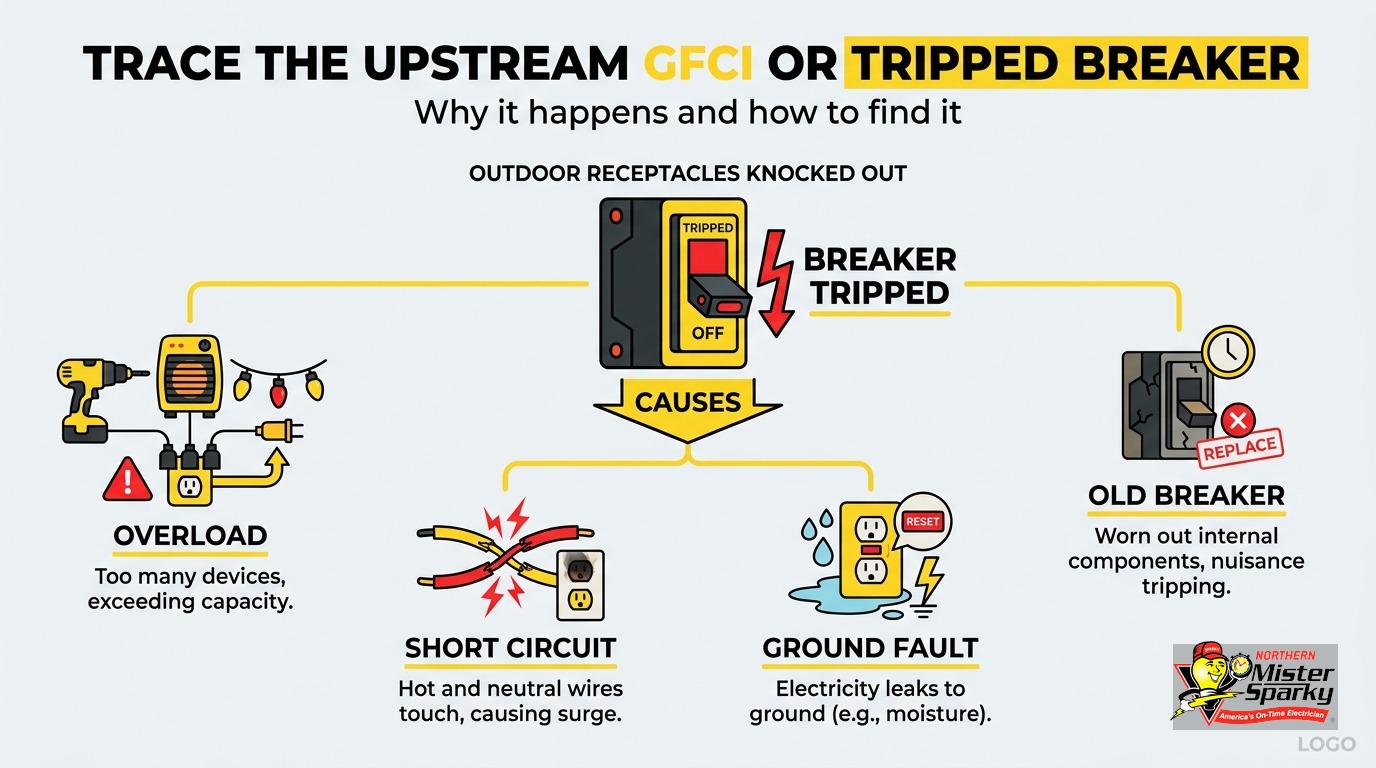
- All outdoor outlets stopped working at once because they share a single upstream GFCI outlet or GFCI breaker. When that device trips, every downstream outlet loses power.
- The controlling GFCI usually lives inside the house: check the garage, bathroom, laundry room, and basement utility area first.
- If there is no Reset button on any outdoor outlet, look for a GFCI breaker at the panel. It has a small test/reset button built into its face.
- Minnesota’s freeze-thaw cycle is a real seasonal trigger. Overnight swings from 60 F to 30 F push condensation into outlet boxes, and that moisture trips the GFCI.
- GFCI outlets last 7 to 10 years. An outlet that age or older may not respond to Reset at all. The device itself needs replacement.
- Minnesota adopted the 2023 NEC on July 1, 2023. An electrician diagnosing your outage may find your home is under-protected by current code.
- Under Minnesota Statute 326B.33, circuit additions and modifications require a permit pulled by a licensed electrical contractor.
Why Do All Outdoor Outlets Stop Working at Once?
The short answer: Your outdoor outlets share GFCI protection from a single upstream device, almost always located inside the house. When that one GFCI outlet or GFCI breaker trips, every outlet wired to its LOAD terminals loses power at once. No Reset button on the outdoor outlets will fix it. The controlling device is inside.
That is the gap in most guides on this topic. They hand you a four-step checklist: check the breaker, look for a tripped GFCI, check the garage, call someone. They skip the explanation that actually helps you. Your outdoor outlets are not each independently protected. They are downstream devices wired off one upstream GFCI. One fault anywhere on that chain trips the single upstream device, and the whole string goes dark.
Understanding the topology of your outdoor circuit is what turns a two-hour search into a ten-minute fix.
How GFCI Upstream/Downstream Wiring Actually Works
A GFCI receptacle has two sets of screw terminals: LINE and LOAD. Power from your electrical panel arrives at the LINE terminals. From there, the GFCI feeds the LOAD terminals, which carry power forward to additional outlets on the same circuit.
Any outlet wired to those LOAD terminals inherits the upstream GFCI’s protection. A GFCI detects a current imbalance as small as 4 to 6 milliamps between the hot and neutral conductors and disconnects power in a fraction of a second. That protection covers every outlet downstream. One fault on any device in the chain trips the single upstream GFCI.
Outlets wired to the LOAD side must be labeled “GFCI Protected” per code. Those labels fall off, get painted over, or were never applied by a previous owner’s contractor. So you often have no visual cue that a plain-looking outdoor outlet is protected by a device inside the house.
An entire outdoor circuit can also be protected by a single GFCI breaker at the panel. Every outlet on that circuit then has no Reset button on the wall. The only reset is at the panel itself.
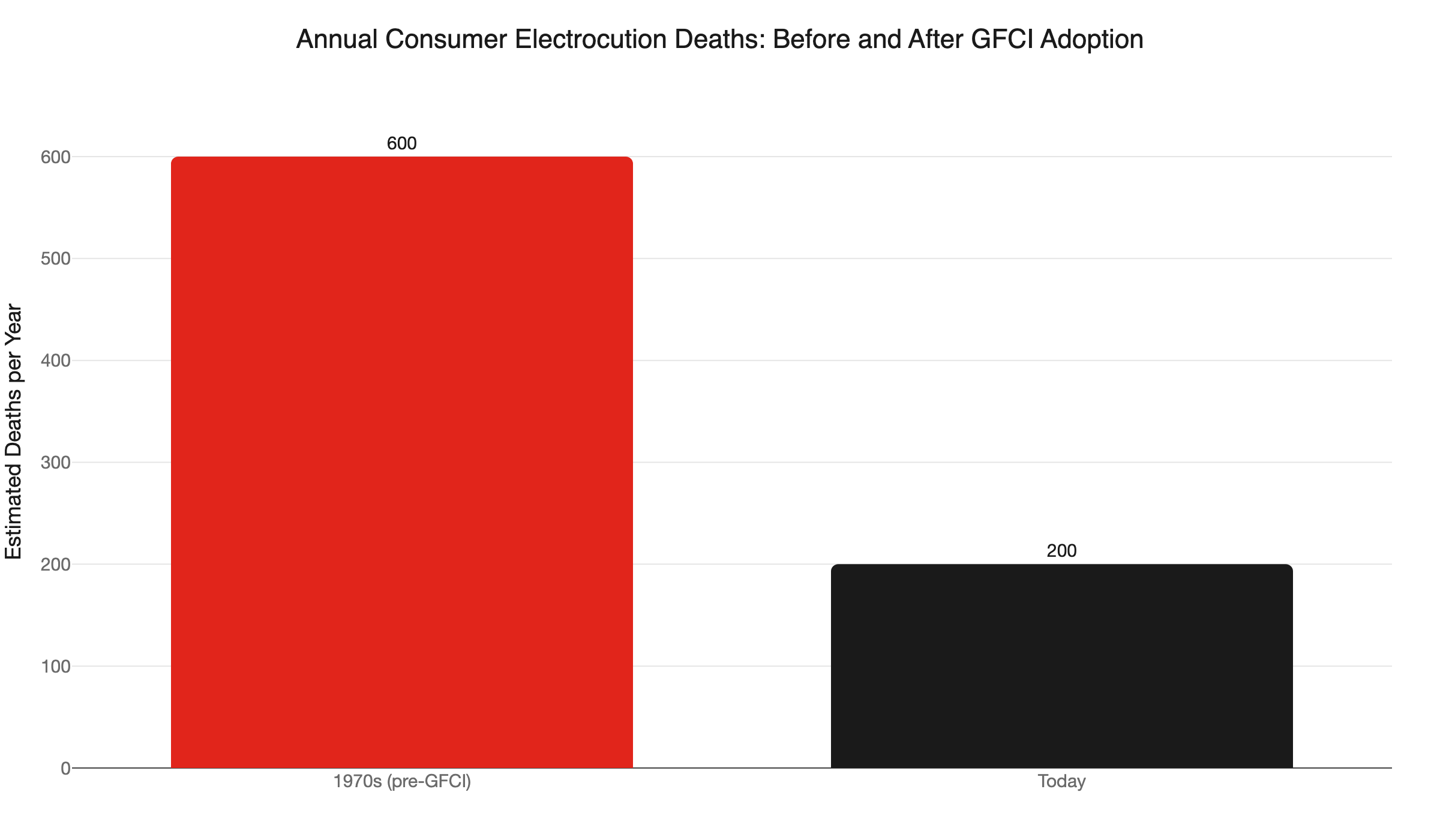
The CPSC has documented the life-safety impact of GFCI protection over decades. Consumer-product-related electrocution deaths have dropped significantly over recent decades, and the CPSC estimates that GFCI protection could have prevented approximately 47% of electrocutions, about 92 deaths per year. GFCI protection was first required on outdoor receptacle circuits in 1973. Older homes are more likely to have gaps in that protection.
That history is why the code keeps expanding GFCI requirements, and why an electrician may find under-protected circuits in homes that predate recent code cycles.
For more background on how these devices work and where they are required, see our guide on GFCI outlet requirements explained.
Where Is the GFCI That Controls Your Outdoor Outlets?
The short answer: In most post-1990s Twin Cities homes, the controlling GFCI is in the garage, primary bathroom, laundry room, or basement utility area. Press Reset on every GFCI outlet you find in each room. If you hear a click and outdoor power returns, that was the device.
Here is the room-by-room search order for Minnesota homes:
Garage first. The garage is the most common location. Electricians route outdoor circuits through the garage wall because it is usually the shortest path to the exterior. Look for a GFCI outlet near the service door or along the front wall. Press Reset.
All bathrooms next. In many builds from the 1980s and 1990s, a single bathroom GFCI was wired to protect both bathroom and outdoor circuits on the same cable run. The NEC required GFCI protection in bathrooms starting in 1975. Builders sometimes combined circuits to reduce material cost. Check every bathroom, including half-baths. Press Reset on each GFCI outlet face.
Laundry room. Some electricians route outdoor circuit power through the laundry room when it shares an exterior wall. Check for GFCI outlets near the washer or dryer.
Basement utility area. A GFCI outlet near a utility sink, water heater, or sump pump sometimes controls outdoor circuits in older builds. It is the least common location but worth checking before you open the panel.
Main electrical panel. If you have pressed every GFCI outlet in the house and outdoor outlets are still dead, open the panel. Find the breaker labeled “outdoor,” “exterior,” or “GFI.” If it is in a tripped middle position, flip it fully OFF and then back ON. If it has a small button on its face, press that button first. Test an outdoor outlet.
A note on pre-1990 homes. In Twin Cities homes built before 1990, a previous owner may have added outdoor outlets and run a circuit off whatever was convenient. The controlling GFCI could be in a finished basement, a mudroom, or inside a wall junction box. If you work through all the rooms above and still cannot find it, a licensed electrician can trace the circuit. It is not a complicated job, but it does require a circuit tracer.
What If There Is No Reset Button on Any Outdoor Outlet?
The short answer: Your outdoor circuit is probably protected by a GFCI breaker at the panel. A GFCI breaker protects every outlet on that circuit from one central location. It has a small test/reset button built into its face. When it trips, every outlet on the circuit loses power with no Reset button visible anywhere on the wall.
Wiring the outdoor circuit to a GFCI breaker at the panel is a valid and common alternative to installing GFCI outlets at each wall location. Electricians use this approach in retrofit situations, on circuits where wall-mounted GFCI outlets would be inconvenient, and in older homes where protecting the circuit from the panel is simpler.
To reset a GFCI breaker:
- Open the panel cover.
- Find the breaker for the outdoor circuit. A GFCI breaker has a small button, usually white or yellow, on the face of the breaker itself.
- If the breaker is in a middle position between ON and OFF, flip it completely to OFF first.
- Flip the breaker back to ON, or press the Reset button on its face.
- Close the panel and test an outdoor outlet.
If the GFCI breaker trips again immediately after you reset it, stop. Do not keep resetting it. A repeated trip is the protection detecting a real fault on the circuit. Resetting it does not clear the fault.
If you are not sure whether you have GFCI breakers or standard breakers, look at each breaker face. A standard breaker is a plain toggle. A GFCI breaker has a small button labeled “Test” or “Reset” in addition to the toggle.
For more detail on resets that will not hold, see our post on what to do when a GFCI outlet won’t reset.
Does Minnesota’s Freeze-Thaw Cycle Trip Outdoor GFCIs?
The short answer: Yes. When overnight temperatures drop from 60 F to 30 F in fall or spring, warm humid air meets cold outlet components and leaves condensation inside the box. That moisture creates a small current path the GFCI detects as a fault. This is the protection working correctly, not a wiring failure.
This is specific to Minnesota’s climate and it is seasonal. You plug in a patio heater in mid-October. It works for a week. One morning after the first cold night, the whole outdoor circuit is dead. Nothing changed except the temperature.
Condensation inside outlet boxes from overnight temperature swings is a real physical cause of GFCI trips in Minnesota homes. The fix in that case is simple: let the box dry out completely, then reset. On a warm, dry afternoon, point a fan at the outlet cover for 30 minutes before trying the reset. If the outlet holds through the next cold night, moisture was the cause.
The longer-term problem is repeated freeze-thaw cycles across multiple winters. Ice expands inside the outlet box, cracks gaskets and wire insulation, then melts and leaves water behind. A gasket that sealed fine in September may be cracked and letting water in by March. An outdoor outlet that trips every spring, or that trips in dry weather after working fine for years, likely needs a new weatherproof cover, a new cover plate, and possibly a new outlet.
GFCI devices also have a service life. GFCI outlets have a limited lifespan before the reset mechanism degrades and the device needs replacement. An aging GFCI outlet may not respond to pressing Reset at all. It just stays dead. That is not a fault in your wiring. It is an end-of-life device that needs to be swapped out.
For more on how cold weather affects outdoor GFCI behavior in Minnesota, see our post on outdoor GFCI nuisance tripping in cold weather.
How to Reset Your Outdoor Circuit: Step-by-Step
Work through these steps in order. Stop when outdoor power returns.
-
Unplug everything outdoors first. A faulty appliance will trip the GFCI again the moment you reset it. Remove all tools, lights, and chargers from every outdoor outlet before you begin.
-
Check outdoor GFCI outlets. Some homes have a GFCI outlet mounted on the home’s exterior wall. Press the Reset button on every outdoor outlet face you can find.
-
Check the garage. Find every GFCI outlet in the garage and press Reset. Look near the service door and along the front exterior-facing wall.
-
Check all bathrooms. Press Reset on every GFCI outlet in every bathroom, including half-baths and powder rooms.
-
Check the laundry room and basement. Look for GFCI outlets near the washer, utility sink, and water heater. Press Reset on each one.
-
Check the panel. Find the breaker for the outdoor circuit. Flip it fully OFF, then fully ON. If it has a small button on its face, press that button first, then flip the breaker ON.
-
Test the outlets. Plug a lamp or phone charger into each outdoor outlet to confirm power is back.
-
If the GFCI trips again immediately: unplug everything outdoors and call a licensed electrician. Repeated tripping with nothing plugged in means the fault is in the wiring itself.
What Does Minnesota Code Require for Outdoor Outlets?
The short answer: Minnesota adopted the 2023 NEC on July 1, 2023. Under NEC 2023 Section 210.8(F), all outdoor outlets at dwellings on single-phase branch circuits rated 150V or less to ground and 50A or less must be GFCI-protected. Garages, accessory buildings, and boathouses were added to that requirement under the 2023 update.
The 2023 NEC expanded the locations that require GFCI protection at residential dwellings. Minnesota adopted the current NEC statewide without amendment, including the expanded outdoor and garage requirements. The state publishes its current adoption schedule and effective dates through the Minnesota Department of Labor and Industry. Permits filed on or after August 17, 2026 must comply with the 2026 NEC.
The NEC also requires at least one outdoor receptacle at both the front and the back of a dwelling, accessible from grade and no higher than 6.5 feet above grade. Many older Twin Cities homes have only one outdoor outlet, or have outlets only at the back. If an electrician finds your home lacks the required receptacle placement, they can quote a circuit addition in the same visit.
What this means in practice: when an electrician comes out to diagnose your outdoor outage, they may find that some outlets or circuits have no GFCI protection at all. That is common in homes where a previous owner added outlets without a permit. It is also common in homes built before 1973, when GFCI protection for outdoor circuits was first required.
A good electrician tells you what they find, gives you an honest quote, and lets you decide the timeline. Code gaps are real, and they matter for your homeowner’s insurance and any future sale inspection. But the conversation should be straight, not pressured.
Under Minnesota Statute 326B.33, a licensed electrical contractor must pull the permit for any new circuit addition or modification. You can reset a GFCI, flip a breaker, and replace a like-for-like GFCI outlet yourself. Running new wire, adding a circuit, or replacing a breaker requires a permit and a licensed electrician.
When Should You Call a Licensed Electrician?
The short answer: Call if resetting every GFCI outlet and breaker in the house did not restore outdoor power, or if the GFCI trips again immediately after you reset it. Those two signals mean the problem is a fault in the wiring, not a tripped device.
You should also call if any of these apply:
- Your outdoor outlets have never worked since you bought the home. A previous owner may have removed GFCI protection, or the circuit may have an open neutral.
- Outdoor outlets trip every time it rains or temperatures drop sharply. Repeated seasonal tripping that did not happen in prior years points to cracked gaskets, degraded wire insulation, or an aging GFCI at end of life.
- You cannot find the controlling GFCI or GFCI breaker anywhere in the house. In some older homes, a retrofitted GFCI lives inside a wall junction. Tracing it requires the right tools and experience.
- You see a burning smell, discoloration, or scorch marks near any outlet or breaker. That is a separate and urgent problem. Call for an emergency appointment rather than continuing the reset sequence.
Northern Mister Sparky is locally owned and operated in the Twin Cities. As America’s On-Time Electrician(R), we show up when we say we will and give you a straight assessment of what we find. If diagnosing your outdoor outage reveals a code gap, we quote the work honestly and let you choose next steps. That is the UWIN(R) guarantee.
Call 763-200-5956 or schedule service online to set up a diagnostic visit. If you want to add or upgrade outdoor GFCI protection while we are there, we quote it in the same visit.
Frequently Asked Questions
Why did all my outdoor outlets stop working at the same time? +
Where is the GFCI that controls my outdoor outlets? +
What if there is no reset button on any outdoor outlet? +
Does Minnesota's freeze-thaw cycle cause outdoor GFCI trips? +
Need an electrician now?