
Outdoor GFCI Outlet Keeps Tripping in Cold Weather: MN Fix
Key Takeaways
- Outdoor GFCIs trip in Minnesota winters because warm, humid indoor air infiltrates the outlet box, condenses on the cold back wall, and creates a leakage current. The device is detecting a real fault, not malfunctioning.
- Minneapolis in January creates a temperature differential of 80°F or more across the outlet box wall. That extreme delta drives condensation faster, more often, and for more months than in virtually any other major US city.
- A GFCI that trips and resets repeatedly is different from one that will not reset at all. Each has a different cause and a different fix.
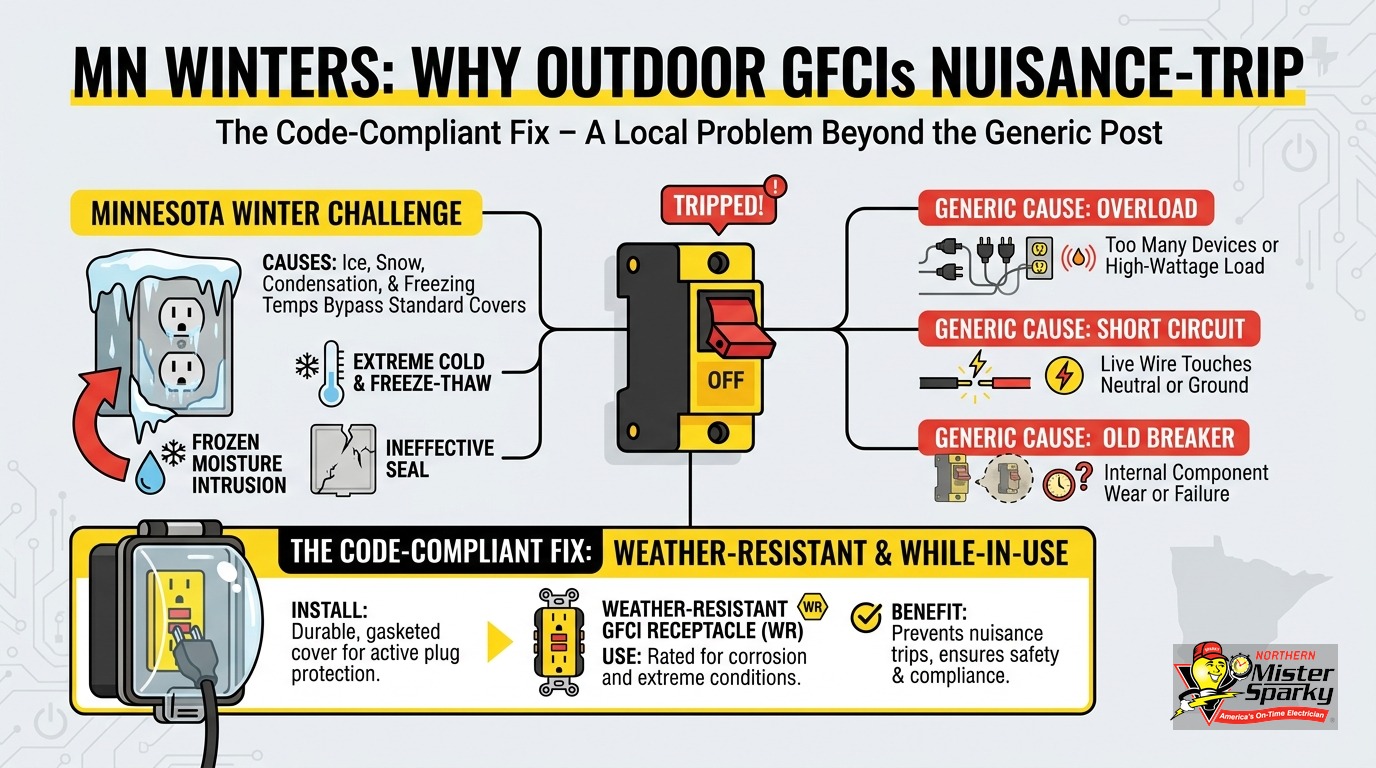
- The code-compliant solution has three parts: seal the box against interior air infiltration, install a while-in-use cover, and confirm the receptacle is WR-rated.
- Minnesota adopted the 2026 NEC effective August 17, 2026. Any permit-required outdoor electrical work now follows 2026 NEC standards.
- Replacing a GFCI in-kind does not typically require a permit. Adding or relocating an outlet does.
- Call 763-200-5956 or book online to schedule service.
Why Does My Outdoor GFCI Outlet Keep Tripping in Cold Weather?
In short: Warm, humid indoor air migrates into the outlet box through gaps around wire entries. It hits the cold back face of the box and condenses. The moisture creates a leakage current path. Your GFCI detects that current and trips because it is working correctly. The problem is the moisture source, not the device.
UL Standard 943, Class A, requires a GFCI to trip when ground-fault current reaches 4 to 6 milliamps. That threshold is intentionally low. At 10 milliamps you lose muscle control. At 100 milliamps, cardiac arrest is possible. The threshold is low enough that a thin film of condensation on wiring insulation, or on the GFCI’s own circuit board, generates enough leakage to trigger a trip.
Here is the mechanism in plain terms. The interior of your wall is warm and humid in winter. The back face of the outdoor outlet box is cold, sometimes well below 0°F on a January night in Bloomington or Woodbury. Wherever there is an unsealed gap between warm interior air and that cold box face (around wire entries, conduit knockouts, or a poorly fitted vapor barrier), warm air migrates to the cold surface. The water vapor in that air condenses. That moisture accumulates inside the box over weeks of freeze-thaw cycling.
The GFCI trips not because something is wrong with the device. It trips because it detects the real leakage current that condensation creates. Replacing the GFCI without addressing the moisture source gives you a fresh device detecting the same condition. The tripping starts again within days.
Most generic guides frame this as a problem caused by rain or sprinkler overspray. In Minnesota winters, the primary moisture source is interior air infiltration through the back of the box. Stopping it requires sealing the box, not swapping the outlet.
Why Is Minnesota Harder on Outdoor GFCIs Than Most States?
In short: A Twin Cities home in January sees a temperature differential of 80°F or more across the outlet box wall. Minneapolis also logs roughly 80 to 100 freeze-thaw temperature crossings per winter. Those two factors combine to make condensation inside outdoor outlet boxes more frequent here than in virtually any other major US metro.
NOAA NWS Minneapolis-St. Paul puts the January average low in Minneapolis at approximately 4°F (-16°C). Extreme cold events routinely reach -20°F to -30°F. A typical home holds interior temperatures around 68°F. On an average January night, that creates a differential of more than 60°F across the wall. On a cold snap, the gap can exceed 90°F.
Compare that to Atlanta. A January cold snap there might produce a 30°F differential. In Houston, outdoor GFCIs rarely see a condensation problem at all. The generic articles about outdoor GFCI trips are largely written for mild-climate homeowners. For those readers, this is an occasional nuisance. For homeowners in Maple Grove, Woodbury, or Blaine, this is a weekly problem from November through March.
The freeze-thaw cycle amplifies everything. Minneapolis averages approximately 156 days per year where the low temperature hits at or below 32°F. The city also sees a high number of freeze-thaw crossings, days where temperatures move through 32°F in either direction. Each crossing is another condensation-evaporation-condensation cycle. Mineral residues build up inside the box over time. The effective leakage path worsens, not improves, over successive winters if the root cause stays unaddressed.
This is a local problem. The Twin Cities version requires a Twin Cities-specific fix.
The Two Types of Cold-Weather GFCI Failure
Identifying which type you have matters before you pick a fix.
Type 1: Trips repeatedly and resets. You press RESET, the outlet works for minutes or hours, then trips again. This is the condensation scenario. The GFCI is detecting a real and recurring leakage current. The device is functional. The problem is the moisture source, not the device.
Type 2: Will not reset at all. You press TEST, then RESET, and the outlet stays dead. No click, no power restoration. This is a component failure. Older GFCI devices use a bimetal mechanism that can stiffen in extreme cold. Below 0°F, the spring tension may not be enough to hold the contacts closed after a reset attempt. Add years of condensation exposure to the device’s internals, and you get a GFCI that has simply reached the end of its service life.
Type 2 requires device replacement. The replacement must be a WR-rated (weather-resistant) receptacle, as required by NEC Article 406.9(A) for outdoor receptacles in wet locations. Look for the “WR” marking on the face of the device. A standard GFCI without the WR rating does not meet code for an outdoor location.
In practice, many cold-weather service calls turn out to involve both failure types. A GFCI that has been fighting condensation for years eventually fails outright. The repair involves replacing the device and sealing the moisture path so the replacement device does not follow the same trajectory.
What Is the Code-Compliant Fix for a Cold-Weather Outdoor GFCI?
In short: Three steps. Seal the outlet box against interior air infiltration. Install a while-in-use cover. Confirm the receptacle is WR-rated. These steps address the moisture source, the weather exposure, and the device specification required under the NEC.
Step 1: Seal the outlet box.
Locate the back of the box where wires enter from inside the wall. Those wire entries are the primary pathway for warm interior air to reach the cold box face. Use a UL-listed low-expansion foam sealant or fire-rated putty pads to close those gaps. The goal is to stop warm interior air from making contact with the cold surfaces inside the box.
This step does not require a permit. It is also the single most effective intervention for the condensation-trip problem, and the step that generic articles consistently skip.
While the box is open, check for standing moisture or corrosion on the wiring or device terminals. If you find standing water, dry the box thoroughly before sealing. Sealing moisture inside accelerates corrosion and shortens device life.
Step 2: Install a while-in-use cover.
NEC Article 406.9(B)(1) requires outdoor receptacles to have a cover that stays closed over a plugged-in cord. The older flat-panel cover that opens wide and leaves the outlet face fully exposed when a cord is plugged in does not meet this requirement for any permit work. The while-in-use cover (also called a “bubble cover” or “in-use cover”) closes around the cord. It keeps precipitation off the plug face and outlet opening.
A properly fitted while-in-use cover also reduces the amount of cold outside air that can enter the box through the front. It is not a perfect air barrier, but paired with a sealed back, it meaningfully reduces the temperature gradient inside the box and lowers the frequency of condensation events.
Step 3: Confirm a WR-rated GFCI.
If the face of your outdoor GFCI does not carry a “WR” marking, it is not weather-resistant rated. NEC 406.9(A) has required WR-rated devices at outdoor wet locations since the 2008 NEC. Any outdoor outlet that predates that cycle, or was installed without a WR device as a cost cut, should be upgraded during any permit work. WR-rated GFCIs use materials rated to handle UV exposure, temperature cycling, and sustained humidity.
For a detailed look at what the full installation involves, see our post on outdoor GFCI outlet installation.
What NEC Code Applies to Outdoor GFCIs in Minnesota?
In short: Minnesota adopted the 2026 NEC on August 17, 2026, per the Minnesota Department of Labor and Industry. Any permit work filed on or after that date must meet 2026 NEC. Key articles: 210.8(A)(3) for GFCI protection, 406.9(A) for WR-rated devices, and 406.9(B)(1) for while-in-use covers.
Minnesota’s electrical code lives in Chapter 1315 of the Minnesota State Building Code. It formally adopts the NEC (NFPA 70) with state-specific amendments. Minnesota jumped to the 2026 NEC as of August 17, 2026. Most other states are still on the 2023 edition. If a contractor quotes outdoor electrical work to “current code” in Minnesota, that means 2026 NEC, not 2023 NEC.
The DLI also maintains a specific code bulletin titled “Circuit breakers in low ambient temperatures.” It acknowledges that Minnesota’s climate requires specific attention to how electrical protection devices behave in cold. That bulletin is listed in the DLI’s electrical bulletin library at the page linked above. Its existence confirms something important for homeowners who wonder whether cold-weather GFCI behavior is a recognized problem. It is. The state’s own licensing body has documented it.
Here is what the 2026 NEC requires for permit work on outdoor receptacles at dwelling units:
- GFCI protection is required for all 125V, 15-amp and 20-amp receptacles at outdoor locations (NEC 210.8(A)(3)).
- All outdoor receptacles in wet locations must be WR-rated (NEC 406.9(A)).
- All outdoor receptacles must have a while-in-use cover (NEC 406.9(B)(1)).
These requirements have been in place across multiple NEC cycles. But they are commonly absent from homes built or remodeled before those cycles took effect. Any permit work on an outdoor outlet today requires all three.
When Is It Not a Moisture Problem?
In short: Condensation is the most common cause of cold-weather outdoor GFCI trips. But a downstream wiring fault or an overloaded circuit produces identical symptoms. If sealing the box does not stop the trips within a few days, the fault is elsewhere on the circuit.
Downstream wiring fault. A GFCI outlet protects not only itself, but also every receptacle wired downstream from it on the same circuit. A garage outlet around the corner, a second outdoor receptacle on the other side of the house, or a low-voltage landscape outlet can all fall under that GFCI’s protection. If any of that downstream wiring has deteriorated insulation, a loose connection, or a grounding problem, the GFCI upstream will detect it and trip on it. Cold weather accelerates insulation cracking in older wiring. If box sealing does not resolve the trips after a few days, the fault is likely somewhere further down the circuit.
For more on how GFCI and AFCI protection interact across a circuit, see our post on AFCI vs. ground fault breakers.
Overloaded circuit. If the trip happens consistently when you plug in a space heater, a power tool, or a large string of holiday lights, note which device trips. If it is the circuit breaker rather than the GFCI, the problem is an overloaded circuit, not a ground fault. These are different devices with different roles and different fixes. For more on diagnosing a tripping breaker, see our post on why your circuit breaker keeps tripping.
Arcing or visible damage. If the outlet face shows discoloration, melting, or a black scorch mark, the problem has moved beyond a tripping GFCI. Arcing and heat damage are fire risks. Stop using the circuit and call a licensed electrician before attempting any repair.
Do I Need a Permit for Outdoor Electrical Work in Minnesota?
In short: Replacing a GFCI receptacle in-kind typically does not require a permit. Sealing the box and upgrading the cover do not require a permit. Adding a new outlet, relocating an existing outlet, or running new wiring requires an electrical permit in Minnesota.
The permit requirement is tied to the scope of work. Here is the practical breakdown:
- Replacing a GFCI in-kind: no permit required in most cases.
- Sealing the outlet box and installing a new cover: no permit required.
- Adding a new outdoor outlet where none existed: permit required.
- Running a new circuit from the panel: permit required.
- Relocating an existing outlet by more than a few inches: permit required.
- Upgrading from a standard outlet to a GFCI where none existed: check with the DLI or have a licensed electrician confirm scope.
Minnesota homeowners can pull certain permits themselves under the homeowner exemption, but the work must pass a code compliance inspection. For the full rules on what homeowners can and cannot self-permit, see our guide to electrical permits in Minnesota.
One additional note: an open permit from prior electrical work can surface during a home sale and create complications with the buyer’s lender or inspector. If you plan to sell within a few years, it is worth confirming that prior outdoor electrical work was permitted and the permit was closed.
When Should You Call a Licensed Electrician?
In short: Call when the GFCI keeps tripping after you have sealed the box, when the device will not reset, when you see any sign of burning or arcing, or when the scope of work requires a permit.
Sealing a box with foam sealant and swapping a cover plate is reasonable DIY territory for a handy homeowner. But several situations call for a licensed electrician.
Call an electrician when:
- The GFCI resets and trips again within a day or two after sealing the box. A persistent fault points to a downstream wiring issue or a failing breaker, neither of which a box seal fixes.
- The GFCI will not reset at all. Device replacement is straightforward, but confirming the WR rating and verifying correct downstream circuit wiring is worth professional eyes.
- You see discoloration, melting, or smell burning near the outlet face or inside the box. Arcing and heat damage are fire hazards. Stop using the circuit immediately.
- The outdoor circuit is more than 20 years old and has never been inspected. Freeze-thaw cycling in Minnesota takes a cumulative toll on outdoor wiring. A full circuit inspection is time well spent.
- The scope of work involves adding an outlet, running new wire, or anything else that triggers a permit requirement.
Northern Mister Sparky is a locally owned and operated Twin Cities electrician backed by the standards of “America’s On-Time Electrician(R).” We serve Minneapolis, St. Paul, Bloomington, Brooklyn Park, Woodbury, Blaine, Maple Grove, Plymouth, and the surrounding area. If your outdoor GFCI outlet keeps tripping in cold weather, we diagnose the root cause, not just the part reporting the problem. That is the no-malarky approach to outdoor electrical service.
Call 763-200-5956 or book online. Every job is backed by the UWIN(R) 100% satisfaction guarantee.
Frequently Asked Questions
Does cold weather cause GFCI outlets to trip? +
Do I need to replace my outdoor GFCI if it trips in winter? +
What is a WR-rated GFCI outlet? +
Need an electrician now?