
Arc Fault vs Ground Fault Breaker Difference in Minnesota
Key Takeaways
- AFCI (arc fault circuit interrupter) breakers detect dangerous electrical arcing inside wiring. They prevent fires.
- GFCI (ground fault circuit interrupter) breakers detect current leaking outside its intended path. They prevent electrocution.
- Minnesota adopted the 2026 NEC with an effective date of August 17, 2026. Permits filed on or after that date must meet expanded AFCI and GFCI requirements.
- The retrofit rule catches many homeowners off guard: replacing even one outlet in a covered room can require AFCI protection on that entire circuit, regardless of the home’s age.
- New outdoor outlets for cold-climate heat pumps and mini-splits now require GFCI protection in Minnesota, effective September 1, 2026.
- Dual-function AFCI/GFCI combo breakers satisfy both requirements in a single panel slot.
- Almost all breaker work in Minnesota requires a permit. Unpermitted upgrades can surface during a home sale.
The arc fault vs ground fault breaker difference is one of the most common questions we hear from Twin Cities homeowners tackling a remodel or panel upgrade. The short version: one prevents fires, and the other prevents electrocution. Here is the full breakdown, including what Minnesota’s current code actually requires and what just changed.
What Is the Arc Fault vs Ground Fault Breaker Difference?
Short answer: An AFCI breaker monitors for dangerous electrical arcing that can ignite insulation and start fires inside walls. A GFCI breaker monitors for current leaking outside its intended path, which can cause a fatal shock. They protect against different hazards and are required in different rooms of the home.
The names sound similar. The risks they address are not.
An arc fault happens when electricity jumps across a gap in damaged, loose, or aged wiring. That arc can reach temperatures exceeding 10,000°F. It can ignite insulation or wood framing inside a wall before any smoke detector activates. You may never see smoke. You may never smell anything. The fire can start silently behind drywall.
A ground fault is a separate problem. Current takes an unintended path to ground. If that path runs through a person standing on a wet bathroom floor or gripping a defective appliance near a sink, the result can be fatal. A standard breaker will not trip fast enough to prevent injury.
Electrical failures cause approximately 45,000 home fires per year, and arc faults account for more than 35,000 of those fires. On the electrocution side, GFCI use has helped reduce electrocution deaths from roughly 600 per year in the 1970s to approximately 200 per year today. Two separate hazards. Two separate solutions. Your home likely needs both, and the code tells you exactly where.
How AFCI Breakers Detect Dangerous Arcs
A standard circuit breaker responds to two conditions: overload and short circuit. Neither condition catches the erratic, high-frequency current signature of a dangerous arc fault inside aging wiring or a cord pinched under furniture.
An AFCI breaker uses onboard electronics to analyze the current waveform flowing through the circuit. It distinguishes between normal arcing, like the brief spark inside a motor starting up, and the irregular pattern of a fault arc. When it detects a fault, it trips in fractions of a second.
Modern AFCI breakers come in two types: branch-feeder and combination. Combination AFCI breakers protect against both series and parallel arc faults. Current code requires combination-type breakers for new and renovated circuits. If you are replacing older branch-feeder AFCI breakers during a panel upgrade, confirm with your electrician that combination-type units are specified.
How GFCI Breakers Prevent Electrocution
A GFCI breaker constantly compares the current flowing out on the hot wire against the current returning on the neutral wire. Those two numbers should always match. A difference as small as 4 to 6 milliamps, an amount that can cause serious injury, trips the breaker in about 1/40th of a second.
GFCI protection can be delivered three ways: a GFCI circuit breaker at the panel, a GFCI outlet (the receptacle with “Test” and “Reset” buttons), or a combination AFCI/GFCI device. All three satisfy code. A GFCI breaker at the panel protects every outlet on that circuit, including standard downstream receptacles, which simplifies compliance in rooms with many outlets.
The CPSC estimates that 47% of current home electrocutions, roughly 92 deaths per year, could be prevented with proper GFCI coverage. That is a protection gap that costs relatively little to close.
Which Rooms Need AFCI Protection in Minnesota?
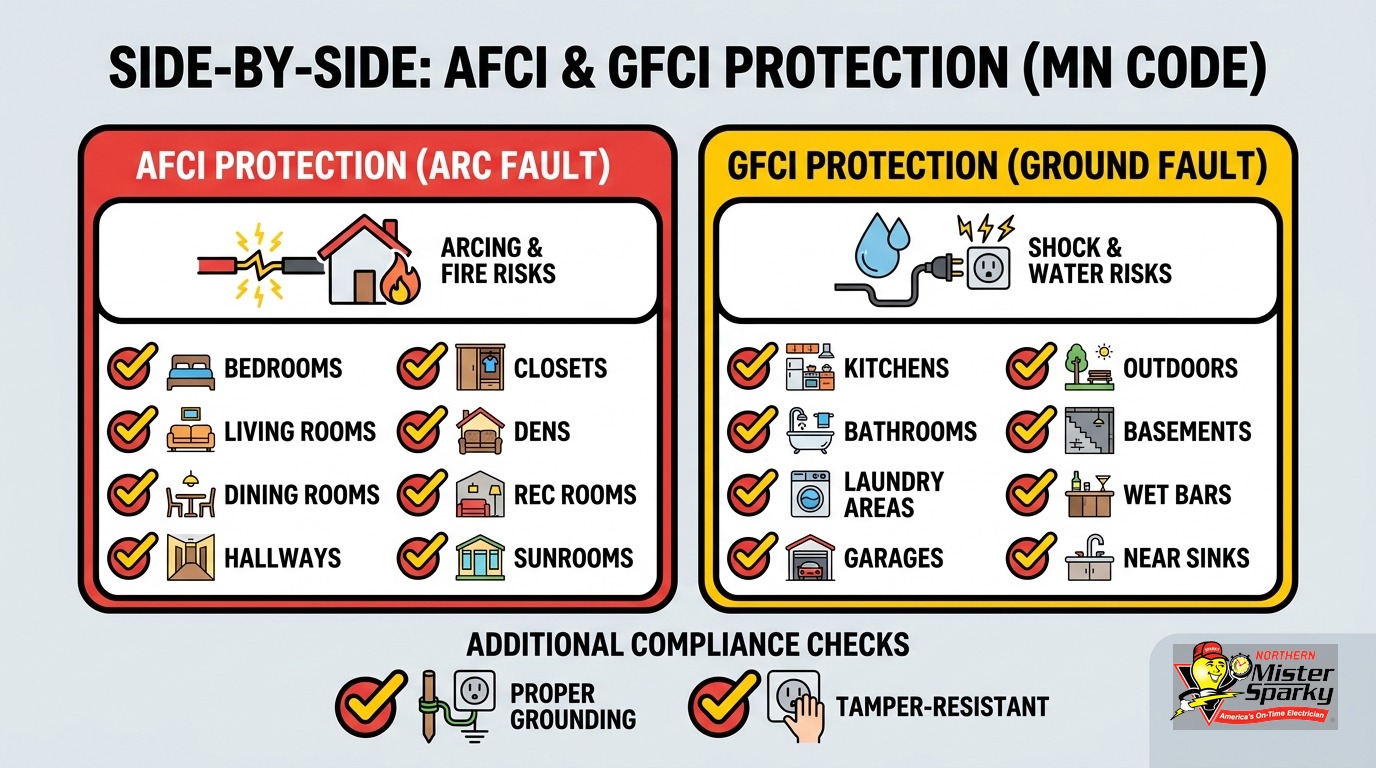
Short answer: Under the 2023 NEC, AFCI is required in kitchens, laundry rooms, family rooms, dining rooms, living rooms, parlors, libraries, dens, bedrooms, sunrooms, recreation rooms, closets, and hallways. That covers most habitable space in a typical Twin Cities home. The 2026 NEC, effective August 17, 2026 for new permits, expands that list to include dedicated appliance circuits.
The breadth of the NEC 210.12(B) list reflects where arcing fires actually start. Bedrooms are high on the list because lamp cords get pinched under mattress legs and headboards for years without anyone noticing. Living rooms have cords running under rugs. Kitchens have appliance cords that get hot and cycle repeatedly.
Notice that kitchens and laundry rooms appear on the AFCI list and on the GFCI list. Those rooms need both types of protection. A dual-function combo breaker installed at the panel handles both requirements in one device.
Under the 2026 NEC, dedicated circuits feeding dishwashers, refrigerators, and garbage disposals must include AFCI protection on new and modified installations. If your permit is filed on or after August 17, 2026, those appliance circuits are now on the list.
For a detailed code breakdown, see AFCI breaker requirements explained.
Which Locations Require GFCI in Minnesota?
Short answer: GFCI is required wherever water and electricity can meet. Under NEC 210.8(A), covered locations include bathrooms, garages, outdoor locations, unfinished basements, crawl spaces, and kitchen countertop outlets within 6 feet of a sink. Laundry areas and several permanently connected appliances are also on the list.
NEC 210.8(D) extends GFCI to permanently connected appliances: dishwashers, sump pumps, ranges, wall ovens, cooktops, dryers, and microwaves. If you are adding any of those appliances to a new circuit, GFCI protection is required.
The 2026 NEC adds a rule that matters specifically to Minnesota homeowners right now. New outdoor outlets serving air conditioners, heat pumps, and mini-splits must be GFCI-protected under NEC 210.8(F), effective September 1, 2026. If you are adding a cold-climate heat pump this year to take advantage of Xcel Energy or CenterPoint rebates, the new outdoor outlet must meet this requirement. Minnesota does have a state exclusion for existing HVAC equipment that is simply being replaced. A brand-new system on a new outlet does not qualify for that exclusion.
For the full outlet-level breakdown, see GFCI outlet requirements explained.
What Did Minnesota’s 2026 NEC Change?
Short answer: Minnesota adopted the 2026 NEC with an effective date of August 17, 2026. Permits filed before that date use the 2023 NEC. Permits filed on or after must comply with the 2026 NEC. The key changes are expanded AFCI coverage for appliance circuits and new GFCI requirements for outdoor HVAC outlets.
Here is what shifts in practice:
Appliance circuits now require AFCI. Dedicated circuits for dishwashers, refrigerators, and garbage disposals were outside the 2023 AFCI scope. The 2026 NEC closes that gap. Any new or modified circuit feeding those appliances on a post-August 17 permit must include AFCI protection.
Retrofit compliance gets more flexible. Under 2026 NEC 210.12(E), AFCI compliance on an existing branch circuit has a new option. The first outlet or the first switch on the circuit can be protected instead of the breaker at the panel. That gives electricians practical alternatives in older homes where running new wire back to the panel is not feasible.
Outdoor HVAC circuits require GFCI. New outdoor outlets serving AC units, heat pumps, and mini-splits must now be GFCI-protected. Per the DLI 2026 NEC FAQ, this takes effect in Minnesota on September 1, 2026. The Minnesota-specific exclusion covers like-for-like HVAC replacements, not new installations.
If your permit is in the queue right now, the August 17 filing date determines which code governs your job. Call us before pulling the permit and we will confirm which set of rules applies.
Does the Retrofit Rule Apply to My Older Twin Cities Home?
Short answer: Yes, and it surprises many homeowners. NEC 406.4(D)(4) requires any replacement outlet in a covered room to be AFCI-protected, even in homes built long before AFCI codes existed. NEC 210.12(D) extends that requirement further: any modification, replacement, or extension of a branch circuit in a covered area requires AFCI protection on that circuit, regardless of how old the home is.
Minneapolis and St. Paul have extensive housing stock from the 1940s, 1950s, and 1960s. If you are remodeling a kitchen, finishing a basement, or swapping a worn outlet in the living room, the electrician pulling the permit must bring that circuit into AFCI compliance.
Saint Paul’s Department of Safety and Inspections confirms that the retrofit rule applies to any circuit modification in a covered room. The age of the home is not a waiver, and an inspector will not look the other way.
This is one of the most common budget surprises in a remodel. A homeowner plans to swap two outlets in the dining room and does not expect an AFCI upgrade on the circuit. The electrician is not adding cost arbitrarily. That is what the code requires.
The practical advantage: an AFCI upgrade during a remodel costs less than it would as a standalone trip. If the walls are already open and the electrician is on-site, completing the upgrade at that point is efficient. The inspection closes cleanly and the protection is in place.
Can One Breaker Do Both Jobs?
Short answer: Yes. Dual-function AFCI/GFCI combination breakers satisfy both protection requirements in a single device. They are the right solution for rooms that appear on both the AFCI and GFCI lists, kitchens and laundry rooms being the most common examples.
Combo breakers cost more than a standard breaker at retail, typically $40 to $80 each versus $5 to $15 for a plain breaker. That cost difference often disappears quickly. One combo unit at the panel protects every outlet downstream, eliminating the need for individual GFCI receptacles throughout the room. For a kitchen circuit serving six or eight outlets, the combo breaker at the panel is usually the more economical choice.
One caveat: not every breaker brand is listed for every panel brand. The breaker must be compatible with the panel it goes into. Our team confirms compatibility before ordering parts, so there are no surprises on install day.
For a service page on this work, see circuit breaker replacement.
Nuisance Tripping in Older Twin Cities Homes
Older homes with knob-and-tube wiring or shared neutrals are prone to nuisance tripping on both AFCI and GFCI breakers. It is a real and common frustration in the older neighborhoods of Minneapolis, St. Paul, and the first-ring suburbs. No malarky: the wiring configuration is usually the culprit, not a defective breaker.
Knob-and-tube wiring, common in homes built before 1950, runs without a ground wire and often shares neutral conductors across circuits. A GFCI breaker detects any difference between the current flowing out on the hot and the current returning on the neutral. A shared neutral introduces an imbalance that reads as a fault, even when no real shock hazard exists. The breaker trips. The wiring is not damaged. The protection logic is doing exactly what it was designed to do.
Multi-wire branch circuits present the same problem. Those circuits split a 240V feed into two 120V circuits sharing a neutral. Installing a standard GFCI on a multi-wire branch circuit without accounting for the shared neutral causes persistent nuisance tripping.
The solution is not to remove the protection device. The solution is to diagnose the wiring configuration before selecting and installing the breaker. Our team does this regularly. We identify the root cause of the nuisance trip, correct the underlying wiring condition, and install the right protection device for that specific circuit.
If your home has pre-1950 wiring, see our guide on knob-and-tube wiring replacement for context on what full remediation involves.
Do You Need a Permit to Replace a Breaker in Minnesota?
Short answer: In almost all cases, yes. Minnesota requires permits for virtually all electrical work, including AFCI and GFCI breaker upgrades. AFCI protection is a line item on the state’s rough-in inspection checklist. There is no pathway around it during permitted work.
The Minnesota Department of Labor and Industry’s electrical code page is clear: electrical work in the state is regulated and requires inspection. Unpermitted electrical work can fail a pre-sale home inspection, create homeowner insurance complications, and leave you legally exposed if something goes wrong.
Minnesota does allow homeowners to self-perform electrical work on their own single-family residence in certain circumstances. A permit and inspection are still required either way. Panel work carries specific hazards worth understanding: the line-side terminals in a panel remain energized even when the main breaker is off. Those terminals connect directly to the utility service. Only a licensed electrician, or a homeowner who fully understands the hazard, should work near them.
For a full breakdown of what Minnesota electrical permits cover and cost, see electrical permits in Minnesota.
The Arc Fault vs Ground Fault Breaker Difference: Room-by-Room Breakdown
Use this as a quick reference when planning any electrical project:
- Bedrooms, living rooms, dens, libraries, closets, hallways: AFCI required.
- Kitchens, laundry rooms, family rooms, dining rooms: AFCI required. GFCI also required for countertop and water-adjacent circuits. Use a combo breaker.
- Bathrooms, garages, outdoor circuits, unfinished basements, crawl spaces: GFCI required.
- Permanently connected appliances (dishwasher, disposal, sump pump, dryer, microwave, ranges): GFCI required.
- Dedicated appliance circuits (dishwasher, refrigerator, disposal) on permits filed August 17, 2026 or later: AFCI now required under the 2026 NEC.
- New outdoor outlet for AC, heat pump, or mini-split after September 1, 2026: GFCI required.
If you are uncertain which protection a specific circuit needs, that uncertainty is exactly where a licensed electrician adds real value. An incorrect breaker choice does not just fail inspection. It leaves a genuine protection gap in the home.
Northern Mister Sparky is locally owned and operated in the Twin Cities. We pull permits, schedule inspections, and work in these neighborhoods every day. We know which rooms need which breakers, which panels accept which combo devices, and how to get your project permitted and inspected without delays.
Call us at 763-200-5956 or book online to schedule.
Frequently Asked Questions
What is the arc fault vs ground fault breaker difference? +
Does the AFCI retrofit rule apply to older Twin Cities homes? +
What changed with Minnesota's 2026 NEC adoption? +
Do I need a permit to replace a breaker in Minnesota? +
Need an electrician now?