
Circuit Breaker Won't Reset or Stays Tripped: What's Really Wrong
Key Takeaways
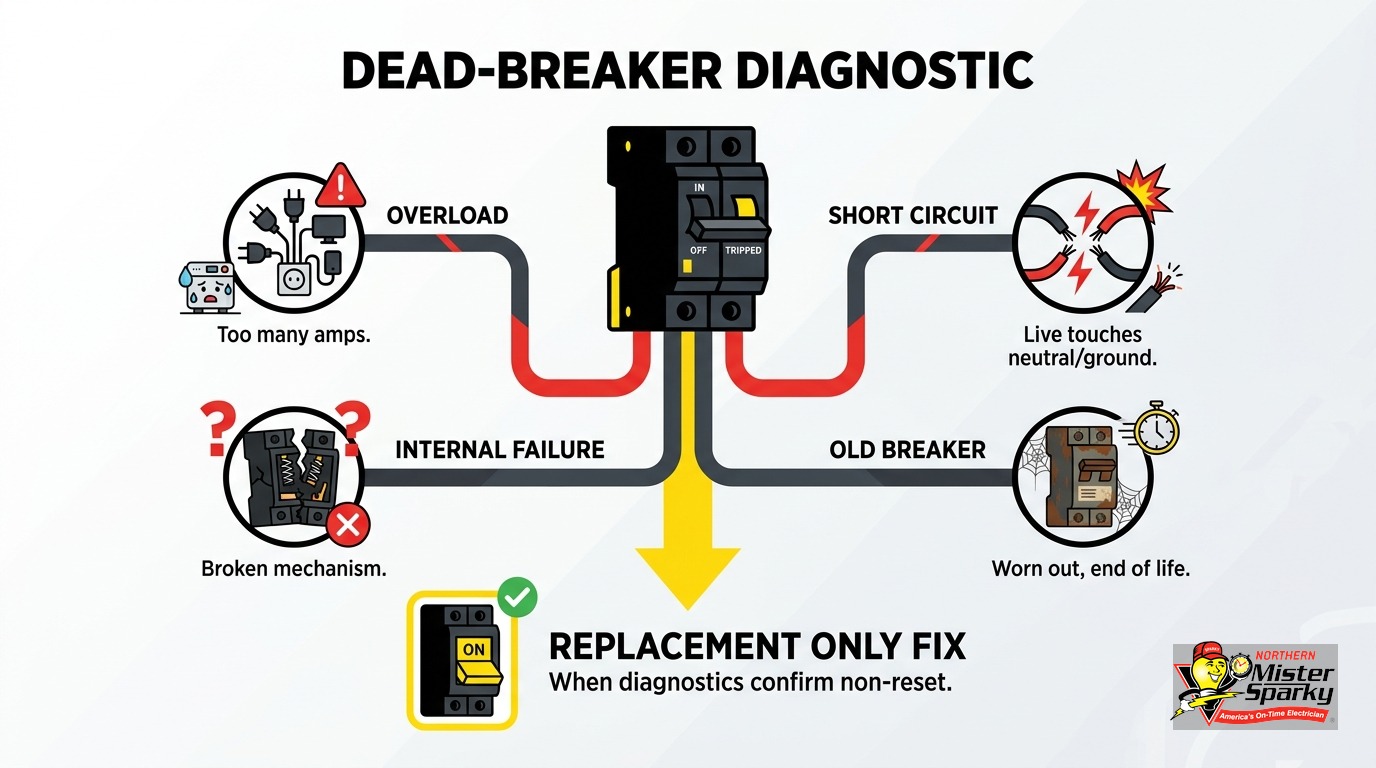
- A circuit breaker that won’t reset or stays tripped has one of three causes: the circuit is still overloaded, a short circuit or ground fault is still present, or the breaker’s internal mechanism has failed.
- Trip timing is your fastest diagnostic clue. A slow trip that takes minutes points to overload. An instant trip the moment you touch the handle points to a short. A trip with nothing connected points to a dead breaker.
- The wire-disconnect isolation test definitively confirms internal failure. Disconnect the load wire, cap it, and try resetting. If the breaker will not stay on with zero load, replace the breaker.
- Breakers cannot be repaired. Once the internal mechanism fails, replacement is the only fix.
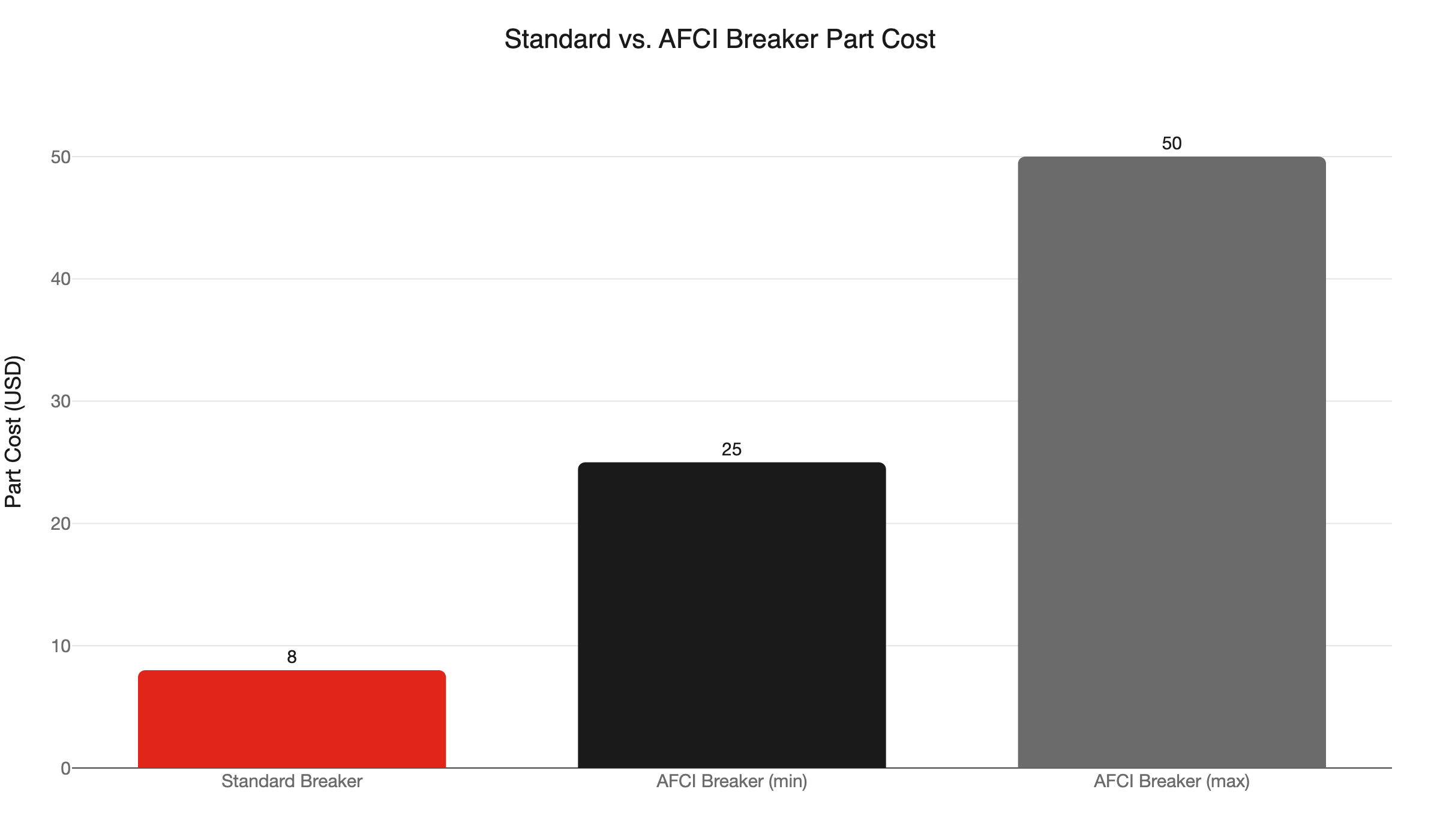
- In Minnesota, replacing a breaker in a bedroom, kitchen, living room, or other covered space may require an AFCI breaker under NEC 210.12(D). AFCI breakers cost $25 to $50 each in parts, versus about $8 for a standard breaker.
- Twin Cities detached garages and outbuildings can produce false trip symptoms in extreme cold. A breaker tripping in an unheated sub-panel on a -20 degree January morning may not have failed internally. It may be at the edge of its temperature rating.
- FPE Stab-Lok and Zinsco panels, common in Twin Cities homes built between 1960 and 1980, have documented design defects. A breaker in one of these panels that won’t reset is a panel-level safety issue, not just a breaker problem.
Why Your Circuit Breaker Won’t Reset or Stays Tripped
Short answer: Your breaker won’t reset because the condition that caused the trip is still present, or the breaker’s internal mechanism has failed. Resetting before diagnosing can weld internal contacts, overheat wiring, or worse. Knowing which of three causes you are dealing with determines every step that follows.
A circuit breaker’s job is to break the circuit when current gets too high. When it trips, it cuts power to protect the wiring downstream. The breaker is working.
When a breaker trips, most homeowners do the same thing: walk to the panel, flip the handle to ON, and hope it holds. Sometimes it does. Sometimes it trips again immediately. Sometimes it holds for a minute, then trips again under load. And sometimes it simply will not latch at all no matter what you do.
Each of those behaviors points to a different root cause. Most guides treat this as a binary problem: overload or short circuit. But there is a third failure mode that gets almost no attention. A breaker can fail internally. When it does, it mimics a wiring problem so closely that homeowners spend hours checking the circuit before realizing the breaker itself is the issue.
Understanding all three is the only way to diagnose correctly and safely.
The Three Failure Modes: Not All Tripped Breakers Are the Same
Before you touch the panel, know what you are looking for. Overload, short circuit, and internal failure share one symptom - a tripped breaker - but they have different diagnostic signatures, different urgency levels, and different fixes.
| Cause | Trip Timing | What You Notice | Fix |
|---|---|---|---|
| Thermal overload | Slow, minutes after reset under load | Multiple devices running; circuit worked fine earlier | Reduce load; add a dedicated circuit if needed |
| Short circuit or ground fault | Instantaneous - milliseconds | Pop or flash before the trip; immediate re-trip on reset | Find and clear the fault before any reset attempt |
| Internal breaker failure | Erratic, or trips with zero load | Won’t stay set even with nothing connected | Replace the breaker |
Trip timing is the key differentiator between all three patterns. The rest of this post walks you through each one.
What Is a Thermal Overload, and Is It Safe to Reset?
Short answer: A thermal overload happens when too much current flows through a circuit over time. The breaker heats up and trips - this is normal protection working as designed. Reset it once you have removed the excess load. If it trips again under a normal load, something else is wrong.
An overloaded circuit is the most common reason a breaker trips. It is also the least urgent.
The thermal element inside the breaker heats up as current flows through it. When the heat crosses a threshold, a bimetal strip bends and releases the latch. That is why an overload trip feels slow: you might run the microwave and toaster together for five minutes before the breaker finally gives out.
Think back to what was running when the circuit tripped. A bedroom circuit that trips when you add a space heater is a classic overload. A kitchen circuit that trips when the dishwasher, microwave, and coffee maker all run together is another.
To reset after an overload: unplug or turn off half the devices on that circuit. Wait a few minutes for the breaker to cool. Then push the handle firmly to OFF first, then back to ON. The firm-off step matters. A tripped breaker sits in a middle position - not fully off, not fully on. You have to push past that neutral position before you can reset.
If the circuit holds, you had an overload. Move some devices to a different circuit.
If it trips again under a normal load - a lamp and a phone charger, for example - overload is not the root cause. Keep reading.
A persistent overload pattern on a heavily used circuit often means the circuit needs to be split into two dedicated runs. That is an electrician job, not a breaker problem.
What Does a Short Circuit Do to a Breaker, and When Is It Dangerous?
Short answer: A short circuit creates a sudden current surge that trips the breaker in milliseconds. The instant trip is the signature. Forcing a reset when a short is still present can weld the breaker’s contacts permanently shut or ignite wire insulation inside the wall. Stop and diagnose before touching the handle again.
A dead short happens when a hot conductor makes direct contact with a neutral or ground conductor. This can occur inside an outlet, a light fixture, an appliance cord, or anywhere along the wiring run.
Trip timing is the fastest field diagnostic. If the breaker trips the instant you move the handle toward ON - or if you heard a pop or saw a flash before the trip - you are almost certainly dealing with a short circuit or a hard ground fault.
Do not force a reset on a breaker that trips instantly. Forcing it can weld the internal contacts shut. A fused-shut breaker cannot interrupt the next fault. That breaker looks normal but provides no protection - which is the most dangerous failure mode a panel can have. Forcing a short-circuit reset can also ignite insulation on wiring hidden inside your walls.
Here is how to narrow it down:
- Turn off or unplug everything on that circuit.
- Try resetting the breaker.
- If it holds with no load, plug devices back in one at a time.
- The circuit trips again when you add the faulty device or plug into the faulty outlet.
If unplugging everything does not change the behavior - if the breaker still trips the instant you reset it - the short may be in fixed wiring rather than a device. Or the breaker itself may have failed internally. That brings us to the third failure mode.
For more on locating a fixed wiring fault, see our post on how to find an electrical short in your home.
How Do You Know If the Breaker Itself Has Failed?
Short answer: The definitive sign of internal breaker failure is a breaker that trips with nothing at all connected to the circuit. The wire-disconnect isolation test confirms it: with the load wire disconnected and capped, a breaker that still will not stay set has failed internally and must be replaced. No repair option exists.
This is the failure mode that trips up homeowners and even some technicians. A dead breaker mimics a wiring problem almost perfectly. The circuit tests clear. Every device is unplugged. And still the breaker will not hold.
Common signs of internal breaker failure include:
- Won’t reset at all, even with no load attached
- Trips immediately on reset with nothing plugged into the circuit
- Handle is loose or won’t latch firmly in the ON position
- Breaker feels noticeably hot to the touch
- Burning smell near the panel
- Scorch marks or discoloration on the breaker body or case
- Buzzing or humming from the breaker itself
- No power on the circuit even with the handle in the ON position
One or two of these symptoms together point toward internal failure. You do not need to see all of them.
A breaker can also fail in a direction that is far more dangerous than nuisance tripping: it stops tripping when it should. Internal failure modes include contact surfaces that burn and pit under load, a mechanical latch that weakens and trips too easily, terminal screws that overheat from a loose connection, and internal contacts that fuse shut. The most dangerous failure is not a breaker that won’t reset. It is a breaker that cannot interrupt a fault at all.
The Wire-Disconnect Isolation Test
This test is the definitive way to confirm internal failure. It involves working near live bus bars inside the panel, so it is a licensed electrician’s job. Knowing what it involves helps you understand what you are asking for.
The procedure:
- Turn the breaker off and remove power from the circuit.
- Disconnect the load wire from the breaker terminal.
- Cap that wire safely so it cannot contact anything.
- Attempt to reset the breaker with absolutely nothing attached.
- If the breaker trips or refuses to latch with zero load, the internal mechanism has failed.
At that point, there is nothing more to diagnose. Breakers cannot be repaired. Replacement is the only path forward.
Do Unheated Twin Cities Garages Cause False Breaker Trips?
Short answer: Yes, they can. Minnesota DLI has published a specific bulletin on circuit breakers in low-ambient-temperature environments. A breaker in an unheated detached garage can trip on a -20 degree January morning not because it has failed, but because it is operating at the edge of its temperature rating. A straight breaker swap may not solve that problem.
This scenario catches a lot of Twin Cities homeowners off guard. Standard residential breakers are designed to operate within a defined temperature range. When a sub-panel in an unheated detached garage or outbuilding drops to extreme cold, the thermal element inside the breaker can reach its limit. It trips even though the circuit is not overloaded and the breaker is not internally failed.
Minnesota’s Department of Labor and Industry has published a specific code bulletin on circuit breakers in low ambient temperatures, dated July 2026. It is one of the only state-level regulatory documents in the country addressing this installation scenario directly.
If your breaker is in a detached garage or outbuilding sub-panel and trips only in deep cold, the diagnostic branches differently:
- Note whether the panel enclosure is in a conditioned or unheated space.
- Ask your electrician about cold-rated breakers designed for low-ambient installations.
- Ask about a heated enclosure for the sub-panel.
A cold-weather false trip is an environmental problem, not a failed component. Replacing the same breaker with the same breaker may produce the same result come January.
What About FPE or Zinsco Panels in Twin Cities Homes?
Short answer: FPE Stab-Lok and Zinsco panels are found in many Twin Cities homes built 1960-1980. Their breakers have documented design defects: they can fail to trip on a fault, and they can malfunction on reset. The CPSC has documented these as safety hazards. A breaker that won’t reset in one of these panels is a panel-level safety issue, not just a breaker problem.
If you are not sure what panel you have, check the label on the inside of the panel door. FPE panels say “Stab-Lok.” Zinsco panels may also be branded Sylvania.
The U.S. Consumer Product Safety Commission documentation covers two directions of failure in these panels: a breaker that stays ON when it should trip, and a breaker that malfunctions on reset. Both are present in these designs. Neither is a problem that a targeted breaker swap reliably fixes.
If you have one of these panels, the right response is a full panel evaluation by a licensed electrician, not a single breaker replacement. Our post on dangerous electrical panel brands in Minnesota covers what those evaluations involve and what panel replacement looks like when it is warranted.
Does Replacing a Breaker Require an AFCI Upgrade in Minnesota?
Short answer: It can. Under NEC 210.12(D), replacing or modifying a breaker in a covered living space - bedroom, living room, kitchen, dining room, hallway, or laundry room - triggers the AFCI requirement, even in homes built before AFCI breakers existed. Minnesota follows the NEC as written, with no state exemptions.
This catches homeowners off guard. A standard breaker costs about $8 in parts. An AFCI breaker runs $25 to $50 each. For a panel with multiple failed breakers in covered rooms, that cost difference adds up quickly.
Minnesota’s electrical code is Chapter 1315 of the MN State Building Code, which adopts the NEC as published by NFPA. The 2026 NEC takes effect for permits filed on or after August 17, 2026. Permits filed before that date use the 2023 NEC. In either version, the AFCI requirement for covered living spaces applies.
The AFCI rule has been in the NEC since 2011. “My house was built in 1975” is not an exemption.
What this means practically: if a breaker in your bedroom, living room, or kitchen has failed, the code-compliant replacement is an AFCI breaker. The electrician you hire should pull the required permit. If they are not mentioning the permit, ask why.
For more on which rooms require AFCI and how AFCI breakers differ from standard ones, see our post on AFCI breaker requirements explained.
When a Circuit Breaker Won’t Stay Reset: What the Replacement Process Involves
Replacing a circuit breaker is a straightforward job for a licensed electrician. It is not a job to estimate without diagnosing first. The root cause changes what gets ordered and whether a permit is required.
The replacement breaker must match the original on: brand and series, voltage rating, pole count, interrupting rating, and wire gauge. Matching amperage alone is not enough. NEC 110.3(B) requires following the listing and labeling for the panel. You cannot substitute a generic breaker into a branded panel and call it code-compliant.
The job involves:
- Confirming the root cause before ordering parts - overload, short circuit, or internal failure.
- Pulling a permit if the scope requires one.
- Removing the panel cover and identifying the failed breaker.
- Disconnecting the load wire and pulling the breaker off the bus bar.
- Seating the new breaker firmly and reconnecting the wire.
- Torquing the terminal to spec - a loose terminal connection is itself a fire risk.
- Verifying the circuit with a meter before closing the panel.
If AFCI is required, the new breaker also needs to be checked against the existing wiring. Older wire runs can interact with AFCI electronics differently than modern Romex. A properly installed AFCI breaker may trip on the first test if an existing wiring fault was previously masked by the failed breaker.
For full cost context on parts and labor, see our circuit breaker replacement cost guide.
When to Call a Licensed Electrician Right Now
Most tripped breakers are not immediate emergencies. You have time to diagnose, unplug devices, and schedule service. But some situations warrant a call before anything else.
Call us now if you notice any of the following:
- A burning smell from the panel or near any outlet on the circuit
- Scorch marks, discoloration, or melted plastic on the breaker or inside the panel
- A breaker that feels hot to the touch
- Buzzing or humming coming from the panel
- Any sign of arcing: a pop, a flash, or a scorched outlet face
- A breaker that will not stay set even with the circuit completely clear
- Any breaker problem in an FPE Stab-Lok or Zinsco panel
These are not situations to wait on for a convenient appointment. A panel that cannot interrupt a fault is not protecting your home. Panels rarely give much warning before things go wrong.
We are locally owned and operated in the Twin Cities. Our team serves Minneapolis, St. Paul, Bloomington, Brooklyn Park, Woodbury, Blaine, Maple Grove, Plymouth, and the surrounding communities. As America’s On-Time Electrician(R), we show up when we say we will - no malarky.
Call 763-200-5956 or book online to schedule service. We will walk you through the diagnostic, tell you exactly what is wrong, and fix it right the first time. That is the UWIN(R) guarantee.
Frequently Asked Questions
Why won't my circuit breaker reset? +
Is it safe to keep resetting a tripped breaker? +
How do I know if my circuit breaker has failed internally? +
Does replacing a circuit breaker require an AFCI upgrade in Minnesota? +
Need an electrician now?