
Electrical Panel Making a Humming Noise: Safe or Dangerous?
Key Takeaways
- A faint, constant hum is normal electromagnetic vibration from 60 Hz alternating current. It is not a problem on its own.
- A loud buzz, crackling sound, or hum that changes when appliances run is a warning sign.
- The three most common dangerous causes: a failing breaker, a loose connection, and an overloaded circuit.
- In Minnesota, opening your panel to tighten connections requires a licensed electrician and a separate DLI electrical permit. It is not a DIY task.
- Homes built between the 1950s and 1980s may carry Federal Pacific Stab-Lok or Zinsco panels. These brands have documented breaker failure modes.
- Minnesota adopted the 2026 National Electrical Code on August 17, 2026. Any new work must comply.
- If you hear buzzing, smell burning, or see scorch marks near the panel: call 763-200-5956 today.
That electrical panel in your basement or utility closet is making a humming noise. Maybe it started recently, or maybe you just noticed it for the first time. Either way, your electrical panel making a humming noise is worth understanding. The difference between normal and dangerous is not obvious from the sound alone. In Minnesota, knowing that difference matters.
This guide covers what the sound means, how to read the warning signs, and what Twin Cities homeowners specifically need to know before touching anything near the panel.
Is My Electrical Panel Making a Humming Noise Normal?
The short answer: A soft, constant hum is normal. Alternating current switches direction 60 times per second, which causes low vibrations in the panel’s metal components. That hum has been present since installation and does not change with load. A louder buzz, a crackling or sizzling sound, or any hum that gets worse when you run appliances is different and needs attention.
Alternating current at 60 Hz causes transformer laminations, bus bars, and other metal components inside the panel enclosure to vibrate at that same frequency. The result is a low, steady hum. Most homeowners only notice it in a quiet house at night, standing close to the panel. That sound by itself is not a problem.
The key test is stability. A normal hum does not change pitch or volume when the dishwasher kicks on or the air conditioner starts. It does not come with a burning smell, scorch marks around the breakers, or lights that flicker when appliances cycle. If all of those hold, you are almost certainly hearing normal vibration.
But “almost certainly normal” is not a full diagnosis. If the sound is new, has grown louder recently, or comes with any other symptom at all, a licensed electrician can confirm it in a short service call.
Electrical Panel Making a Humming Noise: 5 Causes That Need Attention
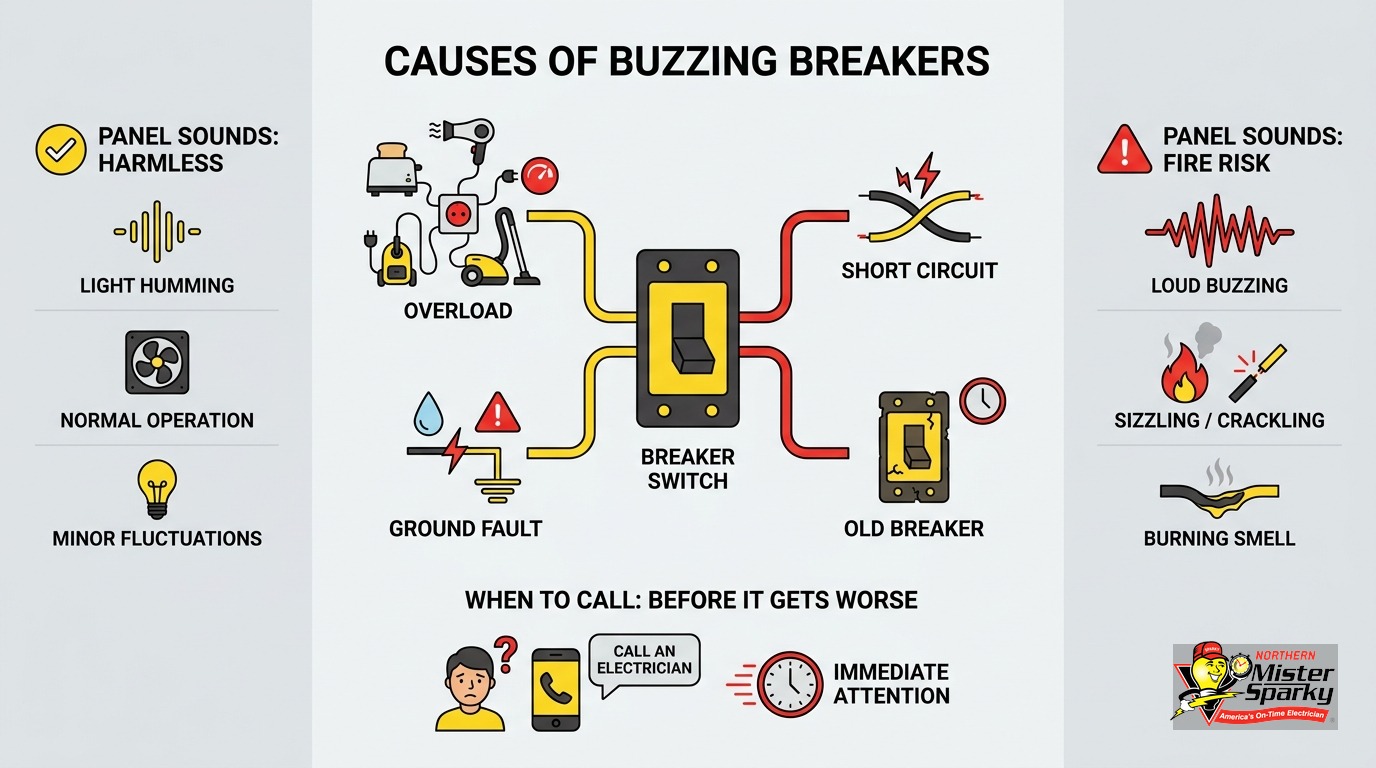
The short answer: When the hum crosses into something louder or more concerning, the most likely causes are a failing breaker, a loose wire connection, an overloaded circuit, backstab wiring that has come loose over time, or corrosion. All five generate heat inside the panel. Research on the causes of panel buzzing identifies these as the five most common culprits.
Here is what each cause means:
1. Failing or worn breaker. A breaker that cannot trip properly allows more current to flow than the circuit can handle. The buzzing is the sound of protection that has already degraded. From the outside, the breaker may look completely normal. The failure is inside the mechanism, where you cannot see it.
2. Loose connection at a lug or bus bar. A loose wire cannot carry current smoothly. Electricity arcs across the gap. Arcing generates heat and a crackling buzz. Over time, the arc chars the wire insulation and the panel interior. Left alone, it leads to fire.
3. Overloaded circuit. A circuit running at or near its rated amperage runs warm. You may hear a hum that gets louder when high-draw appliances run on that circuit: an electric range, HVAC equipment, or a large window air conditioner.
4. Backstab wiring that has loosened. Some older installations used push-in connections instead of screw terminals at breakers and devices. These loosen over years of heating and cooling cycles. A loose backstab creates the same arcing risk as a loose lug.
5. Corrosion. Older panels in Minnesota homes corrode at connection points over time. Corrosion increases resistance. Higher resistance means more heat, more noise, and eventually component failure.
Harmless Hum vs. Dangerous Buzz: How to Tell the Difference
Your ears and your nose are your first diagnostic tools. Use this checklist before calling anyone or touching anything.
Signs the hum is likely harmless:
- Soft, low-pitched, and consistent from day to day
- Present since the panel was installed and unchanged since then
- Does not get louder when major appliances turn on
- No burning smell anywhere near the panel or inside the walls
- No visible scorch marks, discoloration, or darkening around any breaker handle
- No flickering lights in the house
Signs that mean call an electrician today:
- Loud buzzing or a crackling, popping, or sizzling sound
- The hum gets louder when major appliances run
- A burning smell near the panel or in the walls nearby
- Scorch marks, darkening, or discoloration around any breaker handle or the bus bar area
- A breaker that trips repeatedly or cannot be reset
- Warmth or heat on the outside of the panel cover
- Any visible sparks
According to a professional assessment of buzzing panel emergencies, danger rises sharply when buzzing is accompanied by heat, a burning odor, or visible scorch marks. Those are not “keep an eye on it” signs. They are “call today” signs.
If a burning smell is the symptom that brought you here, see our guide on burning smells from outlets and breakers for what the smell indicates and what to do immediately.
Why Does Cold Weather Make Panel Buzzing Worse in Minnesota?
The short answer: Circuit breakers are rated for a specific ambient temperature range. When a panel in an unheated garage or outbuilding drops well below that range in a Minnesota winter, the thermal elements inside breakers may not perform as rated. A buzzing panel in a cold space is a different diagnostic situation than one inside a heated home.
Standard residential breakers are designed for a defined range of ambient temperatures. A panel in a heated utility room stays within that range year-round. A panel in an unheated detached garage in February in Minneapolis does not.
When temperatures drop far below a breaker’s rated range, the thermal trip mechanism inside the breaker behaves differently. A breaker may not trip at the amperage it is rated for. Or it may trip earlier than expected, creating nuisance trips that homeowners reset without investigating the underlying cause.
In July 2026, the Minnesota Department of Labor and Industry published a bulletin specifically addressing circuit breakers in low ambient temperatures. That bulletin addresses exactly this concern. If your panel is in an unheated space and you are hearing buzzing, the cold-weather context matters to the diagnosis.
A practical observation: if a panel in an unheated space buzzes louder in winter than in summer, note that change and report it to your electrician. A sound that worsens with cold is a signal the breaker’s thermal performance may be compromised.
Do Older Panel Brands Like Federal Pacific and Zinsco Buzz Differently?
The short answer: These panels have documented breaker failure modes where breakers do not trip under overload. Any buzzing from a Federal Pacific Stab-Lok or Zinsco panel should be treated as urgent. The usual “soft hum, probably fine” framework does not apply when the breaker itself is the documented failure point.
Many Twin Cities homes built in the 1950s through the 1980s still carry their original Federal Pacific Stab-Lok or Zinsco electrical panels. These brands have a documented record of breakers that fail to trip when they should. The breaker looks intact from the outside and passes a visual check. Under excess current, it does not cut the circuit.
That failure mode changes the stakes entirely for buzzing. If a Stab-Lok or Zinsco breaker is the source of the buzz, it may never trip. Current will keep flowing. Wiring will keep heating. There will be no automatic shutoff to stop the damage.
Identifying these panels is straightforward. Federal Pacific panels often say “Stab-Lok” or “FPE” on the enclosure. Zinsco panels typically have colored breaker handles in blue, red, or green, and may be labeled “GTE-Sylvania.”
Our post on dangerous electrical panel brands in Minnesota covers what is known about each brand and what steps to take if you have one. If either name matches your panel, do not treat the buzzing as a low-priority item.
Can I Open the Panel Cover Myself to Fix the Buzzing?
The short answer: No. In Minnesota, opening a panel cover to tighten connections is electrical work. It requires a licensed electrician and a separate DLI electrical permit. Some national websites suggest homeowners can do this in 15 minutes with a screwdriver. That advice is not accurate for Minnesota, and it is physically dangerous regardless of where you live.
Minnesota’s electrical code is Chapter 1315 of the Minnesota State Building Code. It adopts NFPA 70, the National Electrical Code, without state amendments. It requires a separate electrical permit from the Minnesota Department of Labor and Industry before any electrical work begins. Not after. Before.
Beyond the permit, there is the physical reality of an open panel. When you remove the cover, the bus bars are live. The main breaker does not de-energize the service entrance conductors coming in from the utility. Only the utility company can do that. A homeowner tightening a loose lug is working next to 120-240 volt conductors with no way to shut them off from inside the house.
The right move is to call a licensed electrician. They pull the permit, do the work safely, and create the documentation your homeowner’s insurance needs if you ever make a claim connected to the panel.
What Are AFCI Breakers, and Why Do They Matter for a Buzzing Panel?
The short answer: Arc-fault circuit interrupters (AFCIs) detect the exact arcing signature that causes panel buzzing and electrical fires. They cut power when they sense an arc, before significant heat builds. Under current Minnesota code, AFCI protection is required in most living spaces of new and remodeled residential work.
Every explanation of panel buzzing points to the same danger: arcing at a loose connection. Very few connect that danger to the technology specifically designed to address it.
Standard breakers trip on overcurrent or short circuit. They do not detect low-level arcing at a loose connection that builds slowly over days or weeks before igniting wire insulation. AFCIs do. An AFCI monitors the current waveform on a circuit. When it detects the irregular signature of an arc, it trips the circuit before enough heat accumulates to cause damage.
If your electrician finds a failing breaker or a loose connection, ask whether adding AFCI protection makes sense on the affected circuits. It often does. You address the symptom and add a layer of ongoing protection at the same time.
The 2026 NEC FAQ published by Minnesota DLI details the current requirements for AFCI and other protective technologies on new and remodeled residential work. Our post on AFCI breaker requirements covers what is code-required and what to expect in the conversation with your electrician.
Why Does My Breaker Keep Tripping After I Hear Buzzing?
The short answer: A tripping breaker is doing its job: cutting power to prevent worse damage. But if the same breaker keeps tripping, the underlying cause has not been resolved. Each forced reset while the fault is active pushes additional heat through the wiring and compounds the damage.
A breaker that buzzes and then trips is one step past the warning stage. The protection is functioning. The problem driving it has not gone away.
Do not reset a tripping breaker more than once or twice without understanding why it tripped. The reset restores power. It does not fix the overload, the loose connection, or the failing breaker mechanism that caused the trip. If the breaker is failing, each reset pushes more heat through the wiring it is supposed to protect.
The sound can escalate too. A breaker that cracks louder on each reset is telling you the condition is getting worse, not better. That is a clear signal to stop resetting and start calling.
Our post on what to do when a circuit breaker will not reset covers the diagnostic steps and what to tell your electrician when you call.
When Should I Call an Electrician About Panel Buzzing?
The short answer: Call today if the buzzing is new or louder than before, if it comes with a burning smell or scorch marks, if a breaker keeps tripping, or if you have a Federal Pacific Stab-Lok or Zinsco panel. A soft, unchanged hum that has been there for years can wait for a scheduled maintenance visit. Everything else cannot.
Here is a simple rule: if the sound is new, louder, or accompanied by any other symptom, it is worth a call today. Electrical problems do not get better on their own.
We are locally owned and operated in the Twin Cities. Our team holds Minnesota electrical licenses, pulls permits through DLI, and backs every job with the UWIN(R) 100% satisfaction guarantee. As America’s On-Time Electrician(R), we show up when we say we will and give you a straight answer about what your panel needs and what it costs to fix. No malarky.
Call 763-200-5956 or book online. We serve Minneapolis, St. Paul, Bloomington, Brooklyn Park, Woodbury, Blaine, Maple Grove, Plymouth, and the surrounding Twin Cities area. If your panel is talking to you, it is worth listening.
Frequently Asked Questions
Is a humming electrical panel dangerous? +
Can I open my electrical panel to fix the buzzing myself? +
What causes an electrical panel to make a buzzing noise? +
When does panel buzzing become a fire risk? +
Need an electrician now?