
Electrical Panel Corrosion and Rusty Breakers in the Twin Cities
Key Takeaways
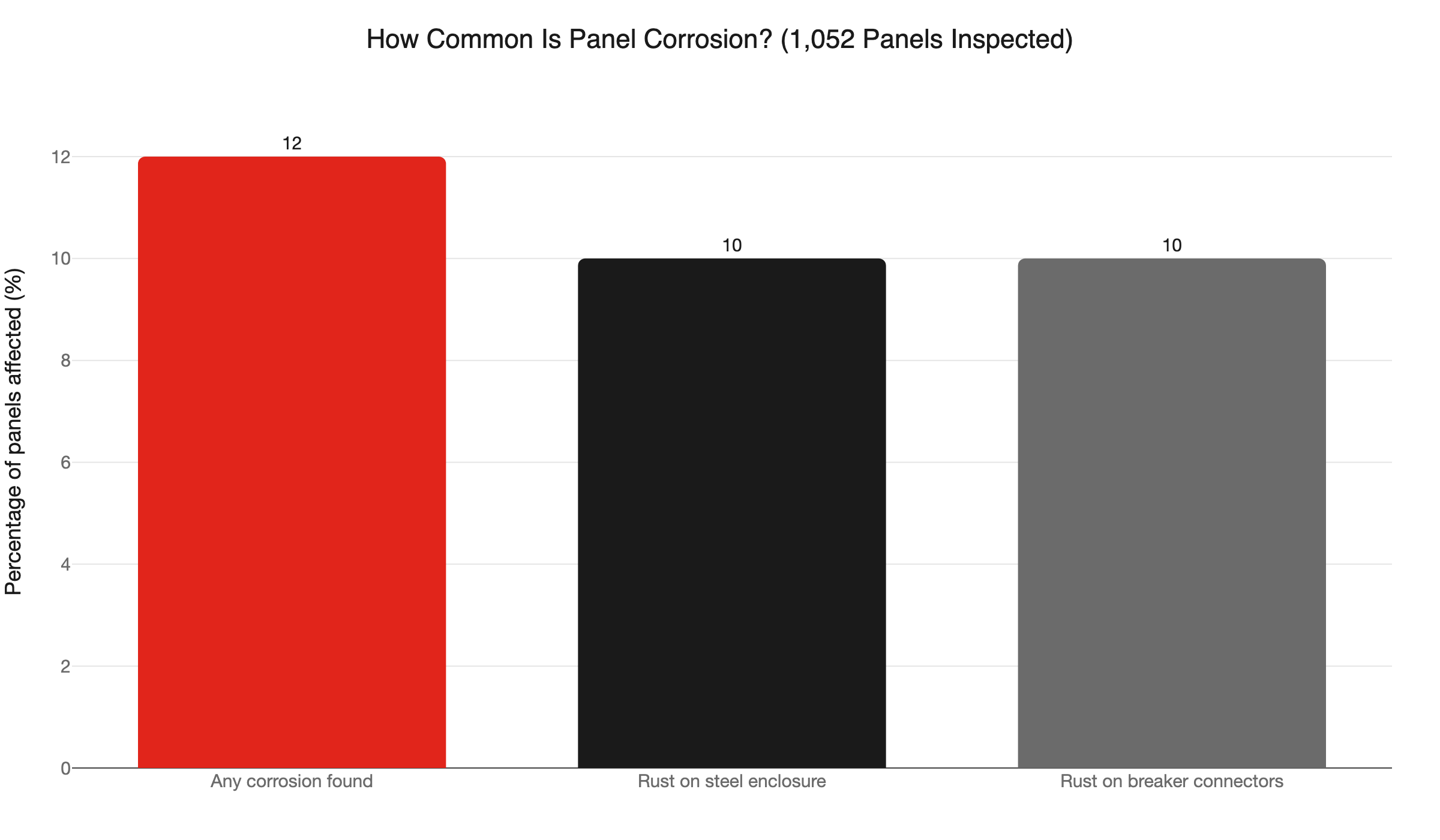
- Electrical panel corrosion and rusty breakers are more common than most homeowners expect: a study of 1,052 residential panels found corrosion in 12% of them.
- Minnesota’s climate is uniquely hostile to panels in below-grade utility rooms. Freeze-thaw cycles, clay soil, and summer humidity work together to push moisture toward your panel year-round.
- Surface rust on the steel enclosure is a warning sign. Rust or oxidation on bus bars or breaker terminals is an urgent problem.
- Aluminum bus bars corrode more dangerously than copper ones. Many 1970s-era Twin Cities homes have aluminum branch wiring and aluminum bus bars.
- Minnesota adopted the 2026 NEC on August 17, 2026. Panel replacement requires a DLI permit and inspection.
- Every fix has two parts: eliminate the moisture source, then evaluate or replace the panel. Skipping the first step means the new panel corrodes too.
What Is Electrical Panel Corrosion?
Short answer: Corrosion is the chemical breakdown of metal surfaces inside your panel. On steel it shows as orange-brown rust. On copper it appears as green patina. On aluminum it leaves white-gray powder. Any of these inside the enclosure means moisture is reaching components it should never touch.
Your electrical panel is a sealed metal enclosure by design. The internal components - bus bars, wiring terminals, and breaker connectors - are meant to stay dry. When moisture enters, it reacts with those metal surfaces and begins to degrade them.
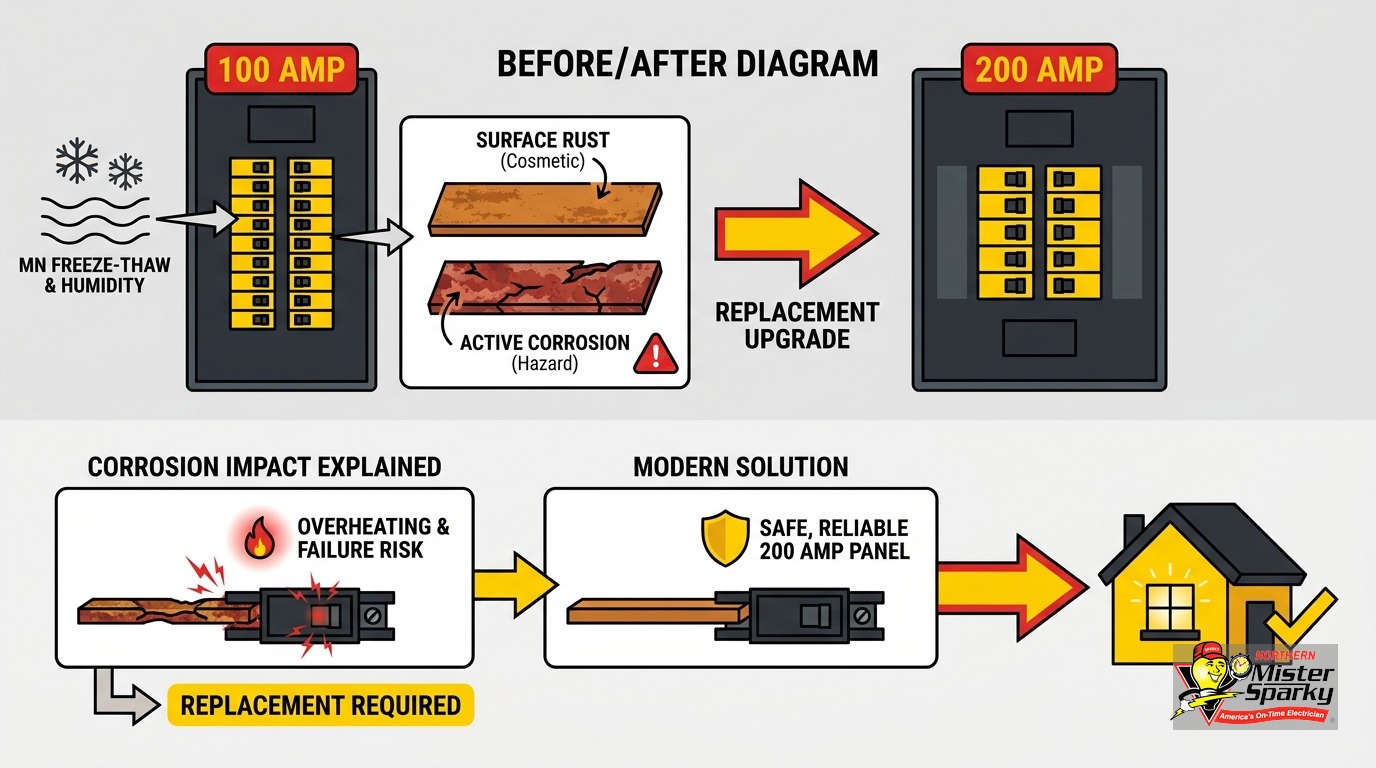
The hazard chain is direct. Corrosion increases electrical resistance at connection points. Higher resistance generates heat. Sustained heat at a breaker terminal or bus bar connection is a pathway to electrical fires.
A 1991 study of 1,052 residential panels found corrosion in 12%, rust on steel enclosure components in 10%, and rust on breaker screw connectors in approximately 10%. That is one in eight homes from a national sample. In the Twin Cities, the number is likely higher. The reason is the climate.
Why Does Minnesota’s Climate Make Panel Corrosion Worse?
Short answer: Three forces hit Twin Cities basements simultaneously. Freeze-thaw cycles crack foundations. Clay soil holds moisture against those cracks. Humid summers condense on cool basement concrete. No competitor article on this topic makes that connection - but it is the mechanism behind corrosion in below-grade utility rooms here.
Most articles on panel corrosion offer generic advice: keep humidity below 50%. That ignores what actually happens in a Minnesota basement from November through August.
Freeze-thaw cycles crack the path open
The Twin Cities averages 55 to 60 freeze-thaw cycles per snow season, with extremes ranging from 39 to over 95 days. Each cycle stresses your foundation. Water expands when it freezes, widening hairline cracks over time. Those cracks become channels for liquid water and humid air to enter the basement.
Clay soil keeps walls wet for weeks
Twin Cities glacial soils are clay-heavy. Clay does not drain like sandy soil. It holds water from rain and snowmelt against foundation walls long after a storm ends. That sustained pressure forces moisture through even small cracks.
Summer humidity condenses on cool concrete
From June through August, outdoor air carries significant humidity. When that air enters a basement, it meets walls and floors that stayed cool from winter. Liquid water forms on surfaces without any visible leak. Your panel sits in that condensation cycle for months each year.
Underground conduit creates a direct pipe
If your home has underground electrical service, the conduit running from the meter to the panel creates a direct path between soil and the panel interior. Humid soil air travels up that conduit and condenses on cool metal bus bars inside the enclosure. There is no water leak visible anywhere. There does not need to be.
What Is the Difference Between Surface Rust and Active Corrosion?
Short answer: Surface rust on the steel box may be a cosmetic warning. Active corrosion that has reached bus bars, terminals, or breaker connectors is a safety issue requiring professional evaluation and likely replacement.
Not all corrosion inside a panel carries the same immediate risk. Understanding the distinction helps you decide how fast to act.
Arrested corrosion
Arrested corrosion shows these characteristics:
- The enclosure interior is dry when inspected
- No visible moisture, staining, or water marks
- Oxidation is limited to surface rust on the steel box
- No pitting on metal surfaces
- No progression to bus bars or breaker terminals
- No identifiable active moisture entry path
If corrosion is confined to surface oxidation with no pitting, no moisture present, and no progression to internal components, a licensed electrician may assess it as monitorable. Monitorable still means you must find and fix the moisture source. Corrosion does not appear without a cause.
Active corrosion
Active corrosion shows one or more of these:
- Visible moisture inside the enclosure
- Rust or oxidation on breaker terminals or screw connectors
- White-gray powder or green patina on bus bars
- Pitting on any internal metal surface
- Water stains or mineral deposits around the panel
- Breakers that trip without clear cause, feel sticky, or will not reset
The Mike Holt forum consensus among licensed electricians is consistent: replace a corroded breaker, do not clean corrosion from bus bars, and fix the moisture source before anything else. Cleaning bus bar corrosion can strip the protective oxide layer and accelerate deterioration. Replacement is the correct call once corrosion reaches internal components.
Does the Metal Type Matter - Copper vs. Aluminum Bus Bars?
Short answer: Yes, significantly. Copper patina is often less urgent than aluminum oxide. Aluminum corrosion creates a highly resistive layer that warrants faster action. Many Twin Cities homes from the 1970s have both aluminum branch wiring and aluminum bus bars.
The metal determines how dangerous the corrosion is.
Copper bus bars
Copper develops a green patina (cupric oxide) in humid conditions. Light green patina on copper may not significantly increase contact resistance. A qualified electrician must assess severity. Light surface patina is different from heavy pitting or oxidation at connection points. Copper is more forgiving - but active corrosion at copper terminals still creates resistance and heat that need to be addressed.
Aluminum bus bars
Aluminum develops a white-gray oxide in humid conditions. That oxide is highly electrically resistive. Unlike copper patina, aluminum oxide at connection points sharply increases resistance, generates heat, and can lead to arcing. Significant aluminum oxidation on bus bars warrants urgent evaluation and likely replacement.
This matters specifically in the Twin Cities because many homes built in the 1960s and 1970s have aluminum branch wiring alongside aluminum bus bars. If your home is from that era and you see white powder inside the panel, treat it as urgent. Our guide to aluminum wiring dangers and fixes covers what that combination means for your home.
How Can I Tell If My Panel Has Dangerous Corrosion?
Short answer: Look for orange-brown rust or white powder on breaker faces and the back of the door. Any moisture, pitting, or discoloration at connection points means you need a licensed electrician now.
Do not open the panel to inspect bus bars. That exposes you to live conductors. A visual inspection of what is visible with the door open is appropriate for a homeowner. Full internal inspection is for a licensed electrician.
What you can safely check:
- The exterior of the panel box: rust streaks, bubbling paint, or staining
- The wall and floor around the panel: moisture marks, white efflorescence deposits, or watermarks
- The panel door interior: orange-brown rust or white residue, without touching any components
- Breaker faces: discoloration, corrosion, or white residue along the edges
- Breaker behavior: tripping without obvious load cause, refusing to reset, or feeling stiff
If any of these apply, stop and call us. Do not spray, clean, or treat corrosion yourself.
Additional warning signs worth noting:
- A burning smell from any outlet or breaker indicates heat buildup at a connection
- Lights dimming when appliances start can signal resistance at a corroded connection point
- Breakers that trip repeatedly without a clear overload cause point to a compromised circuit
Any combination of these alongside visible corrosion should move an inspection from “soon” to “today.”
What Does Minnesota Code Say About Corroded Panels?
Short answer: NEC 110.12(C) prohibits corroded internal panel components. Panel replacement in Minnesota requires a DLI permit. The 2026 NEC has been in effect since August 17, 2026.
This is a code requirement, not a safety opinion.
NEC 110.12(C) states that internal parts of electrical equipment - including busbars, wiring terminals, insulators, and other surfaces - shall not be damaged or contaminated by corrosive residues. That standard is now the 2026 NEC, which Minnesota adopted effective August 17, 2026. All permits filed on or after that date must comply.
Panel replacement in Minnesota requires a DLI permit and inspection. The minimum inspection fee is $55. Homeowners who skip the permit process to avoid the hassle are left with an uninspected panel that already has moisture intrusion and corrosion. That is the risk, stated plainly.
Minnesota does allow homeowners to pull their own electrical permits. But the work still requires inspection. Panel replacement involving corroded conductors and a moisture intrusion problem is work where mistakes have severe consequences. A licensed electrician handles the permit, the work, and the inspection scheduling.
Our panel upgrade service covers the full scope: assessment, permit, replacement, and coordination with DLI inspection.
What Happens If You Ignore Electrical Panel Corrosion?
Short answer: Corrosion progresses. Resistance at corroded connections increases over time, generating more heat with every amp that flows. The endpoint is arcing, panel failure, or fire.
The failure mode follows a predictable sequence:
- Moisture enters the panel through a foundation crack, conduit path, or condensation.
- Oxidation forms on metal surfaces: steel rusts, copper patinates, aluminum develops resistive white oxide.
- Corroded connections at breaker terminals or bus bars increase electrical resistance.
- Higher resistance generates heat every time current flows through that connection.
- Sustained heat accelerates further corrosion and can cause arcing inside the enclosure.
- Arcing inside the panel is a fire risk.
Left alone, corrosion does not stabilize. The moisture source that caused it keeps delivering moisture. Each Minnesota winter adds more freeze-thaw cycles to the foundation. Each summer adds condensation. The corrosion reaches deeper into the panel over time.
The financial case for acting now is straightforward. A panel assessment and moisture fix cost far less than the structural damage from an electrical fire and the insurance complications that follow a claim traced to a known, uninspected hazard.
Corrosion is also one of several indicators that a panel may have reached the end of its useful life. Our guide on signs you need an electrical panel upgrade covers the full picture.
How Do You Address the Moisture Source?
Short answer: Identify and eliminate the moisture path before replacing or repairing the panel. Common fixes include correcting exterior drainage, sealing foundation cracks, running a dehumidifier, and sealing conduit entry points.
Replacing a corroded panel without fixing the moisture source is working backwards. The new panel will corrode too.
Exterior drainage first. Check that the grade around your foundation slopes away from the house. Flat or inward-sloping ground directs rain and snowmelt toward the foundation. Regrading or extending downspouts is often the most cost-effective first step.
Seal foundation cracks. A waterproofing or foundation specialist can seal cracks from the interior or exterior. Minnesota’s freeze-thaw pressure means the sealant must be flexible enough to accommodate seasonal movement.
Dehumidify the basement. A basement dehumidifier keeps relative humidity below the condensation threshold during humid months. This does not fix the moisture source, but it reduces damage while other repairs are made.
Seal the conduit entry. If underground conduit enters your panel, that entry point should be sealed to stop humid soil air from traveling up into the enclosure. This is a small job for a licensed electrician and is often overlooked entirely.
Once the moisture fix is in place, a licensed electrician can assess what damage the corrosion caused and whether you need individual breaker replacement or a full panel replacement.
When Does Electrical Panel Corrosion Require Replacement?
Short answer: Replace when corrosion has reached bus bars or terminals, when breakers are failing, when the moisture source cannot be fully eliminated, or when the panel is already at the end of its service life.
The threshold for replacement versus repair depends on what the corrosion has reached and whether the panel has remaining service life regardless of the corrosion.
Replace the panel when:
- Corrosion has reached the bus bars, regardless of metal type
- Aluminum bus bar oxidation is visible (the resistive oxide layer means the component is compromised)
- Breakers are failing, sticking, or showing corrosion at terminals
- The panel is 25 to 40 years old and is approaching end of life anyway
- The moisture source cannot be fully sealed due to underground conduit or chronic condensation
- The panel is one of the brands with documented reliability issues in the Twin Cities region (covered in our guide to dangerous electrical panel brands in Minnesota)
Replace individual breakers when:
- Corrosion is isolated to one or two breakers with no bus bar involvement
- The enclosure is dry and the moisture issue has been resolved
- The panel itself is modern, properly sized, and otherwise in good condition
A licensed electrician can tell you which situation you are in. The assessment is part of the job.
Panel age is also a factor independent of corrosion. Our guide to electrical panel lifespan and when to replace covers all the signals that a panel has reached the end of its useful life.
Get Your Panel Inspected by a Local Expert
Electrical panel corrosion is a symptom. The moisture mechanism causing it is still running. The longer it runs, the deeper the corrosion reaches.
Our locally owned and operated Twin Cities team shows up on time - that is the “America’s On-Time Electrician(R)” commitment, backed by the UWIN(R) 100% satisfaction guarantee. If your panel has rust, white powder, or breakers that are acting up, we will tell you exactly what you are dealing with and what it will take to fix it. No guesswork, no malarky.
Call 763-200-5956 or book online to schedule your panel inspection. For larger panel replacement projects, ask about financing options when you call - we want to make sure the right fix is accessible, not just the cheapest one.
Frequently Asked Questions
Is surface rust on my electrical panel dangerous? +
How do I know if my panel corrosion is active or arrested? +
Does Minnesota require a permit to replace a corroded panel? +
Why are Twin Cities panels especially prone to corrosion? +
Need an electrician now?