
How Long Does an Electrical Panel Last? Age-by-Age Guide
Key Takeaways
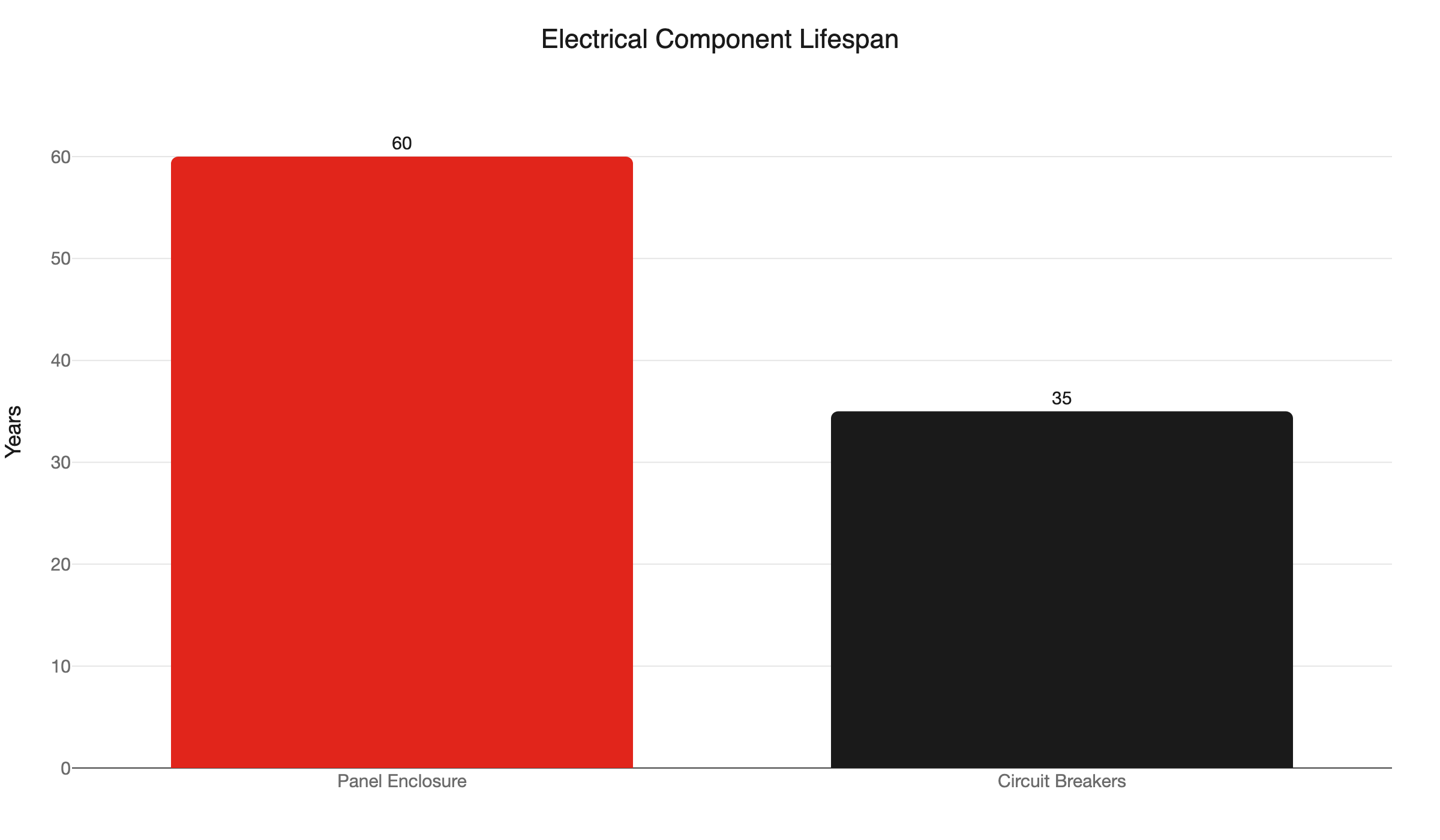
- The metal panel enclosure can last 40-60 years. The circuit breakers inside can wear out over time, per CPSC guidance. Those are two separate clocks in the same box.
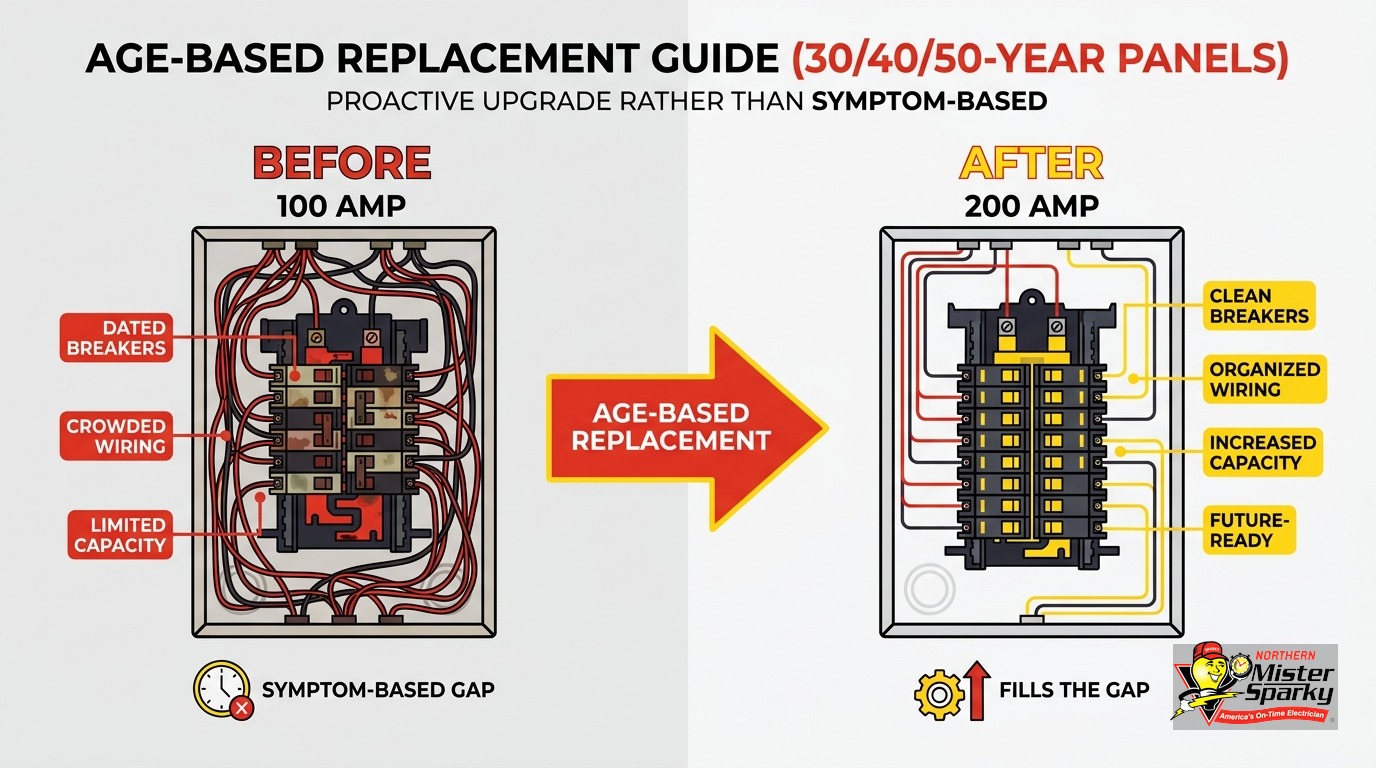
- At 30 years: schedule a licensed electrician to inspect the breakers and look for signs of wear.
- At 40 years: plan for panel replacement. The breakers have exceeded their recommended service life.
- At 50 years and beyond: act now. Panels this old predate modern safety codes and may be uninsurable.
- Federal Pacific (Stab-Lok), Zinsco, Pushmatic, and Challenger panels are dangerous at any age.
- Pre-1973 aluminum branch-circuit wiring is a separate hazard. Homes with it are considerably more likely to reach fire hazard conditions than copper-wired homes.
- Xcel Energy offers up to $1,500 in rebates for panel upgrades in the Twin Cities. A Minnesota state grant program has not launched as of September 2026. Do not delay needed work waiting for it.
- All panel replacement work in Minnesota requires a permit and must comply with the 2026 NEC, effective August 17, 2026.
How Long Does an Electrical Panel Last?
The short answer: The panel enclosure can last up to 60 years under ideal conditions. The circuit breakers inside it wear out in 30-40 years. Those are two different timelines in the same box, and both affect your safety.
Most electricians treat 40 years as the practical replacement milestone. At that point, the breakers inside your panel have exceeded their expected service life - even if the metal box on the wall looks fine. A breaker that no longer trips reliably on an overload is the failure mode behind a significant share of residential electrical fires.
Knowing how long does an electrical panel last is a useful starting question. The more useful question is: “What does my home’s build year actually tell me about my specific panel?” The answer depends on age, brand, and a few Minnesota-specific factors that the generic articles on this topic skip entirely. Generic articles treat age as background noise. It is not. It is a framework.
The Panel and the Breakers Are Not the Same Thing
Understanding this distinction prevents one common mistake: assuming a box that looks intact means everything inside it is fine.
Your electrical panel has two main parts. The enclosure is the metal cabinet mounted to the wall. It is durable. It can outlast the components inside it by decades. The circuit breakers are the mechanical switches arranged on the bus bar inside that cabinet. Each breaker controls a specific circuit and is designed to trip - to shut off current automatically - when the load exceeds safe levels.
Breaker mechanisms use spring-loaded contacts. Those springs degrade over thousands of on-off cycles. After 30-40 years, a breaker may lose the ability to trip reliably. It looks normal. It may even reset normally. But in an overload or fault condition, it may not interrupt current fast enough to stop a fire from starting.
The Consumer Product Safety Commission recommends replacing circuit breakers on a regular schedule, regardless of the enclosure’s condition. Homes over 40 years old show disproportionately high electrical fire rates in CPSC research. Aging breakers are a primary reason.
What Does Your Home’s Age Tell You?
The short answer: A lot. Build year is the fastest way to place your panel in a known-risk window, identify possible hazardous brands, and determine whether breaker wear alone warrants professional attention.
If you know when your house was built, you have a baseline. The panel is almost always original to the construction. No permit record, no replacement label on the inside of the door, and no visible signs of newer equipment? Assume the panel is as old as the house.
Here is what each era typically means for Twin Cities homeowners:
1945-1965 (61-81 years old): The post-war building boom filled neighborhoods across Minneapolis, St. Paul, and the first-ring suburbs. Panels from this era are at or past the end of any credible service life. A 1960 build is 66 years old. These homes fall squarely in the Federal Pacific and Zinsco installation window - two of the most problematic panel brands ever widely distributed in the U.S.
1966-1985 (41-60 years old): This range covers the tail of the hazardous-brand era through the early 1980s. Many homes built before 1973 in this window were wired with aluminum branch circuits. A 1975 build is 51 years old - well past the breaker replacement threshold. A professional evaluation is not optional at this age.
1986-1995 (31-40 years old): Panels from this period are entering the edge of their expected breaker service life. The enclosure may be in good shape. The breakers inside it are not. This is the window where a professional inspection makes the most sense: you may still have time to plan the replacement rather than react to a failure.
1996 and newer (under 30 years old): Panels in this range are generally in serviceable condition, assuming no brand flags apply. Focus on symptoms rather than age: tripping breakers, flickering lights, burn smell, or humming from the panel.
The 30-Year Mark: Get an Inspection
At 30 years, the panel enclosure is not yet at end-of-life. But the circuit breakers inside are entering their wear zone. This is the right time to get a licensed electrician’s eyes on what is happening inside the box.
What an inspection at this stage looks for:
- Breaker behavior: Do any fail to reset cleanly? Do any feel loose on the bus bar?
- Heat damage: Discoloration on the terminals or bus bar indicates past overheating events.
- Double-tapping: Two wires terminated on one breaker is a code violation in most configurations. It also means the circuit lacks proper protection.
- Corrosion: Cold Minnesota basements and attached garages create moisture conditions that accelerate bus bar corrosion and terminal degradation faster than the national averages assume.
- Capacity: Is the panel already at the limit on breaker slots? If so, adding an EV charger, a generator interlock, or any new circuit is impossible without a panel upgrade.
A 30-year inspection is also the right moment to assess service size. A 100-amp service installed in 1994 was adequate then. A home today with an EV charger, a heat pump, and modern kitchen appliances needs more. If the capacity question is on your mind, our post on signs you need an electrical panel upgrade covers the full list of indicators.
When Should You Replace an Electrical Panel? The 40-Year Answer
The short answer: At 40 years, replacement moves from “consider” to “plan.” CPSC data shows a clear increase in electrical fire incidents in homes past this threshold. The breakers have exceeded their recommended life, and you are operating without meaningful safety margin.
The core problem is that breaker failure is not obvious from the outside. A breaker that looks solid, feels firm on the bus, and resets normally may still fail to interrupt a fault quickly enough to prevent a fire. You cannot diagnose internal spring wear with a visual inspection.
At 40 years, any of the following makes immediate replacement the right call:
- Breakers that trip without a clear overload cause
- Breakers that refuse to reset after tripping
- A burning smell near the panel - even faint, even intermittent
- Lights that dim noticeably when a large appliance starts
- Humming or buzzing from the panel enclosure
- A panel with no remaining breaker slots and a growing list of needed circuits
If none of those apply and your 40-year-old panel is symptom-free, you are not in immediate danger. But you are past the point where waiting is the conservative choice. Schedule a professional evaluation and plan the replacement before a failure forces the decision on a timeline you did not choose.
The 50-Year Mark and Beyond: Do Not Wait
A panel that has run for 50 or more years is operating outside every manufacturer’s intended service window. “It has worked fine” is not a safety argument. It is a description of luck holding so far.
A few realities specific to panels in this age range:
Insurance: Many Minnesota insurers, including State Farm and Travelers, decline new policies or cancel existing ones on homes with panels from the 1950s-1980s hazardous-brand era. If your home is in this cohort and you plan to sell or refinance, a flagged panel complicates the transaction. Buyers’ inspectors flag it. Underwriters flag it. It is not a negotiating chip - it is a blocker.
Code requirements: A panel replaced today must comply with the 2026 National Electrical Code, which Minnesota adopted effective August 17, 2026. The 2026 NEC includes updated arc-fault and ground-fault circuit interrupter requirements for bedrooms, kitchens, laundry areas, and other locations. A 50-year-old panel predates all of it.
Minnesota climate: Panels in attached garages or uninsulated basements in Minnesota face wider temperature swings than the NFPA national baseline assumes. That thermal cycling accelerates mechanical wear on breaker springs and contacts. A panel that might limp along in a milder climate may fail sooner here.
Which Panel Brands Are Dangerous?
The short answer: Federal Pacific Electric (Stab-Lok), Zinsco (also sold as GTE-Sylvania), Pushmatic, and Challenger panels are flagged as hazardous. If you have one of these, brand risk overrides the age thresholds above. Act now.
Federal Pacific Stab-Lok panels have been estimated to cause house fires at an elevated rate. A New Jersey court found that FPE knowingly misrepresented its UL safety certifications. The core defect: the breakers fail to trip under overload conditions. The circuit stays live when it should shut off. That is the mechanism that leads to fires.
Zinsco panels have a different but equally serious problem. The bus bar design allows breakers to arc and weld to the bus. A welded breaker may never trip again, regardless of the fault current flowing through it.
FPE and Zinsco panels were installed across the Twin Cities throughout the post-war building boom and into the 1980s. If your home was built between 1950 and 1985 and the panel has not been replaced, look at the label on the inside of the panel door. “Federal Pacific,” “Stab-Lok,” “Zinsco,” or “GTE-Sylvania” means call a licensed electrician this week.
Our full post on dangerous panel brands in Minnesota covers what these panels look like, why they fail, and what replacement involves.
Does Your Home Have Aluminum Wiring?
The short answer: If your home was built before 1973, aluminum branch-circuit wiring is a real possibility and an independent risk factor. Pre-1973 aluminum wiring makes a home 55 times more likely to reach fire hazard conditions than copper-wired homes. That risk compounds with panel age.
Aluminum expands and contracts more than copper through heating and cooling cycles. Over decades, connections at outlets, switches, and breaker terminals loosen. Loose connections create resistance. Resistance creates heat. That heat - at a receptacle, inside a wall cavity, or at a breaker terminal - is where fires start.
Remediation depends on the extent and condition of the wiring. Options include CO/ALR-rated outlets and devices, copper pigtailing at every connection point, or a broader upgrade when the wiring has deteriorated significantly. Our post on aluminum wiring dangers and fixes covers all three approaches and when each one applies.
What Does a Panel Replacement Cost, and What Rebates Are Available?
The short answer: A standard panel replacement in the Twin Cities runs $2,000-$4,500 for most residential jobs. Xcel Energy offers up to $1,500 back for qualifying upgrades. A Minnesota state grant program has funding but has not launched. Do not delay needed work waiting for it.
Cost variables include service size (staying at 200A vs. upgrading to 400A), whether the meter base or service entrance cable also need replacement, permit fees by jurisdiction, and any additional circuit work required by the 2026 NEC.
On rebates: Xcel Energy offers rebates for Twin Cities customers who upgrade to a higher-amperage panel. A licensed electrician does the work and pulls the permit. After the inspection is approved, you submit the invoice and permit documentation to Xcel. The rebate is available now.
The Minnesota Residential Electrical Panel Upgrades grant program has approximately $5.8 million for homeowners who upgrade to at least 200A or install a qualifying smart panel. As of September 2026, it has not launched - it is still awaiting DOE approval. The Minnesota Department of Commerce explicitly advises against delaying needed repairs while waiting for the program to open. Grants are not retroactive.
Minnesota DLI requires a permit for all panel replacement work. Your licensed electrician handles the permit application. The completed work is then inspected by the state or local authority having jurisdiction.
Ready to Find Out Where Your Panel Stands?
If your home is 30 or more years old and the panel has never been evaluated by a licensed electrician, start with an inspection. It takes less than an hour. It tells you whether you are in a monitor-and-wait situation or looking at near-term replacement.
If your panel is 40 or more years old, or if it carries one of the hazardous brand names, skip the inspection step and call for a replacement quote. At that age, the answer from an inspection is nearly always the same.
When you call, have this ready:
- Approximate build year of the home
- The brand name and amperage rating on your current panel (on the label inside the door)
- Any symptoms: tripping breakers, flickering lights, burn smells, or buzzing
- Any planned electrical additions (EV charger, whole-home generator, hot tub, major appliance)
Our panel upgrade service covers the full scope: assessment, permit, installation, and inspection. We serve Minneapolis, St. Paul, Bloomington, Brooklyn Park, Woodbury, Blaine, Maple Grove, Plymouth, and the surrounding Twin Cities metro. As America’s On-Time Electrician(R), we show up when we say we will. Our UWIN(R) 100% satisfaction guarantee means you know what you are getting before we start.
Call 763-200-5956 or book online to schedule your panel inspection. No malarky - just a straight answer about where your panel stands.
Frequently Asked Questions
How long does an electrical panel last? +
Do I need a permit to replace my electrical panel in Minnesota? +
Can I get a rebate for upgrading my electrical panel in Minnesota? +
Which panel brands are dangerous? +
Need an electrician now?