
Federal Pacific Electrical Panel: Replace Now or Wait?
Key Takeaways
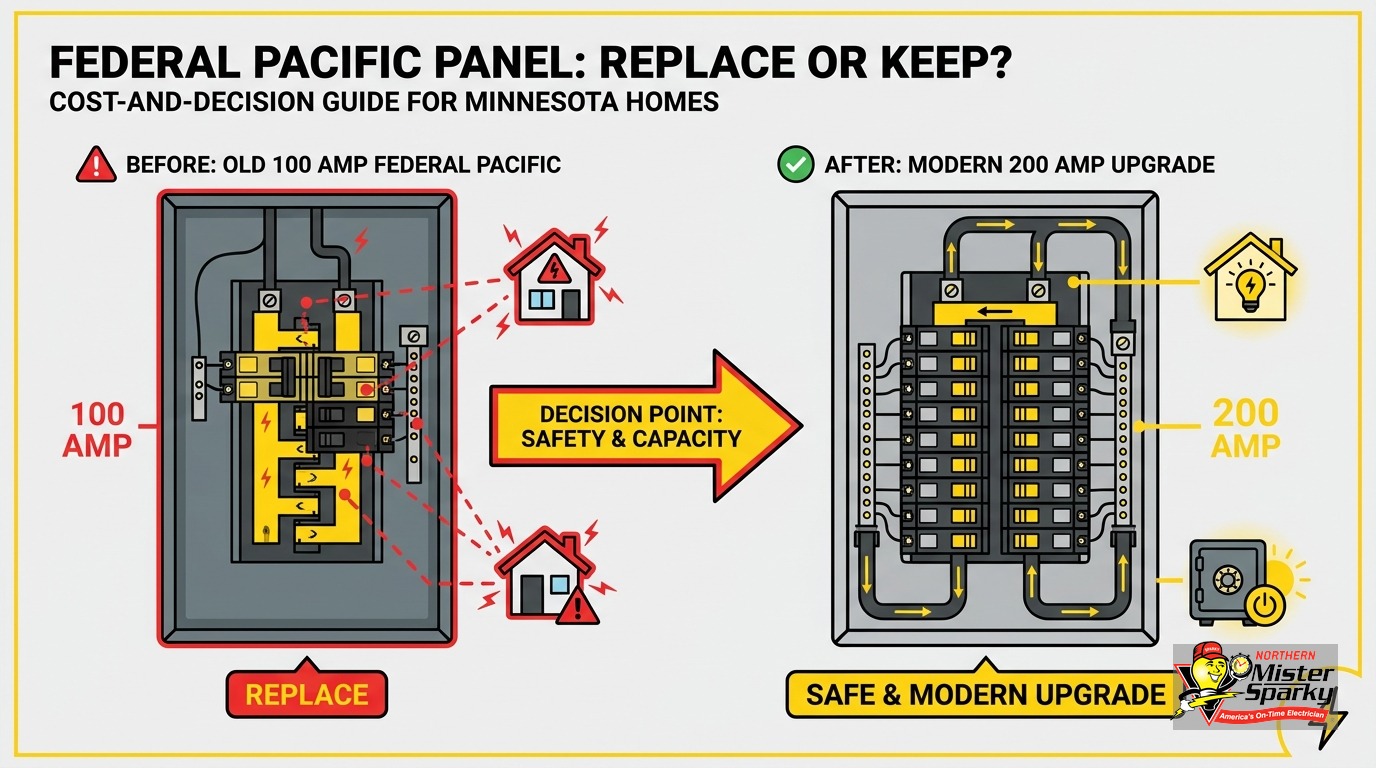
- In 1980, FPE’s parent company told the U.S. Consumer Product Safety Commission that many FPE breakers did not fully comply with UL requirements, and CPSC testing confirmed they failed certain UL calibration tests.
- No federal recall exists. No Minnesota law requires removal. Three specific circumstances, however, make replacing now the clearly correct financial call.
- If the new panel raises your amperage, Xcel Energy offers a rebate of up to $1,500. A same-amperage replacement does not qualify.
- Minnesota adopted the 2026 NEC effective August 17, 2026. Any permit filed today runs under that code.
- Some insurers will decline or non-renew a policy once they learn a home has an FPE panel.
What Is a Federal Pacific Electrical Panel?
Federal Pacific Electric was one of the most common residential panel manufacturers in the U.S. from the 1950s through the late 1980s. Their product was the Stab-Lok panel, named for the snap-in breaker design.
In June 1980, Reliance Electric, which had bought FPE in 1979, reported to the CPSC that many FPE circuit breakers did not fully comply with Underwriters Laboratories (UL) requirements. CPSC testing confirmed that these breakers fail certain UL calibration tests. The investigation focused mainly on two-pole breakers made before 1979.
FPE panels were especially common in the post-WWII suburban boom. In the Twin Cities, that covers many ranch-style and split-level homes across Bloomington, Roseville, Edina, St. Louis Park, and first-ring suburbs from that era. If your home was built or heavily renovated between 1955 and 1984 and has never had an electrical upgrade, there is a meaningful chance Stab-Lok breakers are still running your circuits.
How Do I Know if I Have a Federal Pacific Electrical Panel?
Open your breaker box and look for “Federal Pacific Electric” or “Stab-Lok” printed inside the door or on the face of the breakers. FPE breakers have distinctive narrow red indicator tabs. The panel cabinet is usually beige or tan. Homes built between 1950 and 1990 are the most likely candidates.
You may discover this for the first time through a home inspector’s report, an insurance application, or when an electrician opens the panel for other work. If your home was built during that era and you have never had the panel looked at, it is worth confirming what you have. An electrical inspection when buying a home is the most common entry point for this discovery. If you are already living in your home and unsure, call us and we will identify the panel during an evaluation.
What Are the Real Risks of a Federal Pacific Electrical Panel?
A breaker is designed to interrupt current when a circuit overloads. If it fails to trip, wiring absorbs excess load, heats up, and can ignite insulation inside the wall. That is the documented Stab-Lok failure: the breakers often stay on when they should cut off.
UL’s calibration tests check that a breaker holds its rated current and trips within set time limits when a circuit is overloaded. The CPSC confirmed that the FPE breakers it tested failed some of those tests. Independent engineer Dr. Jess Aronstein has also published test reports on Stab-Lok breakers failing to trip, summarized by InspectAPedia.
A balanced read matters here. The CPSC closed its FPE investigation in 1983, saying the data it had “does not establish that the circuit breakers pose a serious risk of injury.” It also said it closed the matter without deciding whether the breakers are safe, and that gathering the data to decide would cost several million dollars. No federal recall has ever been issued. Reliance’s position was that the breakers trip reliably in normal household use. The concern is documented. It is not a guarantee of catastrophe.
What determines urgency is not the failure rate alone. It is whether any of three specific circumstances applies to your situation right now.
Three Triggers That Make Replacement the Right Call Now
Most homeowners with an FPE panel already know the reputation. The question they actually need answered is not “is this bad?” but “should I replace it now, or is waiting acceptable?” That depends almost entirely on what else is happening with your home. Here are the three circumstances where the cost of waiting exceeds the cost of acting.
You Are Selling in the Next 12-18 Months
An FPE panel flagged in a buyer’s inspection report can slow or stall a sale. If a buyer’s lender or insurer asks for the panel to be replaced, the deal waits until it is.
Replacing the panel before listing removes that contingency. A new 200-amp panel is a genuine selling point for buyers planning to add an EV charger or convert to electrification. A dated FPE panel is leverage against your asking price. A freshly permitted upgrade is not.
Pair the replacement with a pre-sale electrical inspection to document the work and move the panel from “flagged unknown” to “inspected and resolved” in the report. That documentation matters when offers come in.
Your Insurance Is up for Renewal or You Are Shopping for a New Policy
Some carriers will cancel or non-renew a policy once they discover a home has an FPE panel, and the notice period can be short.
New-policy applications routinely ask about panel brand and age. An FPE panel can produce a higher premium, a coverage exclusion, or an outright denial. Minnesota’s FAIR Plan exists as a last resort if private coverage is denied, but it is basic coverage - not a substitute for a standard homeowner policy and not a long-term answer.
If your policy renews soon, get the panel evaluated before the carrier schedules their own inspection. Replacing on your own schedule is easier than replacing under a deadline.
You Are Adding an EV Charger, Heat Pump, or High-Load Equipment
This is the trigger where the financial case for replacement is strongest.
If you are adding a Level 2 EV charger, a heat pump, or an electric water heater, you very likely need a 200-amp panel regardless of the FPE issue. That reframes the project: the replacement is electrification-driven, not fear-driven, and because the amperage goes up, Xcel’s panel rebate of up to $1,500 can apply.
Minnesota winters push heating systems at sustained high loads for months. An old panel running near capacity through a long heating season is not where you want to be in January.
Xcel also lists heat pumps, water heaters, EV charging and heating upgrades among the projects that may need a panel upgrade, and has separate rebates for many of them. Ask us which ones apply to your project.
What Does Federal Pacific Panel Replacement Cost in the Twin Cities?
Every home is different, so we price each panel upgrade in writing after looking at your service. The price includes materials, labor, and the required permit and inspection. Several variables move the number:
- Condition and age of the service entrance cable
- Whether the meter base needs replacement at the same time
- Accessibility of the panel location in the home
- Whether the home currently has 100-amp service
One important note on scope: a same-amperage swap on an FPE panel does not qualify for the Xcel rebate. Many homeowners upgrade to a higher amperage during an FPE replacement, which can make the rebate apply and adds headroom for future loads. If your home has a 100-amp service entrance, the service upgrade is typically addressed at the same time, which affects both cost and scope.
The permit and inspection cost is always built into a compliant estimate. All panel work in Minnesota requires a permit. If a quote does not mention the permit, ask why.
How Does the Xcel Energy Panel Rebate Work?
Xcel Energy’s panel rebate is worth up to $1,500. According to Xcel, you may be eligible if you get residential electric service from Xcel, you upgrade your panel to a higher amperage, and you use a licensed electrician. Replacing a broken panel at the same amperage does not qualify.
Going from an aging Stab-Lok panel to a larger service usually involves an amperage increase, which is the condition the rebate is built around. Confirm your utility first: not every Twin Cities address is served by Xcel.
For a full overview of available Xcel programs for Minnesota homeowners, see Xcel Energy electrical rebates in Minnesota.
What Code Requirements Apply to Panel Work in Minnesota?
All panel work in Minnesota requires a permit and an inspection. The work must be performed by a licensed electrical contractor. Depending on your address, the inspector works for the state DLI or for your city, and the inspection has to pass before the job is closed out. Homesteaded-owner exemptions exist for some electrical tasks, but they do not apply to panel replacements in practice.
Minnesota adopted the 2026 NEC effective August 17, 2026. Any permit filed on or after that date runs under the new code. The 2026 NEC updates arc-fault and ground-fault protection requirements that affect how a new panel is wired. Your licensed electrician handles those details. What you need to know is simpler: unpermitted panel work can cause insurance and resale problems. No shortcuts worth taking.
What Happens If I Keep My FPE Panel for Now?
If none of the three triggers above apply, replacing the panel is a financial choice rather than an emergency. The panel has been in your home for decades. That does not make the risk zero, but it means you are not in a crisis today.
The responsible step is an evaluation. A licensed electrician can inspect the bus bar for heat damage or signs of arcing and give you a condition report. That documentation matters if an insurance question or a home sale arises later.
A few practical things to know if you are keeping the panel in the short term:
- Do not add load without addressing the FPE question at the same time. Any project that opens the panel - a new circuit, a subpanel, a whole-home surge protector - is a natural point to discuss replacement.
- Check clearance around the panel. Items stored against it, a water heater too close, or inadequate ceiling height are code violations independent of the FPE question. Electrical panel clearance requirements lay out what the 2026 NEC mandates for panel access and spacing.
For a broader look at the warning signs that point toward a panel upgrade - beyond the FPE brand question alone - see signs you need an electrical panel upgrade.
Keeping a dated panel indefinitely is not a plan. It is a deferral. The upgrade will happen eventually, driven by age, insurance pressure, or a project that demands it. Scheduling it on your own terms, while the Xcel rebate is available, causes less disruption than scheduling it reactively.
Have Your Federal Pacific Panel Evaluated by Northern Mister Sparky
Northern Mister Sparky is locally owned and operated here in the Twin Cities. As America’s On-Time Electrician(R), we show up when we say we will and give you a straight read on what you have, what it means, and what it will cost - without padding the estimate.
If you have an FPE panel, or think you might, call 763-200-5956 or book online. We will identify the panel, check its current condition, and walk you through timing, cost, and which rebates apply to your home. See our electrical panel upgrade service for what a replacement includes. Every job is backed by the UWIN(R) 100% satisfaction guarantee. No malarky.
Frequently Asked Questions
How do I know if I have a federal pacific electrical panel? +
Can I get a rebate to replace a federal pacific electrical panel in Minnesota? +
Will an FHA or VA loan pass a home with a Federal Pacific panel? +
Need an electrician now?