
Upgrade Electrical Panel to 200 Amps in Minnesota
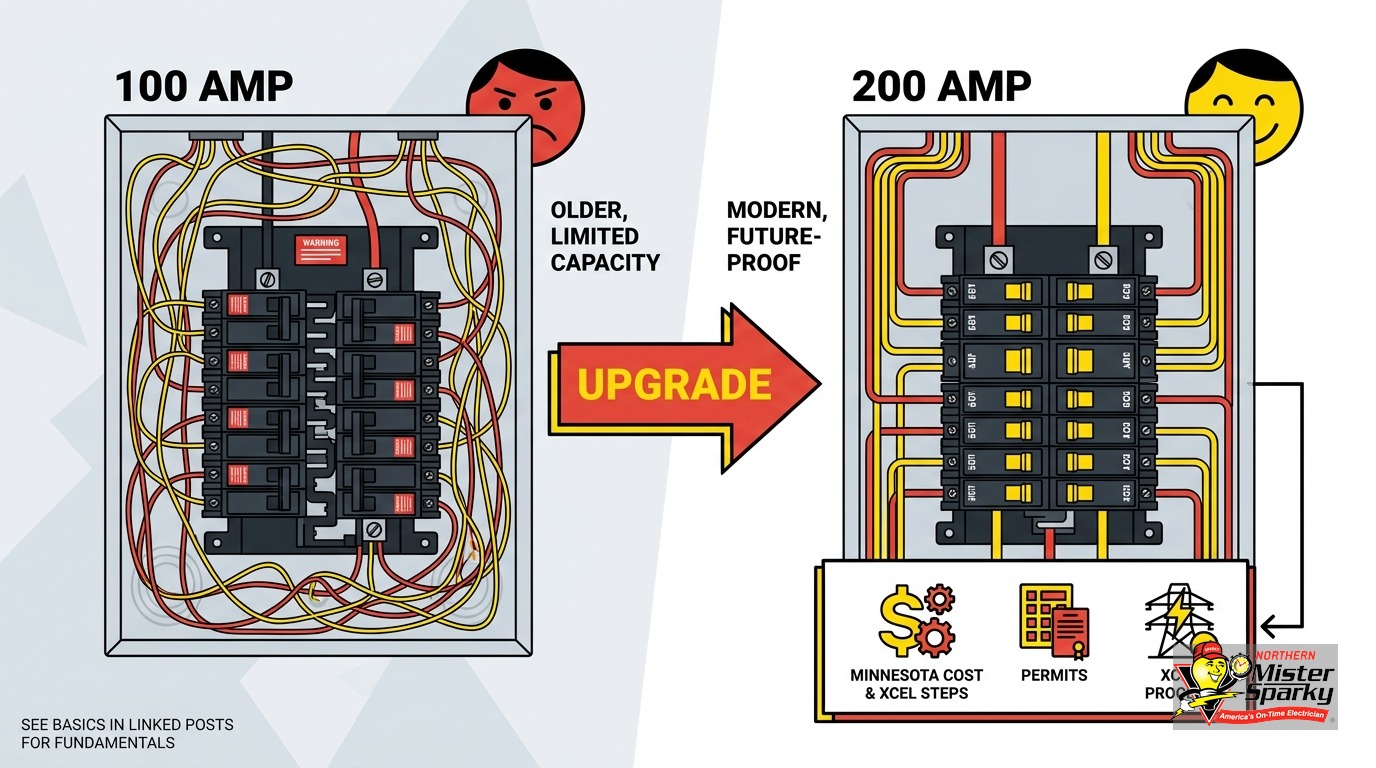
Key Takeaways
- A standard 100-to-200 amp upgrade in the Twin Cities costs $2,500 to $4,500. Full service entrance replacement runs $7,700 to $9,500.
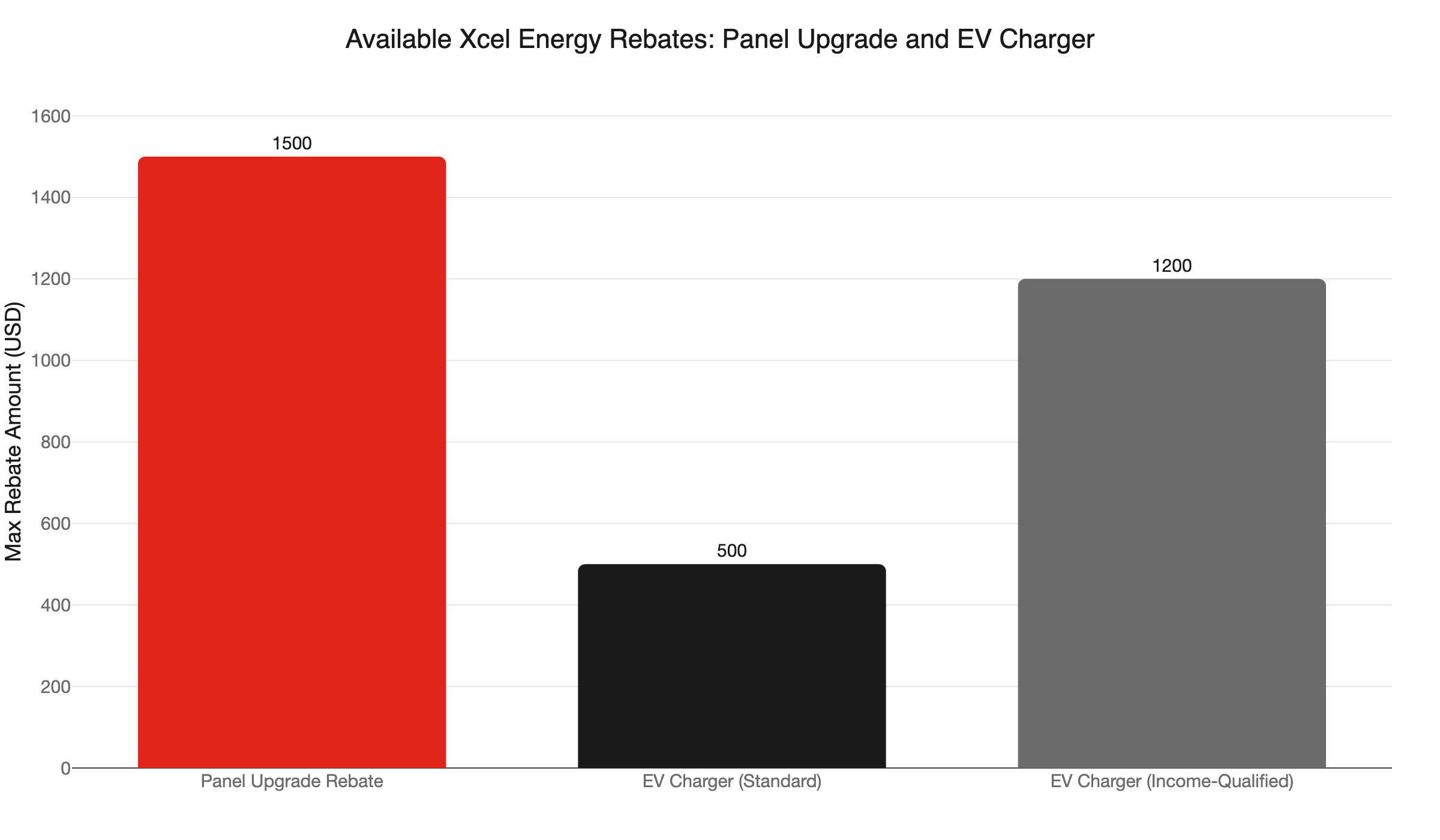
- Xcel Energy offers up to $1,500 back on a qualifying upgrade. Stack the EV charger rebate on top and the savings add up fast.
- Minnesota adopted the 2026 NEC on August 17, 2026. Every service upgrade now requires a whole-home surge protector and an outdoor emergency disconnect.
- About 66 Minnesota cities act as their own electrical authority, separate from the state DLI. Your electrician files with the right body. You do not have to figure that out yourself.
- The electrician initiates the Xcel service request, not the homeowner. You cannot start the Xcel coordination yourself.
- The federal 25C tax credit for panel upgrades expired December 31, 2025. Work done in 2026 does not qualify.
- The Minnesota HEAR grant (up to $3,000) is not yet live as of October 2026. No retroactive grants when it does open.
What Does It Cost to Upgrade Your Electrical Panel to 200 Amps in Minnesota?
Quick answer: Most Twin Cities homeowners pay $2,500 to $4,500 for a standard 100-to-200 amp upgrade. That price covers the panel, meter socket, surge protector, and code-required items. A full service entrance replacement runs $7,700 to $9,500. After the Xcel $1,500 rebate, out-of-pocket cost on a mid-range job is often $2,000 to $3,000.
Minneapolis-area prices run roughly 5% above the national average, driven by local permit requirements and metro labor rates. Most cost guides online are built from national averages. Those numbers understate what a Minnesota job actually costs.
A Twin Cities-area contractor puts the range at $2,500 to $4,500 for a standard panel upgrade and $7,700 to $9,500 for a full service entrance replacement. A full service entrance means replacing the weatherhead, service cable, and meter base, not just the panel box. That is a larger job with more materials and labor.
What pushes cost up:
- Full service entrance replacement instead of a panel-only swap
- Old wiring between the meter and the first disconnect
- Adding a subpanel to distribute load after the upgrade
- Relocating the panel to a different spot in the home
What brings cost down:
- Panel-only swap with the existing service in good shape
- Clean interior access with no drywall removal needed
- Combining the upgrade with an EV charger to capture both Xcel rebates in one mobilization
Is a 200 Amp Panel Upgrade the Right Size for My Home?
Quick answer: For most Twin Cities homes built before 1980, 200 amps handles current demand with solid room for growth. If you are adding an EV charger, heat pump, or electric appliances, 200 amps is almost always the right call. Homes with heavy shop equipment or two EV chargers may need to look at 400 amps.
We cover the sizing question in detail at 100 Amp vs. 200 Amp Electrical Service. Once you know a 200 amp upgrade is right for your home, come back here for the process and cost.
The Three Tracks Every Panel Upgrade Runs On
A panel upgrade is not one approval process. It runs on three tracks simultaneously: the permit track, the Xcel Energy coordination track, and the code compliance track. All three have to close before power is restored.
Most homeowner confusion about timelines comes from not knowing all three exist. A good electrician runs them in parallel. Here is what each one looks like.
Which Permit Authority Covers My Address?
Quick answer: Either the Minnesota Department of Labor and Industry (DLI) or one of about 66 local authorities that handle their own electrical inspections. Your electrician files with the right body. Permit fees run from $25 plus $55 per inspection visit at DLI to $55 to $315 at larger city jurisdictions.
Minnesota’s DLI is the default electrical permit authority, but about 66 cities, including Minneapolis and St. Paul, act as their own electrical AHJ and issue permits locally. Filing with the wrong authority wastes time and delays your job.
Homeowners can pull their own permit in one specific case: they own and occupy a single-family home. That exception does not apply to rentals, condos, or duplexes. All other property types require a DLI-licensed contractor to pull the permit.
Most homeowners let their electrician handle the permit regardless. An electrician who pulls the permit is also the one responsible for getting the inspection passed.
Permit cost breakdown:
- DLI: $25 base fee, $1 surcharge, and $55 per inspection visit minimum
- Larger Twin Cities jurisdictions: $55 to $315, depending on city and job scope
- Source: DLI electrical contractor fee schedule
The permit is not optional. Xcel Energy will not reinstall your meter without a signed inspection certificate. No permit means no power restoration.
How Does the Xcel Energy Coordination Work?
Quick answer: Your electrician initiates the Xcel service request via the contractor portal (my.xcelenergy.com/BuildingRemodeling) or by email (bclco@xcelenergy.com). Xcel pulls the meter before work starts and reinstalls it after a passing inspection. Standard lead time in the Twin Cities is 1 to 3 weeks from the request to the meter pull.
This step surprises most homeowners. You cannot kick off the Xcel process yourself. Xcel requires the electrician’s license information upfront, so only the contractor can initiate the request.
The sequence, start to finish:
- Your electrician submits the Xcel service request via the portal or email.
- Xcel schedules the meter pull. Expect 1 to 3 weeks of lead time in the Twin Cities.
- Work happens on the scheduled day. Your home is without power for roughly 4 to 8 hours.
- The electrical inspection takes place and the inspector signs off.
- Your electrician sends the signed certificate to Xcel.
- Xcel reinstalls the meter. With a smart (AMI) meter, remote reconnect takes about 30 minutes. Without one, a truck visit adds delay.
For the full breakdown of what the electrician submits and what Xcel expects at each step, see Xcel Energy Meter Pull and Panel Upgrade Process.
St. Paul note: St. Paul publishes Xcel’s specific service upgrade requirements for contractors. Those requirements differ slightly from other jurisdictions. Your contractor needs that document for any St. Paul job.
Total timeline from first call to restored power: typically 4 to 8 weeks. Complex jobs or those requiring extra city coordination can stretch to 12 weeks.
What Does the 2026 NEC Now Require for a Panel Upgrade in Minnesota?
Quick answer: Minnesota adopted the 2026 NEC on August 17, 2026. Every service upgrade now requires a whole-home surge protector and an outdoor emergency disconnect. Both items are typically bundled into contractor quotes. Permits filed before August 17, 2026 used the 2023 NEC instead.
Minnesota’s 2026 NEC adoption took effect August 17, 2026. If you are getting quotes now, both new items are already in the price. You do not need to request them separately.
What the surge protector does:
A whole-home surge protector mounts at the main panel. It shields your appliances and electronics from voltage spikes caused by lightning, utility switching events, and large motors cycling on and off. Minnesota winters create real surge exposure from temperature-driven load swings on the grid.
What the outdoor emergency disconnect does:
It mounts near the meter and lets first responders cut power from outside the building without entering. This requirement has been standard in commercial construction for years. The 2026 NEC extends it to residential service upgrades.
Both are code requirements, not upsells. Any Minnesota electrician quoting a panel upgrade after August 17, 2026 must include them.
What Rebates Can I Stack on a Panel Upgrade?
Quick answer: Xcel Energy offers up to $1,500 for a qualifying amperage upgrade. Stack the EV charger rebate (up to $500 standard, or $1,200 income-qualified) if you are adding a charger in the same project. Submit your invoice and permit approval to Xcel after the job. Processing takes 6 to 8 weeks.
The rebate math changes the picture significantly. On a $3,500 job, the Xcel panel rebate alone brings your out-of-pocket cost to $2,000. Add an EV charger in the same project and you recover another $500 to $1,200.
Xcel panel upgrade rebate details:
- Up to $1,500 for a qualifying amperage upgrade
- Replacing a broken panel at the same amperage does not qualify; the amperage must increase
- Must use a DLI-licensed electrician
- Applies to 1- to 4-unit residential properties only
- Submit invoice and permit approval to Xcel after the job closes
- Processing: 6 to 8 weeks
- Apply through Xcel’s rebate portal
Getting the most from the rebate stack:
If you know you need both a panel upgrade and an EV charger, plan them as one project. One electrician, one Xcel coordination, two rebates. The combined savings are real and worth scheduling around.
For a full breakdown of rebate tiers, income qualifications, and how to submit claims correctly, see Xcel Energy Electrical Rebates for Minnesota Homeowners.
What About the State HEAR Grant and the Federal Tax Credit?
Quick answer: The Minnesota panel upgrade grant (up to $3,000) exists in state law but is not yet open for applications as of October 2026. The federal 25C tax credit for panel upgrades expired December 31, 2025. Work done in 2026 does not qualify for the federal credit.
Minnesota Residential Electrical Panel Upgrade Grant:
Minnesota passed this grant under Minn. Stat. 216C.45. The structure is:
- Up to $3,000 for households below 80% of Area Median Income
- Up to $2,000 for households between 80% and 150% AMI
- Approximately $5.8 million available statewide
The program is waiting on federal Department of Energy approval as of October 2026. No applications are being accepted yet, and there will be no retroactive grants. Check the Minnesota Commerce Department page for a launch announcement.
Federal 25C tax credit:
The IRS Section 25C circuit upgrade tax credit expired December 31, 2025. The credit was worth 30% of cost, up to $600. If you installed a qualifying heat pump and panel upgrade in 2025 and have not yet filed your 2025 tax return, you may still be able to claim it. Work completed in 2026 does not qualify.
Some contractor websites and older blog posts still reference this credit as if it is active. For 2026 work, it is not.
Planning a Winter Panel Upgrade in Minnesota
Cold weather does not rule out a panel upgrade. The Minnesota Cold Weather Rule runs October 1 through April 30 and protects customers from utility-initiated disconnections. A voluntary service disconnect for construction is not covered by that rule. Your upgrade can proceed in January if that is when the schedule makes sense.
The one thing to plan for: your home will be without power for roughly 4 to 8 hours on the day of the work. On a cold day in a Minnesota winter, that matters. Our team works with you to pick a window that keeps the disruption manageable, and we move efficiently to minimize it.
Spring is our busiest panel upgrade season. Booking now typically means a shorter wait and more schedule flexibility. For a detailed look at what to expect from first call to restored power, see our Electrical Panel Upgrade Timeline.
Ready to Upgrade Your Electrical Panel to 200 Amps?
Here is where things stand:
- Cost: $2,500 to $4,500 for most Twin Cities upgrades. Full service entrance replacement: $7,700 to $9,500.
- Rebate: Xcel pays up to $1,500 back after the job closes. Stack the EV charger rebate if you are adding a charger in the same project.
- Permit: Your electrician files it. DLI or your local AHJ, depending on your city.
- Xcel: The electrician initiates the service request, not the homeowner. Total timeline: 4 to 12 weeks.
- Code: The 2026 NEC is in effect. Surge protector and outdoor emergency disconnect are required on every upgrade.
We are locally owned and operated right here in the Twin Cities. As America’s On-Time Electrician(R), we run all three tracks: permit, Xcel, and code. You are not managing three separate conversations on your own. Our UWIN(R) guarantee means you are covered if anything falls short of expectations.
See our panel upgrade services or call us at 763-200-5956 to get on the schedule.
Frequently Asked Questions
How much does it cost to upgrade to a 200 amp panel in the Twin Cities? +
Does Xcel Energy offer a rebate for a panel upgrade? +
Do I need a permit to upgrade my electrical panel in Minnesota? +
Can I pull my own permit for a panel upgrade in Minnesota? +
Need an electrician now?