
NEC 2023 Outdoor Main Disconnect: Twin Cities Guide
Key Takeaways
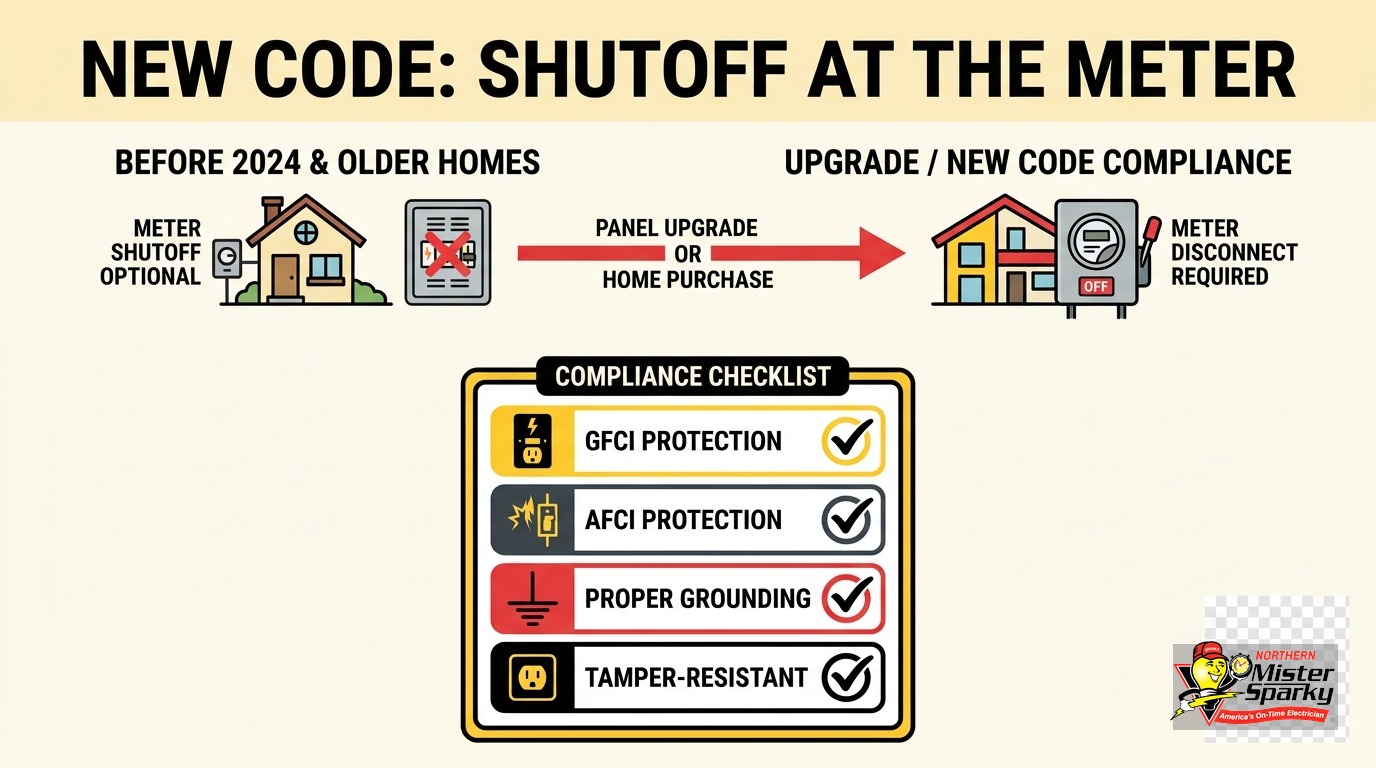
- Minnesota adopted NEC 2020 on November 17, 2020. That edition required an outdoor emergency disconnect for new one- and two-family dwellings.
- NEC 2023 took effect July 1, 2023. It added the replacement trigger: any panel or service equipment replacement now requires the outdoor disconnect.
- NEC 2026 took effect August 17, 2026. It goes further: the service disconnect itself must be located outdoors. The labeled companion-box approach no longer applies to new permits.
- Replacing only a meter socket, service entrance conductors, or raceways does NOT trigger the NEC 2023 requirement.
- A full 100A-to-200A service upgrade in the Twin Cities runs $7,700-$9,500 installed, before rebates.
- Xcel Energy offers up to $1,500 for qualifying panel upgrades. Minneapolis homeowners may stack a CEE bonus on top.
- The federal 25C tax credit for panel upgrades expired December 31, 2025. It is not available in 2026.
- Home buyers: always request the permit number for any panel replaced after July 1, 2023.
What Is the NEC 2023 Outdoor Main Disconnect Requirement?
The NEC 2023 outdoor main disconnect requirement places a labeled emergency shutoff in an accessible outdoor location on one- and two-family dwellings. Minnesota adopted NEC 2023 on July 1, 2023. Any panel or service equipment replacement permitted on or after that date requires the outdoor disconnect.
The rule lives in Section 230.85 of the 2023 National Electrical Code. It applies to one- and two-family dwellings, which covers most single-family homes in the Twin Cities.
The disconnect must be in a readily accessible outdoor location. It must sit on or within sight of the home. “Readily accessible” has a specific code meaning: reachable without tools, a ladder, or moving anything out of the way.
Labeling is required and specific. Per NEC 2023 Section 230.85, the outside front of the enclosure must read “EMERGENCY DISCONNECT” in white letters on a red background. Letters must be at least 1/2 inch tall. Handwritten labels and inkjet printouts do not meet code under the sign and label standards in Section 110.21(B).
One technical spec inspectors flag on every job: the short-circuit current rating (SCCR). The disconnect must have an SCCR equal to or greater than the available fault current at the connection point. Your electrician pulls that figure from Xcel Energy during the meter-pull coordination step.
Why Firefighters Need a Switch They Can Reach
The code exists for a specific reason. Firefighters and paramedics arriving at a structure fire need to cut power immediately. Without an outdoor disconnect, that means entering the building to find the interior panel. In a house fire, in the dark, under smoke, that is dangerous work.
Consider what this looks like on a real service call. A fire crew arrives at a house fire. The panel is in the basement. Finding it means entering the building, going down stairs, navigating smoke. With a labeled outdoor disconnect on the exterior wall, the crew cuts power in under a minute without stepping inside.
That is the entire purpose of the rule. It is not a technicality. It is a life-safety measure built around real emergency response scenarios. Understanding that context helps homeowners see the value beyond the permit requirement. The box on your exterior wall protects your family and the people who respond if something goes wrong.
When Did This Rule Take Effect in Minnesota?
The outdoor disconnect requirement first arrived in Minnesota on November 17, 2020, when NEC 2020 took effect. NEC 2020 required it only for new construction. NEC 2023, effective July 1, 2023, added the replacement trigger. NEC 2026, effective August 17, 2026, tightened the standard further: the service disconnect itself must be located outdoors.
Minnesota has adopted every recent NEC edition without amendment. Here is how each code era maps to your home’s permit date.
Before November 17, 2020 (NEC 2017 or earlier)
No outdoor disconnect requirement existed. Homes built before this date are grandfathered. As long as no service equipment is replaced, no trigger applies.
November 17, 2020, through June 30, 2023 (NEC 2020)
NEC 2020 became effective in Minnesota on November 17, 2020, adopted without amendment. Section 230.85 introduced the outdoor disconnect requirement for new construction of one- and two-family dwellings. Replacing a panel in an existing home did not yet trigger the rule under this edition.
July 1, 2023, through August 16, 2026 (NEC 2023)
NEC 2023 became effective in Minnesota on July 1, 2023, again without amendment. This edition added the replacement trigger. Replacing your main panel or service equipment, at any amperage, now required the outdoor emergency disconnect. A same-size swap was included.
August 17, 2026, onward (NEC 2026)
NEC 2026 became effective in Minnesota on August 17, 2026. Section 230.85 was deleted. The requirements consolidated into Section 230.70. Under NEC 2026, the service disconnect itself must be located outdoors for one- and two-family dwellings. The labeled companion box used under NEC 2023 no longer satisfies the code for new permits.
Which edition applies to your project?
The code in effect on the permit filing date controls the job. A permit filed before August 17, 2026, follows NEC 2023. A permit filed on or after that date follows NEC 2026. If your job is in progress, confirm the permit date with the local inspection office before your electrician finalizes the design.
For more on how Minnesota permit timelines work for electrical projects, see our guide to electrical permits in Minnesota.
Does Replacing Your Panel Trigger the Requirement?
Yes, with one important exception. Replacing the main panel or service equipment triggers the NEC 2023 outdoor main disconnect requirement. Replacing only a meter socket, service entrance conductors, raceways, or fittings does not.
This exception trips up many homeowners. The meter base sits upstream of the service equipment. Utility-driven meter upgrades often replace only the socket. That work alone does not trigger the outdoor disconnect requirement under NEC 2023.
Per NEC 2023 Section 230.85 analysis from NEC Mastery, the replacement trigger applies specifically to service equipment. Isolated meter socket replacements fall outside the trigger.
The practical test: are you touching the main panel or the main protective device? Meter socket only? Not service equipment. Main panel and breaker bus? Service equipment.
Here is a clear breakdown:
Triggers the requirement:
- Replacing the main service panel (any amperage, including same-size)
- Replacing the main circuit breaker or service disconnect
- Installing a new meter-main combo unit
- A complete service upgrade combining the panel, meter socket, and conductors as one job
Does not trigger the requirement:
- Replacing only the meter socket or meter base
- Replacing only service entrance conductors or raceways
- Adding breakers to an existing panel
- Replacing individual circuit breakers
- Installing new circuits or outlets without touching service equipment
If you are on the fence about whether your project crosses the threshold, ask before you pull the permit. Asking at the start saves a second inspection and a potential re-inspection fee.
No malarky: “it is just a like-for-like swap” does not exempt you. NEC 2023 is explicit on this point. Same-amperage replacements are covered. Budget for the outdoor disconnect on any panel replacement job permitted after July 1, 2023.
For help identifying whether your panel is due for replacement, see our overview of signs you need an electrical panel upgrade.
What Must the Outdoor Disconnect Look Like?
The disconnect must be in a readily accessible outdoor location, on or within sight of the home. Per NEC 2023, the outside front of the enclosure must read “EMERGENCY DISCONNECT” in white letters on a red background, with letters at least 1/2 inch tall. Handwritten or inkjet labels fail inspection.
Placement is the first thing inspectors check. “On or within sight” means the service entrance and the disconnect must have a clear line of sight between them, without obstruction. Mounting on the exterior wall near the meter base is the standard solution. Placing the box behind a fence or inside a locked utility compartment fails.
“Readily accessible” applies to the box itself. It must be reachable at ground level without moving anything, opening a latched door, or using a tool. A disconnect inside an enclosure that requires a key does not qualify.
The SCCR requirement deserves attention on every job. The device’s short-circuit current rating must equal or exceed the available fault current at the point of connection. Your electrician gets this number from Xcel Energy during the service coordination step. An undersized SCCR is an inspection failure and requires a replacement device before the permit closes.
Under NEC 2026, the design changes entirely. The separate labeled-box approach no longer applies to new permits. For jobs permitted on or after August 17, 2026, the service disconnect itself must be outdoors under Section 230.70. This affects the entire service entrance design, not just a companion component.
How Does NEC 2026 Change the Rule for Jobs Permitted Now?
NEC 2026, effective August 17, 2026, deleted Section 230.85 and consolidated the requirements into Section 230.70. For one- and two-family dwellings, the service disconnect itself must be located outdoors. Any job permitted on or after August 17, 2026, must meet the stricter 230.70 standard, not the NEC 2023 labeled-box approach.
Per ECM Web’s summary of key 2026 NEC Chapter 2 revisions, the workarounds available under NEC 2023 are gone. The meter disconnect workaround is gone. The indoor-panel-with-outdoor-companion-box approach is gone. For new permits, the service disconnect goes outside.
This matters for any job quoted or permitted today. Contractors must design for an outdoor service disconnect location, not a companion add-on box. If you received a quote based on the older approach, ask your electrician to confirm the permit date and verify the design is current.
What Should Home Buyers Ask About the Outdoor Disconnect?
Ask your inspector when the panel was last replaced. If it was replaced after July 1, 2023, there should be an outdoor disconnect and a valid permit number on file. No outdoor box on a post-2023 panel is a red flag. Request the permit number and verify it with the city building department.
Home buyers face a specific vulnerability here. A seller may have upgraded a panel without pulling a permit. An inspector may have signed off and missed the missing outdoor disconnect. Either way, you inherit the non-compliance after closing.
Here is the checklist to work through with your home inspector:
- When was the panel replaced or upgraded? Ask for documentation.
- If replaced after July 1, 2023: is there an outdoor emergency disconnect installed?
- Is the labeling correct? Check for “EMERGENCY DISCONNECT” in white letters on a red background, on the outside front of the enclosure.
- Is there a permit number on file with the city or county building department?
- Is the disconnect in a readily accessible location, unobstructed and reachable at ground level?
- If replaced after August 17, 2026: is the service disconnect itself located outdoors per NEC 2026?
A panel replaced after July 1, 2023, with no outdoor disconnect points to one of two things: the permit was skipped, or the inspector missed it. If you are purchasing the home, budget for a correction or negotiate a seller credit to cover bringing the installation into compliance.
For a full walkthrough of what an electrical inspection covers before a home purchase, see our guide to electrical inspections when buying a home.
What Does an Outdoor Disconnect Add to a Panel Upgrade?
In most Twin Cities panel upgrade quotes, the outdoor disconnect is bundled into the full job scope rather than priced separately. A complete 100A-to-200A service upgrade runs $7,700-$9,500 installed. That includes the panel, meter socket, outdoor disconnect, surge protector, grounding, Xcel coordination, and permit.
The disconnect itself is not the cost driver on a service job. The labor cost is spread across the meter-pull coordination, the permit, the inspection scheduling, and the time a licensed electrician spends installing service equipment correctly. The outdoor disconnect is one component in a full service job, not a significant add-on.
For homeowners replacing a panel at the same amperage, the scope is smaller. But even a like-for-like swap triggers the outdoor disconnect requirement under NEC 2023. That adds material and installation time compared to a pre-2023 identical replacement. A quote that does not reflect this on a post-2023 job is missing something.
Your contractor’s quote should line-item the outdoor disconnect as part of the service equipment package. If a quote omits it entirely on a post-July 2023 job, ask why. It should be included.
For the full breakdown of what a Twin Cities service upgrade includes and how the Xcel meter-pull process works, see our Xcel Energy meter pull and panel upgrade guide.
Can You Stack Rebates to Lower the Cost?
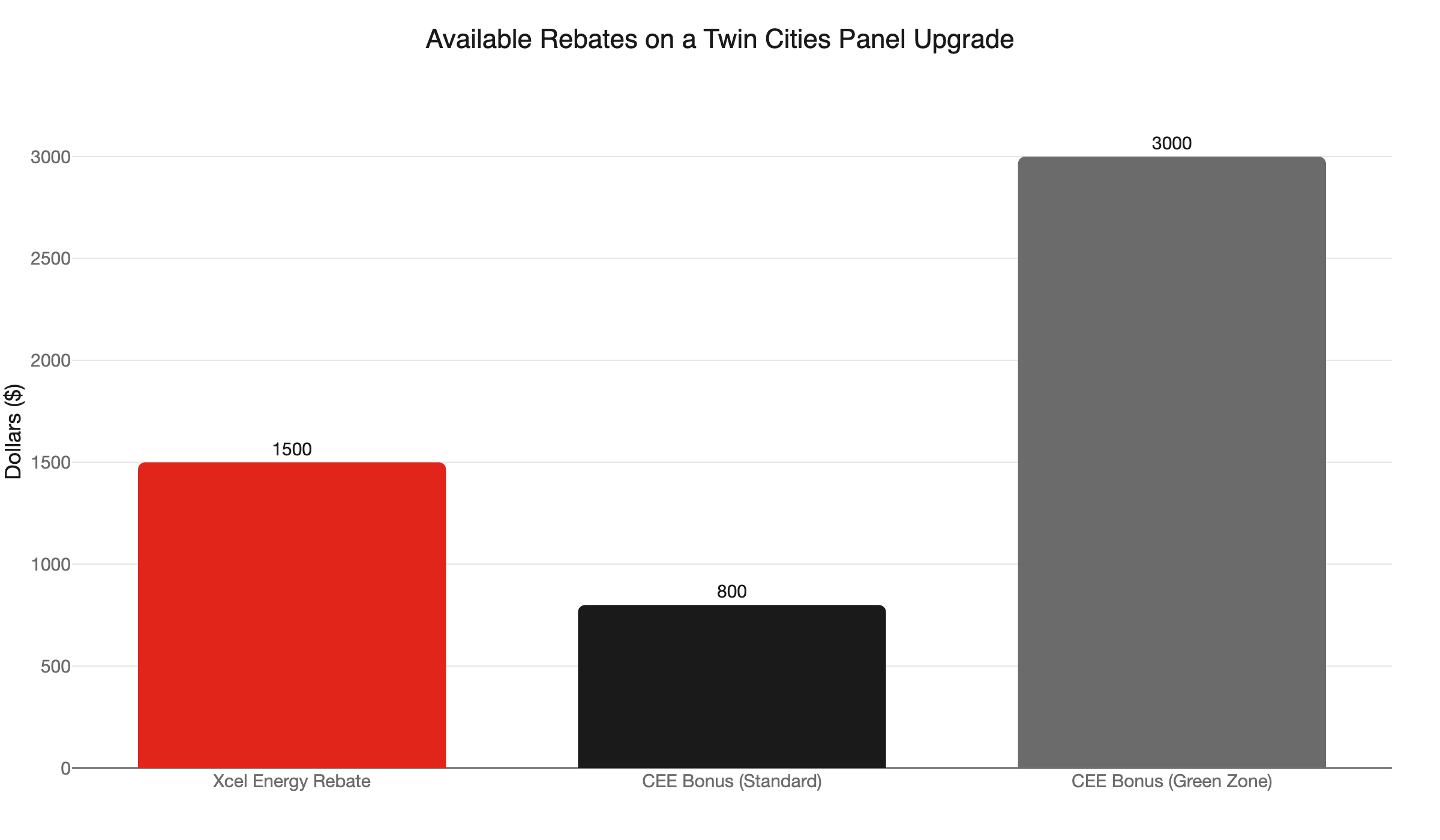
Yes. Xcel Energy offers up to $1,500 for a qualifying panel upgrade. Minneapolis homeowners can stack a CEE bonus when pairing the upgrade with a qualifying heat pump or heat pump water heater. The federal 25C tax credit expired December 31, 2025.
Here is how each incentive works in practice.
Xcel Energy rebate
Requires a licensed Minnesota electrician, a permit, and an amperage increase. Same-size panel replacements do not qualify. The rebate applies to qualifying panel upgrades where you increase your service amperage, for example from 100A to 200A. Maximum rebate: $1,500. Xcel processes it after the inspection certificate is issued.
CEE bonus (Minneapolis)
The Center for Energy and Environment administers a bonus when you pair a panel upgrade with a qualifying heat pump or heat pump water heater. The bonus is $800 outside a designated Green Zone and up to $3,000 inside one. This stacks with the Xcel rebate on the same project.
Federal 25C tax credit
The federal residential clean energy tax credit for panel upgrades under Section 25C expired December 31, 2025. It is not available for work completed in 2026. Do not plan for it in your budget.
What this means for your out-of-pocket cost
A full 100A-to-200A upgrade runs $7,700-$9,500 before rebates. After the Xcel $1,500 rebate, that range drops to roughly $6,200-$8,000. A qualifying Minneapolis homeowner who stacks the CEE bonus reduces the net cost further, depending on the CEE project scope and whether the property falls inside a Green Zone.
Our team handles the rebate documentation as part of the job. You do not need to contact Xcel or the CEE program separately. We file what is needed during the permit and inspection process.
Schedule Your Panel Upgrade
Northern Mister Sparky is locally owned and operated in the Twin Cities. We handle the Xcel coordination, permit filing, and inspection scheduling in-house. You do not chase paperwork across multiple offices. One call starts the process.
Call us at 763-200-5956 or book online. Our team will assess your current service, confirm which NEC edition applies to your permit date, and walk you through the rebate options.
As America’s On-Time Electrician(R), we show up when we say we will. With our UWIN(R) 100% satisfaction guarantee, the job is not done until you are satisfied with the result.
Frequently Asked Questions
Does replacing a single circuit breaker trigger the outdoor disconnect requirement? +
My home was built in 2021. Should it already have an outdoor disconnect? +
Who can install the outdoor disconnect in Minnesota? +
Does the Xcel $1,500 rebate apply to a same-size panel replacement? +
Need an electrician now?