Outlet Sparks When Plugging In: Normal Flash or Fire Risk?
Key Takeaways
- A small, brief, blue spark when plugging in a high-draw appliance is usually normal. It is inrush current - a momentary surge as the circuit closes.
- Repeated sparks, large arcs, yellow or white color, burning smells, or scorch marks on the outlet face are warning signs. Stop using the outlet and call a licensed electrician.
- Arc faults cause a significant number of home fires each year in the U.S. A standard circuit breaker does not detect them. An AFCI breaker does.
- Minnesota adopted the 2026 NEC on August 17, 2026. Any outlet replacement permitted on or after that date must meet the new AFCI protection requirements on covered circuits.
- Homes with 2-prong ungrounded outlets cannot simply swap in a 3-prong cover. The code requires a GFCI or AFCI/GFCI receptacle.
- Northern Mister Sparky is locally owned and operated in the Twin Cities. We pull the permit, pass the inspection, and make sure the fix is the whole fix.
Outlet sparks when plugging in a high-draw appliance are common enough that homeowners often wonder whether to call an electrician or ignore it. The answer depends on what the spark looks like, how often it happens, and what is going on in your home’s wiring. Some sparks are harmless physics. Others are the first sign of an arc fault that can ignite your walls before any smoke detector responds.
This guide explains the difference, covers what the code requires now that Minnesota has adopted the 2026 NEC, and walks through what older Twin Cities homes with 2-prong outlets need to know.
Is an Outlet Spark When Plugging In Normal?
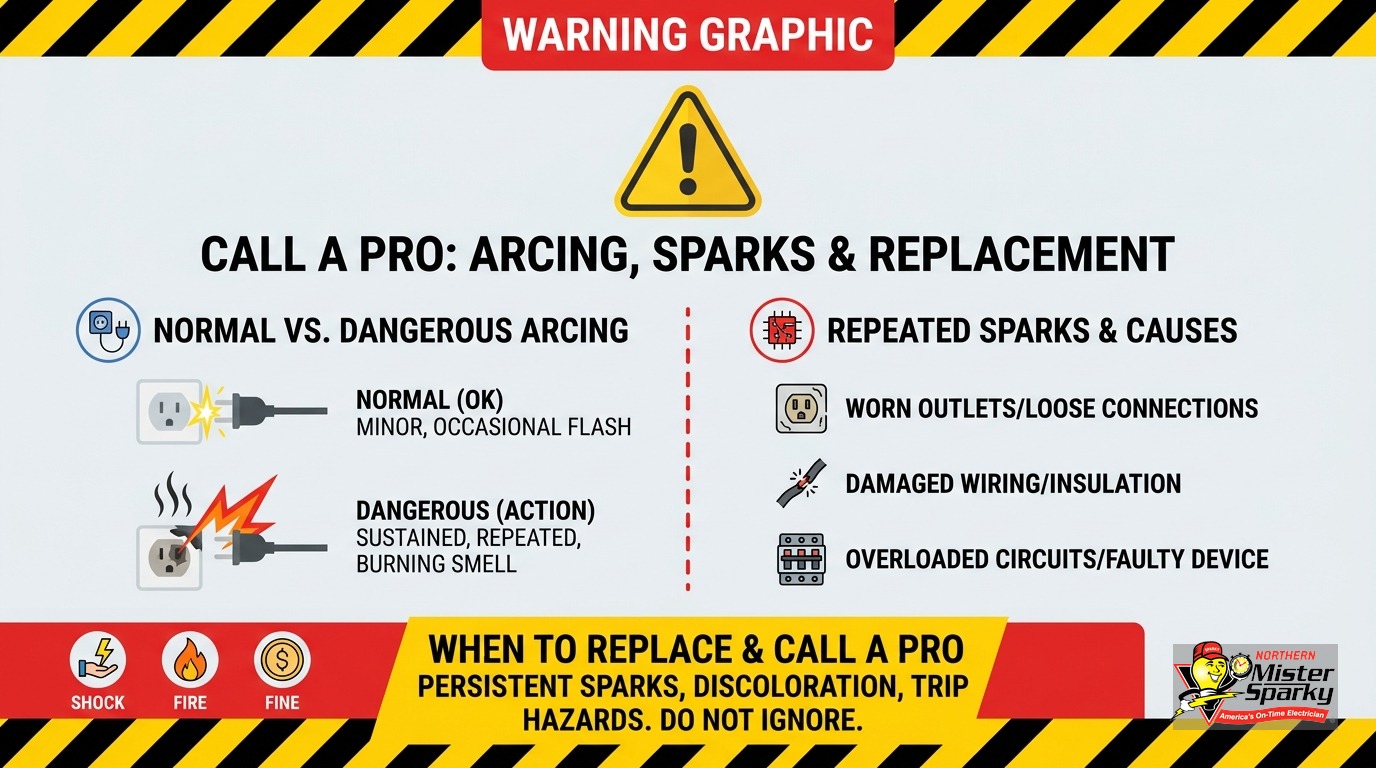
A quick, small, blue spark when plugging in a high-draw appliance is usually normal. It results from inrush current - a brief surge the device draws the instant the circuit closes. If it is occasional, odorless, and the breaker holds, you can usually relax.
Plug in a refrigerator, vacuum, power drill, or window air conditioner and you may see this. The spark is brief - a fraction of a second. It happens once per connection, not repeatedly. If that matches what you saw, the outlet is likely fine and the device is doing what inductive loads always do.
Where it gets concerning: when the spark happens with ordinary, low-draw devices like a phone charger or a lamp. Those do not pull the kind of current spike that causes inrush arcing. If a low-draw device sparks the outlet, the problem is in the outlet or the wiring - not the device.
What Is Inrush Current and Why Does It Cause a Spark?
Inrush current is a brief surge of electricity a motor-driven or capacitive appliance draws the instant it powers on. That surge creates a momentary arc as the plug’s prongs make contact with the outlet’s contacts. The spark lasts a fraction of a second and then stops - it is physics, not a defect, unless it repeats.
Appliances with electric motors, compressors, or large capacitors - refrigerators, vacuums, power tools, air conditioners - can draw a spike several times their steady-state current in the first milliseconds of operation. When the prongs make contact, that spike bridges the air gap before the connection fully seats. The result is a small, visible arc.
The outlet’s contacts and the breaker are rated to handle it. Once the device is fully plugged in and drawing normal current, the arcing stops. You will likely see it again the next time you unplug and replug that appliance.
The key distinction: inrush sparks happen at the moment of first contact, they are small and blue, and they do not continue once the device is plugged in. Arc fault sparks - the dangerous kind - can happen at any point and tend to repeat.
When Is Outlet Sparking Actually Dangerous?
Sparking is dangerous when it is large, yellow or white in color, repeated across multiple uses, accompanied by a burning smell or smoke, or when it trips the breaker. These signs point to an arc fault inside the outlet or the wiring behind it - a problem that can ignite insulation and wood framing inside your wall cavity, away from any smoke detector.
Repeated arcing progressively damages insulation and contacts, building heat that can start a fire inside the wall before any alarm activates. That is what makes arc faults different from other electrical problems: they are hidden.
Here is a quick field diagnostic:
Likely safe - normal inrush:
- Small, brief flash lasting a fraction of a second
- Blue or blue-white color
- Happens only when first plugging in a high-draw appliance
- No burning odor, no marks on the outlet face
- Breaker holds; no tripping
Needs immediate attention - possible arc fault:
- Large arc, visible flame, or scattered sparks
- Yellow, orange, or white color
- Happens repeatedly, or with low-draw devices like lamps or chargers
- Burning plastic smell or smoke from the outlet or nearby wall
- Scorch marks or heat discoloration on the outlet face or wall plate
- Breaker trips when you use that outlet
If your outlet matches anything in the second list, stop using it. Unplug everything from that outlet - and from the others on the same circuit if you can identify them. Faulty wiring and related equipment account for a large share of electrical-malfunction home fires according to the U.S. Fire Administration. The risk is real and it compounds over time.
For related warning signs, see our guide on burning smells from outlets and breakers.
What Causes Outlet Sparks When You Plug Something In Repeatedly?
Repeated sparking at the same outlet points to a real problem: worn outlet contacts, a damaged device cord, an overloaded circuit, degraded wiring inside the wall, or moisture intrusion. Any of these can worsen over time. Ignoring repeated sparks is not a safe option.
Here are the five most common causes:
1. Worn or loose outlet contacts. Outlets are not rated for infinite use cycles. Over years of plugging and unplugging, the spring-loaded contacts inside the receptacle lose tension. A loose connection creates resistance; resistance generates heat and arcing at that point. If the plug feels loose when seated - if it droops or wiggles - the receptacle needs replacement.
2. Damaged device cord or bent prongs. A cord with frayed insulation near the plug, or a plug with bent or corroded prongs, creates an inconsistent connection every time you use it. The arc fills the gap between prong and contact. Replace the cord before using that device on any outlet in your home.
3. Overloaded circuit. Too many high-draw devices on a single circuit pushes the wiring to its rating. Under sustained heavy load, some arcing can occur at contacts that were not built to carry that current continuously. If the breaker holds but the outlet sparks under load, the circuit may need to be split or upgraded. See our page on overloaded circuits for what that involves.
4. Degraded wiring inside the wall. Wiring insulation breaks down over decades, especially in pre-1970 construction. Loose wire nuts, backstabbed connections on the back of older outlets, and aluminum wiring used in many 1960s-1970s Twin Cities homes all create conditions for arc faults invisible until they cause damage. Aluminum wiring carries specific risks that require a licensed electrician - not a receptacle swap.
5. Moisture intrusion. Outlets near sinks, in unfinished basements, or on exterior walls can collect condensation. Water and electricity arc freely. A sparking outlet in any of these locations is also a GFCI compliance issue and needs a licensed electrician with the right combination device.
What Is an AFCI Breaker, and Do I Need One?
An AFCI (arc fault circuit interrupter) breaker detects the electrical signature of arcing on a circuit and cuts power before a fire can start. A standard breaker only trips on overcurrent - it cannot detect the low-level arcing that occurs when insulation breaks down or connections loosen. If your outlet sparks repeatedly, AFCI protection addresses the root risk.
Standard circuit breakers were designed to protect against overloads and direct short circuits. They work well for both. What they miss is the waveform distortion created by an arc fault - the kind that starts as a minor spark and gradually builds heat inside your walls. AFCI breakers were added to the NEC in 1999 specifically because ordinary breakers were failing to detect this class of wiring defect, and residential fires were the result.
The numbers are not abstract. Arc faults cause a significant number of home fires each year in the U.S. The Consumer Product Safety Commission estimates that nearly 50% of all home electrical fires could be prevented with AFCI protection. That is why the NEC has expanded its list of required rooms with every edition.
For a detailed breakdown of how AFCI and GFCI breakers differ - and why many circuits need both - see our AFCI requirements guide and our AFCI vs. GFCI explainer.
Minnesota’s New Code Changes What a Sparking Outlet Repair Involves
Minnesota adopted the 2026 NEC effective August 17, 2026. Any electrical permit filed on or after that date falls under the 2026 edition. This is the detail no national article covers, because it only matters here.
Under Minnesota’s Chapter 1315 electrical code, the 2026 NEC now requires AFCI protection for all standard branch circuits supplying outlets in living rooms, dining rooms, bedrooms, hallways, kitchens, laundry areas, family rooms, and similar spaces. This is NEC Section 210.12.
Here is what that means in practice for a sparking outlet:
If you replace an outlet on an AFCI-required circuit and a permit is pulled, a like-for-like receptacle swap is not code-compliant unless AFCI protection already exists upstream on that circuit. The repair must include one of these options:
- A combination AFCI/GFCI receptacle installed in the outlet box
- A standard receptacle installed downstream of an AFCI receptacle on the same circuit
- A combination AFCI circuit breaker at the panel protecting the entire circuit
The City of St. Paul’s electrical guidance aligns with this requirement under NEC Sections 406.4(D) and 210.12. The practical consequence: the fix is often bigger than the outlet. Our team sizes the repair to meet the 2026 NEC and pulls the permit correctly from the start.
If the inspection surfaces an undersized panel - which happens more often than homeowners expect in older homes - the Xcel Energy panel upgrade rebate of up to $1,500 is available to qualifying Minnesota customers. Financing is also available for larger jobs. Ask us about both when you call.
What If My Home Has 2-Prong Outlets?
Older Twin Cities homes with ungrounded 2-prong outlets cannot simply be upgraded to 3-prong outlets by swapping the receptacle. A 3-prong outlet requires a grounding conductor behind it. Without that conductor, a 3-prong outlet is a code violation and implies protection it does not actually provide.
This is a common situation in Minneapolis and St. Paul neighborhoods with heavy pre-1960 housing stock. Longfellow, Northeast Minneapolis, and Mac-Groveland in St. Paul all have homes where the original wiring has no ground wire. The outlets are 2-prong by design, not oversight.
The NEC-approved fixes for a sparking 2-prong outlet are:
- GFCI receptacle: Replace with a GFCI outlet (labeled “No Equipment Ground” on the face). This protects against electric shock even without a ground conductor. It does not provide equipment grounding for sensitive electronics.
- AFCI/GFCI combo receptacle: Adds arc fault detection alongside shock protection. This is the correct fix on an AFCI-required circuit under the 2026 NEC, and it is the most thorough single-device solution.
- New grounded circuit: Run new wiring back to the panel with a proper ground conductor. This is the most complete fix and is worthwhile when the existing wiring is aged or the panel is already being touched.
Installing a 3-prong cover plate over a 2-prong outlet without a grounding conductor is a code violation and a false sense of security. A home inspector will flag it at sale. For more on this pathway, see our guide on ungrounded outlets in older homes and the two-prong outlet upgrade options.
Do I Need a Permit to Replace a Sparking Outlet in Minnesota?
Yes, in nearly all cases. Replacing an outlet is inspectable electrical work in Minnesota, and a permit is required. The permit triggers an inspection, and the inspection verifies the work meets the 2026 NEC - including any AFCI requirements that apply.
Minnesota homeowners may pull their own electrical permit on a single-family home they own and occupy, but the work still has to pass inspection. About 66 cities in Minnesota operate as local authority-having jurisdictions with their own inspection programs. All others file permits with the state DLI at ims.dli.mn.gov.
Skipping the permit saves nothing. An unpermitted outlet replacement that later causes a fire can create insurance complications. It also means no one checked whether the wiring behind the outlet was the actual problem. A licensed electrician handles the permit paperwork, schedules the inspection, and makes sure the work passes - that is part of what you are hiring for.
Warning Signs That Go Beyond One Outlet
Sometimes a sparking outlet is a symptom of something wider. Electrical problems in older homes are often systemic, not isolated to one device box. Call for a full inspection if you also notice:
- Lights that flicker or dim when large appliances run
- A breaker that trips frequently or will not reset
- A burning or fishy smell from anywhere in the house
- An outlet or switch plate that feels warm to the touch
- Multiple outlets on the same wall or circuit that have stopped working
One sparking outlet can point to conditions affecting the whole circuit or the panel feeding it. Faulty wiring and related equipment account for a large share of electrical-malfunction home fires according to the U.S. Fire Administration. The earlier you catch a wiring problem, the less it costs - in money and in risk.
For a broader checklist of signs your home needs an electrician, see our warning signs guide.
Should I Try to Replace the Sparking Outlet Myself?
Swapping a receptacle looks simple, but under the 2026 NEC, a replacement on an AFCI-required circuit must include AFCI protection. A like-for-like swap leaves the circuit out of compliance and still exposed to the arc fault risk that caused the problem in the first place.
No malarky: the real work is knowing what is behind the outlet and what the code requires for the full circuit - not just the device. That means opening the box, reading what is there, and designing a fix that meets 2026 NEC. Most homeowners have no way to know whether their circuit already has upstream AFCI protection, what type of wiring is in the wall, or whether the box is even the right size for a combination device.
Our electricians do this daily. We carry the right combination devices, pull the permit, and get the inspection done. Electrical outlet repair with Northern Mister Sparky includes all of that - no guesswork, no shortcuts.
When to Call Right Now
Do not wait if you see any of these:
- Sparks that are large, yellow, orange, or white in color
- A burning smell from the outlet or the wall around it
- Scorch marks or heat discoloration on the outlet face or wall plate
- The breaker trips every time you use that outlet
- Any sparking from a 2-prong outlet in a home with aging wiring
These are not situations to monitor. An arc fault building heat inside a wall cavity can ignite wood framing before a smoke detector triggers. Call us at 763-200-5956 or book online and we will get an electrician to you. We are locally owned and operated in the Twin Cities, and as America’s On-Time Electrician(R), we show up when we say we will.
Frequently Asked Questions
Is it normal for an outlet to spark when plugging in a device? +
What causes repeated outlet sparks? +
Do I need an AFCI breaker if my outlet sparks? +
Can I replace a sparking outlet myself in Minnesota? +
Need an electrician now?