
Electrical Emergency at Home? What to Do Before the Electrician Arrives
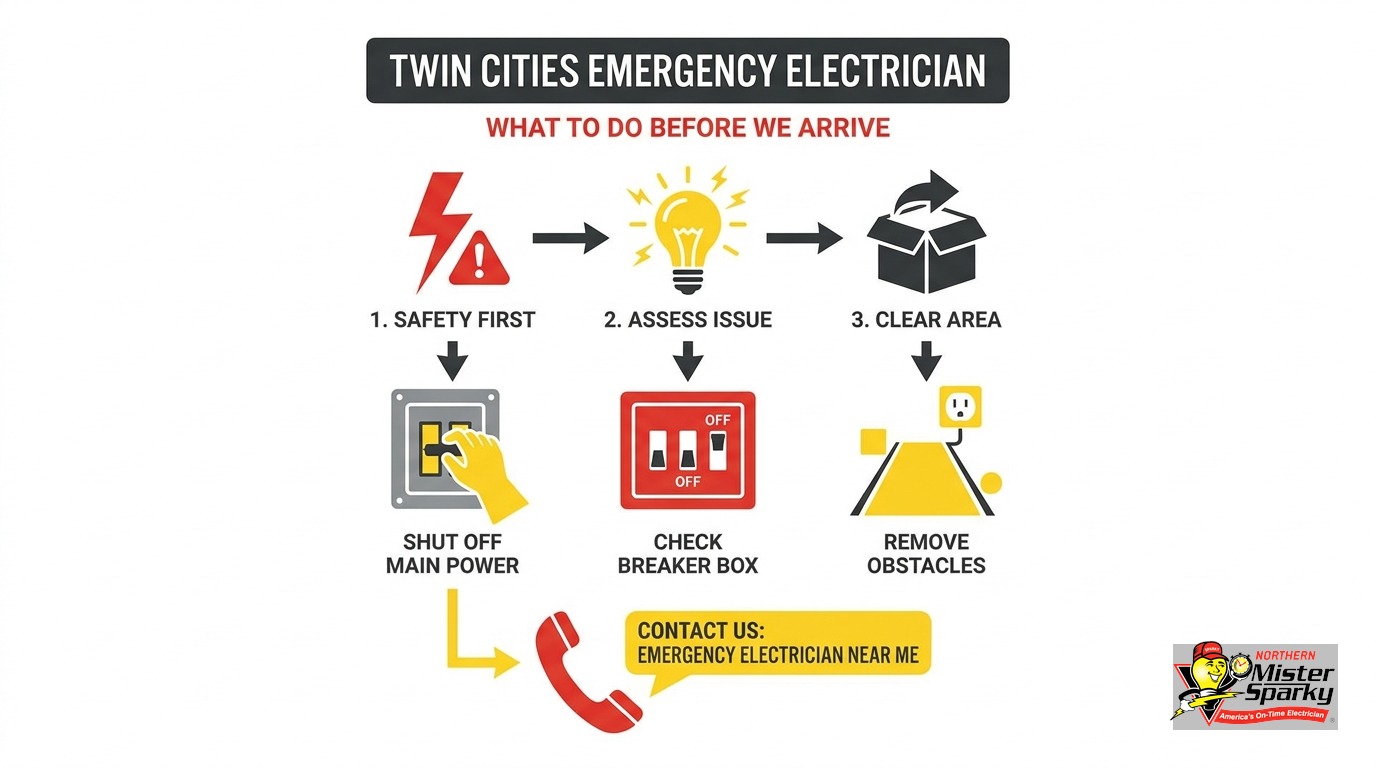
Key Takeaways
- Call 911 first for any life-threatening emergency: fire, electrocution, or a downed line.
- For outages and downed lines in the Twin Cities, call Xcel Energy at 1-800-895-1999. Stay at least 35 feet from any downed line.
- Shut off the breaker to the affected circuit. If you do not know which one, cut the main.
- Do not use water on an electrical fire. Leave the house if smoke is spreading.
- If your home was built between 1965 and 1973, aluminum wiring may be a factor. Tell the electrician when you call.
- Verify any electrician’s Minnesota license before they enter your home: secure.doli.state.mn.us/lookup/licensing.aspx.
- After a storm, Xcel restores their side of the line. You need a licensed electrician to repair a damaged mast or weatherhead before they will reconnect your house.
When Is It an Electrical Emergency?
Not every electrical problem warrants a midnight call. A genuine emergency is one where waiting until morning creates a real risk of fire, injury, or loss of power to critical systems.
Call an electrician right away if you have any of these:
- A burning smell from an outlet, panel, or wall
- Sparking or arcing at any outlet, switch, or breaker
- A breaker that trips immediately and will not reset
- Complete loss of power after a storm, especially with a damaged weatherhead or mast
- Outlet covers that feel warm to the touch - particularly in a home built in the late 1960s or early 1970s
- Visible scorching or melted plastic on any device or wiring
- A breaker that feels hot when you touch the panel door
- Any shock received from an outlet, appliance, or fixture
According to the NFPA, fires involving electrical distribution and lighting equipment averaged an estimated 32,620 U.S. home fires per year from 2015 to 2019, with an estimated 430 civilian deaths and $1.3 billion in direct property damage each year.
If you are unsure whether your situation qualifies, call anyway. We would rather talk you through it and confirm it can wait than have you delay something that cannot. To see what our emergency electrician service covers, visit that page.
What Should I Do First If I Smell Burning or See Sparks?
Act immediately. Shut off power to the affected circuit at your breaker panel - or cut the main breaker if you do not know which circuit is involved. Get everyone out of the room. If there is visible fire, leave the house and call 911. Do not use water on an electrical fire.
Here is the sequence:
- Get people and pets out of the affected area. Do not stop to grab belongings.
- Shut off the circuit at your breaker panel. If you are unsure which one, cut the main.
- Do not use water. Water conducts electricity. Use a Class C fire extinguisher if the fire is small and contained and you can reach it safely.
- Call 911 if there is any visible fire, smoke spreading beyond one room, or anyone injured.
- Once the immediate danger is under control, call a licensed electrician. Do not restore power until they clear the problem.
If your panel is inside the affected area - say, a laundry room that is already smoking - do not enter. Leave and call 911. Your safety comes before any piece of equipment.
Understanding Who Owns What: The Utility Line vs. Your Wiring
One of the most confusing moments for Twin Cities homeowners happens after a storm. Xcel Energy restores power to the whole block, and their house is still dark.
Here is why that happens, and exactly what to do.
Xcel Energy owns the service drop: the wires running from the utility pole to your weatherhead. The weatherhead is the point where the wires enter the conduit on your roof or side wall. That is their equipment, and they repair it on their schedule.
You own everything from the weatherhead down: the service mast, the meter socket, the meter base, and all the wiring inside the home. If a storm tears the mast away from the house, bends it, or pulls the weatherhead loose, Xcel will not reconnect your service until a licensed electrician repairs your side first.
This is the most common post-storm emergency call we take in the Twin Cities. The homeowner’s neighborhood gets power back. Their house stays dark. They call Xcel, who tells them to call an electrician. We repair the weatherhead and mast, coordinate with Xcel, and power is restored.
If you are in this situation, do not wait for Xcel to fix it. That is not their responsibility. Call us directly. We handle service mast and weatherhead repair and coordinate the reconnect with Xcel once your side is clear.
What if Xcel Restores Power to the Block but My House Is Still Dark?
Your weatherhead or service mast likely took storm damage. Xcel restored their line to the weatherhead. Your side needs repair before they reconnect. Call a licensed electrician, not Xcel, for this fix.
This situation is different from a full neighborhood outage. Sometimes only one of the two legs of your 240V service fails. Half the house has power. The other half does not. Lights work, but anything drawing 240V - dryers, ovens, HVAC, well pumps - goes dark. That is not a tripped breaker. It is a service-entrance problem.
For a full explanation of how this works, see our guide on partial power loss and lost-leg situations.
Is Aluminum Wiring a Risk in My Twin Cities Home?
If your home was built between 1965 and 1973, yes. Aluminum branch-circuit wiring may be present, and it carries a significantly higher risk of connection failure at outlets and switches. Tell any electrician you call about the age of your home.
The Consumer Product Safety Commission found that homes wired with aluminum during that era are 55 times more likely to have an outlet connection reach fire-hazard temperature than copper-wired homes. The Twin Cities has a large share of housing stock from exactly that period. Ramblers and split-levels built in the late 1960s and early 1970s are common throughout Minneapolis, St. Paul, Bloomington, and the inner-ring suburbs.
The warning signs for aluminum wiring failure look almost identical to other electrical emergencies:
- Outlet covers that feel warm to the touch
- Flickering lights on a circuit that should be properly loaded
- A faint burning-plastic smell with no obvious source
- Discoloration around outlet or switch cover plates
If you live in a home from that era and you are seeing any of these signs, do not wait until morning. What looks like an overloaded circuit might be a connection at an aluminum splice point that is oxidizing under load.
For a full explanation of the risks and long-term fixes, see our post on aluminum wiring dangers and fixes.
How Do I Verify That the Electrician Showing Up at Midnight Is Actually Licensed?
Look them up before you open the door. Go to secure.doli.state.mn.us/lookup/licensing.aspx and search by company name or license number. Active license, active company: you are good. No record or an expired license: do not let them in.
This matters more than most homeowners expect. Electrical emergencies create urgency, and urgency creates an opening for unlicensed contractors. An unlicensed contractor doing emergency work can leave you with code violations and unpermitted repairs. We have seen this happen in the Twin Cities after major storms.
When you call Northern Mister Sparky, you are calling a locally owned and operated shop backed by the national “America’s On-Time Electrician(R)” system. Our license information is on file with the Minnesota Department of Labor and Industry. We will give you our license number on the phone. Ask any electrician for theirs before they come through the door.
A quick note on code: Minnesota adopted the 2023 NEC effective July 1, 2023. For permits filed on or after August 17, 2026, the 2026 NEC applies. Per the DLI, licensing exams switched to the 2026 NEC on September 8, 2026. Any electrician doing permitted work in your home right now needs to be current on that standard. The DLI lookup confirms not just that the license is active, but that it is the right class for the job.
What Happens With Permits for Emergency Electrical Repairs?
Emergency repairs still require permits in Minnesota. Your licensed electrician pulls the permit. You do not have to manage it.
This surprises homeowners. But yes, emergency work still needs a permit when it involves the panel, a new circuit, or the meter socket. Minnesota has about 66 cities that act as local Authorities Having Jurisdiction and issue their own permits. The rest go through the state system. Either way, the licensed electrician handles the paperwork.
What you need to know: a contractor who tells you “we can skip the permit to save time tonight” is a contractor you should not hire. Unpermitted work creates real problems at resale and can void your homeowner’s insurance coverage for a related claim.
Winter-Specific Hazards Every Twin Cities Homeowner Should Know
Minnesota winters create electrical hazards that most states do not face. These are the ones most likely to drive an emergency call.
Demand surge after storm restoration. When Xcel restores a large area after an extended outage, every electric heat source, water heater, and refrigerator in the neighborhood kicks on at the same time. If your panel is already marginal - old breakers, a full box, a double-tapped circuit - that surge can expose a failing breaker that was barely getting by under normal load. If circuit breakers keep tripping immediately after power returns, that is a signal your panel needs attention beyond a simple reset.
Heat tape and circuit capacity. Roof heat tape and pipe heat tape are standard in Minnesota. They draw real, continuous current. Heat tape run on a circuit not rated for continuous load - or sharing a circuit with other high-draw devices - is a fire hazard. If you are adding heat tape, it belongs on a dedicated circuit.
Weatherhead damage from ice and snow loads. Ice dams and heavy accumulation pull on the service mast over time. A mast that looked fine in October may be stressed by February. If your outdoor service entrance has shifted, shows visible corrosion, or has gaps where the conduit meets the house, have it inspected before it becomes an emergency call.
Generator backfeed. After a long outage, homeowners with portable generators sometimes plug them directly into a dryer outlet or use an extension cord to feed the panel. This is dangerous. It can electrocute utility workers on the line, damage your own equipment, and violates code. The correct setup is a generator interlock kit or a proper transfer switch. If you are using a portable generator right now without proper isolation from the grid, call us.
What to Expect When You Call Us
When you call 763-200-5956, here is what happens:
- You describe the situation. We ask a few quick questions: what you see, smell, or hear; whether power is off to the affected area; and whether anyone is injured.
- We give you immediate safety guidance. If there is anything else you should do before we arrive, we tell you on the call.
- We dispatch a licensed electrician to your Twin Cities address. We cover Minneapolis, St. Paul, Bloomington, Brooklyn Park, Woodbury, Blaine, Maple Grove, Plymouth, and surrounding communities.
- The electrician assesses and repairs. For permitted work - panel, service entrance, new circuits - we pull the permit. You do not manage that.
- We do not leave until the problem is resolved and you understand what was done and why.
We back every job with the UWIN(R) 100% satisfaction guarantee. No malarky.
Should I Try to Fix Anything Myself Before the Electrician Arrives?
No - with one exception. The one thing you can and should do is shut off the breaker to the affected circuit, or the main breaker if you are unsure which one. Beyond that, wait for the electrician.
Here is why: electrical emergencies often look simpler than they are. A breaker that trips and will not reset is not just a breaker problem. It is the panel signaling that something is wrong downstream. Resetting it yourself - without knowing why it tripped - can cause a wire to overheat inside a wall where you cannot see it until it ignites.
Outlets, panels, and wiring are not DIY territory in an emergency. The risks are too high. The fixes usually require permits and licensed work regardless.
Step back, keep people away from the affected area, and let the electrician diagnose it with the right tools.
The Number to Have Before You Need It
Save these before you ever need an emergency electrician:
Northern Mister Sparky: 763-200-5956
Xcel Energy emergencies and outages: 1-800-895-1999
Minnesota DLI license verification: secure.doli.state.mn.us/lookup/licensing.aspx
Life-threatening emergency: 911
We are locally owned and operated in the Twin Cities, and we are the “America’s On-Time Electrician(R)” for this market. When something goes wrong with your electrical system at any hour, call us first - or book online if the situation allows time.
Frequently Asked Questions
What is the Xcel Energy emergency phone number for Twin Cities outages? +
How do I verify an electrician's license in Minnesota before letting them in? +
Does my Twin Cities home have aluminum wiring? +
Do emergency electrical repairs in Minnesota still need a permit? +
Need an electrician now?