
Half of House Has No Power: Causes, Risks, and Who to Call
Key Takeaways
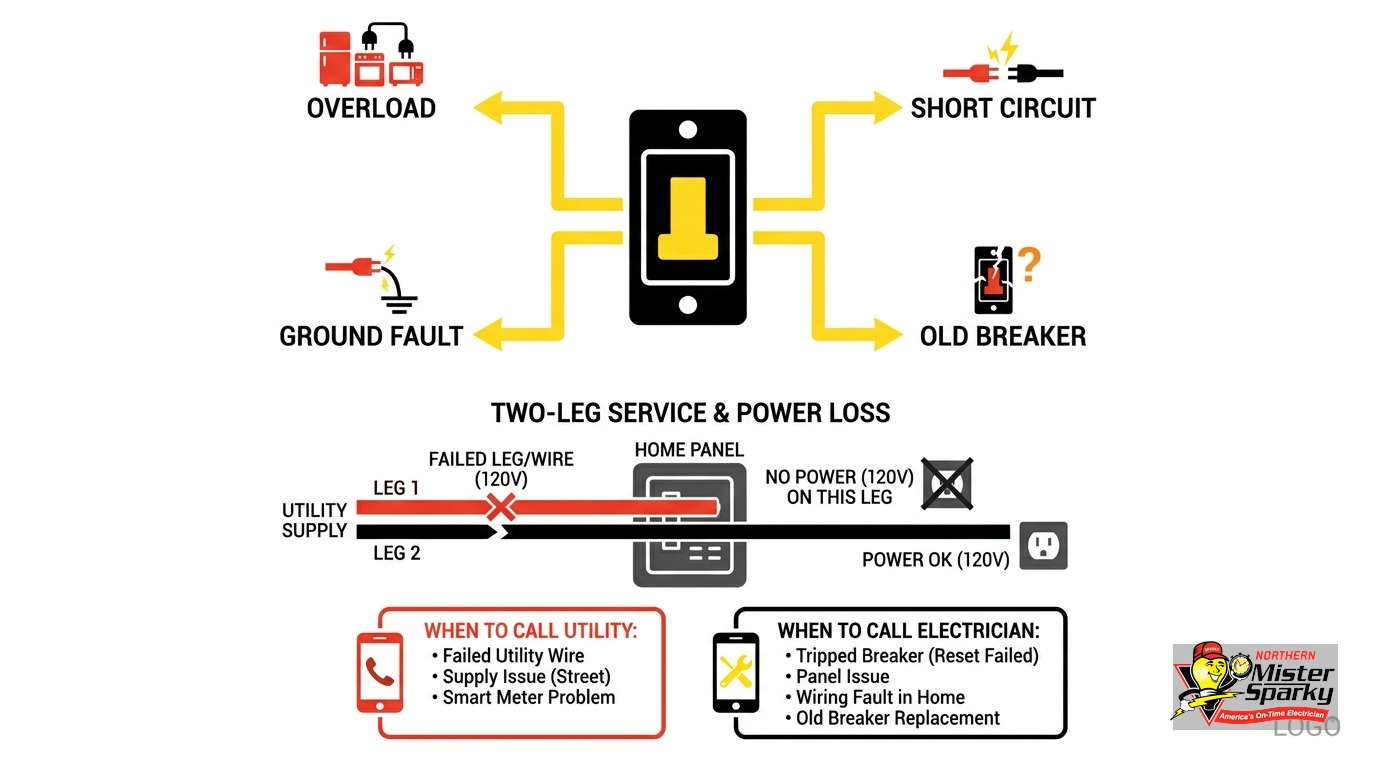
- “Half of house has no power” almost always means one of your panel’s two 120V hot legs has failed - a condition called a lost leg.
- The checkerboard pattern of live and dead rooms happens because your panel’s breaker slots alternate between Leg A and Leg B. Lose one leg, and exactly every other circuit goes dark.
- An electric dryer drum that spins but produces no heat is a classic lost-leg tell.
- Losing one leg creates dangerous backfeed voltage in your 240V appliances. Turn off your range, dryer, water heater, and central AC breakers at the panel right now - before anything else.
- Xcel Energy owns the overhead service drop from the pole to your weatherhead. You own everything from the weatherhead inward: the riser conduit, meter base, meter socket, and service entrance conductors.
- Service entrance repairs in Minnesota require an electrical permit. Xcel will not restore power without a passing electrical inspection.
- If your neighbor also has no power or your meter screen is blank, call Xcel at 1-800-895-1999. If your neighbor has full power, call a licensed electrician.
Walking through your house and finding half your lights working while the other half are completely dead is disorienting. A dryer drum that spins but blows cold air makes it worse. Both point to the same cause: a lost leg. Here is what that means, what the hazards are, and exactly who you call first in Minnesota.
What Does “Half of House Has No Power” Actually Mean?
A lost leg means one of the two 120V hot legs supplying your main panel has failed. Every circuit on that leg goes dark. Your 240V appliances lose half their power and become a hazard until the problem is found and fixed.
Your home runs on split-phase electrical service. A distribution transformer on the utility pole divides its secondary winding into two 120V halves, with neutral at the center. The two hot legs - Leg A and Leg B - run from the transformer down the overhead service drop to your weatherhead. Inside your main panel, these two legs land on alternating bus bars. Slot 1 is Leg A. Slot 2 is Leg B. Slot 3 is Leg A again. The pattern repeats all the way down the panel.
Every single-pole 120V breaker connects to one leg only. Every double-pole 240V breaker spans both bus bars and needs both legs to operate. Lose Leg A, and every breaker in an odd-numbered slot goes dark. Lose Leg B, and every even-numbered slot goes dark.
That is the checkerboard. The bedroom next to the living room has opposite power status because adjacent breaker slots connect to opposite legs. The pattern is not random - it follows the physics of your panel’s wiring.
This is an emergency. Before you investigate further, handle the backfeed danger below.
The Backfeed Danger: Turn Off 240V Breakers Right Now
Open your main panel and flip off every double-pole breaker before you do anything else. Those are the wide breakers that occupy two adjacent slots. In a typical Twin Cities home they cover the electric range, dryer, water heater, central AC, and any electric baseboard heaters.
Here is why: when one leg fails, any 240V appliance left on tries to draw current through the surviving leg. That current pushes back through the dead leg’s conductors and into the panel. The resulting voltage is unpredictable - reported cases show readings of 60V, 180V, or higher appearing on circuits that should read either a stable 120V or zero. Sensitive electronics connected to those circuits - refrigerators with digital control boards, smart TVs, computers, gaming consoles - can be destroyed in seconds. Appliance motors running at the wrong voltage also overheat faster than thermal protection can respond.
You do not need to shut off the entire main breaker to stop this hazard. Turn off each 240V double-pole breaker individually. Leave them off until a licensed electrician inspects the panel and clears it.
What Are the Classic Lost-Leg Symptoms?
Three patterns point directly to a lost leg: a room-to-room checkerboard of live and dead circuits, lights that dim when you try to run a 240V appliance, and an electric dryer drum that spins but produces no heat. Any one of these is reason to stop running 240V loads and work through the triage steps below.
Pattern 1: Room-to-room checkerboard. One room has power. The room next to it does not. One kitchen outlet works; the outlet on the opposite wall is dead. Walk through the house and note which rooms are live and which are dark. The alternating pattern - every other circuit across your panel’s alternating bus bars - is the clearest indicator that an entire leg has failed, not a single tripped breaker.
Pattern 2: Lights dim and surge when you try to run a 240V appliance. If the lights suddenly brighten or dim when someone turns on the range or dryer, the surviving leg is being stressed. The 240V appliance is pulling irregularly across the panel because it has lost its partner leg.
Pattern 3: Electric dryer drum spins but produces no heat. The dryer motor is a 120V load. The heating element is a 240V load and needs both legs. When one leg is gone, the motor runs and the drum spins. The element gets nothing. Cold air is the result. This is one of the clearest hardware tells for a lost leg.
Write down which pattern you observed and when it started. That information matters when you call.
Is This Xcel Energy’s Problem or Mine?
If your neighbor has full power and your meter reads normally, the fault is on your side of the service entrance. Call a licensed electrician. If your neighbor is also dark or your meter screen is blank, call Xcel at 1-800-895-1999 first.
Use this table to read your situation:
| What you observe | Likely cause | First call |
|---|---|---|
| Neighbor also dark, or active outage on Xcel map | Utility transformer or service drop | Xcel: 1-800-895-1999 |
| Neighbor has full power, meter screen blank or shows error | Meter or utility-side connection | Xcel: 1-800-895-1999 |
| Neighbor has full power, main breaker buzzing or burning smell | Failed main breaker or lug connection | Electrician, same day |
| Symptoms started during or after an ice storm and track with temperature | Weatherhead or drip loop connection | Electrician (coordinates with Xcel for disconnect) |
| Neighbor has full power, symptoms are intermittent flicker, not a fully dead leg | Loose service entrance conductor or meter socket jaw | Electrician + permit; Xcel Meters: 1-800-422-0782 |
Who Owns What on a Minnesota Service Entrance?
Xcel Energy owns the service drop: the overhead conductors from the transformer on the pole to the connection point at your weatherhead. You own everything from the weatherhead forward.
Xcel’s published installation standard is specific on this: the weatherhead, insulator, riser conduit, meter base, meter socket, and all service entrance conductors between the meter and the main panel are homeowner-owned equipment. If the fault is in Xcel’s service drop (pole to weatherhead): they repair it at no cost to you. If the fault is at the weatherhead, riser, meter socket, or the conductors below the meter: it is your repair, and you need a licensed electrician.
A common point of confusion is the meter socket jaw. The socket uses spring-loaded jaws to grip the meter’s blade contacts. Over years, those jaws lose tension or develop corrosion at the contact surface. A single failed jaw can interrupt one leg and produce the half-power pattern described in this post. The meter socket is homeowner equipment. Its repair requires an electrician, a permit, and a coordination call to Xcel Meters at 1-800-422-0782 to arrange a bypass socket while the work is inspected and service is re-energized.
For a breakdown of what each service entrance component looks like and what a repair involves, see our guide on weatherhead and service mast storm damage repair.
Does MN Winter Make This Problem More Likely?
Yes. Ice accumulation at the weatherhead or at the utility’s drip loop connection is a documented cause of lost-leg events in the Twin Cities - and it does not get much coverage in national electrical content.
Aluminum service conductors expand and contract with temperature. At the weatherhead, where the utility’s drip loop connects to the homeowner’s service entrance conductors, a compression connector holds the joint together. In freezing rain, ice builds up at this junction and at the opening where conductors enter the conduit. The ice load compresses the connector and can push corroded surfaces into intermittent contact. One leg gets interrupted. The checkerboard appears.
The diagnostic clue: symptoms appeared or got noticeably worse during a freezing rain event and seem to improve when the temperature climbs above freezing. The ice is making and breaking contact as it cycles through freeze and thaw. That temperature dependence - not a tripped breaker, not a utility outage - points to the weatherhead or drip loop.
Do not wait for conditions to improve and assume the problem is solved. Arcing at a corroded, ice-covered connection generates heat. That heat degrades the service entrance conductors and can create a fire risk at the point where they enter your home. Call us while symptoms are active so the fault can be localized before conditions change.
What Can Cause a Lost Leg? Four Common Culprits
The four most common causes are a failed utility service drop, a damaged weatherhead or service entrance conductor, a tripped or failed main breaker, and a corroded meter socket jaw. Each has a different repair path and a different responsible party.
Cause 1: Utility service drop failure. An overhead conductor between the transformer and your weatherhead has a broken strand, corroded connection, or damage from a tree branch or ice load. This is Xcel’s equipment. When Xcel confirms the fault is in the service drop, the repair is their responsibility and there is no charge to you.
Cause 2: Weatherhead or service entrance conductor failure. The riser conduit sustained physical damage, or the aluminum conductors inside have corroded at the meter socket entry. Aluminum service entrance conductors are standard in Minnesota residential applications and are prone to oxidation at connection points - particularly in the Twin Cities’ wet, freeze-thaw climate. This is homeowner equipment. A licensed electrician does the repair, a permit is required, and Xcel coordinates the re-energization after inspection passes.
Cause 3: Tripped or failed main breaker. The main breaker’s internal contacts have worn, or one pole has tripped on an overload or fault. A simple trip can sometimes be reset. A burned lug or failed contact inside the breaker requires same-day replacement. NEC Article 230 defines the main disconnect as the dividing line between utility and customer equipment. Everything on the load side is your electrician’s jurisdiction.
Cause 4: Failed or corroded meter socket jaw. The meter socket’s spring-loaded jaws grip the meter’s blade contacts. Over time, jaws lose tension or develop corrosion. One failed jaw interrupts a single leg and produces the exact half-power pattern described in this post. This repair requires pulling a permit, electrician work on the socket, and a coordination call to Xcel Meters at 1-800-422-0782 for a bypass socket while the repair is inspected and service is re-energized.
Step-by-Step: How to Triage Half of House Has No Power
Work through these steps in order. Do not call an electrician until you have ruled out the utility side, and do not force a buzzing or burned main breaker.
Step 1: Ask your nearest neighbor. Do they have full power? This single question tells you whether the problem is on the utility’s side or your service entrance.
Step 2: Check Xcel’s outage map online. Active outages appear in real time. If your address is in an outage zone, call 1-800-895-1999 anyway to confirm your address is logged and a crew is assigned.
Step 3: Look at your smart meter. A scrolling readout is normal. A blank screen or error message alongside a neighbor who has full power points to the meter socket or a utility-side connection.
Step 4: Inspect your main panel - look, do not touch yet. Is the main breaker in the middle (tripped) position? Is there a burning smell? Do you hear buzzing or crackling from the panel? Any of those signs means call a licensed electrician immediately. Do not attempt to force a breaker that is burned or buzzing. For more on telling a tripped breaker from a failed one, see our guide on what to do when a circuit breaker will not reset.
Step 5: Turn off all 240V double-pole breakers. Range, dryer, electric water heater, central AC. Do this before you attempt to reset the main breaker.
Step 6: Try resetting the main breaker once. Push it fully to OFF. Wait five seconds. Push it firmly to ON. If it holds and circuits restore: call us to inspect the panel regardless, because something caused that trip. If the breaker trips again immediately, or if it does not move smoothly to ON, stop. Each forced reset on a failing breaker adds heat to an already compromised connection.
Step 7: Call 763-200-5956. If the utility side is clear and the main breaker will not hold, you have a service entrance or main breaker problem.
For a deeper look at what distinguishes a main lug panel from a main breaker panel and what each failure mode looks like, see our main lug vs. main breaker panel explained guide.
When Do I Need a Permit for This Repair?
Every time. Service entrance work in Minnesota requires an electrical permit without exception. Xcel Energy will not re-energize your service after a repair without a passing electrical inspection. No permit means no inspection, and no inspection means the power stays off until you fix that too.
Minnesota’s Department of Labor and Industry oversees electrical permitting for most of the state. About 66 Minnesota cities - including Minneapolis and St. Paul - issue their own local permits rather than routing through DLI. Outside those cities, permits are filed through DLI’s online portal. The permit filing date also matters because Minnesota adopted the 2023 National Electrical Code, effective August 3, 2026. The date you file determines which code version governs your repair.
The permit is not a formality. It is the step that authorizes the inspection, and the inspection is what triggers Xcel’s reconnect. Skip it and you are stuck with no power until you file one and pass anyway.
In practice, we handle the whole chain. We pull the permit, do the work to current Minnesota code, schedule the inspection, and coordinate the Xcel re-energization. You do not have to manage any of it. Our Minnesota electrical permit guide walks through each step if you want to understand the process before we arrive.
Call Northern Mister Sparky for Half-Power Emergencies in the Twin Cities
When the utility is not the cause and half of your house has no power, the fault is in your service entrance. That is our work.
We are locally owned and operated here in the Twin Cities. As America’s On-Time Electrician(R), we back every job with the UWIN(R) 100% satisfaction guarantee. We show up when we say we will, pull the permit, do the repair to current Minnesota code, and coordinate the Xcel Energy inspection so your power comes back the right way. No malarky.
For larger service entrance repairs, meter base replacements, or main panel work, we offer financing options so cost does not become a barrier to getting the job done safely. We serve Minneapolis, St. Paul, Bloomington, Brooklyn Park, Woodbury, Blaine, Maple Grove, Plymouth, and the surrounding Twin Cities metro.
Call 763-200-5956 or book online. We are ready when you are.
Frequently Asked Questions
Why does only half my house have no power? +
How do I know if this is Xcel Energy's problem or mine? +
Is it safe to stay in the house while half the power is out? +
Do I need a permit to repair a lost leg? +
Need an electrician now?