
Service Entrance Cable Replacement Cost in the Twin Cities
Key Takeaways
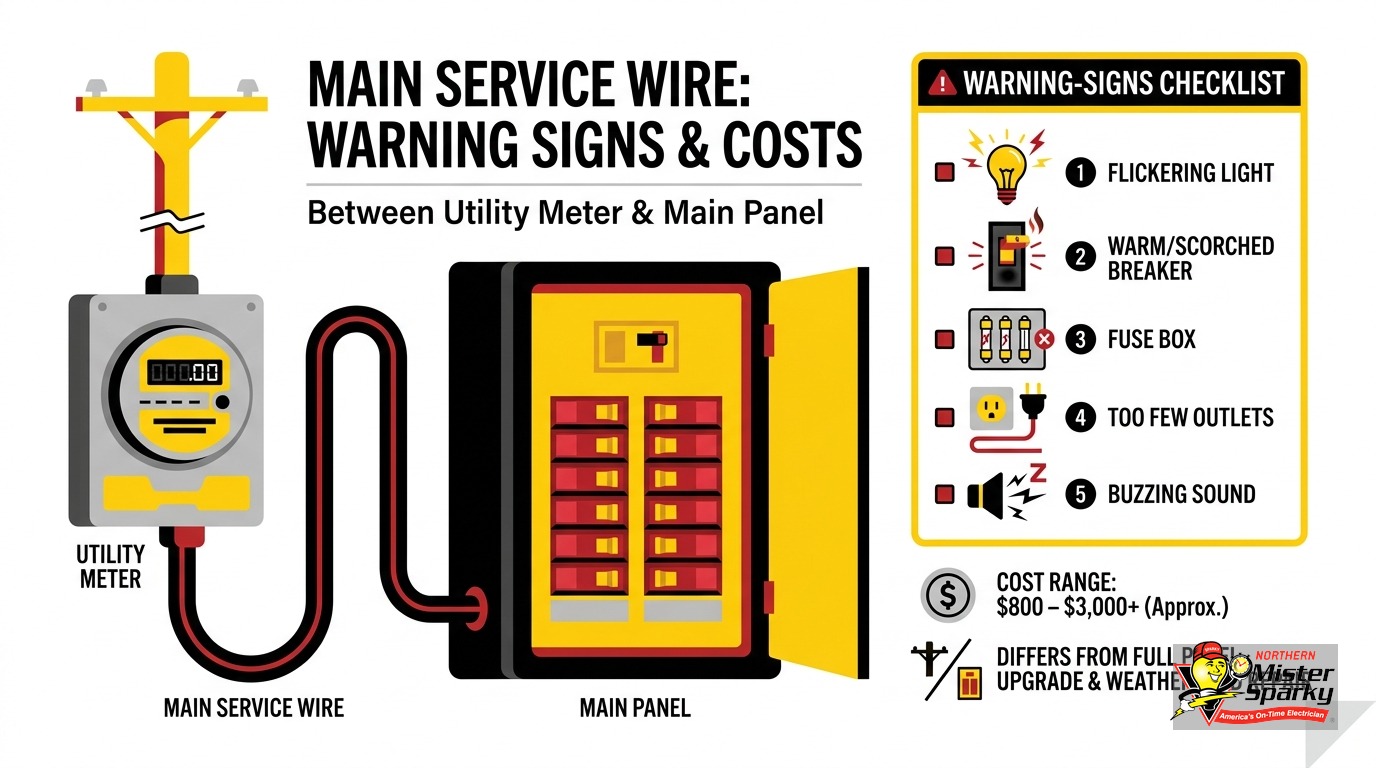
- Service entrance cable (SEC) replacement costs $1,000-$2,500 for a standard 100-amp overhead job in the Twin Cities. A 200-amp upgrade raises the total to $1,800-$2,500+.
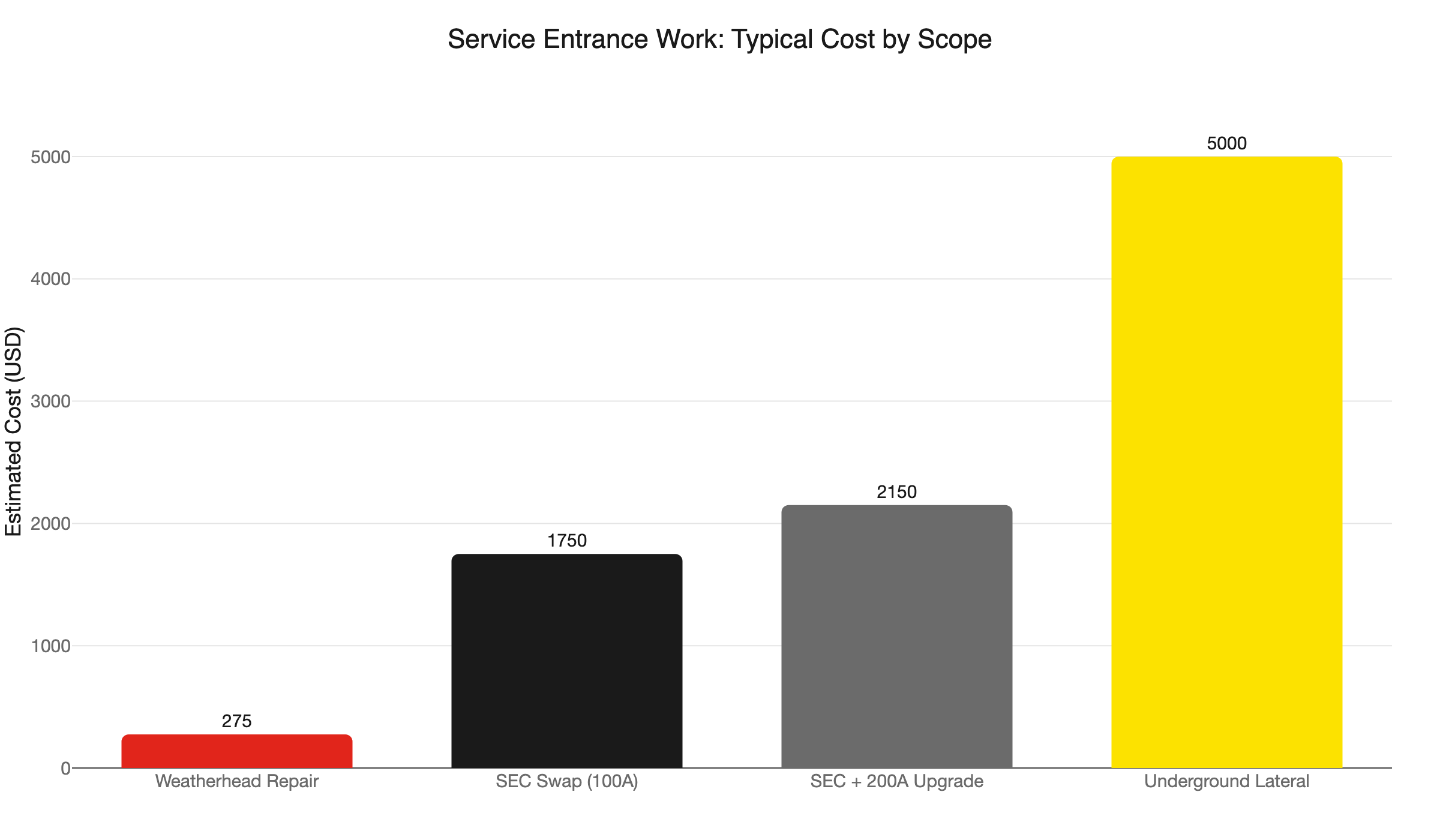
- SEC replacement, weatherhead repair, and a full panel upgrade are three separate scopes. The price gap between the smallest and largest is more than $4,000.
- Xcel Energy owns the service drop from the pole to the weatherhead. You own the weatherhead, mast, meter socket, and all SEC conductors - and you pay to replace them.
- Minnesota adopted the 2026 NEC effective August 17, 2026. Any permit filed now must comply with the updated code.
- Warning signs include cracked or brittle cable insulation, rust at the meter socket, lights dimming when the air conditioner starts, and a burning smell near the panel.
- The SEC has no upstream overcurrent protection. A failing cable is a direct fire and shock path. Do not wait on this one.
What Is a Service Entrance Cable?
Short answer: The service entrance cable is the set of conductors that runs from your meter base into your main breaker panel. It carries every amp your home uses. Unlike branch wiring inside your walls, the SEC runs exposed and unprotected from the elements.
Most Twin Cities homes have overhead electric service. Xcel’s service drop carries power from the pole to the weatherhead at the top of your mast. From there, SEC conductors run down the mast, through the meter socket, and into the panel.
The conductors are almost always aluminum. That is code-approved and appropriate for this application. The risk is the insulation and outer sheathing around those conductors, not the metal inside. Insulation fails. Conductors last.
Understanding what the SEC is - and what it is not - matters because it sits at the center of the most common and expensive misquote in residential electrical work.
The Three Jobs That Get Confused - and Why the Price Gap Is Over $4,000
Most homeowners call about a vague symptom and receive a quote for something they did not expect. There are three distinct scopes. Pricing one does not mean pricing the others.
Weatherhead repair ($150-$400). The weatherhead is the curved fitting at the top of the mast. It keeps rain out of the conduit. When it cracks or a fitting fails, a targeted repair of the cap and mast top is often all that is needed. Xcel typically does not need to disconnect the service drop for this scope. See our page on weatherhead and service mast storm damage repair for a full breakdown of what that work covers.
SEC conductor replacement ($1,000-$2,500). This is the job this article covers. The insulated conductors inside the mast and running through the meter base are pulled and replaced. Xcel must disconnect the service drop before work begins and reconnect it after inspection. That scheduling step adds lead time. It also means your home is without power for a defined window on the day of the repair.
Full panel upgrade with new service ($3,000-$5,500). When a home moves from 100-amp to 200-amp service, SEC replacement is part of a larger job. The same is true when the breaker box itself is failing. New conductors are sized for higher ampacity, the meter pan often needs replacing, and the panel is swapped out. Not sure whether you have reached that scope? Our guide on signs you need an electrical panel upgrade covers the decision points.
The confusion cuts both ways. A homeowner with a cracked weatherhead cap may get quoted for a full SEC replacement they do not yet need. A homeowner with flickering lights may get quoted for weatherhead work when the conductors inside the mast are actually the problem. Getting the right diagnosis before any work starts is what separates a well-scoped job from an expensive one.
Who Pays for Service Entrance Cable Replacement: You or Xcel Energy?
Short answer: You do. Xcel Energy owns the service drop from the pole to the weatherhead attachment point. Everything from the weatherhead inward - the mast, the SEC conductors, and the meter socket - is the homeowner’s property and cost.
Xcel Energy’s standard for electric installation and use makes the boundary explicit. Xcel maintains the utility pole, the transformer, and the overhead service drop wires. When those need repair, Xcel handles it at no charge to you.
You own everything from the weatherhead inward:
- The weatherhead fitting and cap
- The service mast and conduit
- The meter socket and meter base
- All SEC conductors from the weatherhead to the panel
Xcel will not replace your SEC conductors even if the failure point is right at the attachment. What Xcel will do is schedule a disconnect and reconnect so your electrician can work safely on a de-energized cable. That scheduling step is not same-day. Factor it into your timeline when booking SEC work.
This distinction trips up a lot of Twin Cities homeowners. They call Xcel, Xcel explains that the cable is not theirs, and the homeowner learns for the first time that the mast and conductors are their responsibility. Better to know that upfront.
What Does Service Entrance Cable Replacement Cost in the Twin Cities?
Short answer: A standard 100-amp overhead SEC replacement runs $1,000-$2,500 in the Twin Cities. Adding a 200-amp upgrade raises that to $1,800-$2,500+. Underground service lateral replacement starts at $5,000 because of the trenching required.
The following cost breakdown uses nationally sourced data from Engineer Fix. Twin Cities labor rates run toward the higher end of national ranges.
- Weatherhead repair only: $150-$400
- Short cable swap only (meter to panel, short run): $350-$600
- Standard overhead SEC replacement, 100-amp service: $1,000-$2,500
- SEC replacement with 200-amp upgrade: $1,800-$2,500+
- Underground service lateral with trenching: $5,000+
Several factors move your job toward the high or low end of that range.
Conductor material. SEC conductor material costs $1.50-$15 per foot depending on gauge and whether aluminum or copper is used. Aluminum is standard for SEC runs and handles the load well.
Mast and meter pan condition. Corroded mast conduit or a damaged meter socket adds to the total. This is common in Twin Cities homes built before 1980.
Permit and inspection fees. Required in Minnesota, without exception. A licensed electrician includes this in the quote.
Xcel scheduling. All SEC work requires a scheduled Xcel disconnect and reconnect. That is built into the timeline, not the line-item cost - but if an expedited window is needed, ask your electrician about it upfront.
The 100-amp vs. 200-amp decision. If you are near your current electrical capacity, replacing conductors at 100 amps now and upgrading in two years means two Xcel disconnects, two permits, and two mobilizations. Our guide on 100-amp vs. 200-amp electrical service covers when sizing up now makes financial sense.
What Are the Warning Signs Your SEC Is Failing?
Short answer: Look for cracked or chalky insulation on the visible cable near the weatherhead, rust at the meter socket, the mast pulling away from the siding, lights dimming when large appliances kick on, or a burning smell near the panel. Any one of these warrants a call today.
The primary failure mechanisms are UV exposure, moisture penetration, and wind abrasion. Once the outer sheathing cracks, water enters the conduit and begins oxidizing the aluminum strands inside. Oxidized aluminum creates electrical resistance. Resistance creates heat. Heat in a high-current, unprotected cable is a fire hazard.
Watch for these signs:
Cracked or chalky cable jacket. Check the visible cable as it exits the weatherhead. Surface cracking, brittleness, or a chalky white texture means the insulation is failing. This is often visible from the ground or a ladder.
Rust at the meter socket. Water that enters the conduit drains toward the meter base. Rust streaks on or around the socket indicate moisture has been inside the system, likely for more than one season.
The mast is pulling away from the house. The attachment hardware loosens from years of wind load and freeze-thaw cycling. A gap between the mast and siding means the weatherhead seal is compromised and water is getting in.
Lights dim when the air conditioner starts. This can point to high-resistance connections in a corroded SEC. It can also mean the panel is simply undersized. Either one needs a professional look.
Burning smell near the panel. The SEC carries no upstream overcurrent protection. There is no breaker upstream of this cable to trip if it overheats. A burning smell at the panel is a same-day emergency call.
Electricians have documented these warning signs for years. They do not improve on their own. If you see more than one at the same time, the urgency is higher - the failure is likely further along than a single sign suggests.
Does Minnesota’s Climate Affect How Fast a Service Entrance Cable Wears Out?
Short answer: Yes, significantly. Minnesota’s roughly 130-degree annual temperature swing - from below -30°F in January to above 100°F in summer - stresses cable insulation well beyond what national lifespan estimates assume. Freeze-thaw cycling at the weatherhead seal is a specific local failure mode that national guides overlook entirely.
PVC cable insulation has a general life expectancy of 25-50 years. That range assumes a temperate climate with moderate annual swings. In the Twin Cities, the SEC insulation at the weatherhead seal endures the full temperature range every year - and rapid freeze-thaw events multiple times each winter.
The specific failure sequence works like this. A micro-crack forms in the weatherhead seal during a cold snap. The gap freezes open. Spring melt drives water into the conduit. The next winter, the cycle repeats. By the time visible cracking appears from the ground, moisture damage inside the mast may already be significant.
The aluminum conductors themselves resist this. Aluminum does not corrode quickly in a dry environment. But once moisture enters the conduit, the conductor insulation degrades faster than the outer sheathing degradation alone would suggest.
If your home was built before 1990 and the SEC has never been professionally assessed, a one-time inspection is a reasonable step. You may have a decade of service life left. You may have one hard winter left. You will not know without a look from someone qualified to give you a straight answer.
Does SEC Replacement Require a Permit in Minnesota?
Short answer: Yes, always. SEC replacement is a major electrical change and requires a permit in every Minnesota jurisdiction. Minneapolis routes permits through state DLI. St. Paul runs its own process. Any permit filed on or after August 17, 2026, must comply with the 2026 NEC.
Minnesota adopted the 2026 National Electrical Code effective August 17, 2026. That was 12 days ago. Any electrical permit filed today must meet the updated requirements. The 2026 NEC includes revised language for service disconnect placement (NEC 230.70) and updated requirements for how exterior wall penetrations at the SEC conduit entry must be sealed under Minnesota’s energy code.
The Twin Cities has a jurisdictional split worth knowing:
- Minneapolis uses state DLI permitting. Your electrician files through the state system, and inspections are coordinated through DLI.
- St. Paul runs its own permitting through the city’s Department of Safety and Inspections. The city publishes specific guidance on residential service upgrades and has separate documentation on Xcel Energy’s requirements for service changes.
- Suburbs vary. Some communities use state DLI. Others - including Bloomington, Woodbury, and Maple Grove - run local permitting with their own inspection offices.
A licensed electrician handles all of this. The permit cost is part of a properly scoped job. If a contractor quotes SEC work with no mention of a permit, treat that as a red flag. Unpermitted electrical work creates problems when you sell the home and voids your homeowner’s insurance coverage on the affected scope.
For more on how Minnesota electrical permitting works in practice, see our overview of electrical permits in Minnesota.
Should I Bundle SEC Replacement With a Panel Upgrade?
Short answer: If your current service is 100 amps and you plan to add significant new loads in the next few years, yes. One Xcel disconnect, one permit, one mobilization covers both jobs. If your panel is healthy and loads are stable, a straight SEC swap is the right call.
The case for bundling is economic. An SEC replacement requires Xcel to disconnect and reconnect the service drop. A panel upgrade also requires that step. Done separately, you pay for two Xcel coordination windows, two permit pulls, and two mobilizations. Done together, you pay for one of each.
The case against bundling is equally simple. If your panel is a 200-amp Square D or Eaton breaker box in solid condition, replacing it is waste. Pull the old conductors, install new ones, and close the job.
Three questions help frame the decision:
- Is your home currently on 100-amp service?
- Are you planning a large new load in the next two to three years: an EV charger, a generator transfer switch, a heat pump, or an addition?
- Is your panel more than 30 years old?
If you answered yes to two or more, the bundle is likely to pay for itself in avoided second-mobilization costs. If your answers were mostly no, keep the scopes separate and address the panel when it actually warrants attention.
Get a Straight Assessment From a Local Electrician
SEC assessment is not complicated. An electrician can look at your mast, inspect the visible cable jacket, and tell you clearly what needs attention now - and what can wait.
Our team at Northern Mister Sparky is locally owned and operated in the Twin Cities. As America’s On-Time Electrician(R), we show up when we say we will, quote the scope your house actually needs, and give you a straight answer. No malarky.
Call 763-200-5956 or book your inspection online. We serve Minneapolis, St. Paul, Bloomington, Brooklyn Park, Woodbury, Blaine, Maple Grove, Plymouth, and the surrounding Twin Cities metro. Every job is backed by the UWIN(R) 100% satisfaction guarantee.
Frequently Asked Questions
How much does service entrance cable replacement cost in the Twin Cities? +
Does Xcel Energy replace my service entrance cable? +
Do I need a permit to replace a service entrance cable in Minnesota? +
Need an electrician now?