
Underground Electrical Service Lateral Replacement Cost
Key Takeaways
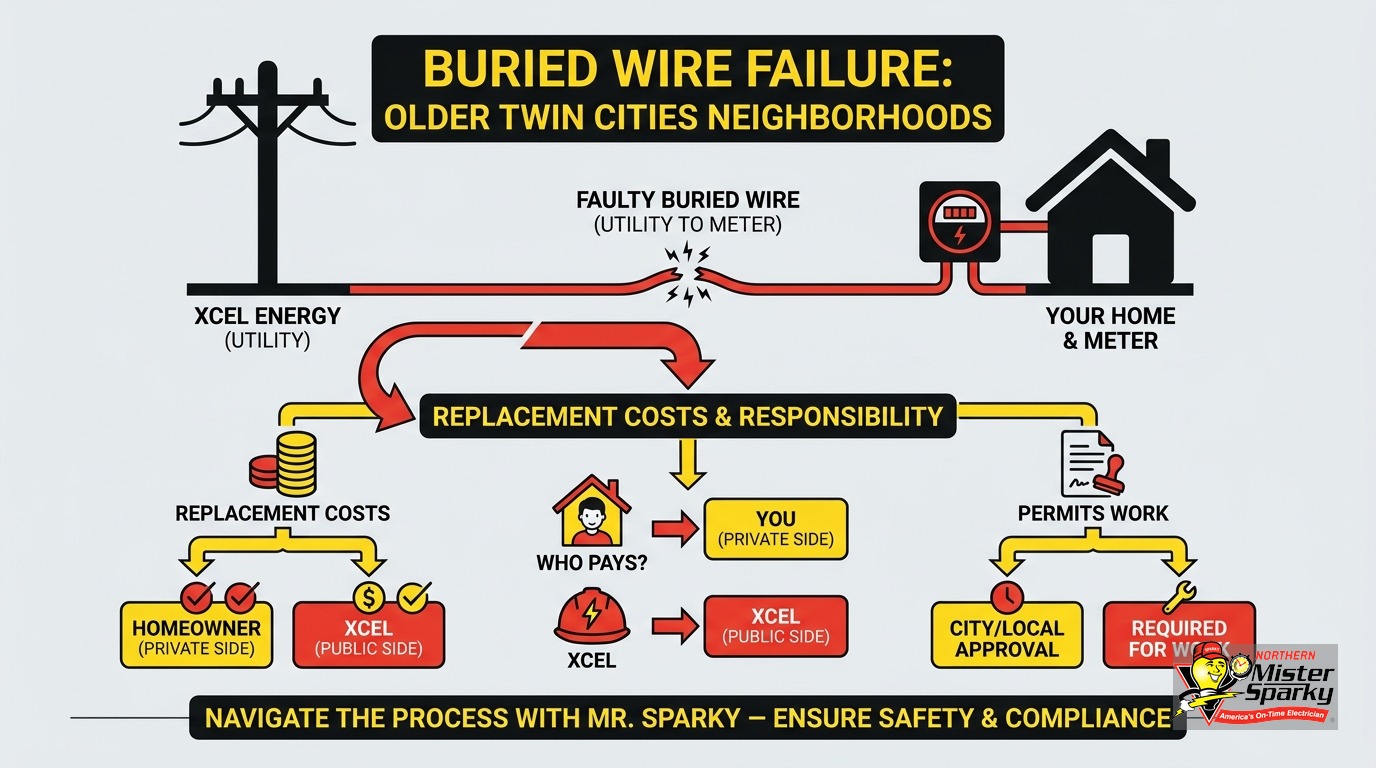
- Xcel Energy owns the underground lateral it installed. You own the meter socket and all wiring from the meter inward.
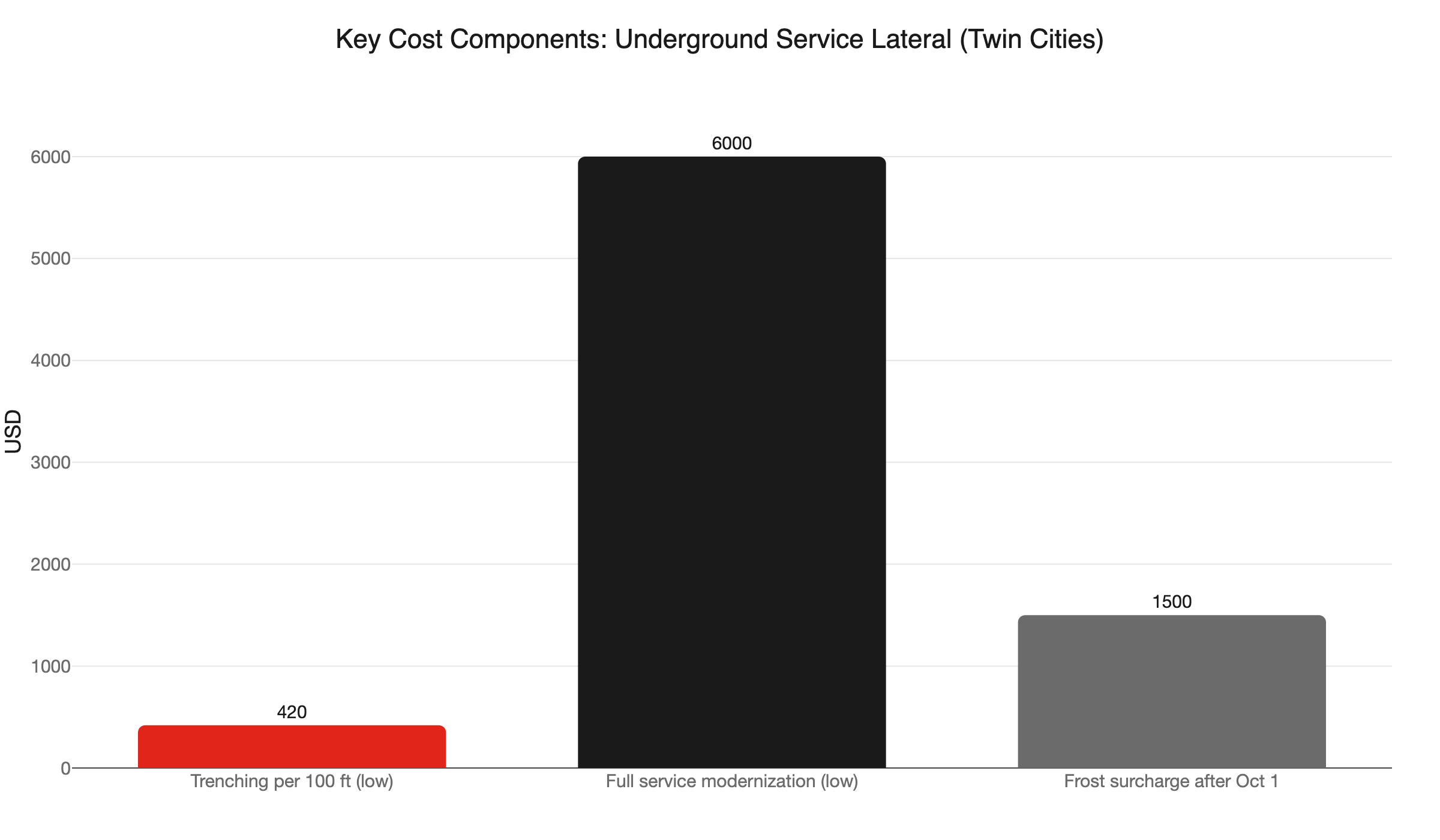
- Underground electrical service lateral replacement cost for full service modernization runs $6,000-$8,750+ in the Twin Cities.
- Trenching in the Minneapolis area costs $420-$1,260 per 100 linear feet, depending on soil and obstructions.
- Applications submitted after October 1 trigger a $1,500 Xcel frost surcharge. A September call avoids it.
- Three permits must run at roughly the same time: a Minnesota DLI electrical permit, a city Right of Way permit, and Xcel’s signed Residential Underground Service Contract.
- Older laterals were direct-buried aluminum at 18-24 inches with no conduit and no warning ribbon, which is why they fail decades later.
The Wire You Never See Until It Fails
Your electrical service lateral is the buried conductor that runs from Xcel Energy’s transformer to your meter socket. Understanding underground electrical service lateral replacement cost - and who actually pays it - matters the moment that wire starts to fail. In older Twin Cities neighborhoods, that cable has been underground for 40, 50, or 60 years. When it starts to go, lights flicker throughout the house. Breakers trip for no clear reason. Sometimes half the house goes dark, not because of a tripped breaker but because the buried wire carrying one leg of 240V service is corroding or has been cut.
Most homeowners do not know who owns that wire. Fewer still know there is a hard calendar deadline that can add $1,500 to the job with no warning.
What Is an Underground Service Lateral?
Short answer: It is the buried conductor that carries power from Xcel’s transformer to your home’s meter socket. Most Twin Cities subdivisions built from the 1960s onward used underground service as the default. These homes have a buried wire that most owners have never thought about.
The service lateral starts at the utility transformer, which may sit in a street-side pad cabinet or on a pole at the edge of your lot, and ends at your meter socket on the exterior of your home. Xcel owns and maintains the transformer and all conductors running to the meter. You own the meter socket and everything that runs from the meter into the house.
Underground service became standard in suburban construction because buried lines survive ice storms, high winds, and errant vehicles in ways that overhead lines do not. In older neighborhoods still running overhead service, some homeowners choose to convert for the same reason. Converting from overhead to underground service involves the same permit stack and a similar cost profile, just starting from a different baseline.
Minnesota adopted the 2026 NEC effective August 17, 2026. Permits filed before that date used the 2023 NEC. Service work permitted today falls under the 2026 standard.
Who Owns the Buried Wire - You or Xcel Energy?
Short answer: Xcel Energy owns the underground lateral it installed. Per Xcel’s own published standard, “underground systems installed by Xcel Energy shall be the property of Xcel Energy.” You own the meter socket, the conduit stub-up, and everything from the meter inward.
This ownership line is the whole article. When Xcel’s conductor fails, Xcel replaces it. That is not your bill. But the conduit stub-up, the meter socket, and all work on the homeowner’s side of the meter are entirely your responsibility.
Here is the split in plain terms:
Xcel owns and handles:
- The underground conductor from the transformer to the meter
- Scheduling and performing any lateral installation or replacement
- Backfilling the trench after installation
The homeowner owns and is responsible for:
- The meter socket and meter base
- The conduit stub-up (Xcel requires 2-inch Schedule 80 PVC minimum as the termination point for their conductor)
- All service entrance wiring from the meter into the home
- Grounding and bonding at the meter and panel
- Restoration of any landscaping, sod, concrete, or hardscaping Xcel’s trench crew disturbs
One point that surprises homeowners: Xcel does not accept customer-installed underground service wire. You cannot supply your own wire for the lateral run. Xcel installs the conductor. Your electrician handles everything on the homeowner’s side.
One more detail worth knowing: Xcel will not be financially responsible for damage to any unexposed facilities. Before any crew digs, you must disclose every buried system on your property. Sprinkler lines, invisible pet fencing, drain tiles, old septic tanks, and buried oil tanks all need to be identified and marked. If Xcel’s crew damages an undisclosed system, the repair cost falls on you, not them.
Why Do Older Twin Cities Laterals Fail?
Short answer: Most were direct-buried aluminum cable at 18-24 inches with no conduit and no warning ribbon above the wire. Frost heave, soil movement, and landscape equipment stress and eventually damage the conductor. There is nothing wrong with how they were originally installed. They simply have a lifespan, and many Twin Cities homes are at or past it.
The NEC 300.5 underground burial depth standard requires direct-buried cable at a minimum of 24 inches. The current code also requires a warning ribbon placed 12 inches above any direct-buried conductor per NEC 300.5(D)(4). Pre-NEC-300.5 installations in Twin Cities neighborhoods from the 1960s and 1970s went in without conduit and without the warning ribbon.
The Twin Cities frost line sits at 42 inches per MN Rules 1303.1600. That depth governs plumbing and foundation work because pipes freeze. Electricity does not freeze. Electrical burial depth minimums are shallower. But freeze-thaw cycles do move soil, and a direct-buried aluminum conductor at 18-24 inches is stressed by that movement every winter. After 50 years of Minnesota winters, a cable originally at 22 inches may now sit at 14 inches or shallower due to cumulative frost heave.
The absent warning ribbon is the other failure mode. A crew digging a sprinkler trench at 10-12 inches can slice a decades-old lateral with no visual warning. Bare aluminum corrodes in wet soil, especially where small nicks in the insulation let moisture reach the conductor. The combination of mechanical stress, frost movement, and gradual corrosion is why the failure often looks sudden but has been building for years.
Signs Your Underground Service Lateral Needs Replacement
The wire is buried, but the symptoms show up inside your home. Watch for:
- Flickering or dimming lights throughout the house, not isolated to one circuit or room
- Breakers tripping with no obvious change in load
- Half the house losing power intermittently - this is a lost-leg symptom and distinct from a single tripped breaker
- A burning or acrid smell near the meter base or main panel
- Visible corrosion, arcing marks, or heat discoloration at the meter socket
- Power problems that worsen during wet weather or in the days following a hard frost cycle
These symptoms overlap with other service entrance problems. If your service entrance cable also shows damage or wear, the scope of work may expand. An inspection identifies what is failing before you commit to a repair plan.
What Does Underground Electrical Service Lateral Replacement Cost?
Short answer: Full service modernization in the Twin Cities runs $6,000-$8,750+. Trenching adds $420-$1,260 per 100 linear feet. An application submitted after October 1 adds $1,500 in frost surcharge. Total homeowner-side cost for a typical project runs roughly $7,000-$12,000, depending on run length, soil conditions, and scope.
Here is how costs break out by component:
Trenching: In the Minneapolis area, trenching costs vary, depending on soil conditions, depth, and obstacles. A typical residential run from the utility easement to the meter is 50-150 feet. Longer runs on larger lots add proportionally.
Underground wire installation: Installing underground electrical service wire is priced per linear foot, with longer runs increasing the total. Most Twin Cities residential laterals are well under 500 feet, but the per-foot rate applies to your specific run length.
Full service modernization: A complete job covering the riser, meter socket, grounding, bonding, surge protection, external emergency disconnect, and a new panel runs $6,000-$8,750+ in the Twin Cities. Many lateral replacement projects expand to this scope because the meter socket and panel are also at end of life when an old direct-buried lateral finally fails.
DLI permit fees: Minnesota requires an electrical permit before any service work begins. As of July 1, 2025, the base fee for a residential service inspection includes a $25 permit fee, $1 surcharge, $35 service inspection, and $55 minimum inspection fee per MN Statutes 326B.37.
Landscaping restoration: Xcel fills the trench but does not restore sod, plants, pavers, or concrete. Budget separately for any disturbed landscaping, driveway, or hardscape. Trench backfill also settles over the first year, so plan to top-dress and re-seed the following spring.
Financing is available for larger service jobs. Ask about options when you call.
What Permits Does This Job Require?
Short answer: Three, and they have to run at roughly the same time. A Minnesota DLI electrical permit, a city Right of Way permit if the trench crosses public ground, and Xcel’s signed Residential Underground Service Contract. Getting them out of order is the most common source of multi-week delays on this project.
Layer 1: Minnesota DLI electrical permit. Your electrician files this before any work begins. Minnesota Statutes 326B.37 governs the fee structure. The permit triggers a licensed inspector, and Xcel will not energize a new service without the inspection sign-off.
Layer 2: City Right of Way permit. If the trench crosses a sidewalk, alley, or public street, the city requires this permit before digging starts. Minneapolis and St. Paul each have their own ROW permitting offices and review timelines. Approval can take 5-30 days. This permit needs to go in early, running in parallel with the DLI application, not after it comes back.
Layer 3: Xcel’s Residential Underground Service Contract. The application goes through Xcel’s Building and Remodeling Services. You submit a bid estimate form, a site sketch, and a copy of the DLI electrical permit. Xcel schedules their crew only after receiving the signed contract and full payment. No signed contract, no crew date.
Our guide to electrical permits in Minnesota covers the DLI filing process in detail.
Can You Permit and Do This Yourself?
Short answer: No. Minnesota requires a licensed electrician for service entrance work. The homeowner electrical permit exemption covers certain interior wiring projects. It does not cover service entrance installations, lateral coordination, or work at the meter socket.
The licensed electrician is the permit holder and the inspected party on this job. Xcel will not schedule their crew in response to a homeowner-filed permit alone. Their application process requires a contractor’s bid estimate, and their contract is executed with the licensed party on the homeowner side.
The three-permit stack reinforces this. Xcel’s application requires a copy of the DLI permit, which requires a licensed contractor of record. There is no practical path to doing this job without a licensed electrician handling the homeowner’s scope. What you can do is understand the process, ask the right questions, and call before October 1.
Why Does October 1 Matter?
Short answer: Xcel adds a $1,500 frost surcharge on applications submitted after October 1. One Minnesota homeowner who completed this process confirmed the frost charge “would have doubled the total project expense,” putting the base Xcel-side cost at approximately $1,500. Apply before October 1, and you keep that money.
The surcharge covers the added equipment and labor required to dig into frozen ground. The cutoff is firm. An application dated October 2 pays it. One dated September 30 does not.
If your lateral has been showing symptoms all summer, this is the most time-sensitive item on your list right now. Waiting until November means paying the frost surcharge on top of the base project cost. Waiting until the lateral fully fails in January means paying the surcharge plus emergency after-hours rates.
The math is simple: a September call costs nothing. Waiting until October costs $1,500.
What Happens to Your Yard After the Job?
Xcel fills the trench. That is where their responsibility ends. They do not:
- Re-lay sod or re-seed bare soil along the trench path
- Repair concrete, asphalt, or pavers cut for the installation
- Restore plantings, gardens, or landscape features disrupted by the trench
- Account for the ground settlement that filled trenches experience over the first year
Budget for restoration as a separate line item. If the trench runs through a driveway, patio, or planted bed, get a landscaping or concrete quote before the job starts. Trench settlement is also worth planning for: the backfill compacts over time, and you will likely need to top-dress and re-seed the disturbed area the following spring.
Before any crew breaks ground, have all underground utilities marked. Call 811 for public utility locates. Then identify your private systems: irrigation lines, invisible pet fencing, drain tiles, and any old fuel tanks or septic infrastructure. Damage to an undisclosed private system is the homeowner’s cost, not Xcel’s.
Call Before October
If your home is showing signs of a failing lateral, or if you have an older home with a direct-buried aluminum lateral and no conduit, get a service inspection on the calendar now.
Our locally owned team at Northern Mister Sparky handles everything on the homeowner’s side: the meter socket, conduit stub-up, permit filings, and coordination with Xcel’s Building and Remodeling Services. As “America’s On-Time Electrician(R)” backed by the UWIN(R) 100% satisfaction guarantee, we show up when we say we will and call when we say we will call. No malarky.
If the scope expands to a full panel upgrade, ask about financing when you call.
Call 763-200-5956 or book online. If it is September, mention the October 1 frost deadline. We will make sure Xcel’s application is submitted before the cutoff.
Frequently Asked Questions
Who owns the underground electrical service lateral - the homeowner or Xcel Energy? +
Does Xcel charge extra for underground service work after October 1? +
What permits are required for underground service lateral work in Minnesota? +
Need an electrician now?