
Bury Electrical Service Line Cost: Twin Cities MN Guide
Key Takeaways
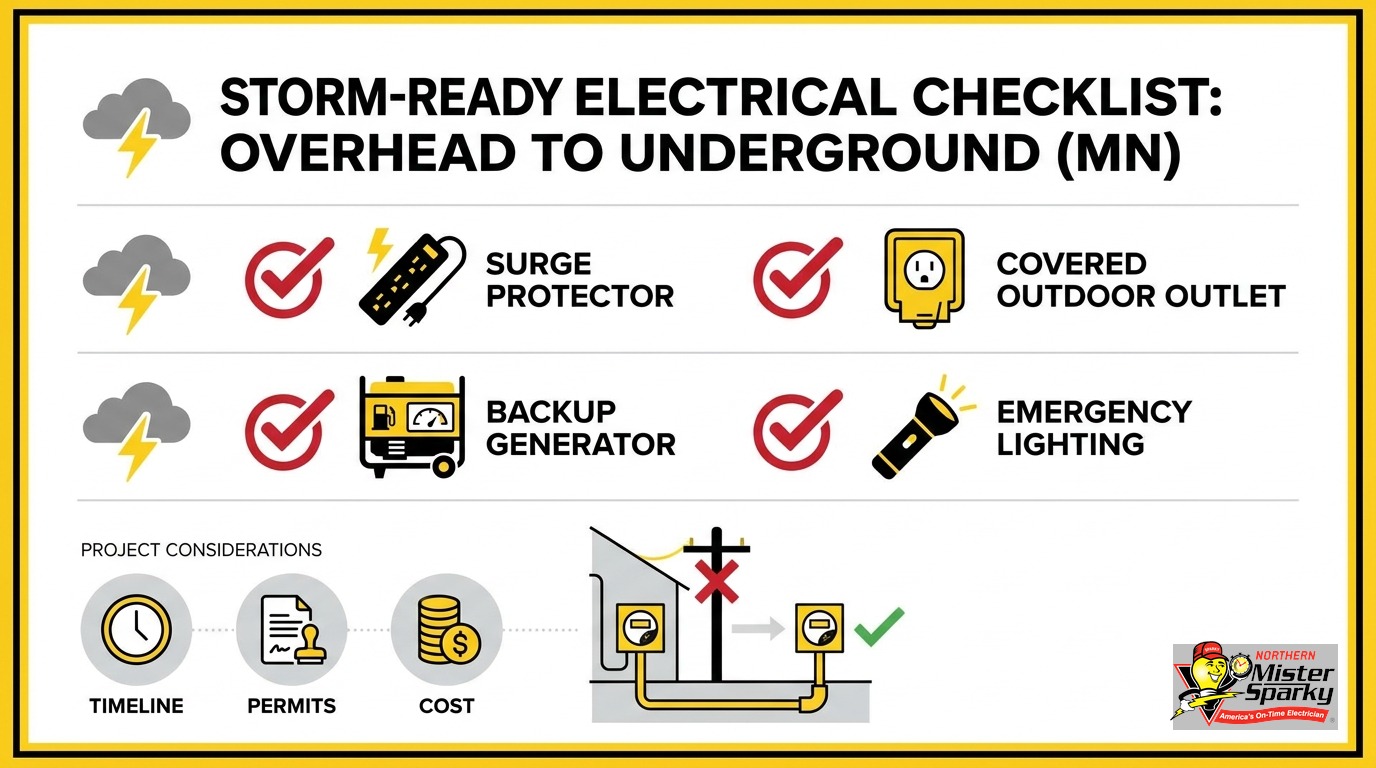
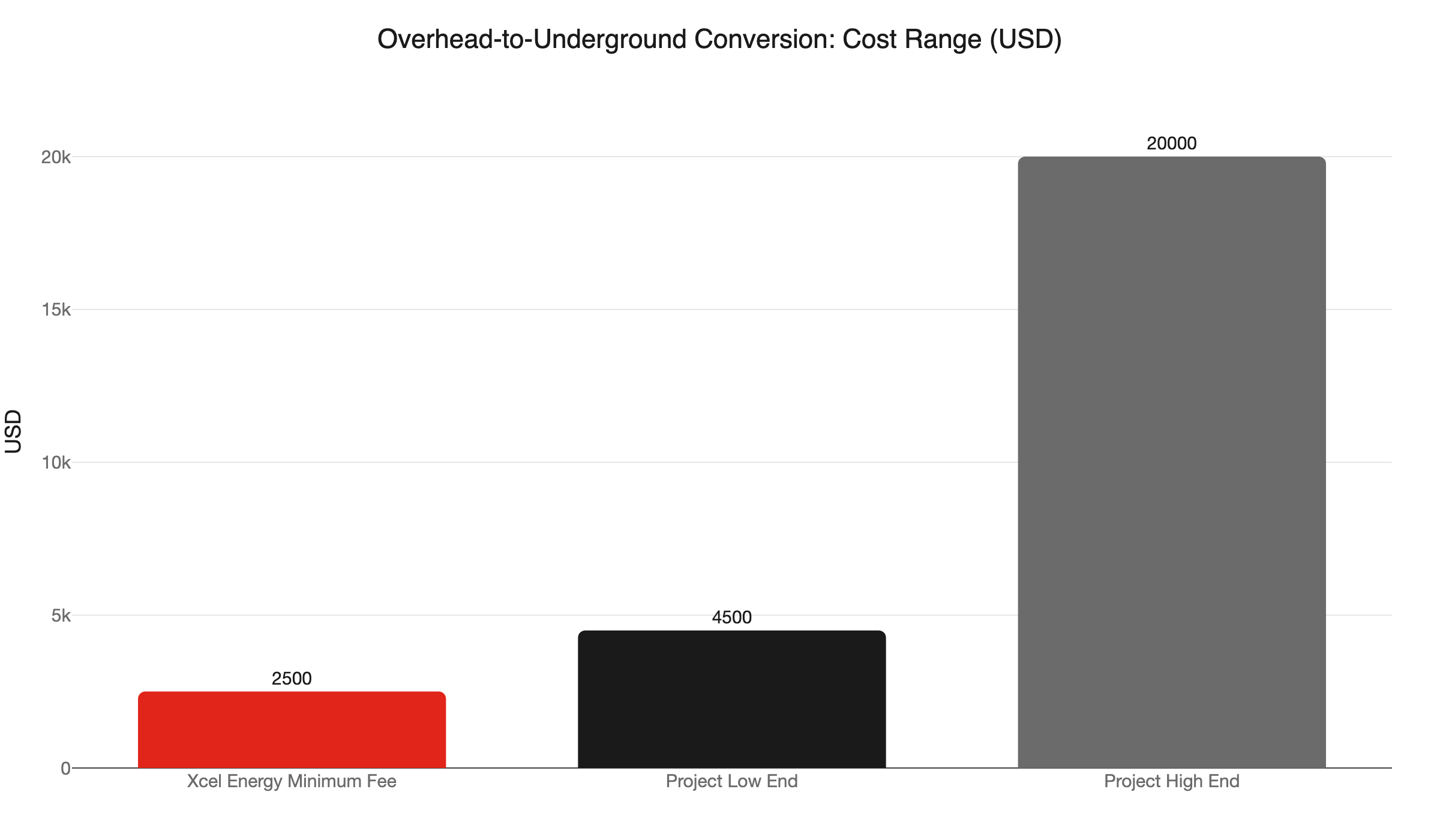
- The bury electrical service line cost for a full overhead-to-underground conversion in Minnesota runs $4,500 to $20,000 or more, depending on trench length, conduit type, soil conditions, and whether you need a panel upgrade.
- The job is split between two parties: Xcel Energy handles the trench from the pole or transformer to your meter; your licensed electrician handles everything from the meter socket to your panel. Two scopes, two permits, two inspection tracks.
- Xcel Energy’s process has eight steps. One documented Minnesota project took nearly eight weeks from application to final inspection.
- Minnesota law requires you to call 811 (Gopher State One Call) at least 48 business hours before any excavation, including a trench you dig yourself.
- The 2023 National Electrical Code (NEC), adopted in Minnesota effective July 1, 2023, requires an exterior emergency disconnect on all new or upgraded services. Most conversions from a 100-amp overhead drop trigger this requirement.
- Frozen ground ends the trenching season. If your inquiry comes after an October ice storm, plan for a spring start. Use the winter to get permits pulled and Xcel applications filed so you are first in queue when the ground thaws.
What Is the Bury Electrical Service Line Cost in Minnesota?
A full overhead-to-underground service conversion in the Twin Cities typically costs between $4,500 and $20,000 total, covering both the Xcel Energy scope and your electrician’s scope. Underground conduit installation runs $8 to $40 per linear foot before any panel or disconnect work is added.
The wide range reflects real variables. How long is the trench run from the pole to your meter? What kind of soil are you digging through? Are you in a dense urban corridor with other utilities to navigate? Does your existing panel need an upgrade before the new service entrance can be landed?
The $8-per-foot floor assumes straightforward conditions and a short run. The $40-per-foot ceiling reflects complex urban trenching, rocky or clay-heavy soil, and longer service runs. Minnesota has plenty of both. Twin Cities clay soil can make a 24-inch-deep trench a much more expensive job than a quick dig in sandy backfill.
Every estimate you get should break down the two scopes separately: Xcel’s portion and your electrician’s portion. If a contractor quotes you a single number without explaining that split, ask for the breakdown.
What Does Xcel Energy Handle vs. Your Electrician?
Xcel Energy owns the service from the utility pole or transformer to your meter. Your electrician owns everything from the meter socket inward, including the meter base, the service entrance conductors, and your panel. These are two separate scopes, two permits, and two separate inspection tracks.
Most homeowners do not know about this split until they are mid-project. It matters because you cannot simply call Xcel and ask them to bury your power line. You apply, wait for a bid, sign a contract, pay Xcel, and then separately hire a licensed electrician for the customer-side scope.
Xcel Energy starts the customer charge at $2,500 and can refuse a conversion if the cost would be excessive or conditions are impractical, such as a very long run from the nearest transformer. You pay Xcel for their trench and conductors. You pay your electrician for everything on your side of the meter.
Your electrician’s scope on the customer side includes:
- The meter socket and meter base, configured for the new underground service
- The service entrance conduit run from the meter to your panel
- Any panel work the conversion requires (discussed in detail below)
- The new exterior emergency disconnect required under 2023 NEC Section 230.85
- Coordination with Xcel on timing, cut-over sequencing, and the reconnect
What Is the Xcel Energy Application Process?
Xcel’s overhead-to-underground conversion has eight steps. Expect the full process to take six to eight weeks in good conditions, and longer if demand is high or the ground freezes before the crew can schedule.
Here is the documented sequence, based on a real Minnesota homeowner’s project that ran from late September to mid-November, nearly eight weeks start to finish:
- Submit an application at my.xcelenergy.com/BuildingRemodeling.
- Complete Xcel’s Bid Estimate Form and Site Sketch Form.
- Pull the Minnesota state electrical permit (DLI) and submit a copy to Xcel.
- Xcel conducts a site visit to verify conditions and finalize the scope.
- Xcel issues a contract. You sign and pay before any crew is scheduled.
- Xcel’s underground crew installs the conduit and conductors from the pole to your meter.
- Xcel’s overhead crew removes the old service drop and aerial hardware.
- Final inspection closes the permit.
Steps six and seven happen in sequence, not at the same time. The aerial hardware does not come down until the underground service is live and confirmed. Both your electrician and Xcel need to be on the same cut-over schedule, and communication between all parties matters here.
How Long Does the Conversion Take?
Plan for at least six to eight weeks from application to an energized underground service. One documented Minnesota project ran from late September to mid-November with no documented complications.
That timeline assumes you have your ducks in a row before you apply: a licensed electrician booked, a site sketch prepared, and your state electrical permit in hand. If any of those pieces lag, add weeks to the estimate.
The most important timing variable in Minnesota is the frost line. Xcel’s underground crew cannot trench frozen ground. If your project is not permitted, contracted, and actively scheduled before hard frost arrives, it waits until spring. In a typical Minnesota year, that window closes sometime in November and reopens in April. The window varies, but count on it.
Do You Need a Panel Upgrade When You Bury Your Service Line?
Most 1960s-era Minnesota homes with a 100-amp overhead service will need a panel upgrade to 200 amps as part of the conversion. The old overhead service entrance equipment typically cannot be replicated underground at the same amperage in most redesigns.
This is the cost line most homeowners do not see coming when they first ask about burial. If your current service is 100A and the panel is from the same era, the burial job is not just a trench. It is a panel upgrade, a burial, and a new exterior disconnect, bundled into one permit pull.
Our post on upgrading from 100-amp to 200-amp electrical service covers what that project entails and when it makes sense. The short answer: almost always bundle it. The service will be de-energized for the reconnect anyway. You will not get another window that clean or that cost-efficient for years.
The meter base and socket work is also a separate line item and must match the configuration of the new underground service entrance. If your meter socket is original equipment, plan to replace it as part of this project.
What Permits Do You Need in Minnesota?
Minnesota requires two permits for most service burial projects: a state electrical permit from the Department of Labor and Industry (DLI) for the customer-side electrical work, and a city or county permit for the trench itself. The two permits run in parallel but come from different agencies.
The state electrical permit covers the meter socket, service entrance conductors, panel, and the exterior disconnect. The city or county building or right-of-way permit covers the trench in your yard and, in some cases, any bore under a sidewalk or driveway. Fees vary by municipality.
Minnesota homeowners may pull their own electrical permit and perform the customer-side work on owner-occupied single-family homes. This option is not available for condominiums, apartments, or rental units.
If you pull the permit yourself, two inspections are required by state DLI:
- Rough-in inspection: The trench must be open, the conduit and conductors installed and visible before you cover anything. Miss this window and you dig back up. No exceptions.
- Final inspection: After reconnect, with the service live and all panel and disconnect work complete.
The 2023 NEC inspection standards apply to all permit work pulled after July 1, 2023, including the exterior disconnect requirement described below.
Whether you hire a licensed electrician or pull the permit yourself, the permit is mandatory. Unpermitted service work is a liability issue at resale and may void homeowner’s insurance coverage for related incidents.
What Does 811 Require Before You Trench?
Minnesota law (Statute Chapter 216D) requires you to notify Gopher State One Call at least 48 business hours before any excavation, including a trench you dig with a shovel. This is free and non-negotiable.
Gopher State One Call notifies Xcel Energy, CenterPoint Energy, fiber and cable utilities, and other buried-infrastructure owners to mark their lines in your yard before you dig. Marked lines are painted or flagged within the 48-hour notice window.
One critical limitation: utilities mark only to your meter. Lines from your meter to detached garages, sheds, irrigation systems, outdoor lighting, and other private infrastructure are your responsibility. If your trench path runs near any private buried lines, hire a private locator before breaking ground.
A homeowner who digs without an active 811 ticket is personally liable for any utility damage. That includes natural gas lines, which are buried in most Twin Cities yards. A gas line strike is not a paperwork problem. Call 811 first, every time.
The Trench Depth Rules That Affect Your Cost
The 2023 NEC sets minimum burial depths for residential service conductors. The conduit type you choose changes the required depth, which changes trench cost significantly in Minnesota’s clay-heavy soils.
Under the current NEC:
- 24 inches minimum for service conductors in standard conduit under a yard
- 18 inches for Schedule 80 rigid metal conduit (RMC)
- 12 inches for RMC encased in concrete
Conduit type and trench depth interact directly with labor cost. Hand-digging or machine-trenching 24 inches through compacted clay is a meaningfully different job from running 12 inches of open topsoil. Your electrician will specify conduit type based on the full picture: soil conditions, run length, frost exposure, and local inspector preferences.
Most residential conversions in the Twin Cities use Schedule 40 or Schedule 80 PVC, which requires the deeper trench. RMC in concrete is typically reserved for runs under driveways or hardscape where cutting and restoring pavement is already on the scope.
What Is the 2023 NEC Exterior Disconnect Requirement?
Minnesota adopted the 2023 NEC effective July 1, 2023. Section 230.85 now requires an exterior emergency disconnect on all new or upgraded services. This allows first responders to de-energize the home from outside without entering.
If your conversion includes a panel upgrade, a new meter socket, or a service amperage change, you are installing an upgraded service. NEC 230.85 applies. The new exterior-rated disconnect must be installed near the meter socket, clearly labeled, and accessible from outside the home.
Many homes in the Twin Cities do not have this disconnect. It is not optional on a conversion project, and it adds to both material and labor cost. Budget a few hundred dollars for the disconnect hardware and installation. Any permit application will surface this requirement, but knowing it upfront prevents sticker shock when the bid comes back.
Should You Time a Service Burial With a Landscaping Project?
Yes, and this is one of the most practical ways to reduce the overall cost.
If you are planning a deck, an addition, a new driveway, or significant regrading, coordinate the electrical trench with your landscaper or contractor before any digging starts. When ground is already open for one project, adding the electrical conduit run to the same trench cuts labor. Gas, cable, phone, and electrical can share the same open-ground window, each pulled to its own required depth.
The coordination requires lead time. Xcel’s eight-step process needs to be started before the landscaper arrives. That means landscaping projects planned for spring should have Xcel applications filed in late winter or early spring, with an electrician already booked.
This is also why October ice storm calls miss the window. The storm happens, homeowners want underground lines, and by the time the application goes in and Xcel schedules, the ground is frozen. If that is where you are right now, use the winter well: get the permit pulled, the electrician contracted, and the Xcel application in. Be first in queue when the ground thaws in April.
What About Storm Damage to Your Current Overhead Service?
If an ice storm or heavy wind damaged your service mast or took down the overhead drop, the first call is emergency repair, not conversion planning. A damaged service is a utility emergency.
Our team handles weatherhead and service mast storm damage repair, and we can walk through a conversion plan once the immediate repair is resolved. In some cases, a storm creates a natural opening to contact Xcel about a permanent underground conversion rather than restringing overhead equipment that will face the same risk next winter.
Storm damage does not accelerate Xcel’s queue. You still go through the eight-step process. But if your overhead service needs significant repair anyway, run the numbers on a conversion before committing to an overhead rebuild.
For homes with older panels or flagged panel brands, a forced service repair after storm damage can be the right moment to address the panel at the same time. The service will be disconnected for the work. Doing the panel in the same pass saves a second disconnection and a second permit cycle.
When to Call Northern Mister Sparky
If you are weighing whether to bury your electrical service line, here is what we bring to the table:
- A written estimate for the full customer-side scope: meter socket, service entrance, panel, and exterior disconnect
- State electrical permit pulled on your behalf
- Coordination with Xcel’s application and inspection schedule
- Conduit type and trench route specified to minimize cost and meet local inspector requirements
- Scheduling aligned with your landscaper or contractor so the open-ground window is not wasted
We are locally owned and operated in the Twin Cities. We know the permit schedules and inspector preferences in Minneapolis, St. Paul, Bloomington, Brooklyn Park, Woodbury, Blaine, Maple Grove, and Plymouth. Every city handles this project slightly differently, and we have done it in all of them.
If you are planning a spring conversion, the time to start is right now. Call 763-200-5956 or book online to get on the schedule.
Frequently Asked Questions
How much does it cost to bury an electrical service line in Minnesota? +
Does Xcel Energy bury my electrical service line? +
Do I need a permit to bury my electrical service line in Minnesota? +
Need an electrician now?