Home Power Quality Problems and Voltage Sags: Xcel or You?
Key Takeaways
- Voltage sags account for up to 80% of all power quality issues, but most sags in homes are caused by equipment inside the building, not by Xcel.
- Your home voltage should stay between 114V and 126V. That is ANSI C84.1 Range A, the preferred standard for a 120V residential system.
- The fastest diagnostic clue: if current drops at the same time as voltage, the sag is utility-side. If current rises while voltage drops, your own load is causing it.
- Twin Cities winters are prime time for sags. Furnace blowers, heat pumps, and electric backup heat all start and stop frequently on a cold day, and each motor startup briefly pulls voltage down.
- Budget LED bulbs and variable-speed motors are now the leading harmonic source in homes. A home full of inexpensive LEDs may have significant harmonic noise building up on the neutral wire.
- Xcel operates under Minnesota PUC oversight. If they will not fix a confirmed utility-side problem, you have a clear escalation path.
- A licensed electrician can measure your power quality and pinpoint the source before you spend time arguing with the utility.
What Are Voltage Sags?
Voltage sags are brief, temporary drops in your home’s supply voltage. IEEE 1159 defines a sag as a drop to between 10% and 90% of nominal voltage. The event must last at least half a cycle and no longer than one minute. Anything lasting longer is called a sustained sag or a brownout.
In everyday terms, a sag is the brief dimming you see when the furnace kicks on. It lasts a second or two. Then voltage recovers and everything looks normal again.
Most homeowners notice sags as lights that dim momentarily, a clock that resets, or a computer that reboots unexpectedly. These events feel minor. But chronic sags stress motors, compressors, and power supplies over time. A refrigerator compressor that repeatedly starts under low voltage runs hotter and fails sooner. A home server may reboot every time the air conditioner starts. Medical equipment that needs clean, stable power can behave unpredictably.
Minnesota winters sharpen the problem. The furnace blower, heat pump compressor, and electric resistance backup heat all cycle frequently during a cold snap. Every startup draws a burst of current. That burst temporarily pulls voltage down for everything else on the panel. If you recently had a heat pump installed and your lights now dip every time it starts, that is one of the most common patterns our team diagnoses in the Twin Cities.
What Is Power Quality?
Power quality describes how clean, stable, and consistent your electrical supply is. Good power quality means voltage stays close to 120V nominal, frequency holds at 60 Hz, and the waveform is a clean sine wave. Poor power quality covers sags, surges, harmonics, and electrical noise. Each of these conditions can damage equipment or cause unreliable operation over time.
For homeowners, the two most practical measurements are voltage level and harmonic distortion. Voltage tells you whether you are getting enough power. Harmonic distortion tells you whether the power you are getting is clean. Both affect how your appliances and electronics perform. Both are measurable with equipment a licensed electrician brings to the job.
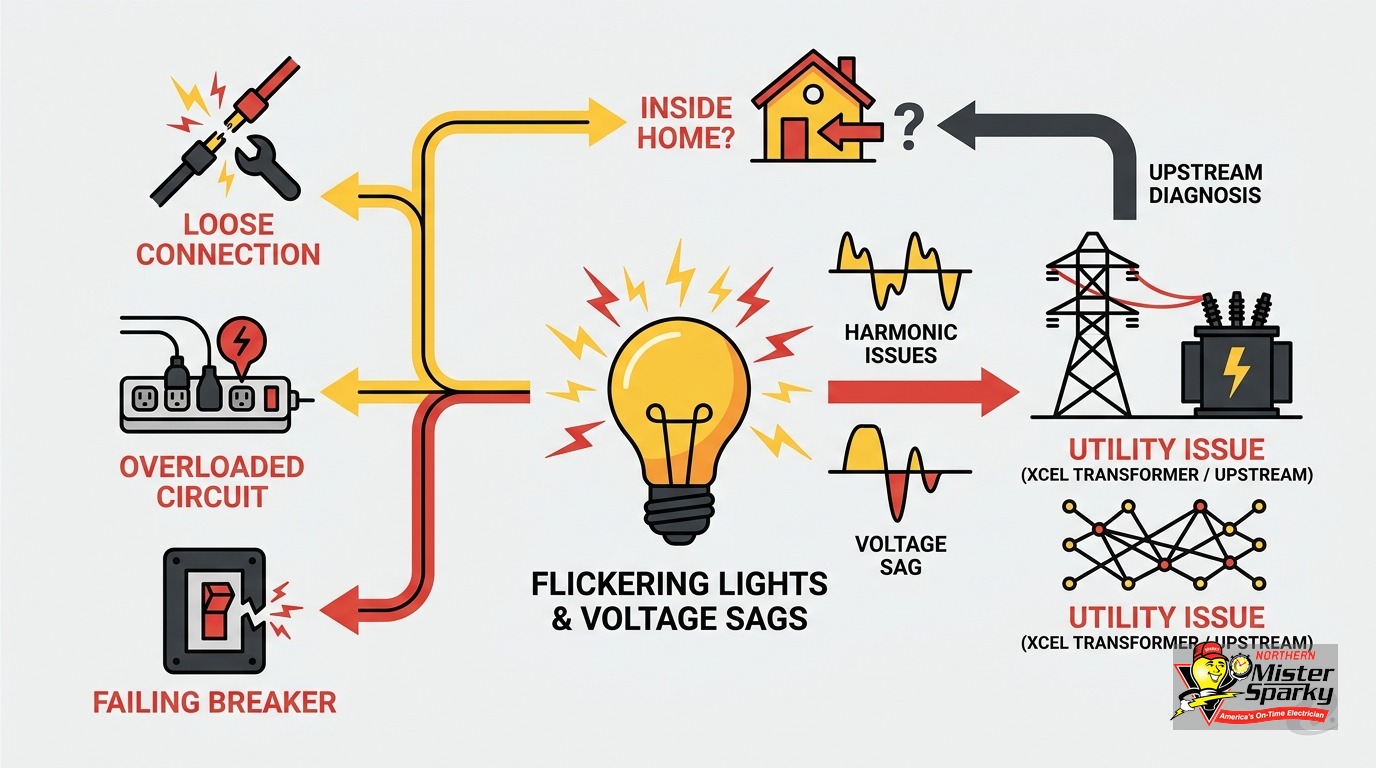
Understanding power quality matters because the symptoms overlap. Flickering lights can mean a voltage sag, a harmonic issue, a loose connection, or an overloaded circuit. Getting the diagnosis right saves you from fixing the wrong thing.
What Causes Low Voltage in a House?
Low voltage in a home comes from one of two places: inside your home or upstream at the utility transformer. Most sags are caused by large appliances starting up inside the building. The utility is a less common cause than most homeowners assume.
The most common in-home causes:
- Motor startups. Refrigerators, HVAC compressors, furnace blowers, and well pumps can draw five to ten times their normal running current for a fraction of a second when starting. That startup surge briefly pulls voltage down across the whole panel.
- Overloaded circuits. Too many loads sharing one branch circuit create a constant low-voltage condition. This is especially true when all loads run at the same time.
- Undersized wiring or long runs. Voltage drops across wire resistance. A long, undersized run to a subpanel or a detached garage produces chronic low voltage at the far end. This happens even when panel voltage looks fine.
- An undersized service panel. A 100-amp panel loaded with a heat pump, EV charger, and electric range lacks headroom. During peak demand, it cannot deliver adequate voltage to all loads simultaneously.
- EV chargers. A Level 2 EV charger is a large, non-linear 240V load. It can cause a noticeable voltage sag on startup and harmonic distortion during the charging cycle. If sags started after an EV charger was installed, that connection is worth checking.
If any of those patterns match what you are seeing, our post on signs you may need an electrical panel upgrade covers the most common indicators.
Utility-side causes do exist. Aging distribution transformers in older Minneapolis and St. Paul neighborhoods can sag when many homes start HVAC simultaneously on a cold morning. A fault on Xcel’s distribution line causes a sag for every customer on that segment. But these follow a different pattern from in-home causes, and the diagnostic test below separates them clearly.
How Can You Tell Whether the Problem Is Xcel’s or Yours?
The key clue is whether current and voltage move in the same direction or opposite directions when a sag occurs. This single relationship tells you which side of your meter the problem lives on.
Here is the rule, drawn from Fluke’s power quality analysis framework:
- Utility-side sag: Both voltage and current drop at the same time. Xcel’s transformer or a distribution fault is reducing what comes into your meter. Your loads are not causing it.
- In-home sag: Voltage drops while current rises. Your own appliance is pulling hard, dragging local voltage down. As voltage falls, the load draws more current to maintain its operation. The two measurements move in opposite directions.
A licensed electrician can measure this precisely with a power quality analyzer. But you can make a reasonable first guess without tools:
- Correlate the sag with an event. Does it happen every time the refrigerator compressor kicks on? Every time the furnace blower starts? Every time the microwave and dishwasher run together? That pattern points to an in-home cause.
- Ask your neighbors. If the whole block dims at the same time, the cause is upstream. If only your house is affected, the cause is on your side of the meter.
- Check what changed recently. If sags started after you installed an EV charger, a heat pump, or new LED fixtures throughout the house, that change is worth investigating.
- Look at the timing. Utility-side sags from transformer overload cluster at morning and evening demand peaks. Random sag events during off-peak hours are more likely in-home causes.
Lights dimming when the refrigerator or furnace starts is one of the most common service calls we receive. Our dedicated post on why lights dim when appliances turn on walks through the most common causes and what fixes them.
What Voltage Should Your Home Have?
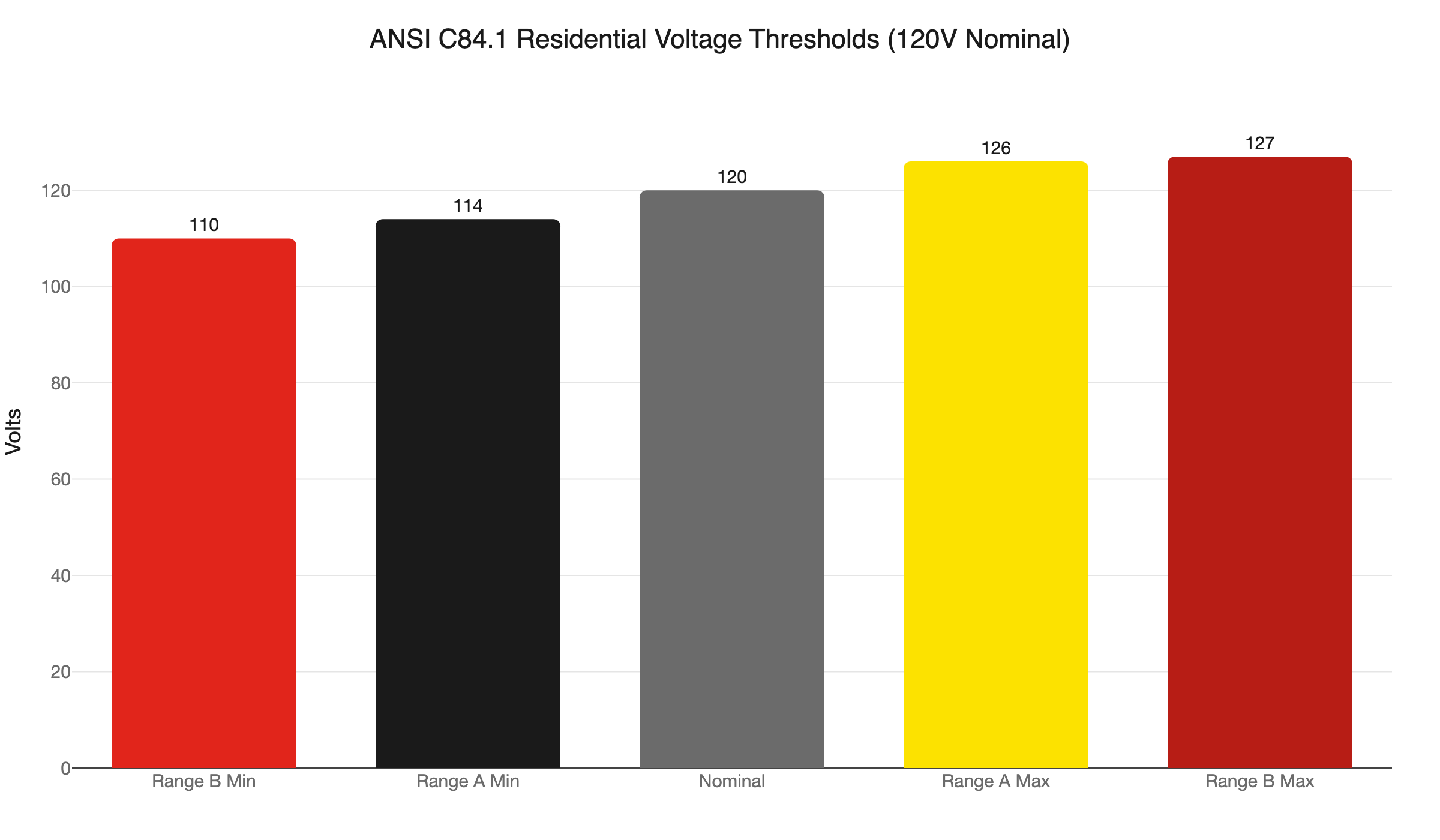
Your home’s voltage should stay between 114V and 126V under normal conditions. This is ANSI C84.1 Range A, the preferred operating range for a standard residential system. It represents plus or minus 5% of the 120V nominal.
There is a secondary standard called Range B, which runs from approximately 110V to 127V. Service within Range B is technically acceptable under the standard. However, it is classified as a condition requiring corrective action. Chronic voltage below 110V is a problem that someone needs to address, either your electrician for an in-home cause or Xcel for a utility-side cause.
The NEC also sets limits on voltage drop in the wiring itself. Branch circuits are limited to a 3% drop. The combined feeder plus branch circuit drop must stay at or below 5%. These limits exist because wire has resistance and resistance drops voltage. A long run to a workshop or a detached garage needs properly sized wire. Otherwise, you will have chronic low voltage at the far end regardless of how clean the panel voltage looks.
You can check your own voltage with a basic outlet tester that displays a voltage readout. These are available at hardware stores for around $20. Take readings at different times of day. Take them while large appliances run. If you consistently read below 114V, you have a documented sag worth a professional diagnosis.
Why Are Modern Devices Making Harmonic Problems Worse?
Budget LED bulbs and variable-speed motors are now the leading harmonic source in residential buildings. This is one of the most underappreciated home power quality problems. Voltage sags and harmonics rarely come up in the same conversation, but they often coexist.
A harmonic is a frequency that is a whole-number multiple of 60 Hz. The 2nd harmonic is 120 Hz, the 3rd is 180 Hz, and so on. Devices that draw current in pulses rather than a smooth sine wave produce these extra frequencies. They are called non-linear loads.
IEEE 519 sets a voltage THD limit of 8% for systems at or below 1.0 kV, which covers all residential wiring. Budget LED drivers with no active power factor correction can produce current THD of 50-100% on their own. Replacing every fluorescent fixture in a home with inexpensive LED panels can dramatically increase harmonic noise on the neutral conductor. Many homeowners have done exactly this and unknowingly created a harmonic problem in the process.
The 3rd, 9th, and 15th harmonics (called triplen harmonics) are the most damaging at home. In a balanced three-phase system, these harmonics cancel in the neutral. In a single-phase home loaded with non-linear devices, they add together instead. According to Influx Electric’s power quality analysis, neutral current in a heavily loaded home can theoretically be much higher than the phase current. A neutral running at that level will run hot. That is a fire hazard, and it typically has no dedicated warning sign until something fails or trips.
Common residential non-linear load sources beyond low-cost LEDs:
- Variable-speed HVAC motors and minisplits
- EV chargers during active charging
- Smart home hubs and devices
- Computer and laptop power supplies
If your home has several of these, watch for signs of harmonic trouble. Nuisance AFCI trips, warm outlet covers, and a neutral wire that feels warm anywhere accessible are all indicators worth reporting to an electrician.
What Should You Do When the Problem Is in Your Home?
Call a licensed electrician and do not open the panel yourself. A power quality analyzer confirms whether you have a voltage issue, a harmonic issue, or both. The correct fix depends entirely on the diagnosis.
Common in-home fixes:
- Dedicated circuits for large appliances. If a refrigerator or HVAC unit shares a circuit with other loads, a dedicated circuit reduces sag severity when the motor starts. Our post on dedicated circuits for major appliances covers what typically qualifies and what the process looks like.
- Panel upgrade. A fully loaded 100-amp service has no headroom. Upgrading to 200 amps gives large motor startups room to draw current without pulling down the rest of the house.
- Wire sizing corrections. If voltage drop is high on a long run, re-running with a heavier gauge wire solves the problem at its source. This is a permanent fix, not a workaround.
- Whole-home surge protection. A surge protector at the panel level will not fix a sag. But it protects your equipment from the voltage spikes that often accompany sags and from utility switching transients. Our guide to whole-home surge protection covers how panel-level protection differs from plug-in strips and why the distinction matters.
- Harmonic mitigation. For severe harmonic problems, a licensed electrician can install mitigation at the panel or at individual problem loads.
If you are seeing flickering throughout the entire home and have ruled out in-home causes, our post on what to expect when rewiring a house covers what the process looks like if aging wiring is part of the picture.
When Should You Call Xcel, and How Do You Escalate?
If a sag correlates with neighborhood-wide events and does not tie to any in-home load, contact Xcel first. Utility-side disturbances are real. Most fault-induced sags originate from single-line-to-ground faults on the distribution network, which are Xcel’s responsibility to fix.
Steps to follow:
- Document the events. Note the date, time, duration, and what was happening. Footage from a security camera or a log from a smart home device helps establish a pattern.
- Call Xcel and open a power quality complaint. Ask specifically for a voltage quality investigation, not just an outage report. That distinction matters internally at the utility.
- If Xcel does not resolve it, escalate to the Minnesota Public Utilities Commission Consumer Affairs Office: 651-296-0406, 800-657-3782, or consumer.puc@state.mn.us. Xcel operates under a Quality of Service Plan, and the PUC has authority to require corrective action.
- If equipment was damaged by a power disturbance, contact Xcel Claims Services at 401 Nicollet Mall, Minneapolis, MN to file a claim.
A written power quality report from a licensed electrician strengthens your case considerably. It documents the measurements, the timestamps, and a professional assessment of cause. That gives you standing when dealing with Xcel or the PUC, rather than a verbal report they can dismiss.
Did a Lightning Strike Knock Out Power to Part of Your Home?
When one side of the house loses power and the other keeps running, that is almost always a lost leg, not lightning damage. Your 240V residential service has two hot legs coming in from the utility. If one leg is lost at the transformer or at the weatherhead, every 120V circuit on that leg goes dead. The 240V appliances that use both legs also stop working. The other leg keeps running normally.
Lightning can also cause sudden voltage spikes that damage appliances and electronics without tripping breakers. If you had a nearby strike and are now seeing equipment failures or breakers that will not reset, call an electrician before assuming everything is fine. Damage may not be immediately visible, and some failures show up days later.
A whole-home surge protector at the panel is the most effective defense against both utility switching transients and nearby lightning. For a look at installation cost and options in the Twin Cities, see our guide to whole-house surge protector installation in Minnesota.
Get a Clear Answer From a Local Electrician
Home power quality problems and voltage sags are diagnosable. You do not have to guess whether the problem is yours or Xcel’s. You do not have to live with flickering lights, equipment that runs hot, or appliances that fail ahead of schedule.
We are locally owned and operated here in the Twin Cities, backed by the nationally recognized standards of America’s On-Time Electrician(R). Our team can run a power quality analysis, identify whether the cause is upstream or downstream of your meter, and lay out a clear repair plan.
Call us at 763-200-5956 or book online to schedule a power quality assessment. Same-day and next-day appointments are available across Minneapolis, St. Paul, Bloomington, Maple Grove, Woodbury, and the surrounding metro. Every job is backed by the UWIN(R) 100% satisfaction guarantee.
Frequently Asked Questions
Can voltage sags damage my appliances? +
Does Xcel Energy have to fix power quality issues on my street? +
What is total harmonic distortion and why does it matter at home? +
Need an electrician now?