
Dedicated Circuit for Appliances: What You Need to Know
Key Takeaways
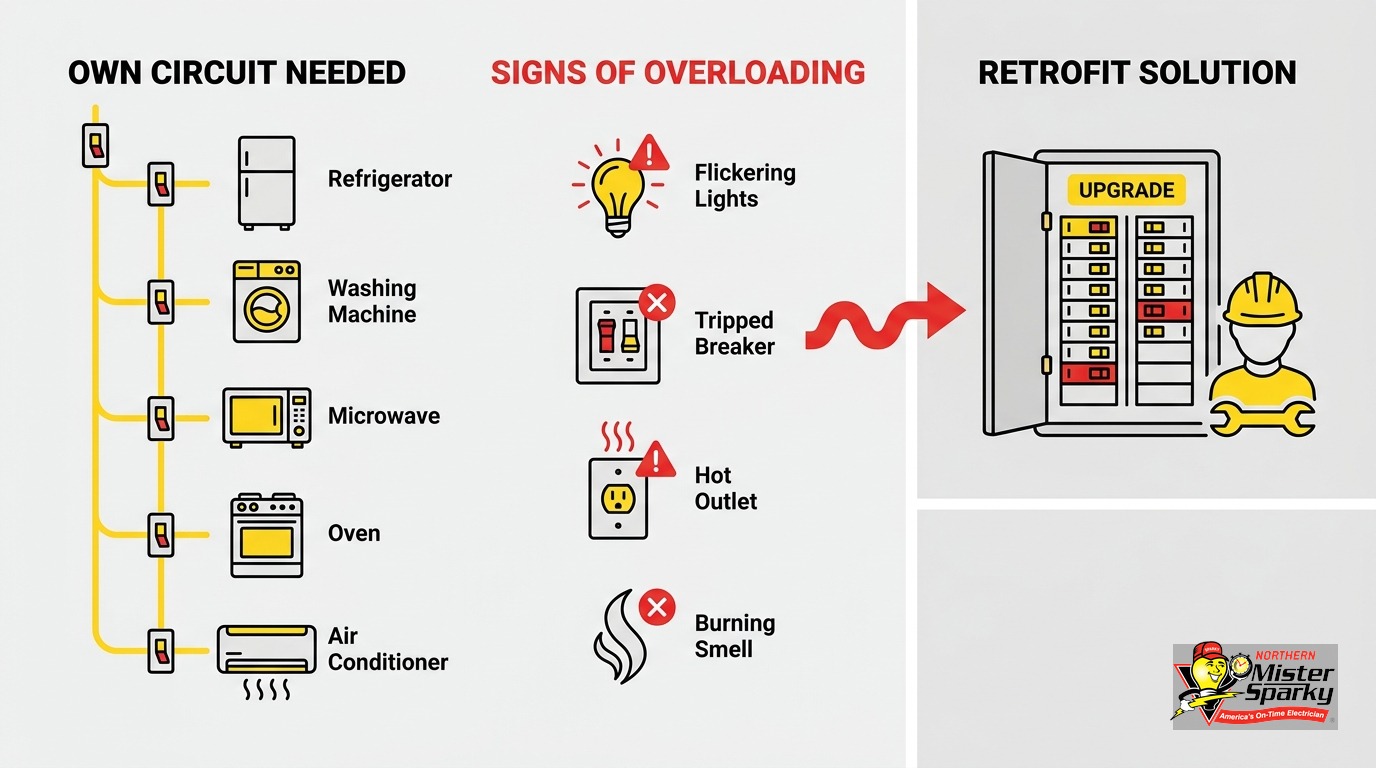
- A dedicated circuit for appliances serves one appliance only, running straight from the panel to a single outlet or hardwired connection
- NEC code mandates dedicated circuits for central heating, AC, electric water heaters, EV chargers, ranges, dryers, dishwashers, and more
- The 2023 NEC, adopted by Minnesota on July 1, 2023, adds GFCI requirements for dishwashers, ranges, wall ovens, and microwaves on new and retrofit circuits
- Seven warning signs point to overloaded circuits before damage or fire occurs
- A full panel is not a dead end: subpanels, upgrades, and tandem breakers are all paths forward
- Minnesota requires a permit before work starts and two inspections after
- Xcel Energy rebates cover up to $500 for EV charger wiring and up to $1,500 for a panel amperage upgrade
What Is a Dedicated Circuit for Appliances?
A dedicated circuit serves one appliance only. It runs directly from the breaker panel to a single outlet or hardwired connection. No other devices share it. For large or continuously running appliances, this is a code requirement, not an optional upgrade.
Most household circuits are shared. Your living room outlets, bedroom lights, and hallway receptacles each share a 15A or 20A branch circuit with other loads. That arrangement works fine for lamps and phone chargers. It does not work for a 240V electric dryer pulling 24 continuous amps.
When a high-draw appliance shares a circuit, two problems follow. First, breakers trip repeatedly as combined load exceeds the rated limit. Second, the wiring heats up. Repeated overloading degrades wire insulation over months and years. NFPA data from 2019-2023 shows electrical distribution fires average 31,650 per year nationally. They cause 430 deaths, 1,300 injuries, and $1.6 billion in direct property damage annually. Overloaded circuits are a leading contributing factor, especially in homes wired before modern appliance loads existed.
A dedicated circuit for appliances removes that risk for every high-draw load in your home.
Which Appliances Require Their Own Circuit Under NEC Code?
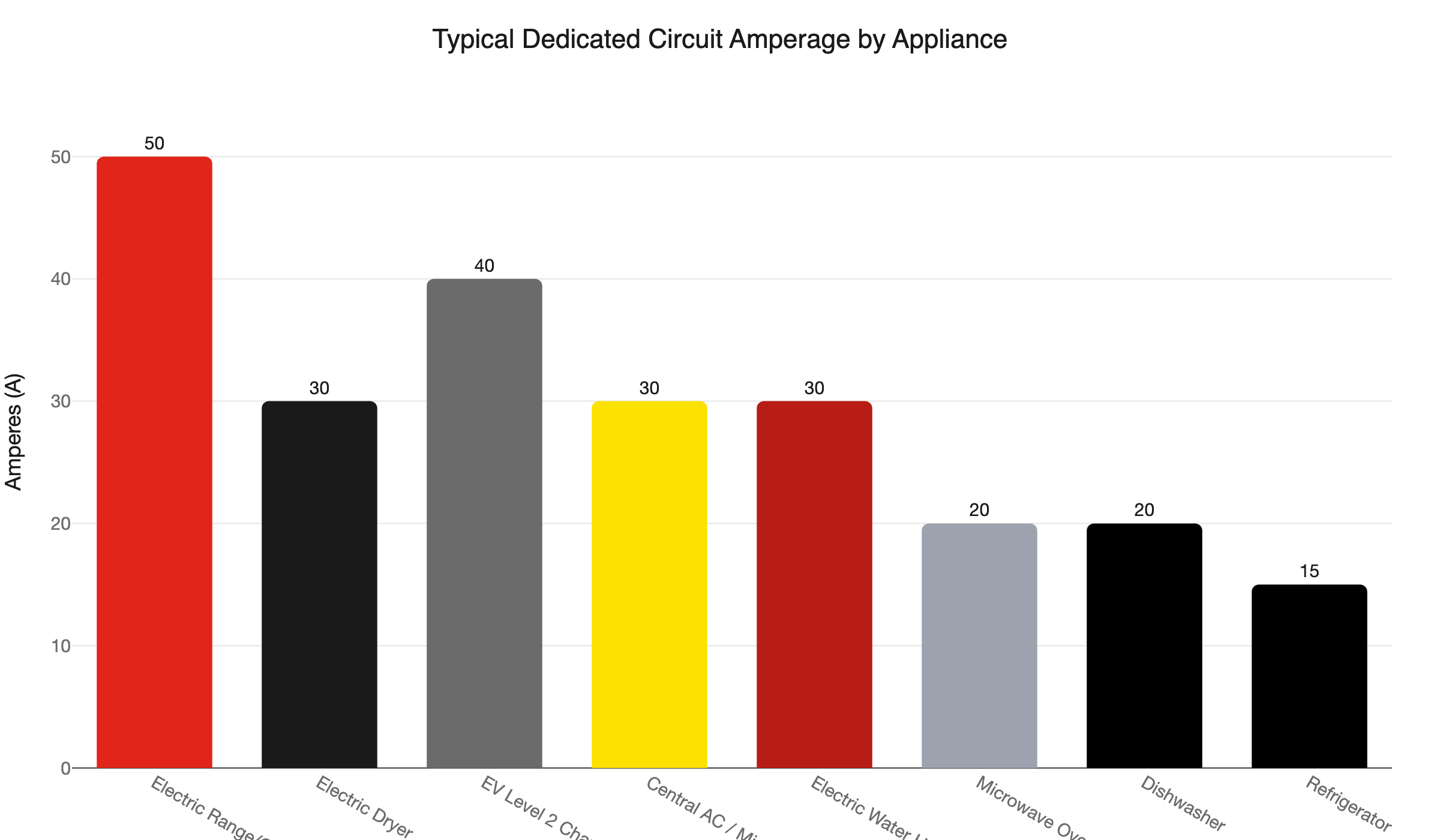
Short answer: The NEC mandates dedicated circuits for central heating, AC, mini-splits, electric water heaters, and EV chargers. Electric ranges, dryers, dishwashers, refrigerators, and microwaves also require dedicated circuits under the 2023 NEC. Minnesota has followed the 2023 NEC since July 1, 2023. That edition added new GFCI requirements for cooking appliances and dishwashers on all new and retrofit circuits.
Here is the breakdown by appliance and the code section that drives the requirement:
Central heating equipment NEC 422.12 mandates an individual branch circuit for all central heating equipment. No exceptions. Electric furnaces, heat pumps used for heating, and electric boilers must each have their own circuit.
Central AC and mini-splits NEC Article 440 effectively requires a dedicated circuit for central AC and mini-split systems. Shared circuits cause voltage drops that damage compressors and control boards. Repair costs on that damage often run higher than a dedicated circuit installation.
Electric water heaters NEC 422.13 classifies electric water heaters as continuous loads. Combined with NEC 210.20(A), which requires overcurrent protection rated at 125% of continuous load, a water heater in practice needs a dedicated 30A circuit.
Electric ranges and wall ovens A standard electric range draws 30-50A at 240V. That load alone maxes or exceeds a typical shared circuit. A dedicated 30-50A/240V circuit is required.
Electric dryers A dedicated 30A/240V circuit is the code standard. Sharing a dryer circuit with any other load is a code violation and a fire risk.
Dishwashers 2023 NEC 210.8(D) added a GFCI protection requirement for dishwashers, ranges, wall ovens, microwave ovens, and counter-mounted cooking units. This is new. Any permit filed in Minnesota after July 1, 2023 must meet it. Dishwashers need a dedicated 20A/120V circuit with GFCI protection.
Refrigerators Refrigerators cycle on and off all day. Each startup sends a brief current spike through the circuit. A dedicated 15-20A circuit prevents those spikes from tripping shared breakers or affecting other devices on the same line.
Microwave ovens A built-in or countertop microwave drawing 1,200 watts or more needs a dedicated 20A/120V circuit. Under 2023 NEC 210.8(D), new installations also require GFCI protection.
EV Level 2 chargers The NEC requires EVSE on its own individual branch circuit - no shared outlets. A Level 2 charger needs a 32-50A/240V dedicated circuit. Our full guide to EV charger installation in the Twin Cities covers everything from panel assessment through permit and final inspection.
What about kitchen counter outlets? NEC 210.11(C)(1) requires at least two 20A/120V small-appliance branch circuits for kitchen countertop receptacles. These are shared circuits by design. A coffee maker and a toaster running on one is fine. A built-in microwave or a high-draw countertop appliance running on one all day is not.
Seven Signs Your Circuits Are Already Overloaded
If your home shows any of these symptoms, you may have appliances running without adequate dedicated circuits - or shared circuits stretched past their design load.
-
Breakers trip repeatedly. A breaker that trips when the microwave and toaster run at the same time is telling you the circuit is undersized. Read more about why circuit breakers keep tripping.
-
Lights dim when an appliance starts. That momentary voltage sag happens when a large motor (refrigerator compressor, AC unit) pulls a startup current surge on a shared circuit.
-
Outlets feel warm or discolored. Heat at a receptacle means resistance in the wiring or connections. Stop using that outlet and call an electrician.
-
You smell something burning near an outlet or the panel. Burning plastic or a warm metallic smell near wiring is a fire risk. Shut off the circuit at the breaker and call immediately.
-
Appliance performance drops over time. A dryer that takes two cycles to finish a load may be voltage-starved. A shared circuit cannot deliver steady voltage under continuous current draw.
-
Your panel has double-tapped breakers. Two wires sharing one breaker terminal is a code violation and a clear sign the panel ran out of space.
-
Your home was built before 1990 and still has the original wiring. Pre-1990 homes were not designed for today’s kitchens, laundry rooms, and garages. If you have added appliances without adding circuits, you are almost certainly overloaded somewhere.
Our team handles overloaded circuit repairs across the Twin Cities. Check two or more of these boxes and a panel assessment is the right next step.
How to Add a Dedicated Circuit for Appliances When Your Panel Is Full
Short answer: A full panel - no open breaker slots - does not block you from adding dedicated circuits. Options include a subpanel fed from the main panel, a full panel amperage upgrade, or tandem breakers where the panel supports them. The right path depends on your panel’s make, age, and current load.
This is the question the generic articles skip. You read that a new EV charger needs a 50A/240V dedicated circuit. You open your panel. Every slot is taken. Now what?
Option 1: Add a subpanel A subpanel is a secondary breaker box fed from the main panel via a double-pole breaker and feeder cable. It gives you four to twelve new circuit slots. This is common for garages (EV charger plus workbench outlets plus lighting) and finished basements. Installed cost typically runs $500-$1,500, depending on feeder amperage and the distance of the run.
Option 2: Upgrade the main panel If your panel is 100A and you are adding an EV charger, a mini-split, and an electric range, a 200A panel upgrade may be the right answer. A 200A panel gives you room for today’s loads and headroom for tomorrow’s. It also makes you eligible for a Xcel Energy rebate of up to $1,500 - but only when you increase the amperage rating. A like-for-like panel swap does not qualify.
For a full checklist on when a panel upgrade makes sense, see signs you need an electrical panel upgrade.
Option 3: Tandem breakers Some panels accept tandem (slimline) breakers that place two circuits in one slot. Not all panels support them. Even panels that do typically limit which slots can accept tandems - check the label inside your panel door for the approved layout. Tandem breakers only work for 120V circuits. They cannot handle the 240V loads that EV chargers, dryers, and ranges require. They are a partial fix, not a complete solution for a heavily loaded panel.
The right answer depends on your specific panel. Our team assesses panels across the Twin Cities and gives you a straight recommendation. Call 763-200-5956 or book a panel assessment online.
Does Minnesota Require a Permit for a Dedicated Circuit for Appliances?
Short answer: Yes. A permit is required before any electrical work starts in Minnesota. File with the state DLI or your local city, depending on jurisdiction. A rough-in inspection happens before the walls close, and a final inspection wraps up the job. A licensed electrician handles permitting as part of the project.
Minnesota’s electrical code lives in Chapter 1315 of the State Building Code. The Minnesota Board of Electricity adopted the 2023 NEC effective July 1, 2023. Any permit filed on or after that date must comply with the 2023 NEC - including the GFCI requirements for cooking appliances and dishwashers.
Minnesota law generally requires all electrical work to be performed by a licensed, bonded, and insured contractor. Homeowners may do their own electrical work only on property they own and have homesteaded. Rentals, condos, and units occupied by others are off-limits for DIY electrical.
The permit process has three steps:
-
File the permit before work begins. You file with the state DLI or your local city building department. Saint Paul uses a “Circuits and Service” permit category that covers dedicated circuit additions and panel upgrades.
-
Rough-in inspection. After wiring is run but before walls close, an inspector checks wire gauge, box fill, breaker sizing, and grounding.
-
Final inspection. After covers and connections are complete, the inspector verifies the finished installation.
Northern Mister Sparky handles permitting and schedules both inspections for every job we do. You do not navigate the DLI portal or track inspection windows yourself.
One timing note: MN DLI published a 2026 NEC FAQ on July 6, 2026, signaling the next code adoption cycle is already in motion. If you are planning a panel upgrade or a major electrification project, scheduling now means your permit files under the 2023 NEC - which our team knows cold.
What Xcel Energy Rebates Apply to This Work?
Short answer: Xcel Energy offers up to $500 for Level 2 EV charger wiring and up to $1,500 for a panel amperage upgrade. Income-qualified customers can receive up to $1,200 for EV charger wiring. You must use a licensed electrician and submit permit approval with your invoice to claim either rebate.
If you are an Xcel Energy customer in the Twin Cities, two rebates apply. Both can meaningfully offset the cost of adding dedicated circuits or upgrading your panel.
EV charger wiring rebate Xcel offers up to $500 for Level 2 EV charger installation. Income-qualified households at or below 80% of area median income can receive up to $1,200. A dedicated 240V circuit is required to qualify. Our EV charger installation service covers everything from panel assessment through permit and inspection.
Panel upgrade rebate Xcel offers up to $1,500 for a panel upgrade when the project increases your panel’s amperage rating - for example, from 100A to 200A. A like-for-like swap does not qualify. Submit your permit approval and invoice to claim.
EV off-peak rate and bill credit Xcel EV customers can add a separate EV meter to charge at off-peak rates nights and weekends. That earns a $50 annual bill credit on top of lower overnight charging costs.
Add an EV charger and upgrade from 100A to 200A in the same project. Xcel rebates could put up to $2,000 back toward total project cost. We walk through which rebates apply to your situation before work starts. No surprises.
What Does Adding a Dedicated Circuit Cost in Minnesota?
Short answer: A single 120V dedicated circuit typically runs $150-$400 installed. A 240V circuit for a dryer, range, or EV charger runs $300-$600. A subpanel adds $500-$1,500. A full 200A panel upgrade runs $1,800-$4,000. Xcel rebates of up to $1,500 apply to qualifying panel upgrades.
Cost depends on circuit type, panel condition, and how far the wire has to run. General Twin Cities ranges:
- Single 120V dedicated circuit (refrigerator, microwave, dishwasher): $150-$400 installed
- Single 240V dedicated circuit (dryer, range, EV charger): $300-$600 installed
- Subpanel addition (4-12 new slots): $500-$1,500 depending on amperage and feeder distance
- Full 200A panel upgrade: $1,800-$4,000 depending on panel, service entrance, and local permit fees
These are real-world ranges for the Twin Cities market. They are not guaranteed quotes. Every home runs different wire, has a different panel, and presents different access conditions.
Get an exact number before any work starts. Northern Mister Sparky is locally owned and operated in the Twin Cities. Our electricians are licensed, bonded, and insured. As America’s On-Time Electrician(R), we arrive on time and give you a clear price upfront. Every job is backed by the UWIN(R) 100% satisfaction guarantee.
Call 763-200-5956 or schedule an appointment online to get a dedicated circuit assessment and quote for your home.
Frequently Asked Questions
Which appliances require a dedicated circuit? +
Do I need a permit to add a dedicated circuit in Minnesota? +
What Xcel Energy rebates are available for electrical upgrades? +
What should I do if my panel is full and I need a new dedicated circuit? +
Need an electrician now?