
Electric Tankless Water Heater Wiring Requirements
Key Takeaways
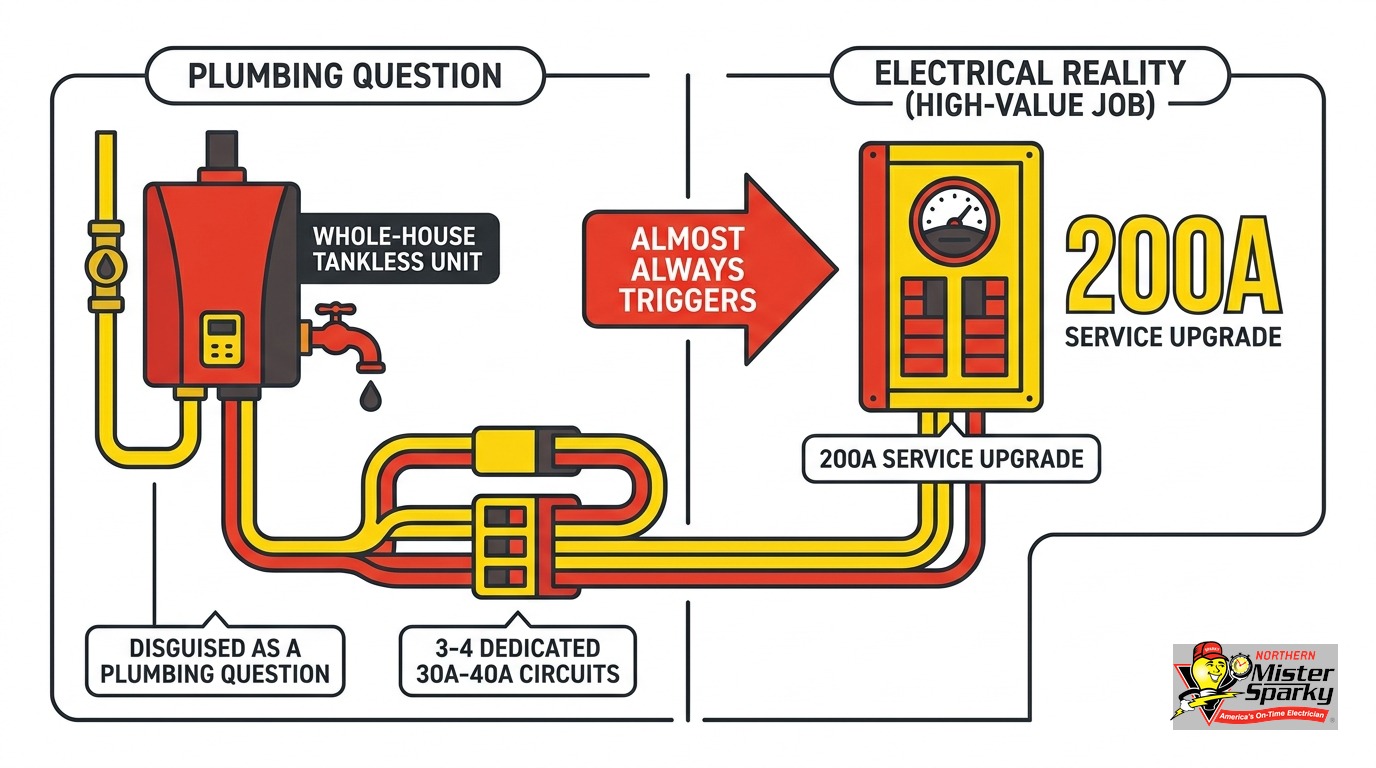
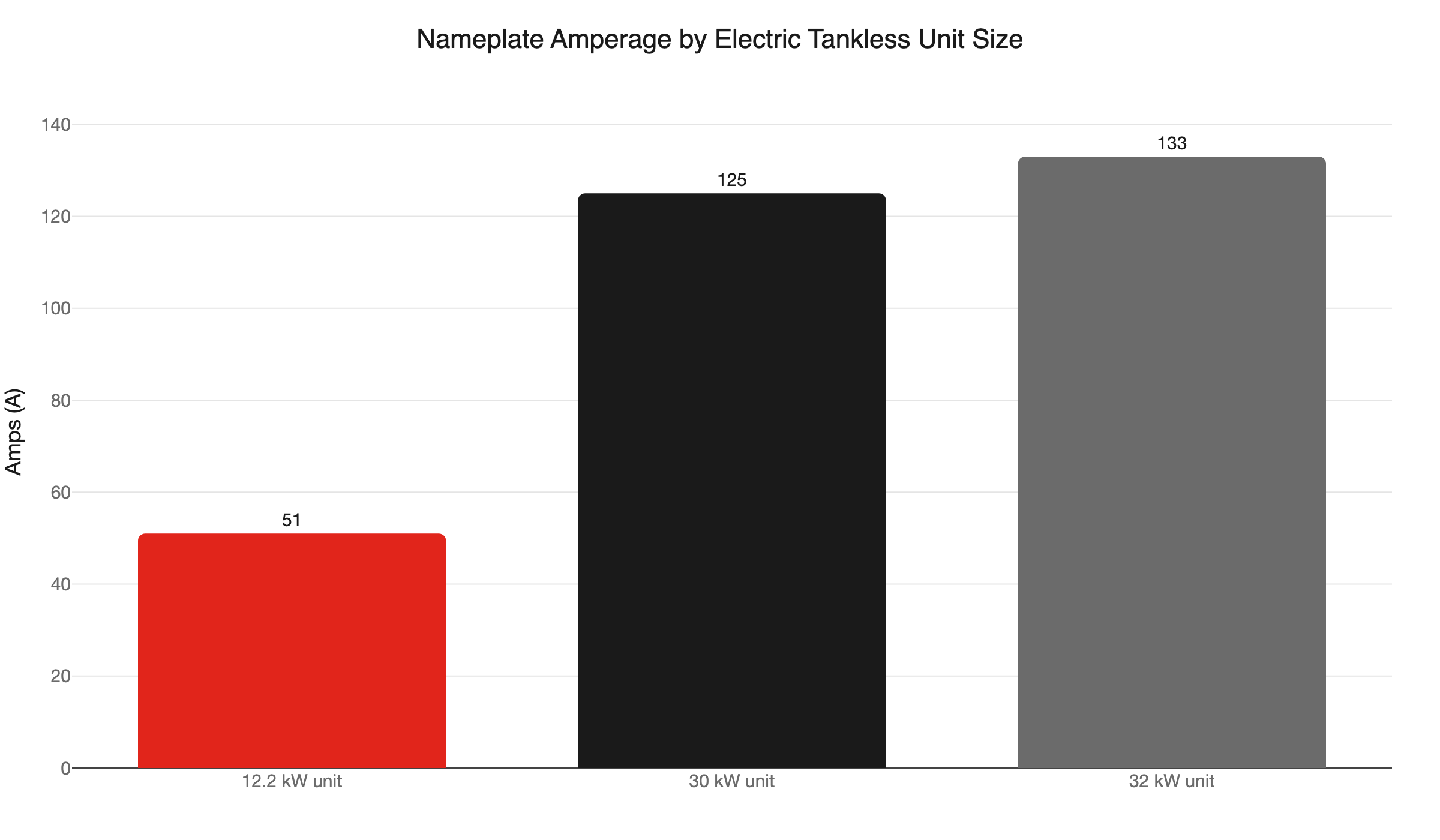
- Electric tankless water heater wiring requirements go far beyond a simple circuit swap. A whole-house unit draws 51-133 amps - far above any standard appliance circuit.
- Most installations require two to four dedicated 240-volt circuits, each protected by its own double-pole breaker.
- Minnesota’s cold groundwater (40-48 degrees Fahrenheit in winter) pushes most Twin Cities installs toward the 24-32 kW range. That tier almost always requires 200-amp service.
- Your old water heater circuit cannot be reused. It must be de-energized and left disconnected.
- Every new circuit, every service upgrade, and every new appliance installation requires a Minnesota DLI electrical permit.
- Two state rebate programs could offset significant cost, but neither has launched as of mid-2026.
- Call 763-200-5956 or book online before you buy the unit. A load calculation first is what keeps this project inside budget.
Understanding Electric Tankless Water Heater Wiring Requirements
Your plumber quotes the tankless unit. The price looks right. Then they mention you will also need an electrician.
Most homeowners picture a quick rewire - same location, new outlet, maybe a bigger breaker. Electric tankless water heater wiring requirements do not work that way. A whole-house unit can draw 133 amps at 240 volts. It may need two to four dedicated circuits. For most older Twin Cities homes on 100-amp service, it almost certainly means a full service panel upgrade.
The smarter sequence: call your electrician before you order the unit. A licensed electrician runs the NEC Article 220 dwelling load calculation first. That tells you exactly whether a panel upgrade is part of the job - before money is committed to a unit your panel cannot feed.
That one step is what prevents the most common and expensive mistake in a tankless conversion: a 32 kW unit sitting on your driveway while you discover the service upgrade alone costs more than the appliance.
This is a conversation we have every week with Twin Cities homeowners. Here is what that assessment covers and what drives each decision.
How Many Circuits Does an Electric Tankless Water Heater Need?
Most whole-house units require two separate 240-volt dedicated circuits, each with its own double-pole breaker. Larger multi-element units may need three or four. Single-element units may need only one 60-amp circuit. One shared circuit is almost never enough for a whole-house application.
A.O. Smith’s tankless installation guide documents this directly: larger units require two separate 240-volt circuits with double-pole breakers rated 40-70 amps each. Smaller single-element units require a single 60-amp circuit.
Each circuit must be dedicated. It shares power with nothing else. The NEC continuous-load rule under Article 210.19(A)(1) requires conductors for continuous loads to be sized at 125% of the appliance’s nameplate amperage. A load sustained for more than three hours qualifies as continuous. A water heater qualifies.
Each dedicated circuit also needs its own double-pole breaker slot in your main panel. Two to four new circuits means two to four new breaker slots - on top of whatever the panel already carries. If the panel is full or nearly so, a panel replacement or subpanel is required before any water heater circuits can be added. Our guide on what to do when your panel is out of breaker slots covers the options.
Your electrician needs the unit’s manufacturer wiring diagram before specifying the circuit count. Manufacturers document exact circuit requirements - breaker count, pole count, and amperage rating - in the installation guide. Ordering circuits without that document risks either a code violation or a unit that cannot run at rated capacity.
For scale: a refrigerator runs on a 20-amp circuit. An electric dryer uses 30 amps. A whole-house electric tankless water heater at nameplate draw is in a completely different tier. The chart above illustrates how quickly amperage climbs with unit size.
Does Going Tankless Trigger an Electrical Panel Upgrade?
Not automatically - but it is common, especially for older homes. For a Twin Cities home with 100-amp service, adding a whole-house electric tankless unit almost always pushes total load beyond what the panel can carry. A licensed electrician must run the NEC Article 220 total dwelling load calculation before any installation can proceed.
That calculation adds up every load in the house - HVAC, lighting, appliances, the new water heater - and compares the total against the service capacity. It is required by code. It is not optional paperwork.
Here is the math on a 30 kW unit. The NEC continuous-load rule under Article 210.19(A)(1) specifies: nameplate amps multiplied by 1.25 equals the minimum conductor ampacity and overcurrent protection rating. At 30 kW: 30,000 divided by 240 equals 125 amps. Multiply by 1.25 and you need conductors and a breaker rated for 156 amps, rounded up to a standard 175-amp breaker.
A 100-amp service panel cannot absorb that load alongside an existing HVAC system, an electric range, and a dryer. The math does not work.
The NEC Article 220 calculation also catches edge cases. A home heating with an electric furnace, running an electric range, and adding a 32 kW water heater may require a 400-amp service in rare scenarios. The load calc surfaces those situations before the project is underway.
A service upgrade to 200 amps is a well-defined job. It covers the panel itself, the meter base, and the service entrance conductors. The utility must briefly de-energize the service at the transformer during the upgrade. Our crew coordinates that outage with your utility as part of the job. Our breakdown of 100-amp vs. 200-amp electrical service explains what separates the two and what the upgrade scope actually looks like.
What Do Electric Tankless Water Heater Wiring Requirements Say About Wire Gauge?
Wire gauge is determined by circuit amperage and run length. For 40-amp circuits, the minimum is #8 AWG copper. For 50-60 amp circuits, use #6 AWG copper. Longer wire runs need to step up one gauge to control voltage drop. The breaker must match the circuit rating. These are code minimums, not suggestions.
AFM Plumbing Heating’s practical electrical requirements guide documents the standard sizing:
- 40-amp circuit: #8 AWG copper minimum
- 50-60 amp circuit: #6 AWG copper minimum
- Longer runs beyond roughly 50 feet: step up one gauge size
Your existing water heater circuit is almost certainly 10 AWG on a 30-amp breaker. It was built for a tank heater drawing fewer than 20 amps under sustained load. Running a 125-amp tankless unit through that wire would cause the conductors to overheat long before the undersized breaker trips. The result is a fire, not a tripped breaker.
Voltage drop is the second concern. Tankless units are sensitive to low voltage. An undersized wire on a long run causes voltage to sag under load. The unit cannot reach target temperature. On a Minnesota January morning with 40-degree groundwater coming in, cold showers are the immediate consequence and premature unit failure is the long-term one.
Every wire run we install for a tankless conversion is sized to the unit’s nameplate amperage, multiplied by 1.25, adjusted for the actual run length to the unit location. No rounding down.
Why Does Minnesota’s Cold Climate Change the Sizing Math?
Cold groundwater forces larger unit selections. Twin Cities groundwater runs 40-48 degrees Fahrenheit in winter. Raising it to 120 degrees requires up to an 80-degree temperature rise - far more than warmer states need. Most Minnesota whole-house installs land in the 24-32 kW tier, which nearly always requires multiple circuits and 200-amp service.
Tankless water heaters are rated in kilowatts. The kilowatt rating determines how much temperature rise the unit delivers at a given flow rate. A unit sized for Georgia’s 65-degree groundwater handles a 55-degree rise. Minnesota in January requires 80 degrees of rise from incoming water.
A 12.2 kW unit may serve a single-bathroom application in a warm-climate state. In a Minnesota household of four in February, it will not keep pace.
That reality pushes most Twin Cities whole-house installs to the 24-32 kW range. At 32 kW, the unit draws 133 amps at 240 volts. Apply the NEC 1.25 multiplier and you are sizing for 166 amps of conductor capacity. A 100-amp service panel cannot support that before accounting for any other load in the home.
The consequence of undersizing is not just poor performance. A tankless unit running at the edge of its limits trips on high-limit protection and shuts down. The homeowner calls the plumber. The plumber says the unit is fine. The electrician finds the voltage is sagging because the wire gauge is undersized for the run length. This happens when out-of-state installation specs meet Minnesota winters. Sizing for Minnesota groundwater in January is not optional. It is the job.
National installation guides often spec smaller units appropriate for the median American climate. Minnesota is not that median. Your electrician should be part of the unit-selection conversation before the order is placed.
Does Minnesota Require a Permit for Electric Tankless Water Heater Wiring?
Yes. Every new circuit, service upgrade, and appliance installation requires a permit from the Minnesota Department of Labor and Industry (DLI). The DLI issues all residential electrical permits statewide - local municipalities do not. The work must be completed by a licensed electrician and inspected before the installation is energized.
Minnesota routes all residential electrical permits through the state, not through city building departments. Whether your home is in Minneapolis, Woodbury, Blaine, or Plymouth, your electrical permit comes from DLI.
We file the permit application as part of every installation. You do not navigate that process yourself.
Skipping the permit is not a calculated risk worth taking. An unpermitted electrical install can void your homeowner’s insurance if the system causes damage. It flags on a pre-sale inspection. And if an undersized wire causes a fire, personal liability falls on a homeowner whose install was never inspected.
Our full guide on electrical permits in Minnesota explains what the permit covers, what the DLI inspection reviews, and the typical timeline for a tankless wiring project from application to sign-off.
Are There Rebates for Tankless Wiring and Panel Upgrades in Minnesota?
Two Minnesota programs could significantly offset the cost - but neither has launched as of mid-2026. When they do launch, income-eligible households may receive up to $4,000 for a panel upgrade and $2,500 for electrical wiring. Both require income verification. Watch the Minnesota Commerce Department program pages for launch announcements.
Minnesota HEAR Program (Save Energy Minnesota)
The HEAR program channels federal Inflation Reduction Act dollars through the state. When it launches, eligible households can receive:
- Up to $1,750 for a heat pump water heater (this applies to heat pump models specifically, not standard electric resistance tankless units)
- Up to $4,000 for an electrical panel upgrade
- Up to $2,500 for electrical wiring
Eligibility requires household income at or below 150% of area median income (AMI). The panel and wiring rebates require a qualifying appliance installation in the same project.
The program has not launched as of June 12, 2026. The U.S. Department of Energy issued new rules that changed how states must implement the rebates. Minnesota Commerce is still working through the required program changes. No launch date has been announced.
Residential Electrical Panel Upgrade Grant
The Panel Upgrade Grant is a separate program authorized under Minnesota Statutes Section 216C.45. It offers:
- Up to $3,000 for households below 80% of area median income
- Up to $2,000 for households between 80-150% of AMI
This program is also not yet launched.
Our advice: do not delay your project waiting for these programs. The work needs to be done correctly regardless of rebate status. When a program launches, homeowners may be eligible for retroactive credit on qualifying work - but that depends on the final program rules. We document the full scope of every eligible install so you are ready when that window opens.
Can You Reuse the Old Water Heater Circuit for a Tankless Unit?
No. The existing circuit is typically 30 amps on 10 AWG copper, sized for a tank heater’s low sustained draw. A whole-house electric tankless unit requires conductors rated at 150 amps or more - or multiple large dedicated circuits. Reusing the old circuit is not a starting point. It is a fire waiting to happen.
ExpertCE’s analysis of branch circuit sizing for electric tankless water heaters is direct on this point: whole-house units require 2/0 AWG or larger conductors with 150-200 amp overcurrent protection - or multiple properly sized dedicated circuits. The 30-amp, 10 AWG run that served your tank heater has no role in that equation.
The old circuit stays de-energized at the panel. New dedicated circuits - properly sized, permitted, and inspected - are the only safe path. No exceptions.
What Does Our Installation Process Look Like?
When you call before buying the unit, here is how the job unfolds.
Assessment and load calculation. A licensed electrician visits the home, reviews the panel, and runs the NEC Article 220 dwelling load calculation. This step determines whether a panel upgrade is part of the scope. No guessing. No budget surprises after the unit is on order.
Written quote with full scope. We document the number of new circuits required, the wire gauge and run plan for each, and whether your service needs to go from 100 to 200 amps. You approve the scope before any work begins.
Permit filed before the first wire is pulled. We handle the DLI permit application. Work does not start until the permit is active.
Panel upgrade, if required. If your service is 100 amps, we upgrade to 200 amps, install the new panel, and reserve the correct number of breaker slots for the new water heater circuits. Our panel upgrade service covers everything that job involves.
Dedicated circuits run. Each circuit gets its own properly sized wire from the panel to the unit location. Wire gauge, run length, and breaker rating are matched to your specific unit’s wiring diagram. No shared circuits. No reused undersized wiring.
DLI inspection and sign-off. We schedule the DLI inspection. The installation is energized only after the inspector approves. No malarky.
Rebate documentation on file. When the HEAR program or the Panel Upgrade Grant launches, we provide records of eligible work completed. Retroactive eligibility depends on final program rules, but we keep the paperwork ready.
We are a locally owned Twin Cities operation. As America’s On-Time Electrician(R), we show up when we say we will. The UWIN(R) 100% satisfaction guarantee backs every job. And because we work in Minnesota every day - not as a national call center dispatching crews from across state lines - we know the DLI permit system, cold-climate sizing requirements, and the load calculations that protect Twin Cities homeowners from undersized installs.
The unit purchase is the point of no return. Once a 32 kW unit is on your driveway, you are committed to whatever electrical scope it requires - whether or not you knew the full picture going in. Calling us first costs nothing and saves you from that situation.
Call 763-200-5956 or book online to start with the load calculation. That single step - before the unit is ordered - is what keeps this project inside budget and inside code.
Frequently Asked Questions
Can I reuse my old water heater circuit for an electric tankless unit? +
Does switching to an electric tankless water heater require a panel upgrade? +
What permits are required for electric tankless water heater wiring in Minnesota? +
Need an electrician now?