
Heat Pump Water Heater Electrical Requirements Explained
Key Takeaways
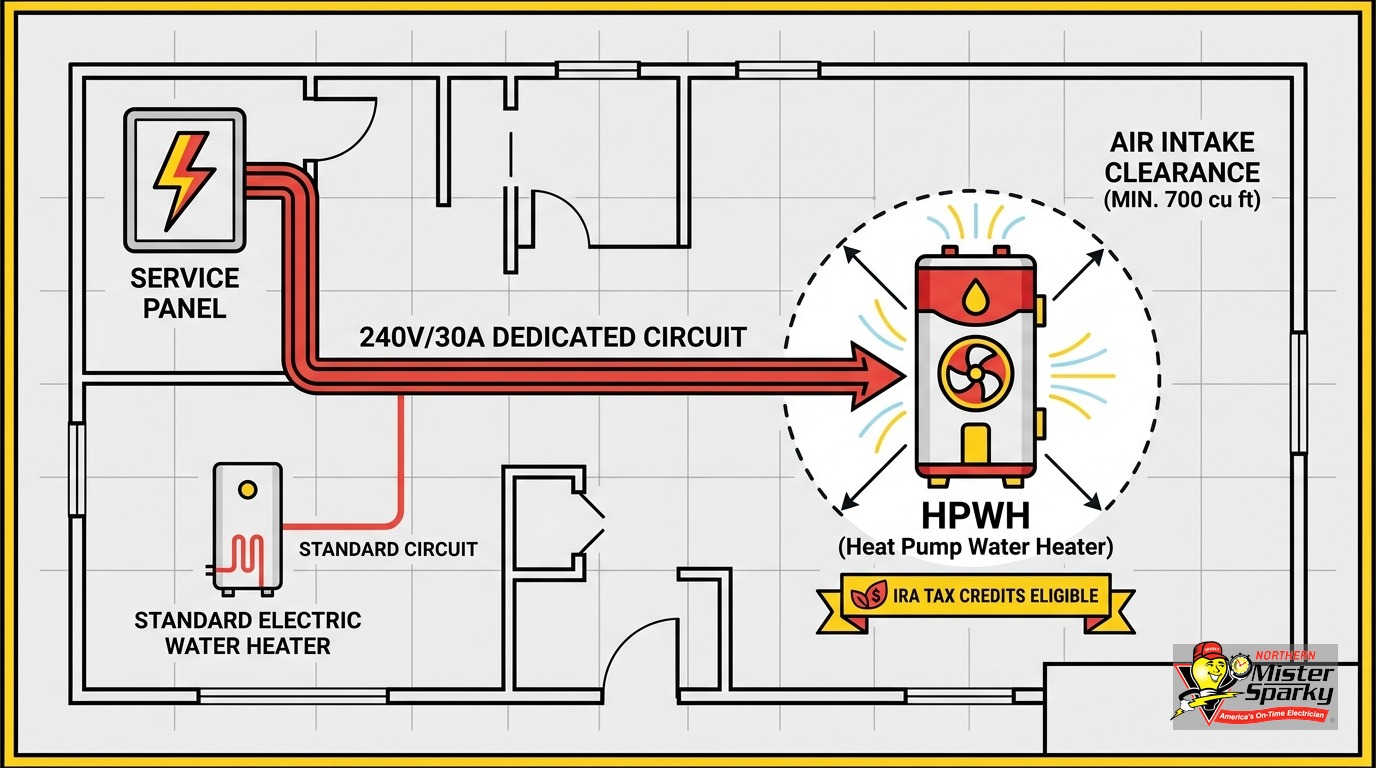
- Heat pump water heaters require a dedicated 240V/30A circuit wired with 10 AWG copper, per NEC Article 422.13.
- Many Twin Cities homes have older 20A water heater circuits. That circuit must be upgraded before an HPWH can run.
- Your panel needs an open double-pole breaker slot. A full 100A panel may need work before the water heater goes in.
- Most HPWHs require 700 to 1,000 cubic feet of surrounding air. Tight mechanical rooms often need ducting to an adjacent space.
- Minnesota adopted the 2026 NEC on August 17, 2026. Permits are non-optional, and a licensed electrician must pull them.
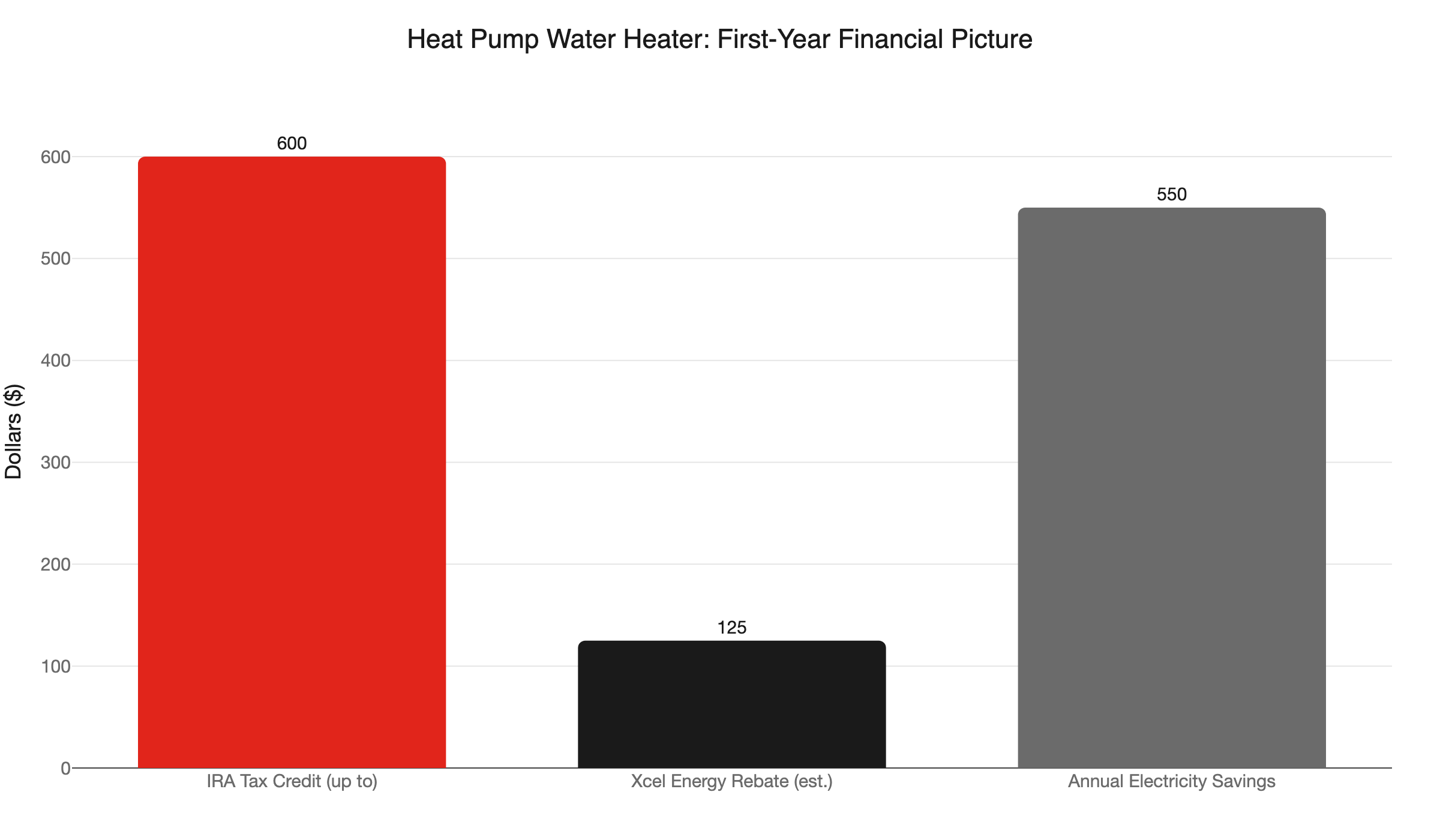
- The IRA Section 25C tax credit can cover up to $600 of costs per year. Xcel Energy offers a utility rebate on top of that.
What Are the Heat Pump Water Heater Electrical Requirements?
A dedicated 240V/30A circuit, double-pole breaker, and 10 AWG copper wire. No other appliances share the circuit. Your panel also needs an available double-pole slot before any of that is possible.
Here is the full picture. A heat pump water heater has a compressor. That compressor is what makes the unit efficient. It is also what changes the electrical math versus a standard electric model.
NEC Article 422.13 governs storage water heaters. It requires a branch circuit rated at not less than 125% of the appliance nameplate amperage. Most HPWH nameplates show a running draw of 15 to 20 amps. Apply the 125% rule: 20 amps multiplied by 1.25 equals 25 amps. The next standard breaker size up is 30 amps. That is the minimum required circuit.
Wire gauge follows the breaker. A 30A circuit requires 10 AWG copper at minimum. Using 12 AWG copper on a 30A breaker is a code violation and a fire hazard. These are not interchangeable.
The 240V supply requires two hot legs from your panel. That is why the breaker is a double-pole. A standard 120V household outlet will not work here.
How Is This Different From a Standard Electric Water Heater?
Standard electric resistance water heaters have been common in Twin Cities homes for decades. Many older homes were wired this way. 1950s and 1960s bungalows and ramblers in Minneapolis, Bloomington, and Brooklyn Park often had 20A water heater circuits. That was acceptable for units with 3,500-watt elements or smaller.
A heat pump water heater cannot run on a 20A circuit. The compressor demands more. If your current water heater runs on 20A, the electrician will run a new 30A circuit from the panel. That means new wire, a new breaker, and a permit.
If your current water heater is already on a 30A circuit with 10 AWG wire, the circuit may carry over. Your electrician will verify the wire gauge and breaker rating before confirming compatibility. For more on how standard water heater wiring works, see our electric water heater wiring guide.
What If My Panel Does Not Have Room for a New Breaker?
A full panel is a real job-stopper. If there are no open double-pole slots, you need a panel solution before the water heater circuit can go in. Common options include tandem breakers where code permits, a small subpanel, or a full service upgrade.
This is one of the most common surprises in older Twin Cities homes. A 100A panel with 20 or 24 circuit spaces sounds like plenty. Until every slot is taken. Adding an EV charger, a mini-split, or a heat pump water heater all compete for the same spaces.
The electrician’s first move is a panel inspection. If slots are available, the job stays straightforward. If not, the conversation shifts to the panel before it shifts to the water heater. A service upgrade to 200A opens up capacity. That often makes sense if an EV charger or other large loads are also in your plans.
Do not assume the slot is available. Have the panel assessed before ordering the unit. We cover the options in detail in our post on what to do when your panel is out of breaker slots.
Does the Air Volume Requirement Affect Where I Can Install a Heat Pump Water Heater?
Yes, and it catches a lot of homeowners off guard. Most manufacturers require 700 to 1,000 cubic feet of surrounding free air. A small utility closet almost certainly fails that test.
A heat pump water heater pulls heat from the surrounding air to heat your water. It needs a meaningful volume of air to draw from. Without it, the unit runs inefficiently and the compressor wears faster.
Specific minimums vary by manufacturer. Rheem’s ProTerra series requires 700 cubic feet. A.O. Smith’s HPTU series requires 1,000 cubic feet. Bradford White’s AeroTherm is also at 700 cubic feet. Verify the spec sheet for the specific model you purchase. These figures come from current installation manuals and can change between product generations.
A 700-cubic-foot room is roughly 10 feet by 10 feet with 7-foot ceilings. Many Twin Cities homes have a utility closet or mechanical room that does not come close. If the space falls short, ducting is required. Typically 7-inch diameter supply and exhaust ducts run to an adjacent room or to the exterior.
In a full basement, air volume is usually not the problem. In a tight mechanical closet or crawl space, it almost always is. Verify the clearance before the equipment is purchased, not after.
How Does Minnesota’s Climate Affect Heat Pump Water Heater Performance?
Minnesota winters are cold, but conditioned basements typically stay above the 40°F operating floor. The real tradeoff is the cool exhaust air the unit dumps back into your heated space.
Most HPWHs require ambient air above 40°F to run in heat pump mode. Below that threshold, the unit falls back to standard resistance heating. That uses more electricity and cuts into the efficiency advantage.
Minnesota’s conditioned basements typically stay above 40°F even in January. If your unit will go into an attached garage or an unconditioned crawl space, verify the winter temperature before buying. A garage in Maple Grove or Plymouth can drop below 40°F on a cold night.
The cool exhaust is the bigger practical concern for most homeowners. As the unit pulls heat from the air, it exhausts cooler, drier air back into the space. In winter, that cool exhaust adds heat load to your basement. Your furnace makes up the difference - roughly 1,000 to 2,000 BTU per day in heating season. That is real, but it is also modest. For most households, the annual electricity savings still come out well ahead of the added furnace load.
This is the honest nuance that most national articles skip for cold-climate homeowners. We are not going to.
Do I Need a Permit to Install a Heat Pump Water Heater in Minnesota?
Yes. Any new electrical circuit requires a permit in Minnesota. A licensed electrician must pull it. The work requires a state inspection, and there is no way around it.
Minnesota’s Department of Labor and Industry oversees electrical licensing and permitting in the state. Homeowners can perform electrical work in their own single-family owner-occupied home. The permit and inspection are still required even for owner-performed work.
Most homeowners hire a licensed electrician for this job. The electrician pulls the permit, runs the circuit, and coordinates the inspection. An unpermitted circuit creates problems when you sell your home. It will not be covered if something goes wrong.
One timing note that matters right now: Minnesota adopted the 2026 NEC effective August 17, 2026. Permits pulled before that date run under the 2023 NEC. Permits pulled on or after that date run under the 2026 NEC. Electricians in the Twin Cities are actively working across that code line. Make sure your electrician knows which edition applies to your permit. For a full overview of how the permit process works, see our guide to electrical permits in Minnesota.
What Tax Credits and Rebates Are Available for Heat Pump Water Heaters?
The IRA Section 25C tax credit covers 30% of equipment and installation costs, up to $600 per year for qualifying units. Xcel Energy offers an additional rebate. Verify both before counting on specific amounts.
The IRA Section 25C credit applies to ENERGY STAR certified heat pump water heaters. As written, the credit runs through 2032. Legislative activity after August 2025 may have altered the terms. Verify the current status at the IRS before claiming it on your return. To qualify, the unit must carry ENERGY STAR certification. Keep the manufacturer’s certification statement and your installation receipts. Use IRS Form 5695 when filing.
Xcel Energy has offered rebates in the $100 to $150 range for qualifying installations. Verify the current rebate amount at the Xcel Energy website before budgeting. Rebate programs change, and the figures above reflect what was available at the time of writing.
CenterPoint Energy is a gas utility. It does not typically offer rebates for electric appliances. If your home has both Xcel and CenterPoint accounts, only Xcel is the relevant utility for this rebate.
On the savings side, ENERGY STAR estimates qualifying HPWHs save roughly $550 per year compared to a standard electric water heater. The U.S. Department of Energy puts lifetime savings at $3,500 or more for an average household. Your results will vary based on household size and current electricity rates.
For the full IRA picture, see our post on IRA electrical upgrade tax credits for homeowners.
What Does the Electrical Scope of Work Actually Look Like?
Most HPWH electrical jobs in the Twin Cities fall into one of three categories.
Circuit upgrade only. Your panel has capacity. Your current water heater runs on a 20A circuit. The electrician runs new 10 AWG wire from the panel, installs a 30A double-pole breaker, and connects the unit. This is the most common scenario for homes built in the 1970s through 1990s. It is also the most straightforward job.
Circuit upgrade plus panel work. Your panel is full or close to it. The electrician needs to create a slot before running the new circuit. Solutions vary: a tandem breaker where code allows, a small subpanel, or a full service upgrade if the overall load warrants it.
Circuit upgrade plus ducting coordination. Your installation space is too small for the required air volume. The electrician handles the circuit. Ducting to an adjacent space or exterior runs as a separate or combined scope. Both need to happen before the unit goes in.
Every job starts with an on-site assessment. There is no substitute for looking at the panel and the installation space before scoping the work.
What Should I Ask the Electrician Before Starting?
Before work begins, confirm these four things:
- What gauge is my current water heater circuit? If it is 12 AWG, a new 30A circuit is required.
- Does my panel have an open double-pole slot? If not, what is the recommended path forward?
- Which NEC edition applies to my permit? The answer depends on whether the permit is pulled before or after August 17, 2026.
- Does my installation space meet the manufacturer’s air volume requirement? Confirm this for the specific model before ordering.
No malarky: these four questions will save you from surprises on installation day.
How Do Heat Pump Water Heater Electrical Requirements Compare to Tankless Electric?
HPWHs sit in the middle of the range. Standard electric resistance water heaters run on 20 to 30A. HPWHs require 30A. Whole-home electric tankless units typically require 40 to 150 amps total, often forcing a service upgrade.
If you are comparing appliance options, knowing where each lands on the circuit-demand spectrum helps. For most Twin Cities homes replacing an electric tank water heater, the move from 20A to 30A is manageable. The move to a whole-home electric tankless unit is a very different conversation.
The HPWH is the more practical choice for most homes with 100A service. The tankless route often forces a panel upgrade on top of the appliance cost. If your panel is already tight, that distinction matters.
Ready to Schedule Your Assessment?
The electrical assessment comes first. Before you order the unit, have a licensed electrician evaluate your panel capacity, your current water heater circuit, and the clearances in your installation space. That single visit tells you exactly what the scope will be and prevents surprises after the equipment arrives.
We are locally owned and operated in the Twin Cities. We serve Minneapolis, St. Paul, Bloomington, Brooklyn Park, Woodbury, Blaine, Maple Grove, Plymouth, and the surrounding metro. As America’s On-Time Electrician(R), we show up when we say we will and tell you what the job costs before we start.
Call us at 763-200-5956 or book online to schedule your assessment. If your project involves a panel upgrade or multiple new circuits, ask about financing options when you call.
Frequently Asked Questions
Does a heat pump water heater need its own dedicated circuit? Yes. The circuit cannot be shared with other appliances. It must be a dedicated 240V/30A branch circuit on its own double-pole breaker, per NEC Article 422.13.
Can I install a heat pump water heater myself in Minnesota? You can perform the work in your own single-family owner-occupied home. You still need a permit and an inspection. Most homeowners hire a licensed electrician because the permit, inspection, and circuit work are straightforward for a pro and carry real risk for a first-timer.
What happens if the air volume requirement is not met? The unit runs less efficiently, the compressor cycles harder, and lifespan may be shortened. Manufacturers can deny warranty claims on installations that do not meet their clearance specifications.
How long does the electrical work take? A simple circuit upgrade with panel capacity available typically takes two to four hours. Panel work adds time. Your electrician can give a firm estimate after the on-site assessment.
Frequently Asked Questions
What circuit does a heat pump water heater need? +
Can I use my existing water heater circuit for a heat pump model? +
How much space does a heat pump water heater need? +
Do I need a permit to install a heat pump water heater in Minnesota? +
What financial incentives are available for heat pump water heaters? +
Need an electrician now?