
Electrical Panel No Room for Breakers: 3 Options Explained
Key Takeaways
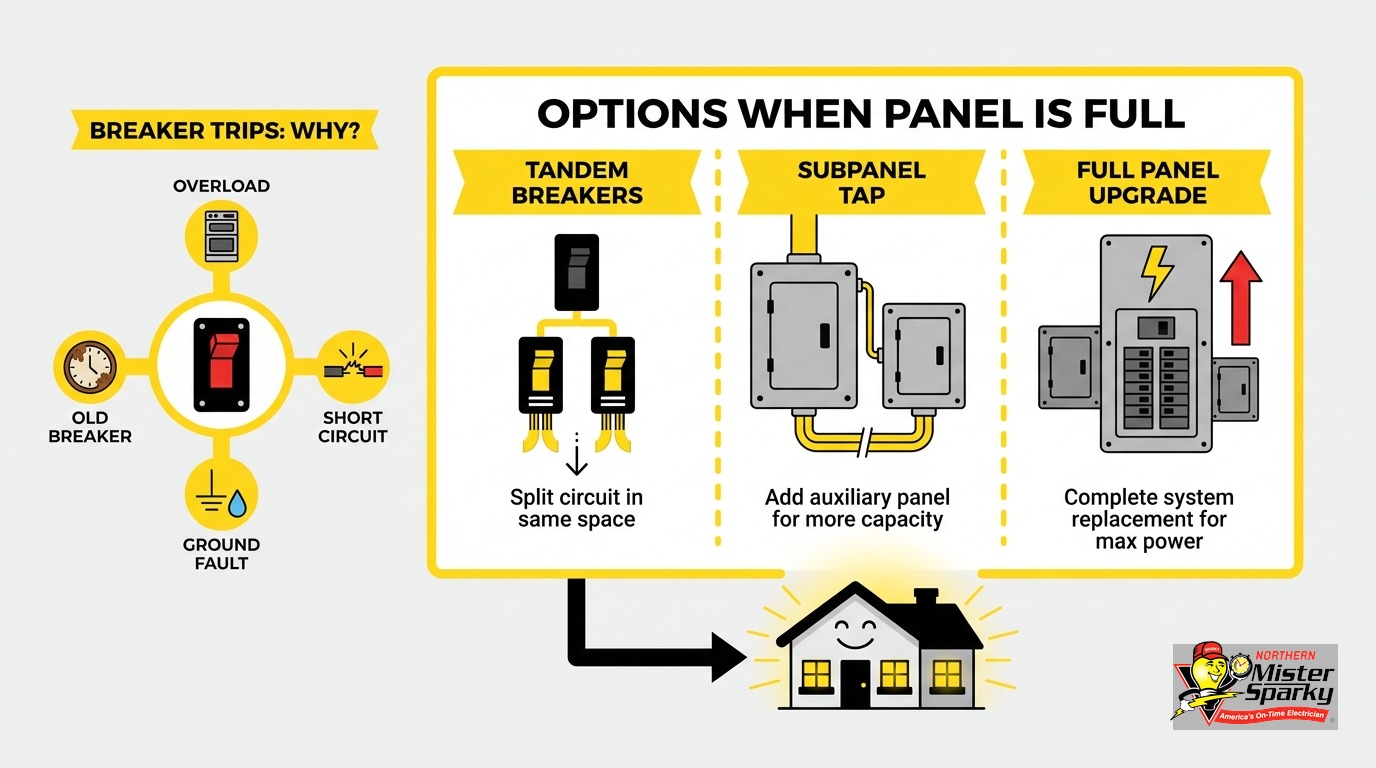
- Three fixes exist when your electrical panel has no room for breakers: tandem breakers, a subpanel, or a full panel or service upgrade.
- Tandem breakers are the cheapest option, but they only work in CTL-approved slots with matching brand hardware.
- A subpanel is the right call for a detached garage, workshop, or a far wing of the house.
- If your service is 100A or less and you are adding modern loads, neither tandems nor a subpanel will solve the real problem.
- Panels made by Zinsco or Federal Pacific should be replaced outright, regardless of slot count.
- Minnesota’s 2026 NEC took effect August 17, 2026. Permits filed on or after that date follow the new code.
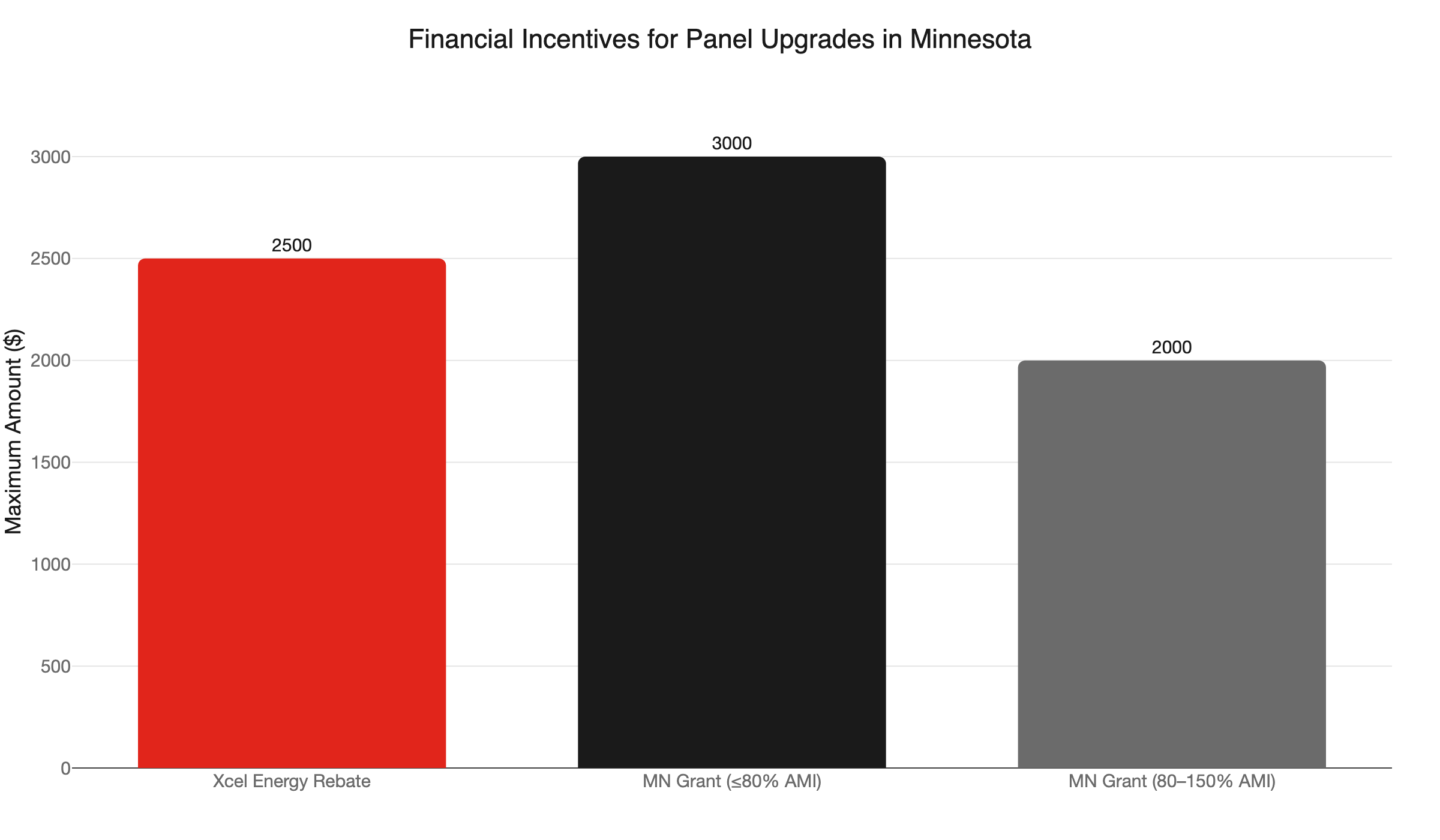
- Xcel Energy customers may qualify for a panel upgrade rebate of up to $2,500.
- A Minnesota state grant of up to $3,000 is on the books for income-qualifying homeowners, but the program has not launched yet. Work done before it opens will not be reimbursed retroactively.
What Does “Electrical Panel No Room for Breakers” Actually Mean?
The short answer: Your panel has a fixed number of slots, and every slot is occupied. Adding a new circuit is impossible without either consolidating space or expanding capacity somewhere else.
Your electrical panel controls every circuit in your home. Each breaker occupies one slot. A standard residential panel ships with 20, 24, 30, or 40 slots, depending on the model and manufacturer.
Over time, panels fill up. A kitchen remodel adds dedicated circuits for a microwave and a dishwasher. An EV charger needs its own 50A circuit. A home office needs more outlets. A heat pump replaces a furnace. Each addition claims a slot. Eventually the panel is full.
When that happens, you have three paths forward. The right one depends on how many circuits you need, what your current service can deliver, and what hardware is already in your panel.
Why a Full Panel Is Not Always Just a Panel Problem
This distinction matters especially in older Twin Cities homes. Many houses built before 1980 were wired for 60-amp or 100-amp electrical service. That was enough for the appliances of that era. It is rarely enough today.
If your service is 60A or 100A, a panel that looks full may actually be running near its total capacity. Adding a tandem breaker or a subpanel gets you more slots, but you are still drawing from the same limited pool. You will hit the same wall.
The real fix in that situation is a service upgrade: replacing the utility connection, the meter base, and the panel together. It costs more, but it solves the actual constraint instead of working around it.
How do you know if this applies to you? Look at your main breaker. If it reads 60A or 100A and you are planning to add an EV charger, a mini-split, or any other heavy load, call us before deciding on a path. That conversation is free and will save you from paying for a fix that does not fix enough.
Option 1: Tandem Breakers
A tandem breaker fits two circuits into one slot. It looks like a standard breaker with a seam down the middle: one 15A or 20A circuit on the left side, another on the right. You get two circuits without using a second slot.
This is the fastest and least expensive solution, when the conditions allow it.
What it costs: Typically $100 to $250 per tandem breaker, including installation.
What it requires:
- CTL-approved slots. CTL, or Circuit Total Limitation, is a standard that limits how many tandem breakers a panel can physically accept. The sticker on the inside of your panel door shows which slots are tandem-approved. Not every slot qualifies, and some panels have no approved slots remaining even if the panel looks full.
- Brand-matched hardware. Installing an Eaton tandem in a Square D panel violates listing requirements even if it physically fits. A mismatched breaker is a code violation and may affect your homeowner’s insurance.
- Enough service capacity to support the added circuits.
When tandem breakers are not the answer:
- You need more than two or three circuits and the panel has no remaining CTL-approved slots.
- Your panel’s brand has been discontinued and matching tandems are no longer available.
- Your panel is Zinsco, Federal Pacific, or a pre-1980 split-bus design. These need to be replaced outright.
Is a Tandem Breaker Safe and Legal in Minnesota?
The short answer: Yes, when installed in an approved slot with matching brand hardware by a licensed electrician holding a permit. A mismatched breaker or a tandem in an unapproved slot is a code violation.
Minnesota’s 2026 NEC took effect August 17, 2026. Permits filed before that date follow the 2023 NEC. Permits filed on or after that date follow the 2026 NEC. The code version that governs your job is locked on the day the permit is filed, not the day work starts.
All panel work in Minnesota requires a permit and a DLI or local inspection. Our guide to electrical permits in Minnesota walks through which cities issue their own permits, which ones route through the state DLI, and what the two-inspection process looks like.
Option 2: Add a Subpanel
A subpanel is a secondary breaker panel fed from your main panel. It distributes power to a specific area: a detached garage, a basement workshop, a home addition, or a far corner of the house.
What it costs: Subpanel installations in the Twin Cities typically run $700 to $2,500, depending on the distance from the main panel, the amperage of the subpanel, and whether trenching or conduit through finished walls is required.
Why a subpanel often beats tandems for remote areas:
When you run a circuit from your main panel to a detached garage 80 feet away, you are pulling a long wire run for every circuit you need out there. A subpanel changes the calculation. You run one larger feed to the subpanel, then shorter individual circuits branch out from there. The result is cleaner wiring, a local disconnect at the subpanel, and lower long-run material costs.
What a subpanel requires:
- A free double-pole slot in the main panel for the subpanel feed breaker.
- A service with enough capacity for the added load.
- A separate ground rod at the subpanel location for any detached structure.
- A permit and two inspections, same as all other panel work.
Our guide to detached garage subpanel installation covers the full setup, including the disconnect requirement and grounding rules specific to Minnesota.
When Does a Subpanel Make More Sense Than Tandem Breakers?
The short answer: When you need circuits in a detached structure, a workshop, or a far wing of the house, a subpanel is almost always the better call. You get a local disconnect, shorter individual runs, and room to grow - for a higher upfront cost than tandems but lower long-run material cost than pulling separate wires for each circuit.
Tandem breakers are a slot solution. A subpanel is a capacity-distribution solution. If you are powering a new garage with lighting, multiple outlets, and a compressor, a subpanel gives you a clean local hub. Running a separate long circuit from the main panel for each of those loads wastes wire and money.
Option 3: Full Panel Upgrade or Service Upgrade
Sometimes the right answer is replacing the panel entirely. Other times it means upgrading the service that feeds the panel - or doing both at once.
Panel replacement swaps your existing panel for a new one with more slots, typically a 200A panel with 40 or more positions. It does not change the service coming from the utility. Cost in the Twin Cities: typically $1,500 to $3,500, depending on panel size and how much rewiring is involved.
Service upgrade replaces the utility connection, the meter base, and the panel together. This is the right move when your service is 100A or less and you are adding modern loads. Cost in the Twin Cities: typically $3,000 to $7,000 or more, depending on the scope of utility work.
Both require permits, two inspections, and coordination with Xcel Energy or your local utility.
When replacement is the only right answer:
- Your panel is Zinsco, Federal Pacific, or another known-dangerous panel brand. Known failure modes make these replacement jobs, not repair jobs.
- Your service is 60A or 100A and you are adding a Level 2 EV charger, a heat pump, a hot tub, or other high-draw loads.
- Your panel is a pre-1980 split-bus design with no main breaker.
For a full list of warning signals, read our post on signs you need an electrical panel upgrade.
How Do You Know Which Option Is Right for Your Home?
The short answer: Check three things: how many circuits you need, what your service amperage is, and whether your panel’s brand and slot layout allow tandems. If all three line up for tandems, start there. If not, work down the table below.
| Your situation | Right call |
|---|---|
| Need 1-2 circuits, panel allows tandems, service is 200A | Tandem breakers |
| Need circuits in a detached garage, workshop, or far area of the house | Subpanel |
| Panel is full AND service is 100A or less AND adding EV, HVAC, or other large loads | Full service upgrade |
| Panel is Zinsco, Federal Pacific, or pre-1980 split-bus | Replace outright, now |
If you are not sure which row describes your home, call us at 763-200-5956. We will look at your panel and give you a direct answer.
What Does Adding a New Circuit Mean for AFCI Requirements?
The short answer: Any new 15A or 20A branch circuit in a dwelling unit must meet AFCI protection requirements under NEC 210.12. That means AFCI breakers rather than standard ones, which adds cost that homeowners often do not anticipate.
NEC 210.12 requires AFCI protection on all 15A and 20A branch circuits in bedrooms, living rooms, dining rooms, hallways, closets, kitchens, and laundry areas. This applies whether you are adding a tandem breaker, a subpanel branch circuit, or a new circuit in a replacement panel.
AFCI breakers cost $30 to $60 each, compared to $5 to $15 for a standard breaker. When you are adding three or four circuits, that cost adds up quickly. Our team includes AFCI breakers in your quote from the start so there are no surprises on installation day.
What About the Xcel Energy Rebate?
The short answer: Xcel Energy customers may qualify for a rebate of up to $2,500 on a qualifying service or panel upgrade. A licensed electrical contractor must do the work. DIY does not qualify.
The Xcel Energy panel upgrade rebate is available to qualifying residential customers in the Twin Cities metro. It applies to service upgrades such as a 100A to 200A upgrade. The rebate is processed after permit approval and invoice submission, with payment typically arriving within 6 to 8 weeks.
To qualify:
- You must be an Xcel Energy residential customer.
- A licensed electrical contractor must complete the work.
- The permit must be approved before you submit the rebate application.
- Supporting documentation includes the permit, the contractor invoice, and the completed rebate application form.
When our team does your panel upgrade, we help you gather what you need for the rebate application. A lot of homeowners leave this money on the table because the paperwork stalls after the job is done.
What About the Minnesota State Grant Program?
The short answer: A state grant of up to $3,000 exists for income-qualifying homeowners, but the program has not launched yet. Grants will not be paid retroactively. Do not delay needed work waiting on it.
The Minnesota Residential Electrical Panel Upgrades grant program, established under Minn. Stat. § 216C.45, offers up to $3,000 for single-family homeowners at or below 80% of Area Median Income, and up to $2,000 for homeowners at 80-150% AMI. About $5.8 million in total grants is available.
The critical caveat: the program was still awaiting coordination with the federal HEAR program as of early 2026 and had not launched. The state has confirmed that grants will not be issued for work completed before the program opens. If your panel is a safety concern, do not wait. Take care of the problem now, capture the Xcel rebate dollars available today, and apply for the state grant when it opens.
What Do Permits Look Like in the Twin Cities?
The short answer: About 66 Minnesota cities handle their own permits as local AHJs. Minneapolis, St. Paul, and most first-ring suburbs are on that list. File with the wrong body and you stall the job in the wrong queue.
All panel work in Minnesota requires a permit under Minn. Stat. § 326B. In the Twin Cities, that usually means filing with your city, not the state DLI. Two inspections are required: rough-in before walls close, and final after the panel is energized and tested.
Starting work before pulling a permit triggers an investigation fee on top of normal permit costs. One detail that catches homeowners off guard: as of January 1, 2026, Minnetonka no longer handles permits for Deephaven and Woodland. Residents of those cities now file directly with their own municipal offices.
Homeowners may pull their own permit only on a single-family home they own and occupy, doing all the work themselves. Condos, duplexes, and rentals always require a licensed electrical contractor.
Our team pulls permits for every job. We know which AHJ has jurisdiction for your address and file with the right office the first time.
What Is the Timeline for Panel Work in the Twin Cities?
The short answer: A tandem breaker job often wraps up in one visit after the permit clears. A subpanel takes one to two days. A full service upgrade requires utility coordination and typically runs two to four weeks from permit filing to final inspection.
Permit processing time varies by city. Minneapolis and St. Paul typically process permits in 5 to 10 business days. Many suburban AHJs move faster. Xcel Energy coordination for service upgrades can add another week or two on top of that, depending on scheduling.
Call us at 763-200-5956 or book online to get on the schedule. We pull the permit and manage the utility coordination from start to finish.
Your Electrical Panel Has No Room for Breakers: What to Do Next
When your electrical panel has no room for breakers, the first step is knowing which of the three options fits your situation. Tandem breakers work fast and cost the least, but only in the right panel with matching hardware. A subpanel is the smart move for remote areas of the house or a detached structure. A service upgrade is the answer when your panel and your service are both maxed out.
The worst move is to ignore the problem. A panel that is consistently over capacity is a fire risk. Adding circuits without a permit is a code violation that can affect your homeowner’s insurance and complicate a future home sale.
We are locally owned and operated, serving Minneapolis, St. Paul, Bloomington, Woodbury, Maple Grove, Plymouth, Blaine, Brooklyn Park, and the surrounding Twin Cities metro. As America’s On-Time Electrician(R), we show up when we say we will, pull your permits, and give you a straight answer - no malarky. Call 763-200-5956 or book online, and we will assess your panel and tell you exactly which path fits your home.
Frequently Asked Questions
Can I add a tandem breaker to any slot in my panel? +
Do I need a permit to add a tandem breaker in Minnesota? +
How long does a panel upgrade take in the Twin Cities? +
Is the Xcel Energy panel upgrade rebate still available? +
Need an electrician now?