
Subpanel vs Service Upgrade: The Twin Cities Decision Guide
Key Takeaways
- A subpanel adds circuit slots. A service upgrade adds total amperage. These are different problems with different fixes.
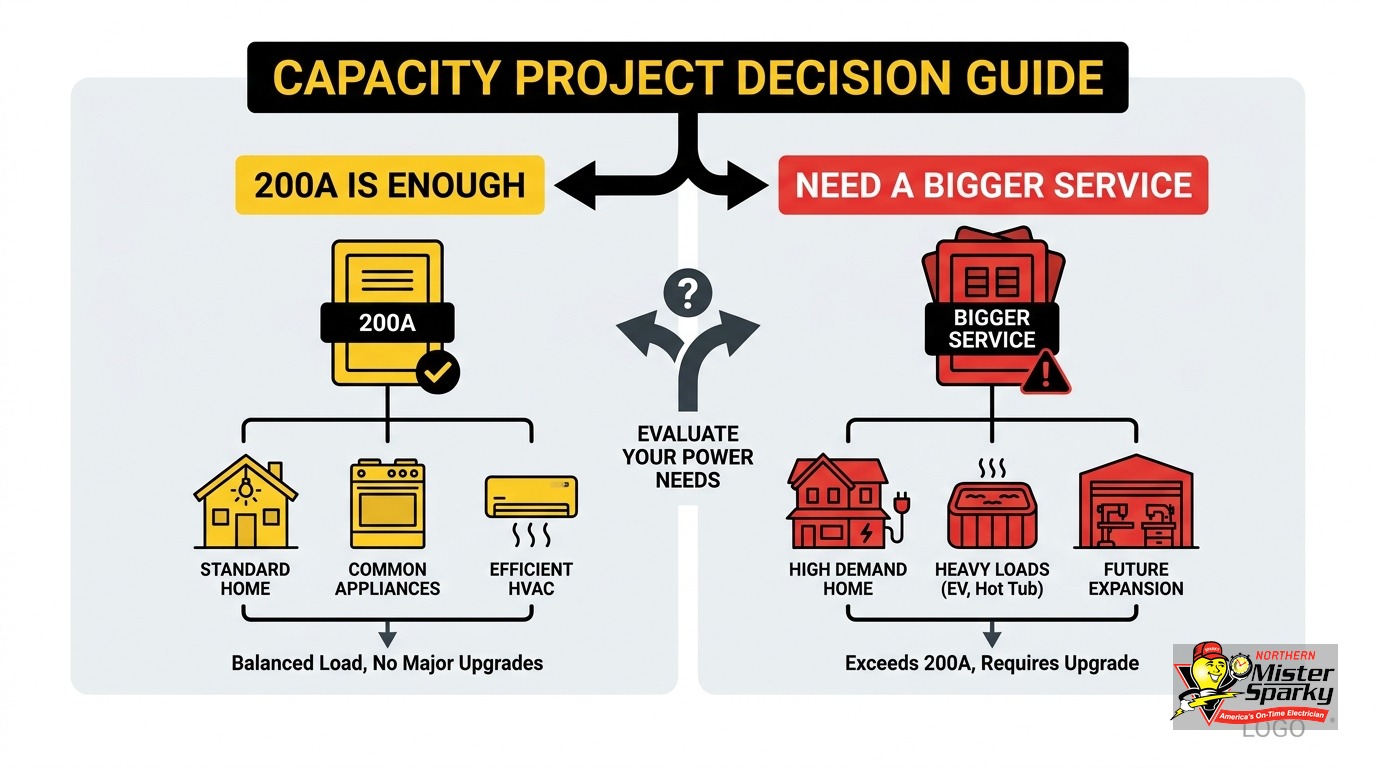
- The only reliable way to know which you need is a load calculation under NEC Article 220. Physical breaker slots tell you nothing about available capacity.
- A 200A main service cannot feed a 200A subpanel plus the rest of your home. The math does not work.
- Minnesota adopted the 2026 NEC effective August 17, 2026. Any permit filed today falls under the new code.
- Xcel Energy offers up to $1,500 for a qualifying panel upgrade, but only when the upgrade increases amperage.
- Federal tax credits for EV chargers and energy upgrades ended in 2025 and 2026. State and utility rebates are now the primary source of financial help.
- Minnesota’s design winter temperature pushes a 200A service harder than the same loads in a warmer climate. This matters for your calculation.
What Is the Actual Difference Between a Subpanel and a Service Upgrade?
Short answer: A subpanel adds circuit slots fed by your existing power supply. A service upgrade increases how much power your utility delivers to the home. They fix different problems: space versus capacity.
Think of your electrical service like the water supply coming into a building. Your main panel is the main shutoff valve. Individual circuit breakers are the faucets. A subpanel is a second cluster of faucets fed from that same main valve. A service upgrade replaces the main shutoff and the supply pipe with a larger one.
If your panel has no empty breaker slots and you need to add a circuit, a subpanel may solve that. You run a feeder cable from your main panel to a subpanel in another part of the home or a detached structure. You gain the circuit positions you need.
If your home is drawing close to its total amperage limit, a subpanel cannot help. Adding more circuits to an already-loaded service is like adding more faucets to a pipe that is already running at full pressure. You need a bigger pipe, and that means a true panel or service upgrade.
Many homeowners, and a surprising number of online guides, blur these two solutions. The result is homeowners who install a subpanel and still lose power during a cold snap. Or homeowners who pay for a full service upgrade when all they needed was a few extra circuits in the basement. Getting the diagnosis right before any work starts saves time and money.
How Do You Know Which One You Need?
Short answer: Run a load calculation. Physical space in your panel (empty breaker slots) tells you nothing about available capacity. A full load calculation under NEC Article 220 is the only reliable diagnostic.
Start by looking at your main breaker. The number stamped on it, whether 100, 150, or 200, is your service’s amperage ceiling. That is how many amps your home can draw before the main breaker trips.
Next, think about what you are running. A standard Twin Cities home with gas heat, a gas range, and basic appliances might use 60-80 amps on a cold evening. That same home with an air-source heat pump, an EV charger, an electric range, and a dryer running simultaneously tells a different story entirely.
The honest answer: this math is not something you should do yourself and trust. A licensed electrician runs the NEC Article 220 calculation using nameplate data from your actual appliances, not breaker handle ratings, plus demand factors that account for the statistical likelihood of all loads running at once. The result tells you whether your existing service can handle what you are planning, or how large a service you actually need.
We offer this assessment as part of any panel consultation. It takes about an hour on-site and removes the guesswork entirely. Before your appointment, our post on home electrical load calculations explains the methodology in plain language.
What Is a Load Calculation and Why Does It Matter?
Short answer: A load calculation adds up every draw in your home, applies code-specified demand factors, and produces a required service size in amps. It is the only way to know whether you need more capacity or just more space.
The NEC Article 220 method works like this. Each circuit and appliance carries a nameplate rating in watts or amps. The calculation adds those ratings together, then applies demand factors. Demand factors reflect the code-recognized reality that not everything in your home runs at full rated load simultaneously. Your electric range, for example, is unlikely to have all burners and the oven at full blast while every other major appliance also peaks.
The output is a number in amps. If that number exceeds your main breaker’s rating, you need a service upgrade. If it fits comfortably within your service rating and the problem is simply no open breaker slots, a subpanel may be all you need.
One thing the demand factors do not fully account for: sustained heating loads in cold climates. That is the Minnesota-specific wrinkle we address in the next section.
A point worth making here: the number on your main breaker is not a target. It is a ceiling. Consistently drawing close to your service limit stresses the panel, accelerates wear on the main breaker, and leaves no headroom for future loads. A comfortable service runs well below its rated ampacity under normal conditions.
The Minnesota Cold-Climate Factor
Most articles written about subpanel vs service upgrade are aimed at a Texas or generic U.S. audience. None of them account for what Minnesota winters do to your load profile.
Here is the scenario that pushes Twin Cities homeowners past 200A faster than any other combination of loads:
- An air-source heat pump drawing 20-30 amps at full output during a -20°F night
- A Level 2 EV charger pulling 32-48 amps in the same window
- An electric range or induction cooktop drawing 30-50 amps at dinner time
- A dryer running at 24-30 amps
- Baseline lighting, refrigeration, and plug loads adding 20-30 amps
That stack can approach or exceed 150 amps of simultaneous demand. Demand factors help reduce the calculated total, but at Minnesota design temperatures, heat pump draw is sustained, not intermittent. The equipment is running near rated capacity for hours at a time, not cycling on and off the way it would in a mild climate. The demand factor assumptions built into NEC Article 220 can undercount that reality if the electrician is not applying Minnesota-specific design temperatures.
Twin Cities housing stock makes this worse. Homes built in the 1950s through 1970s commonly carry 100A services, some still on original fuse boxes. If your home is in that vintage and you are planning any combination of heat pump, EV charger, or electric cooking, a service upgrade is almost certainly the right first step. Adding a subpanel to a 100A service will not fix a capacity problem.
Can You Feed a 200A Subpanel From a 200A Main?
Short answer: No. If a subpanel requires 200A, the main service must be upgraded to 350-400A first. A 200A main cannot supply a 200A subpanel plus the rest of the home’s load without tripping.
This is the most common misconception we run into. A homeowner wants to power a large detached garage or workshop. The main service is 200A. The goal is a 200A subpanel out there. The logic seems to add up.
It does not. The main breaker protects the entire service. If the subpanel alone can draw 200A and the house is simultaneously drawing its own load, the main breaker trips. In practice, a 200A main can support a subpanel sized to 60A or 100A for a garage or workshop when the home’s other loads leave enough headroom. It cannot support a 200A subpanel in any realistic scenario.
If you genuinely need 200A in a detached structure, the path is a service upgrade first. The feeder from the main panel to the structure, the subpanel itself, and the breakers in it all have to be sized to what the total system can deliver, not to what the subpanel nameplate says. An electrician who tells you otherwise is not doing the math.
What Does a Service Upgrade Actually Involve?
Short answer: A service upgrade replaces more than just the panel. It typically includes the meter base, service entrance conductors, and utility coordination for the connection. It is a full-day job that requires a state permit and a utility hold.
This is where homeowners are often surprised. They picture swapping the gray box on the basement wall and are not expecting the full scope of work.
A true service upgrade typically includes:
- Meter base and socket: The meter socket at the exterior of the home must be rated for the new amperage. If you are stepping from 100A to 200A, a 100A-rated socket has to go.
- Service entrance conductors: The cable running from the weatherhead down to the panel must be sized for the new service. Undersized conductors on a larger service are a fire hazard.
- New main panel: The panel itself, with a main breaker rated for the new service size and bus bars that can carry the load.
- Utility coordination: Xcel Energy coordinates the service drop and the final meter connection on the utility side. Your electrician completes the customer-side work, the state inspector approves it, and then the utility reconnects.
Not every service upgrade requires all of these steps. A 100A-to-200A upgrade in a home with a newer weatherhead and entrance cable may reuse some of the existing infrastructure. But a licensed electrician should evaluate each component. Assumptions about what can stay are how problems get missed.
For a close look at the utility coordination piece, our post on meter base and socket upgrade cost covers what to expect and why this piece of the job often surprises homeowners on timeline.
Are Minnesota Electrical Permits Different From Other States?
Short answer: Yes. Minnesota issues electrical permits through the state Department of Labor and Industry (DLI), not local building departments. That is different from most states, and it matters for your project timeline.
Contractors apply through the DLI’s online permit system. The standard permit fee is $110 and covers two inspections plus up to 20 circuits or feeders. The minimum fee is $55.
One critical timing note: Minnesota adopted the 2026 NEC effective August 17, 2026. Any permit filed on or after that date falls under the 2026 code. Permits pulled before that date remain under the 2023 NEC. If you are scheduling a panel or service project, confirm with your electrician which code cycle applies based on permit date, not project date.
The 2026 NEC includes updated requirements for arc-fault and ground-fault protection that affect residential panel work. An electrician who is current on those requirements is not a nice-to-have. They are a requirement for a project that passes inspection.
Northern Mister Sparky pulls all required permits on every job. If a contractor offers to skip the permit to save money, that liability lands on you as the homeowner, not them. Walk away.
Our post on Minnesota electrical permits has more detail on the DLI process, inspection timelines, and what the permit fee actually covers.
What Rebates Are Available for Minnesota Homeowners?
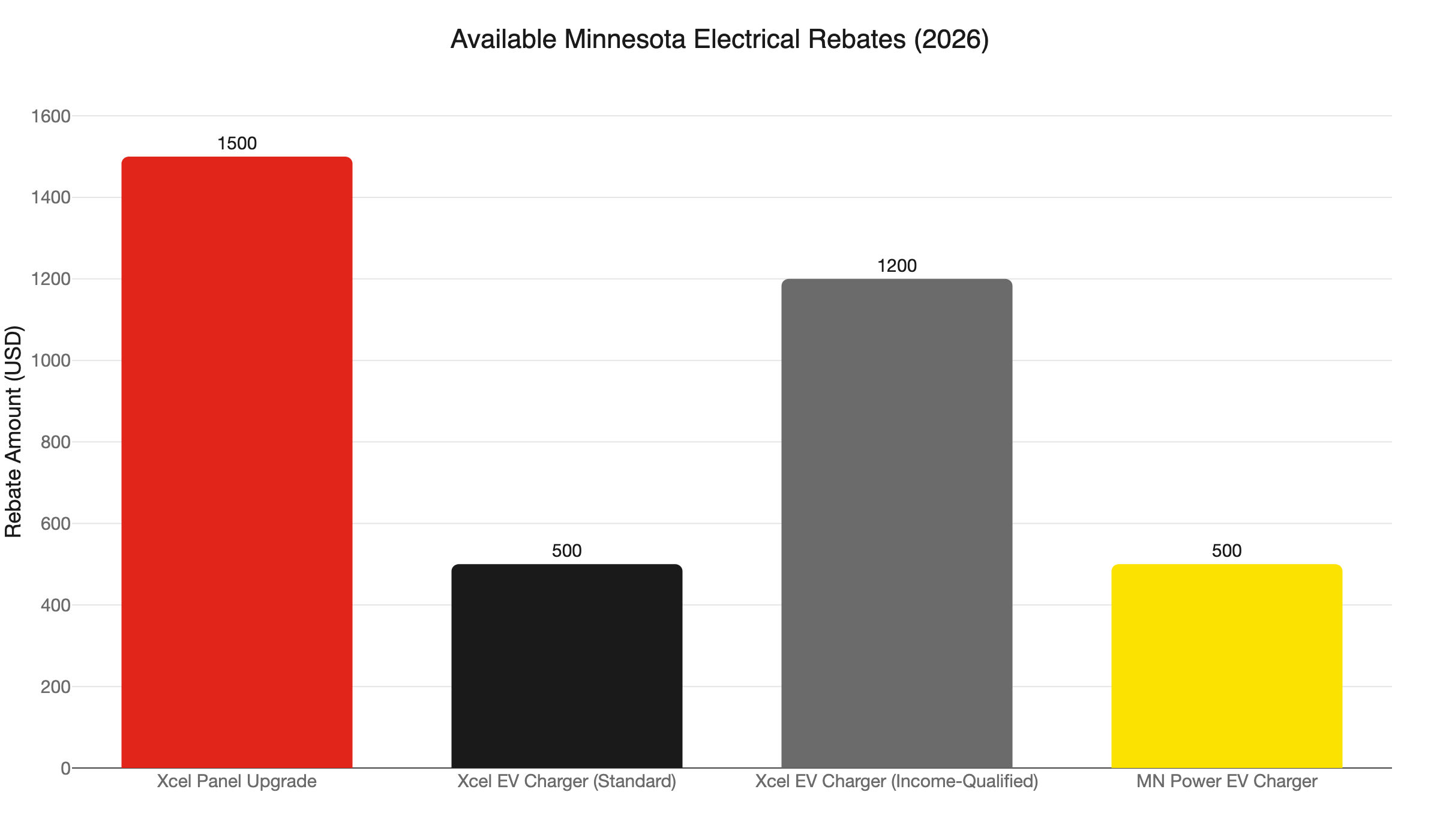
Short answer: Xcel Energy offers up to $1,500 for a qualifying panel upgrade and up to $500 (or $1,200 income-qualified) for EV charger wiring. Federal tax credits for these projects ended in 2025 and 2026.
The rebate picture changed significantly in 2026. Here is where things stand.
Xcel Energy Panel Upgrade Rebate
Up to $1,500 for a panel upgrade that increases service amperage. The key word is “increases.” Replacing a failed 200A panel with another 200A panel in-kind does not qualify. Stepping from 100A to 200A does. This rebate stacks with other Xcel incentives for EV chargers, heat pumps, and electric water heaters. If you are electrifying multiple systems in a single project, the stacking potential is meaningful.
Xcel EV Charger and Wiring Rebate
Up to $500 for standard customers, or up to $1,200 if you qualify for income assistance. This is first-come, first-served. You must enroll in Xcel’s EV charging program before applying, and a licensed electrician is required. Budget permitting, stacking this with the panel rebate on a single project can recover $2,000 or more.
Minnesota Power EV Rebate
If you are in northern Minnesota on Minnesota Power rather than Xcel territory, a $500 rebate is available for a Level 2 charger installation, plus $500 for a second service.
Federal credits: gone
The 30C EV charger tax credit ended for equipment placed in service after June 30, 2026. The 25D and 25C residential energy credits ended after December 31, 2025. Do not factor federal credits into your 2026 project budget.
The practical takeaway: if you are stepping from 100A to 200A service and adding an EV charger in the same project, you could combine the $1,500 panel rebate with the $500 EV wiring rebate. We help customers navigate Xcel’s rebate paperwork as part of the job. It is not complicated, but it needs to be done in the right order.
For more on the EV charger installation process in the Twin Cities, including what to expect from permits and timeline, see our EV charger installation guide.
When Is a Subpanel the Right Call?
Short answer: When your main service has enough total capacity but the physical panel lacks circuit space, and when the new loads will not push total amperage past your service ceiling.
A subpanel is the right answer in these situations:
- Detached garage or workshop: You want 60-100A of capacity out there. Your main service is 200A, and your home’s existing loads leave room in the load calculation. A subpanel on a feeder from the main panel handles this cleanly.
- Basement finish: You need six to eight new circuits for a finished space. Your 200A service passes the load calculation with room to spare. A subpanel mounted near the new space keeps feeder runs short and the main panel uncluttered.
- Home addition: Adding a wing or outbuilding where a long conduit run to the main panel is impractical. A subpanel at the far end of the run, sized correctly, is cleaner than running individual circuits all the way back.
In each case, the decision tree is the same. Run the load calculation first. If the total projected load fits within your existing service amperage, a subpanel solves the space problem. If the total load exceeds your service ceiling, a service upgrade comes first, and you may not need a subpanel at all once the new panel is in and sized correctly.
One common mistake: homeowners who add a subpanel to gain capacity, skip the load calculation, and then wonder why they are still tripping the main breaker. The subpanel did exactly what it was supposed to do. The underlying capacity problem was never addressed.
Ready to Know for Sure?
The fastest way to settle the subpanel vs service upgrade question is a licensed electrician on-site with a load calculation worksheet and your utility account number. There is no reliable shortcut from a blog post, including this one. Every home is different, and the numbers are the numbers.
Northern Mister Sparky is locally owned and operated in the Twin Cities. Our technicians know Minnesota’s DLI permit process, current Xcel rebate requirements, and the 2026 NEC requirements that apply to any permit filed today. We pull permits, we show up on time, and we do not leave you with a job that fails inspection.
As America’s On-Time Electrician(R), we back every job with the UWIN(R) 100% satisfaction guarantee.
Call 763-200-5956 or book online to schedule a panel consultation. If the answer turns out to be a service upgrade, we will walk you through the Xcel rebate application at the same time, so you are not leaving money on the table.
Frequently Asked Questions
What is the difference between a subpanel and a service upgrade? +
Can I add a 200A subpanel to my existing 200A service? +
Does Xcel Energy offer rebates for panel upgrades in Minnesota? +
Need an electrician now?