
Home Electrical Load Calculation: What Electricians Check
Key Takeaways
- A home electrical load calculation determines whether your service panel can handle your actual electrical demand.
- The NEC defines two methods: the Standard Method (Articles 220.41-220.55) and the Optional Method (NEC 220.82). Most electricians run both on upgrade jobs.
- A former Minnesota DLI chief electrical inspector confirmed that the popular square-footage shortcut “isn’t how the NEC calculates load.”
- A Level 2 EV charger adds at least 9,000 VA to your calculated load once the continuous-load rule applies. That single addition can push a borderline 200-amp panel over its limit.
- All panel work in Minnesota requires a permit and state inspection. No homeowner DIY exception.
- Minnesota adopted the 2026 NEC effective August 17, 2026. Permits filed on or after that date fall under the new code.
- The state panel upgrade rebate has not launched. Do not delay needed work waiting for it.
When a Panel Question Becomes a Numbers Problem
Your breaker trips when the microwave and toaster run at once. Your neighbor just got an EV charger and now wants to add an induction range. You are finishing the basement and an electrician says the panel might not have room.
All three situations lead to the same question: can my electrical service handle this?
A home electrical load calculation is how that question gets answered. It is not a guess. It is a code-defined process that adds up every electrical demand in your home and checks it against what your service can safely supply.
This post walks through what actually goes on the clipboard - both NEC methods, how EV chargers change the math, and what Minnesota homeowners need to know right now about permits, the code transition, and the state rebate that has not launched yet.
What Is a Home Electrical Load Calculation?
Short answer: A load calculation is a code-defined process that adds up every electrical demand in your home and checks whether your utility service can supply it safely. It produces a minimum required service size in amps.
Your main electrical panel is rated for a specific amount of power. Residential service typically runs at 100, 150, or 200 amps. That number is set by the utility connection, the meter base, and the panel itself.
When the total demand from everything in your home exceeds that rating, the NEC says there is a problem. The load calculation figures out whether that threshold is being crossed.
An electrician works through every circuit and appliance in the home. They apply demand factors the NEC specifies for each load type. Then they total everything up and express it in volt-amperes (VA). Divide by 240 volts to convert to amps.
If the result exceeds your current panel’s rating, you need more service capacity. If there is room to spare, there is room to add loads. The calculation removes the guesswork entirely.
Why the Square-Footage Shortcut Falls Short
A widely shared DIY approach multiplies your home’s square footage by a fixed number and compares it to your panel’s amp rating. It is fast to run and easy to find online.
It is also not how load calculations work.
A former Minnesota DLI chief electrical inspector confirmed that this formula “isn’t how the NEC calculates load.” That quote appeared in the article ranking first on Google for this topic. The article itself buries the admission and moves on.
The formula fails because square footage only addresses general lighting and receptacle circuits. It ignores your range, dryer, water heater, HVAC system, EV charger, electric baseboard heaters, and every other major load.
Two homes with identical square footage can have vastly different electrical demands. A 2,000-square-foot home with a gas range, gas dryer, and gas furnace looks nothing like the same home with an induction range, electric dryer, heat pump, and a Level 2 EV charger. The shortcut cannot see the difference.
For any decision that matters - a panel upgrade evaluation, a major appliance addition, a home sale - the real calculation is the only one worth running.
How Does the Standard Method Work?
Short answer: The Standard Method adds your square footage at 3 VA per square foot, adds required circuit minimums and fixed appliance loads, then applies tiered demand factors: 100% on the first 3,000 VA of general load and 35% on everything above. All loads are summed and divided by 240 volts for the minimum service size in amps.
Here is what NEC 220.41 and Table 220.42 prescribe, step by step:
Step 1: General lighting and receptacle load
Multiply your finished square footage by 3 VA. A 1,800-square-foot home starts at 5,400 VA. This covers all general-purpose outlets and lighting throughout the house.
Step 2: Required circuit minimums (NEC 220.52)
The NEC mandates minimum loads for kitchen small-appliance circuits and the laundry circuit regardless of what is plugged in:
- Two small-appliance branch circuits in the kitchen: 3,000 VA
- One laundry branch circuit: 1,500 VA
- Combined minimum addition: 4,500 VA
Add this to the general lighting load. For the 1,800-square-foot example: 5,400 + 4,500 = 9,900 VA before demand factors.
Step 3: Apply demand factors (NEC Table 220.42)
This is where the calculation diverges from the shortcut. The first 3,000 VA of the combined general load counts at 100%. Everything above 3,000 VA counts at only 35%.
For 9,900 VA: 3,000 at 100% plus 6,900 at 35% equals 5,415 VA. The demand factor shrinks that raw number significantly. It reflects a real-world fact: every outlet and fixture in the house does not run at full draw at the same moment.
Step 4: Fixed appliances
Each major appliance gets its own load entry. Common additions include the electric range, electric dryer, water heater, dishwasher, refrigerator, and any other permanently wired loads. When there are four or more fixed appliances, the NEC allows a 75% demand factor on their combined load - again, recognizing that not all of them peak simultaneously.
Step 5: Heating and cooling
This step matters more in Minnesota than in mild climates. The NEC requires including 100% of the larger of your heating load or cooling load - not both. If your home has a heat pump with electric resistance backup coils, the backup element capacity often defines the heating number. That figure goes in at full value.
Homes relying on electric baseboard heat carry a substantial load here. This is one reason Minnesota electricians pay close attention to the heating step that a national site written for a warmer climate might underemphasize.
Step 6: Convert to amps
Add all adjusted loads together. Divide the total by 240. The result is the minimum service size your home requires under the Standard Method.
The Optional Method: What Your Electrician Actually Runs
Short answer: NEC 220.82 bundles all loads into one pool and applies simpler demand factors: 100% on the first 10,000 VA, 40% on everything above. It is available for single-family homes with 120/240-volt, 3-wire service rated at 100 amps or greater. It almost always produces a lower calculated load than the Standard Method.
The NEC offers the Optional Method because the Standard Method, while thorough, tends to be conservative. Its broader first-tier threshold and unified demand factor on the remainder usually better reflect actual usage patterns.
Under NEC 220.82, the process works like this:
- List every load in the home: general lighting, all appliances, HVAC, all permanently wired equipment.
- Apply demand: first 10,000 VA at 100%, everything above at 40%.
- Divide by 240 volts for the minimum service amps.
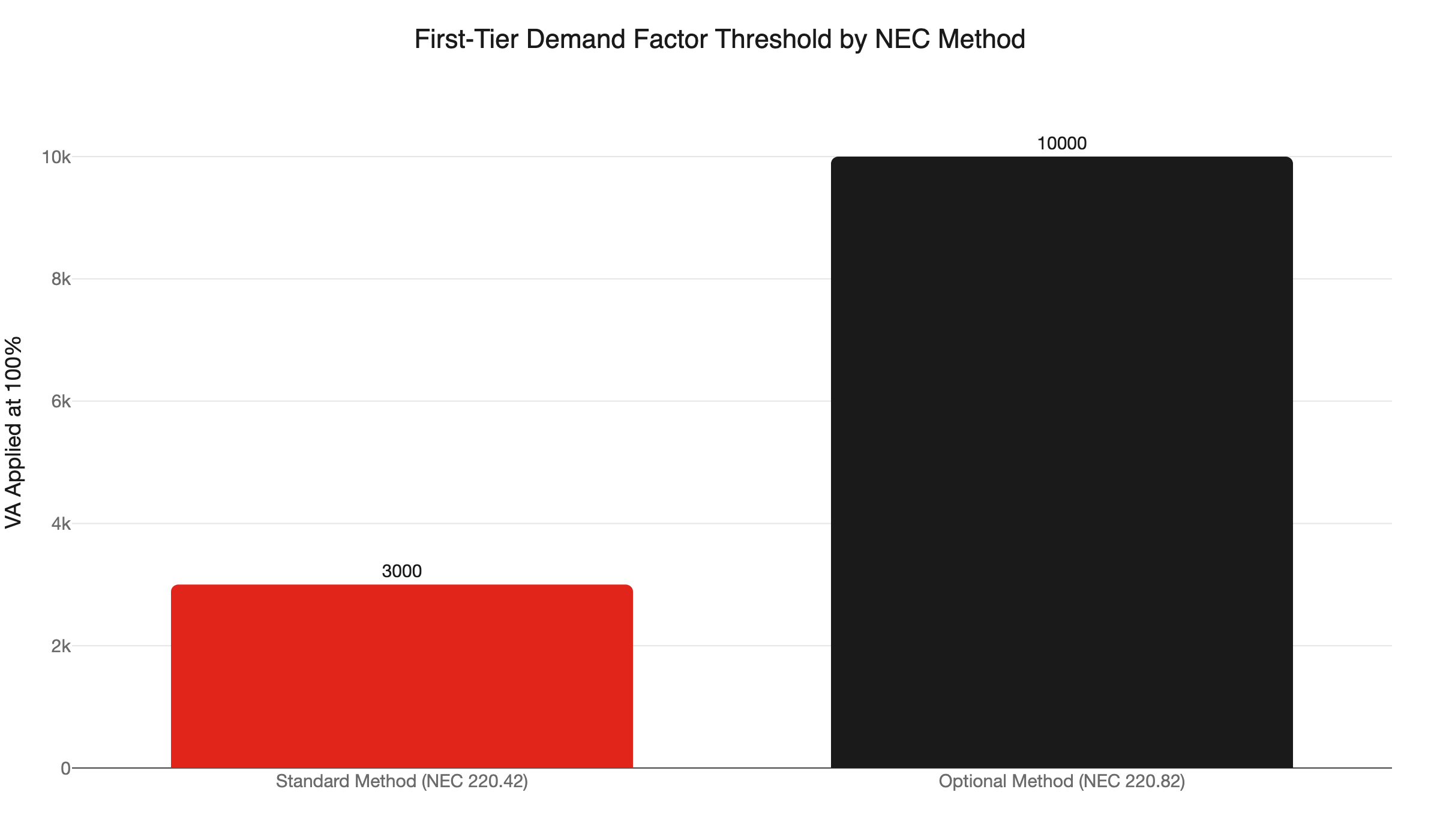
The larger first-tier threshold changes the outcome meaningfully. The chart above shows the difference: the Standard Method runs out of its 100% tier at 3,000 VA. The Optional Method holds 100% through 10,000 VA, then drops to 40% - which is actually a steeper discount than the Standard Method’s 35% on its remainder.
The net result: the Optional Method usually yields a lower calculated load on the same home. A home that appears to need 225 amps under the Standard Method might calculate cleanly at 185 amps under the Optional Method. Both results are NEC-compliant. An electrician can use whichever method supports the installation.
Running both methods is standard practice on any upgrade evaluation. When both say you are over capacity, the answer is clear. When only one method flags a problem, there is room for a conversation. When both show room to spare, you have your answer too.
Does an EV Charger Change Your Load Calculation?
Short answer: Yes, substantially. A Level 2 charger adds at least 7,200 VA to your load - and 9,000 VA once the continuous-load rule applies. That single addition can push a borderline 200-amp panel over its calculated limit.
NEC 220.57 sets the minimum EV load at 7,200 VA or the charger’s nameplate rating, whichever is larger.
The continuous-load rule compounds this. Level 2 charging typically runs for three or more consecutive hours. Overnight charging is the obvious case. That qualifies it as a continuous load under the NEC. Continuous loads require a 125% multiplier on the branch circuit and overcurrent protection sizing.
7,200 VA times 1.25 equals 9,000 VA. At 240 volts, that is 37.5 amps of added calculated load.
For many Twin Cities homes that upgraded to 200-amp service a decade or two ago, that number lands right at the edge. Add the EV charger load to a panel already serving a heat pump, an induction range, and an electric dryer, and the Standard Method often shows an overload - even if the Optional Method shows marginal room.
This is exactly why our EV charger installations in the Twin Cities start with a load calculation before we size the circuit or quote the job. If the panel needs an upgrade to support the charger safely, you will know before any work begins.
Financing is available for combined charger-and-panel-upgrade projects. Ask when you call.
What Does Minnesota Code Require for Panel Work?
Short answer: All panel replacement and service upgrade work in Minnesota requires an electrical permit pulled by a licensed electrician, followed by a state inspection. There is no homeowner DIY exception for panel replacements.
Minnesota DLI enforces this requirement statewide. Unpermitted panel work is uninsured, creates problems at the point of sale, and voids equipment warranties. It also puts your household at risk if something goes wrong and there is no inspection record.
One item worth noting if you have a job in progress right now: Minnesota adopted the 2026 NEC effective August 17, 2026. Permits filed before that date fall under the 2023 NEC. Permits filed on or after August 17 fall under the 2026 NEC. If your project is scheduled around that window, confirm with your electrician which code applies to your permit.
We handle the Minnesota electrical permit process on every job we pull. You do not schedule your own inspection or deal with DLI paperwork.
Will a Subpanel Fix an Overloaded Service?
Short answer: No. A subpanel adds breaker positions, not service capacity. If your main service is the bottleneck, a subpanel does not help.
Think of your main service as the water main coming into the house. A subpanel is a branch pipe - it routes power to a new location, but it does not increase how much total power the main line can carry.
If the load calculation shows your service is at or over capacity, the fix is a service upgrade: new meter base, new service entrance conductors, new panel rated for the higher amperage. A subpanel sitting on top of an undersized service gives you more breaker slots for loads the service still cannot support.
A subpanel is the right tool in a different situation. When your main service has capacity to spare and you need to extend power to a detached garage, a finished basement, or a workshop, a subpanel solves that problem cleanly.
The load calculation tells you which situation you are in. If you are not sure, that is the place to start.
What About Minnesota’s Panel Upgrade Rebate?
Short answer: The program exists in statute but has not launched. Minnesota is waiting on US DOE formal approval. No launch date is set. Rebates will not be issued retroactively.
Minnesota Commerce confirmed that the state is still working through changes the US DOE made to how HEAR and HOMES rebates operate. The state cannot distribute funds until DOE formally approves the updated program structure. As of mid-2026, no timeline is available.
The honest answer for Twin Cities homeowners: the money is not available yet. We do not know when it will be.
Do not delay a panel upgrade your load calculation says you need in hopes of capturing a rebate that may or may not arrive this year. If the rebate launches after your work is complete, you will not be able to claim it retroactively. What you will have is a safe, code-compliant panel.
We are tracking the program and will let customers know when it opens.
What Happens When We Run the Numbers on Your Home?
When you call Northern Mister Sparky about a panel upgrade, one of our licensed electricians visits the home before we quote anything.
Here is what that site visit covers:
- Square footage and layout. The baseline for the general load calculation.
- Appliance inventory. Every fixed load gets listed: range, dryer, water heater, HVAC equipment, dishwasher, and anything else permanently wired.
- Current panel inspection. We check your service size, remaining breaker capacity, wiring condition, and any hazards present. If your panel is on our list of flagged panel brands in Minnesota, that factors into the recommendation.
- Planned future loads. EV charger, heat pump, home addition, hot tub - these go into the calculation now, not as an afterthought after the upgrade is done.
- Both NEC methods. We run Standard and Optional and show you where you stand under each.
From there, you get a straight answer: room to spare, borderline, or needs an upgrade. The math is on the table. No pressure, and no recommendation without the numbers to back it.
If a panel upgrade is warranted, we handle everything from permit to final inspection. We are locally owned and operated in the Twin Cities. We show up when we say we will - that is the America’s On-Time Electrician(R) commitment. And the job is backed by the UWIN(R) 100% satisfaction guarantee.
Call 763-200-5956 or book online to schedule your load calculation.
Frequently Asked Questions
What is a home electrical load calculation? +
What is the NEC Optional Method for load calculations? +
Does adding an EV charger require a panel upgrade? +
Need an electrician now?