
EV Charger Without Panel Upgrade: Minnesota Homeowner Guide
Key Takeaways
- Minnesota adopted the 2026 NEC on August 17, 2026. Permits filed now must comply with the new code, not the 2023 version.
- An EVEMS (EV Energy Management System) can legally support a Level 2 charger on a 100A panel without a service upgrade, codified under NEC 625.42.
- EVEMS devices do not work in every home. If you heat with electric baseboards and have 100A service, your panel may already be at 70-80% capacity on a January morning before the car is plugged in.
- The 30C federal tax credit for EV charger equipment expired June 30, 2026. New installations do not qualify.
- Xcel Energy customers in Minnesota can stack up to $1,200 in EV charger and wiring rebates with up to $1,500 in panel upgrade rebates on the same project.
- Any new EV charger circuit in Minnesota requires a licensed electrician and a permit. No exceptions.

Minnesota adopted the 2026 National Electrical Code on August 17, 2026. Permits filed on or after that date must meet the new rules. If you are planning an EV charger installation in the Twin Cities right now, that timing matters. Adding an EV charger without a panel upgrade just became more nuanced, and no one has written about this change for Minnesota homeowners yet.
Level 2 EV chargers draw significant power - typically 40 to 48 amperes for most home installations. For a home with 100A service, adding that load without upgrading the panel is possible, but only under specific conditions. The 2026 NEC tightened how EV loads are calculated. At the same time, it gave the primary workaround - a load-management device called an EVEMS - explicit legal authorization for the first time. Understanding both changes is how you make the right call for your home.
Can You Add an EV Charger Without a Panel Upgrade?
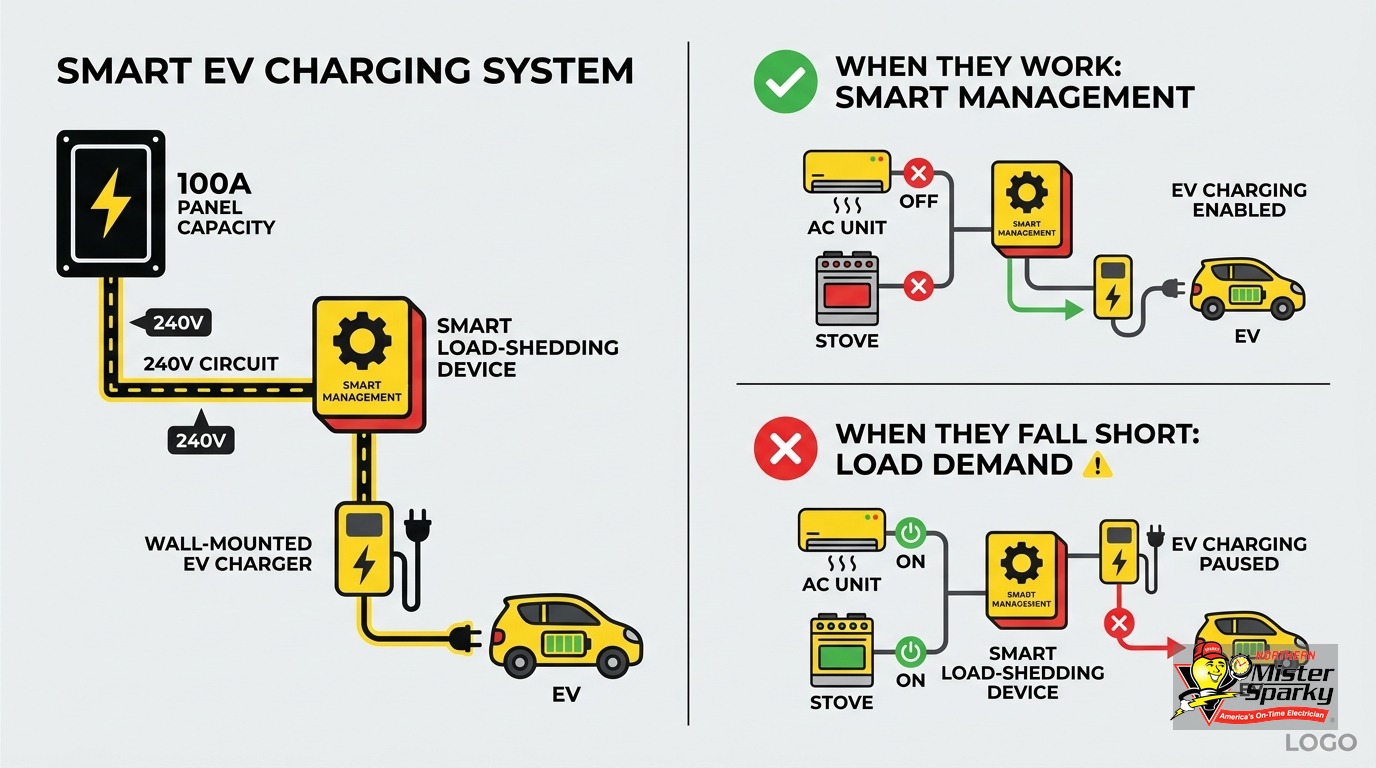
Often yes, but only after a load calculation confirms your panel has room. An EVEMS monitors your panel’s real-time amperage draw and throttles charger output when other loads are heavy. Under NEC 625.42, a panel with a certified EVEMS installed is evaluated at its managed output, not the charger’s full rated amperage. That can bring an over-capacity 100A panel back within code limits.
This is not a hack or a workaround. It is the code-sanctioned solution, and the 2026 NEC makes the authorization explicit.
About 20% of homes need some kind of electrical upgrade before an EV charger can be installed safely. The other 80% have more options than they realize, and the EVEMS route is often the most cost-effective one for homes with sufficient panel headroom.
The device is not a substitute for math, though. A licensed electrician runs a load calculation on your actual panel before making any recommendation. If the numbers do not close, no smart device changes that.
Minnesota Just Changed the Code - What That Means for Your Project
Permits filed on or after August 17, 2026 must comply with the 2026 NEC. Permits filed before that date still fall under the 2023 NEC. Licensing exams transition to the 2026 NEC on September 8, 2026.
The 2026 NEC is now the edition that governs permits for the rest of this building cycle. If your contractor is quoting the project using 2023 NEC rules, ask them to recheck. Two specific things shifted for EV charger projects.
The load calculation tightened. The 2026 NEC now calculates EV charger loads at 100% of the charger’s full rated amperage. No demand factor reduction applies. A 48A charger adds 11,520 volt-amperes to your panel’s load calculation at 240 volts. On paper, more 100A panels now look over capacity than before.
EVEMS got explicit legal authorization. At the same time, NEC 625.42 now states that when a certified EVEMS is installed, the load calculation uses the managed output rather than the charger’s full rating. The tighter calculation created the problem. The same code revision delivers the solution.
One partial offset in homeowners’ favor: the general lighting load calculation dropped from 3 volt-amperes per square foot to 2 volt-amperes per square foot in the 2026 NEC. For a 1,500-square-foot home, that frees up 1,500 volt-amperes of calculated capacity. Not transformative, but it helps at the margin.
How Does an EV Load-Management Device Actually Work?
Current-sensing transformers clamp onto your main service conductors and sample your panel’s load several times per second. The controller adjusts the EV charger’s output via the J1772 pilot signal. That protocol is built into every Level 2 charger and every modern EV. The car already knows how to respond to a varying pilot signal. When your dryer, oven, and electric heat are running at once, the charger pulls back. When those loads ease, the charger ramps back up.
The result is a charger that fills your car overnight without pushing the panel past its rated limit.
Dynamic throttling is also why overnight charging is the practical standard for EVEMS setups. Even a session that occasionally throttles back still adds meaningful range during the eight or more hours most vehicles sit idle. The key is starting with a reasonable state of charge rather than trying to recover from empty in a single night.
A few specifics worth understanding:
- The 80% threshold many devices use by default is a configurable safety margin, not an NEC requirement. The code test is the panel’s full nameplate rating.
- An EVEMS does not change your service size. You still have a 100A panel. It prevents the charger from consuming capacity that something else needs right now.
- EV charging is classified as a continuous load under the NEC. Continuous loads require circuits sized at 125% of the charger’s rated current. A 40A charger needs a 50A breaker and matching wire.
- The device must carry a listing from a nationally recognized testing laboratory. ETL and UL listings are both acceptable. Unlisted devices are not code-compliant.
The Black Box Innovations EVEMS is one ETL-listed example. It supports up to a 48A charger on 60-100A service and is compatible with all major EV manufacturers. Running the dedicated circuit and mounting the device requires a licensed electrician and a Minnesota DLI permit.
When Does an EV Charger Without a Panel Upgrade Fall Short?
When your base load is already high before the car is ever plugged in. An EVEMS can only allocate headroom that actually exists. If something else is consuming most of the panel’s capacity continuously, there is nothing meaningful left to give the charger.
This is the failure case that matters most in the Twin Cities.
Many metro-area homes built in the 1960s through the 1980s use electric baseboard heaters or electric resistance heat. On a January night at minus 10 degrees Fahrenheit, those systems can pull 60 to 80 amperes continuously. That happens before the dryer, the oven, or any other load is running. A 100A panel in that condition has 20 to 40 amperes available at best.
A Level 2 EV charger at its minimum usable rate draws around 16 amperes. That technically fits. In practice, it means a trickle charge that adds perhaps 8 to 10 miles of range per hour. For a driver with a 40-mile daily commute, that is not a workable solution.
And that math assumes the electric heat holds steady. Baseboard heat cycles on and off constantly. The EVEMS responds to those swings, but it cannot manufacture headroom the panel does not have. For these homes, a panel upgrade is often the only real answer in a Minnesota winter.
Other conditions where the EVEMS path does not close the gap:
- The panel is physically full. A new dedicated circuit is required for any EV charger installation. If the panel has no open slots, that must be resolved first. Here is what to do when your panel is out of breaker slots.
- The wiring is aluminum or knob-and-tube. New EV circuits require new wiring regardless of panel capacity. The EVEMS does not change that.
- You want a high-output charger. A 60A charger leaves far less margin than a 40A charger. The load headroom requirement grows with charger size.
- Multiple large loads are planned soon. A hot tub, an induction range, a whole-home generator, or a home gym with commercial equipment all draw significant amperage. If several of these are coming in the next few years, a panel upgrade now is often cheaper than a forced upgrade later.
What Did the 30C Federal Tax Credit Cover, and Is It Still Available?
It is gone. Equipment installed after June 30, 2026 does not qualify. The 30C tax credit covered up to 30% of residential EV charger equipment costs. Equipment placed in service on or before that date can still be claimed on a 2026 return via Form 8911. New installations after June 30 are not eligible.
Nearly every resource you will find online still implies this credit is active or was recently available. It is not.
The expiration changes the financial comparison between an EVEMS install and a panel upgrade. The federal offset that once helped cover equipment costs is gone. What remains is the Xcel rebate stack, which is state-level, still active, and in some cases more valuable than the federal credit was.
What Does Xcel’s Rebate Stack Add Up To?
Up to $2,700 for an income-qualified Xcel customer who upgrades the panel and installs an EV charger in the same project. Two separate rebates stack on the same job: up to $1,200 for the charger and wiring, plus up to $1,500 for a qualifying panel upgrade to higher service amperage.
Here is how each rebate works.
Rebate one: EV charger and wiring. Xcel offers up to $500 for standard-income customers. Income-qualified customers can receive up to $1,200. You must enroll in Xcel’s charging program before applying, then submit the rebate application after installation. A licensed electrician is required. Rebates are first come, first served.
Rebate two: panel upgrade. If the project involves upgrading to a higher amperage service, Xcel offers up to $1,500 toward the total project cost. Replacing a failed panel at the same amperage does not qualify. The upgrade must increase your service capacity to trigger this rebate.
Both rebates apply to the same project and pay out on the same application cycle.
For comparison, a professionally installed EVEMS typically runs $400 to $600 for the device and the associated circuit work. There is no Xcel panel rebate available with that path, since no panel is upgraded.
A panel upgrade to 200A service costs more upfront. With up to $2,700 in stacked Xcel rebates available to qualifying customers, the gap narrows considerably. For a home where the upgrade is needed anyway, acting now captures the rebate and eliminates the workaround entirely.
[The chart on this page shows the three Xcel rebate amounts side by side.]
Do You Need a Permit for an EV Charger in Minnesota?
Yes, for any new circuit. Minnesota’s Department of Labor and Industry requires a licensed electrician and a permit for any new electrical circuit. That includes the dedicated circuit feeding an EV charger or EVEMS controller.
Here is where plug-in devices introduce a nuance worth understanding. An EVEMS that simply connects to an existing outlet does not require a new permit on its own. The moment you run a new dedicated circuit for the Level 2 charger the EVEMS manages, you are in permit territory. That is the standard installation path for any real-world Level 2 setup. Your electrician pulls the permit, the work is inspected, and the load calculation is documented by someone licensed and accountable for it.
That documentation matters in two concrete ways. It ensures the load calculation was done correctly by someone responsible for the outcome. And it protects your homeowner’s insurance coverage - an uninspected circuit that causes a fire is a claim your insurer can legitimately deny. Permitted work protects you.
Signs the Panel Upgrade Is the Right Call
The EVEMS route is a genuine solution for many Twin Cities homes. It is not right for all of them. Consider a panel upgrade when any of these apply.
You heat with electricity and have 100A service. The winter load math in Minnesota closes for an EV charger without a panel upgrade less often than national resources suggest. Electric resistance heat, cold weather, and a Level 2 charger are a hard combination on a 100A panel.
Your panel is already near capacity without the car. Lights that flicker when the dryer starts, breakers that trip when two large appliances run together, or a panel with no open slots are all signs you are at the edge.
You are planning other large loads in the next few years. If a hot tub, an induction range, or dedicated EV charger service is coming alongside other future additions, one panel upgrade now is often cheaper than piecemeal upgrades over several years.
You want to capture the Xcel panel upgrade rebate. If you qualify and the panel is already marginal, the rebate makes the upgrade the better financial decision over a managed workaround.
Our 100A vs. 200A service comparison walks through how to read your panel’s capacity and when the upgrade makes more sense than a load-management device. The load calculation is the decision point. We run it every time before making a recommendation.
Schedule Your EV Charger Assessment
Minnesota has 59,800 registered EVs as of 2025, and the number of Twin Cities homeowners adding Level 2 charging grows every month. The 2026 NEC now gives electricians a cleaner legal framework for EVEMS installations. The Xcel rebate stack makes the panel upgrade more affordable for homeowners who need it.
We are locally owned and operated in the Twin Cities. As America’s On-Time Electrician(R), we show up when we say we will. We run a real load calculation, explain your options with actual numbers, and tell you honestly whether the EVEMS route works for your home or whether a panel upgrade is the better call.
No malarky. No upselling a service you do not need.
Call us at 763-200-5956 or book online to schedule your EV charger assessment. The UWIN(R) 100% satisfaction guarantee backs every job we do.
Frequently Asked Questions
Can I add a Level 2 EV charger to a 100-amp panel without upgrading it? +
Is the federal 30C tax credit for EV charger installation still available? +
What Xcel Energy rebates are available for EV charger projects in Minnesota? +
Need an electrician now?