
What Amp EV Charger Do I Need? A Twin Cities Guide
Key Takeaways
- Start with your panel, not your car. The right charger amperage depends on what your panel can actually support.
- NEC 625.42 requires circuits sized at 125% of EVSE output. A 40A charger needs a 50A breaker, not a 40A one.
- The 40A charger on a 50A circuit is the sweet spot for most Twin Cities homeowners. It is also the maximum output for any plug-connected EVSE.
- A 48A charger legally requires a hardwired unit on a 60A circuit. It earns its cost premium mainly for large-battery trucks and SUVs.
- Minnesota winters regularly throttle EV charging speed regardless of circuit size. The future-proofing case for 48A weakens in January.
- Xcel Energy offers up to $500 (or $1,200 income-qualified) for charger and wiring installs. A separate rebate covers up to $1,500 for panel upgrades.
- The federal Section 30C EV charger tax credit expired June 30, 2026. Many articles still cite it. It is gone.
- Minnesota requires a permit for any new 240V circuit. Your licensed electrician pulls it.
What Amp EV Charger Do I Need?
Quick answer: For most Twin Cities homeowners, a 40A charger on a 50A circuit delivers enough speed for overnight charging and handles the average suburban commute with room to spare. But the real starting point is your electrical panel, not your car’s spec sheet.
Most articles answer this question by sending you to your vehicle’s onboard charger specification. That is not wrong, but it skips the step that determines what you can actually install: your panel’s available capacity.
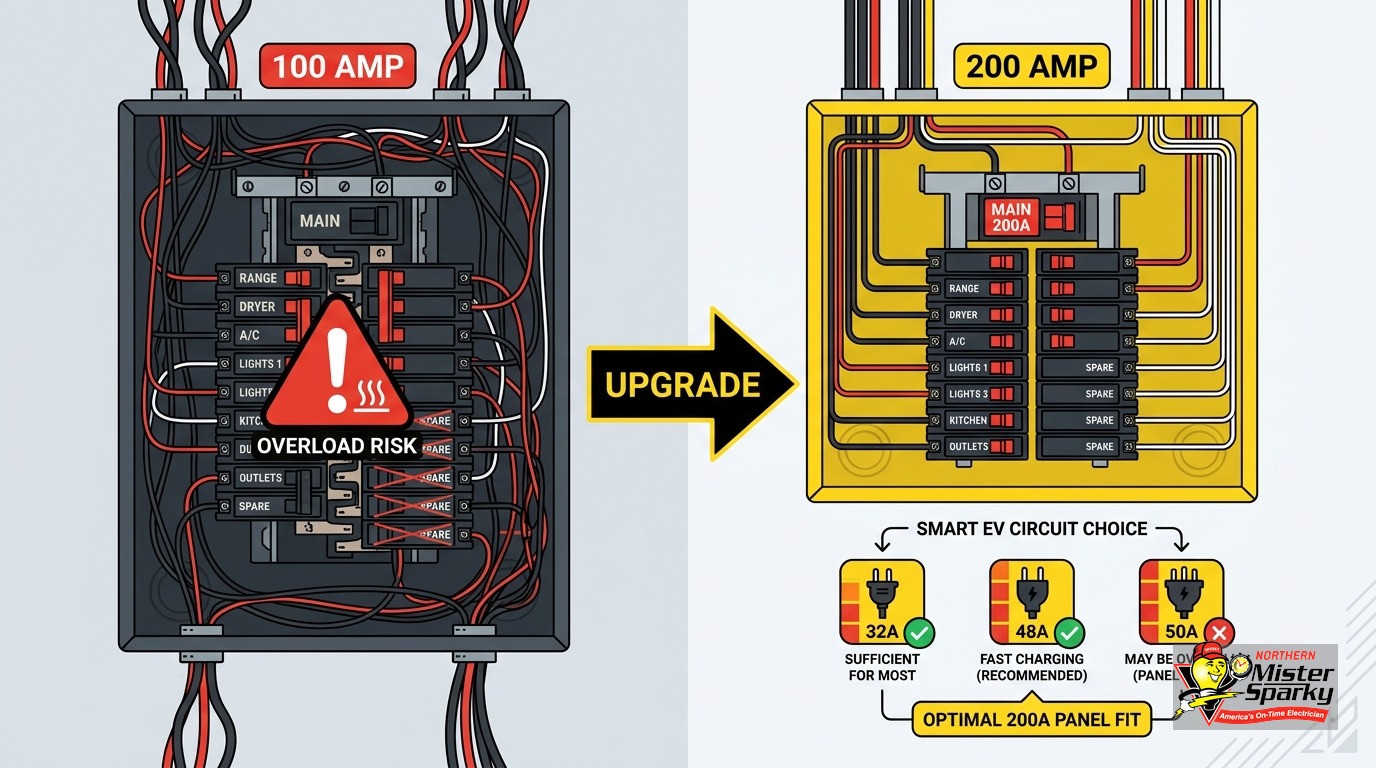
Twin Cities homes built before 2000 often run on 100-amp service. Many of those panels are already carrying close to their rated load. Adding a 50A or 60A EV circuit to a loaded 100-amp panel is not always straightforward. That is the conversation most homeowners need to have before they ever pick a charger brand.
This guide covers the decision in the right order: panel capacity first, NEC code second, vehicle and usage third. It also covers Minnesota-specific details that national articles consistently skip, including permits, Xcel rebates, and cold-weather charging behavior.
Does Your Panel Have Room? Start There.
The most common mismatch we see is this: a homeowner picks a 48A charger. Then they learn the panel cannot support the required 60A breaker without a full service upgrade. Knowing your panel’s condition up front changes the entire conversation.
Panel capacity matters in two distinct ways.
Physical slots. A double-pole breaker for a 50A or 60A EV circuit takes two spaces. If your panel is full, that is an immediate constraint. A tandem breaker can free up slots, but it does not add amperage to your service.
Available load. Even with open slots, your total connected load may leave no real headroom for a large EV circuit. A trained electrician runs a load calculation before any major circuit addition. This is a code-required step, not a formality.
If your panel is near capacity, you have two main paths. First: a panel upgrade to 200-amp service, which permanently solves the problem. Second: an EV load management device that throttles charging dynamically so your total draw never exceeds the panel’s rating. Both options have tradeoffs.
Our post on signs your panel needs an upgrade walks through the warning signs. If you are unsure whether your service is 100A or 200A, the 100-amp vs. 200-amp electrical service guide explains what that difference means for adding large loads.
How Does the NEC 125% Rule Affect Your Breaker Size?
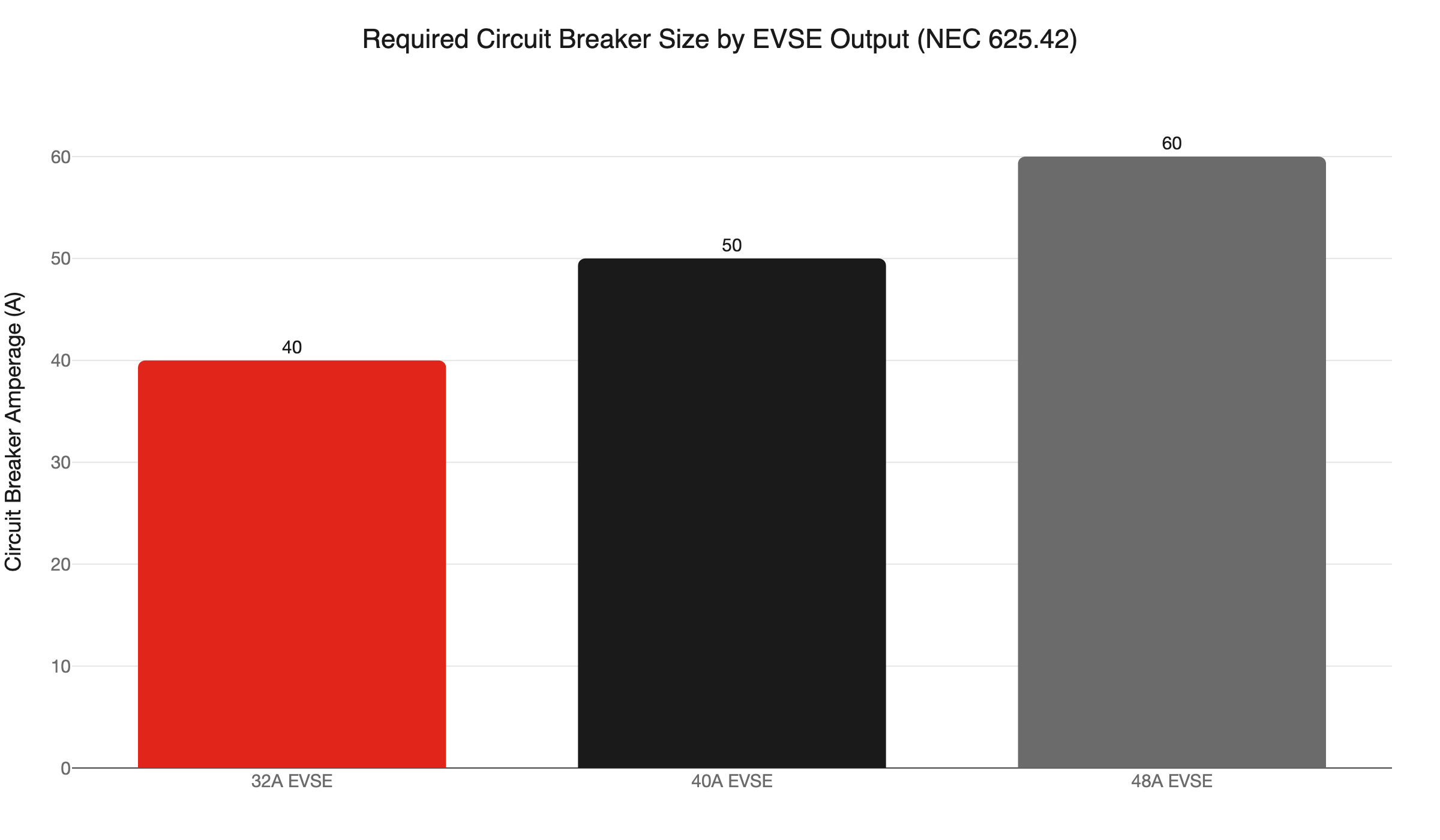
Quick answer: NEC 625.42 classifies EV chargers as continuous loads, meaning the circuit must be rated at 125% of the EVSE’s output. A 40A charger goes on a 50A breaker. A 32A charger goes on a 40A breaker. A 48A charger goes on a 60A breaker.
This surprises homeowners who expect the charger and breaker ratings to match. The 125% rule is not negotiable. A continuous load is any load running for three or more hours at a stretch. Your car charges overnight, so it qualifies.
Here is the sizing ladder for the three most common residential EVSE tiers:
- 32A EVSE: 40A breaker, #8 AWG wire
- 40A EVSE: 50A breaker, #6 AWG wire
- 48A EVSE: 60A breaker, #6 AWG wire (upsize to #4 AWG on runs longer than about 38 feet)
Wire gauge matters beyond just the breaker rating. Longer runs create resistance and voltage drop. Wire that is undersized for the run length generates heat inside your wall. Our team sizes wire for the actual panel-to-garage distance before pulling a foot of cable.
Note for multi-unit buildings: the NEC 2026 EVEMS provision under NEC 625.48 allows the 125% multiplier to be waived when an approved Energy Management System is in place. This is relevant for condos and townhomes, not typical single-family homes.
What Are the Real Differences Between 32A, 40A, and 48A?
Quick answer: 32A adds about 25 miles of range per hour, enough for most commuters. 40A adds roughly 30 miles per hour. 48A reaches the Level 2 ceiling at about 36 miles per hour. For most homeowners, the 40A/50A setup hits the right balance of speed, panel impact, and installation flexibility.
32A (7.7 kW) - The Efficient Choice
A 32A charger delivers roughly 25 miles of range per hour. The average daily commute in the Twin Cities metro runs about 40 miles round-trip. On a 32A charger, you replenish that in under two hours.
If your vehicle has a 60-80 kWh battery and you drive a typical suburban route, 32A is genuinely sufficient. Its advantage: a 40A circuit is your smallest panel hit. That matters when headroom is tight.
The limitation shows up with large-battery vehicles. A nearly depleted 100+ kWh pack takes 13 or more hours to fill on a 32A charger. If that describes your situation, read on.
40A (9.6 kW) - The Sweet Spot
Most electricians, including our team, land here for the majority of Twin Cities homeowners. The 40A charger on a 50A circuit charges meaningfully faster than 32A. It does so without requiring the 60A circuit a 48A unit demands.
There is an important practical advantage at this tier: 40A is the maximum output for any charger connected to a receptacle. A NEMA 14-50 outlet can legally support a 40A EVSE. Hardwired installations are permanent. A plug-connected setup lets you swap charger brands or take the unit with you if you move. For many homeowners, that flexibility is worth having.
48A (11.5 kW) - The High-Ceiling Option
A 48A charger is the fastest residential Level 2 setup available. It legally requires a hardwired EVSE on a 60A circuit. You cannot connect a 48A unit to any receptacle.
The vehicles that earn this circuit are the large-battery trucks and SUVs: the Ford F-150 Lightning, Rivian R1T and R1S, and Chevy Silverado EV. These carry 100+ kWh battery packs. For drivers who regularly run them near empty, the extra overnight charging speed is real.
For drivers of standard 60-80 kWh EVs, the gain over 40A is incremental. Whether a 60A circuit and possibly a panel upgrade justify that gain depends on your driving habits and how your panel sits today.
Is a 48A Charger Worth It in Minnesota?
Quick answer: For most homeowners, no. Minnesota winters mean your EV’s battery management system regularly limits AC charging acceptance well below your circuit’s rated capacity. The future-proofing case for 48A weakens considerably when you will rarely hit 11 kW in January.
Here is what the national articles consistently miss: cold weather and EV batteries do not cooperate. Most EVs use a battery management system that limits how fast the battery accepts a charge when temperatures drop below roughly 20 degrees Fahrenheit. This protects the battery from thermal stress. It also caps your real-world charging speed.
During a Minnesota January or February, your car may only accept 6-8 kW of charge. This holds regardless of whether your circuit can deliver 7.7, 9.6, or 11.5 kW. The extra panel capacity sits unused.
This does not make 48A wrong for every Minnesota homeowner. Two situations shift the calculus. If you drive a large-battery truck and park in a heated garage, the battery stays warm and you will see the full benefit. And if a panel upgrade is already necessary for other reasons, sizing the EV circuit to 60A while you are at it adds little incremental cost. That is a smart time to go bigger.
But if you are choosing between 40A and 48A purely to future-proof against a car you do not own yet, factor in the cold-weather reality. You may be paying for rated capacity you will rarely reach.
What Will an EV Charger Installation Cost in Minneapolis?
Quick answer: Labor and permits typically run $800-$1,800 for a standard install. Total all-in costs, including hardware, generally fall between $1,800 and $2,800. The single largest variable is the distance from your panel to your charging location.
Here is how the numbers break out:
- Labor and permits: $800-$1,800, driven primarily by run length and panel condition
- Charger hardware: $300-$700 for a quality 40A or 48A EVSE
- Panel upgrade (if needed): $2,000-$4,000 additionally, partially offset by Xcel’s $1,500 panel rebate
A short run from an attached garage on a modern panel with open slots is the low end of that range. A long conduit run, finished walls that require fishing wire, or a necessary panel upgrade pushes toward the top.
We provide straight, itemized quotes before any work starts. No surprises, no malarky.
Is the Federal Tax Credit Still Available?
Quick answer: No. The Section 30C residential EV charger tax credit expired June 30, 2026. Many online articles still describe 30% back up to $1,000. That credit no longer exists.
This is the piece of misinformation we encounter most often. Search for “EV charger tax credit” today and you will find 2024 and early-2025 articles that have not been updated. Homeowners reading them are budgeting for money they cannot collect.
The IRS confirms that the Alternative Fuel Vehicle Refueling Property Credit ended under the One Big Beautiful Bill Act (P.L. 119-21). Check the IRS page directly rather than relying on any third-party guide that may be months or years out of date.
The practical upside: Xcel Energy’s rebate is still fully active. For most Twin Cities homeowners, it delivers comparable or greater real value than the expired federal credit did. And unlike the old tax credit, Xcel’s rebate is a direct reduction in your project cost, not a deferred reimbursement at tax time.
What Xcel Energy Rebates Apply to Your Install?
Quick answer: Xcel offers up to $500 toward charger hardware, wiring, and installation labor for standard-income customers. Income-qualified households can receive up to $1,200. A separate rebate covers up to $1,500 if a panel upgrade is required. Apply through Xcel My Account before work begins.
Here is the full breakdown:
- Charger and wiring rebate: Covers permitting, materials, and labor. Up to $500 standard; up to $1,200 income-qualified.
- Panel upgrade rebate: Up to $1,500 if a panel upgrade is needed to support the new EV circuit.
The panel upgrade rebate changes the math for homeowners on the fence. A homeowner needing a 200-amp service upgrade to support a 60A circuit was looking at $2,500-$4,000 out of pocket. With $1,500 back from Xcel, that gap narrows in a meaningful way.
The charger rebate also reshapes the 32A-versus-40A question. Five hundred dollars back makes the step from a 32A to a 40A charger cost-neutral for most homeowners. That small upgrade delivers noticeably faster charging, and Xcel is effectively covering the difference.
Both applications must be submitted before installation work begins. Retroactive applications are not accepted. Our team handles the rebate paperwork as a standard part of every install, so you do not lose eligibility on a technicality.
Do You Need a Permit in Minneapolis?
Quick answer: Yes, without exception. Minnesota law under Minn. Stat. § 326B requires a permit for any new 240V dedicated circuit. Minneapolis permit fees typically run $150-$300 and include both a rough-in and a final inspection. Your licensed electrician pulls the permit.
Any article suggesting you “might” need a permit in Minnesota is wrong. The permit is not optional, and it is not a formality to work around. It protects you in three concrete ways.
Resale. Unpermitted electrical work surfaces in home inspections. It can stall or kill a sale, or require expensive remediation before closing.
Insurance. Some homeowner policies deny claims on damage traced to unpermitted work. That is not a risk worth carrying.
Safety. The inspection process exists to catch wiring errors before they become hazards inside your walls. That protection is the whole point.
We pull the permit on every EV charger install as standard practice. It is included in your quote from the start. For a broader look at the Minnesota permit process, our post on electrical permits in Minnesota covers what to expect from rough-in through final.
How Northern Mister Sparky Handles the Whole Job
Figuring out what amp EV charger you need is one step. The full project covers panel assessment, load calculation, permit, conduit and wire, EVSE installation, inspection coordination, and Xcel rebate filing. That is where homeowners run into trouble when they try to assemble it on their own.
Our team handles all of it. We are locally owned and operated in the Twin Cities, and every install is backed by the UWIN(R) 100% satisfaction guarantee. As America’s On-Time Electrician(R), we show up when we say we will and we do the work right the first time.
Here is what a standard EV charger install looks like with us:
- Panel assessment. We confirm your available capacity or flag the need for an upgrade.
- Circuit sizing. We select the right breaker size, wire gauge, and run path for your setup.
- Permit. We pull it before any work begins.
- Installation. We run conduit, pull wire, and mount the EVSE.
- Inspections. We coordinate both the rough-in and the final walkthrough.
- Rebate. We submit the Xcel application before the first wire is run so you do not lose eligibility.
Ready to get moving? Call us at 763-200-5956 or book your EV charger install online. We serve Minneapolis, St. Paul, Bloomington, Brooklyn Park, Woodbury, Blaine, Maple Grove, Plymouth, and the surrounding Twin Cities metro.
If your project involves a panel upgrade, financing is available. Ask about it when you call.
Frequently Asked Questions
Does Minnesota require a permit to install an EV charger? +
Is the federal EV charger tax credit still available in 2026? +
What Xcel Energy rebate is available for EV charger installation? +
Need an electrician now?