
Level 2 EV Charger Installation Cost in Minneapolis (2026)
Key Takeaways
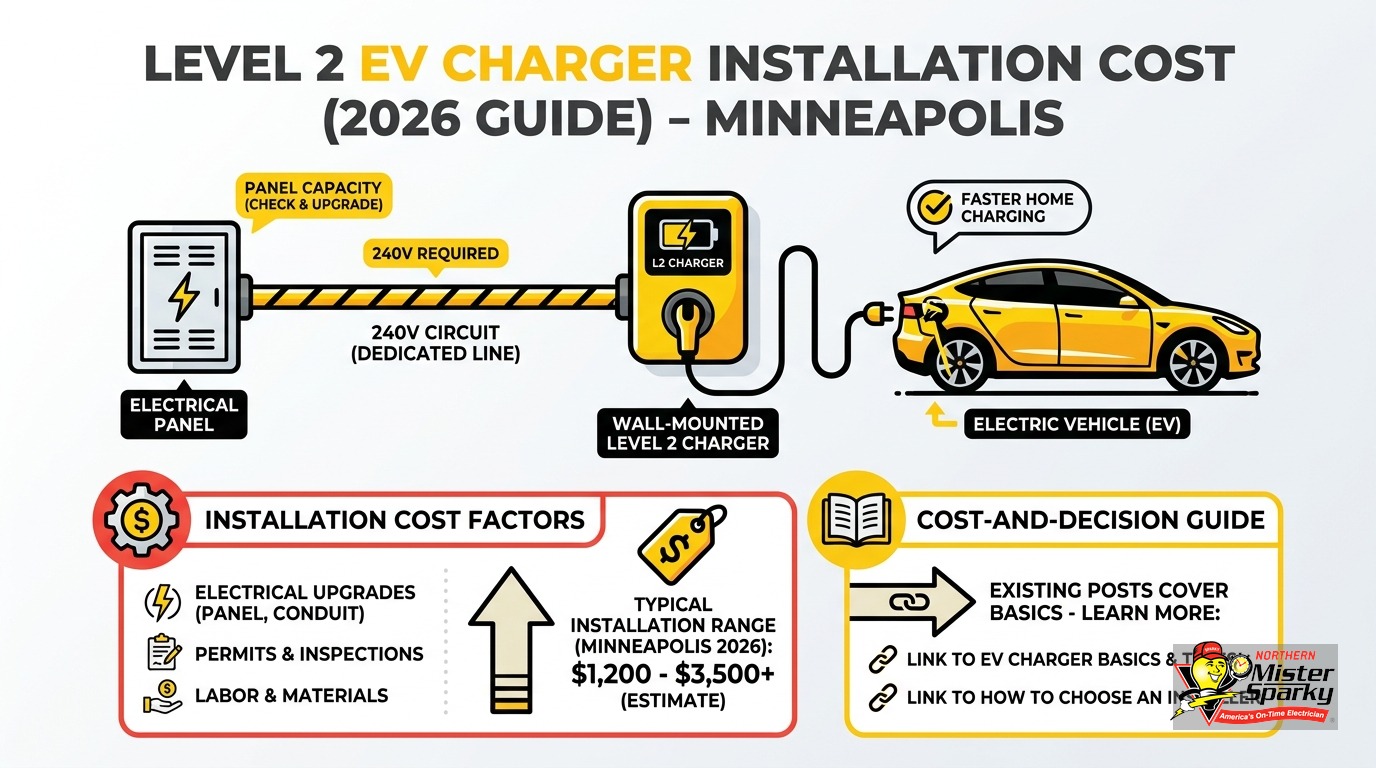
- Level 2 EV charger installation cost in Minneapolis runs $1,200-$2,500 for a standard job, and $2,500-$5,000 or more if a panel upgrade is needed.
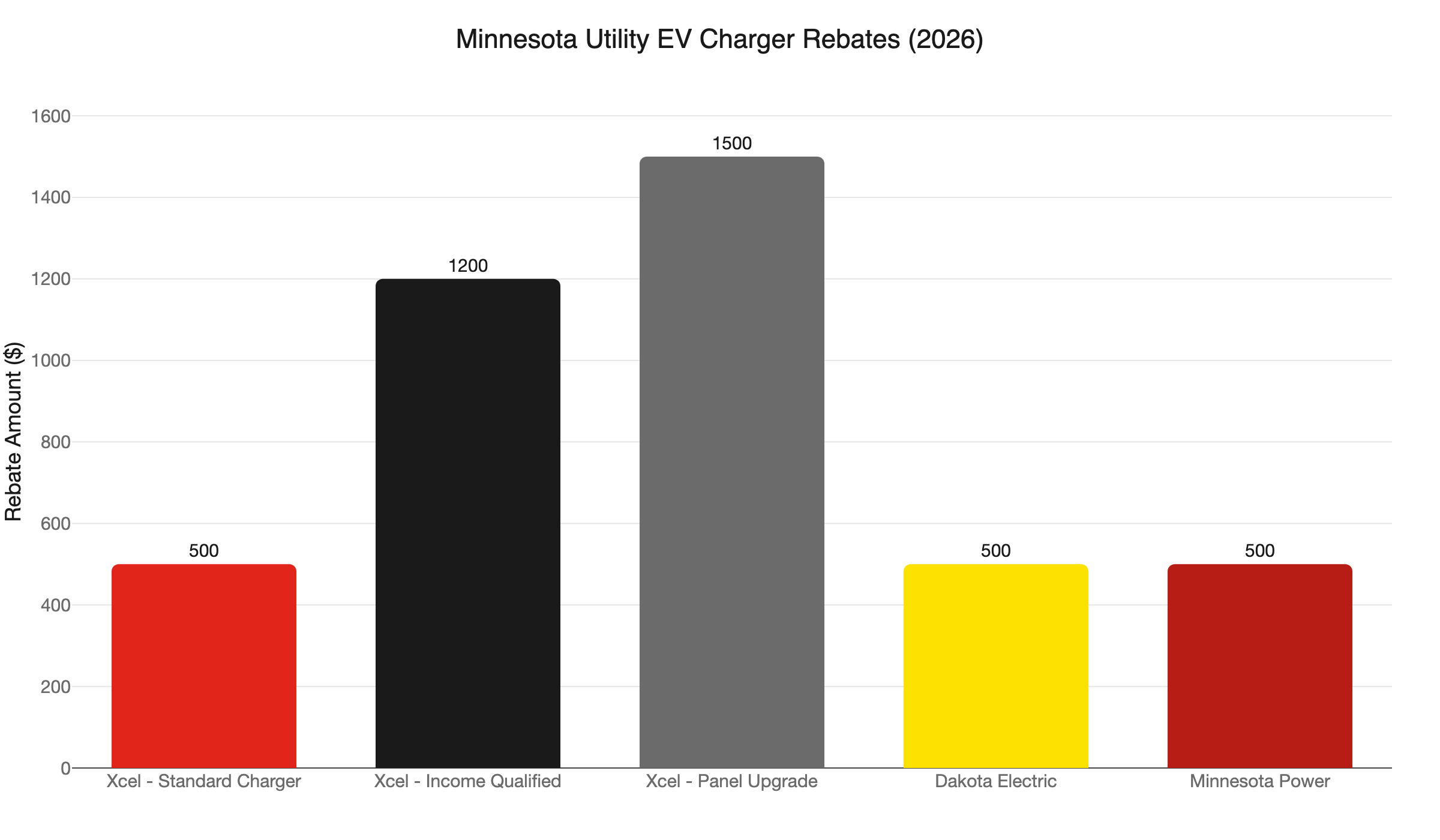
- Xcel Energy customers can stack a $500 EV charger rebate with a $1,500 panel upgrade rebate for up to $2,000 back. Income-qualified customers get $1,200 on the charger alone.
- Dakota Electric customers in the south and east metro qualify for a $500 rebate on the circuit installation.
- The federal 30C tax credit (30%, up to $1,000) expired June 30, 2026. Installs placed in service July 1 or later get zero.
- Minnesota adopted the 2026 NEC on August 17, 2026. Permits filed on or after that date follow the new code.
- A permit is required. Roughly 66 Minnesota cities run their own electrical permit offices; all others use the state portal.
- Most panel and new-circuit work requires a licensed electrician under Minnesota Statute 326B.
What Is the Level 2 EV Charger Installation Cost in Minneapolis?
Most Minneapolis homeowners pay $1,200-$2,500 for a straightforward Level 2 EV charger installation. Jobs that need a panel upgrade push that to $2,500-$5,000 or more. After applicable Xcel Energy rebates, a standard job can run $700-$2,000 out of pocket.
National cost data puts the Midwest range at $1,200-$2,000 for a typical install. That range is real, but it does not account for Minnesota-specific rebates, local permit fees, or the fact that the federal 30C credit expired in mid-2026.
The level 2 ev charger installation cost for a Twin Cities homeowner comes down to three things: the condition of your electrical panel, the distance from the panel to the garage, and which utility serves your address. Get all three right and the rebate math can cut your out-of-pocket cost significantly.
The Three Install Scenarios
Not every job costs the same. Here is how to think about where you might land.
Scenario 1: Easy install ($1,200-$1,700)
Your panel has open breaker slots. The garage is attached and the wire run is short. An electrician installs a dedicated 240V circuit, mounts the charger or outlet, and pulls a permit. Most jobs finish in two to four hours. With Xcel’s $500 rebate applied, your out-of-pocket cost lands at $700-$1,200.
Scenario 2: Standard install ($1,700-$2,500)
A longer wire run, a conduit path through finished space, or a panel with limited room but enough capacity to squeeze in one more circuit. The job takes a full day. After the $500 rebate: $1,200-$2,000.
Scenario 3: Panel upgrade required ($2,500-$5,000+)
Your panel is full or the service is undersized for the added load. You need a service upgrade or a garage subpanel before the charger circuit goes in. This is where Xcel’s stacked rebates do the most work: $500 for the charger plus up to $1,500 for the panel upgrade equals $2,000 in potential rebates. A $4,000 job becomes a $2,000 job on paper - and for income-qualified customers, the charger rebate alone rises to $1,200.
What Rebates Can Twin Cities Homeowners Stack?
Xcel Energy customers can stack a $500 EV charger rebate with a $1,500 panel upgrade rebate for up to $2,000 total. Income-qualified customers get $1,200 on the charger alone. Dakota Electric customers in the south and east metro qualify for a separate $500 rebate.
Here is the full picture by utility.
Xcel Energy (most of Minneapolis, St. Paul, and the metro)
Xcel offers two rebates that can be combined on the same project:
- EV charger rebate: rebates are available, including higher amounts for income-qualified households. The charger must be a networked unit. You need to enroll in a qualifying off-peak charging program before the rebate is issued.
- Panel upgrade rebate: a panel upgrade rebate is available and can be stacked with the EV charger rebate on the same project.
The stacking detail matters. If your job requires both a new circuit and a panel upgrade, submitting both applications in the same project window can capture both rebates. That changes the math on larger jobs considerably.
Our Xcel Energy electrical rebates page covers the full rebate catalog, including energy efficiency programs that sometimes apply alongside an EV charger install.
Dakota Electric Association (south and east metro)
Dakota Electric offers a $500 rebate for Level 2 circuit installation completed on or after January 1, 2026. The limit is one rebate per EV charging circuit. You have one year from the install date to submit your electrician’s invoice.
If you are in Eagan, Apple Valley, Burnsville, or Lakeville, verify whether you are in Dakota Electric’s territory before assuming Xcel applies. The service area boundary runs through the south metro and catches a lot of homeowners off guard.
Minnesota Power (northern Minnesota)
Minnesota Power offers a $500 rebate for Level 2 charger installation in their northern Minnesota service territory. This covers the Duluth area and surrounding communities, not the Twin Cities metro.
Did the Federal 30C Tax Credit Expire?
Yes. The federal 30C alternative fuel vehicle refueling property credit expired June 30, 2026. Any EV charger placed in service on or after July 1, 2026 gets no federal credit. If you installed before that date, file IRS Form 8911 to claim it.
There is a detail worth knowing for context: even when 30C was live, most urban Minneapolis addresses did not qualify. The credit required an eligible census tract, and most dense Minneapolis neighborhoods fell outside that definition. For many Twin Cities homeowners, the expiration did not actually change their situation.
The practical takeaway: do not wait on a federal credit to return. The Xcel and Dakota Electric rebates exist now. A standard install completed today is cheaper out of pocket than the same install completed a year ago while chasing a credit that may never come back.
What Drives the Level 2 EV Charger Installation Cost Up or Down?
Panel capacity, distance from the panel to the garage, charger amperage, and whether you go hardwired or plug-in are the four main cost drivers. A 50-amp circuit costs more to run than a 32-amp circuit, and a 60-foot wire run costs more than a 10-foot run.
Here is what each variable does to your final price.
Panel capacity
If your panel is full, you have three paths. A full service upgrade permanently adds capacity. A subpanel in the garage handles the charger circuit and future garage loads without touching the main service. A load management device monitors overall load and throttles the charger automatically when the house draws heavy current.
The subpanel route is often the best value for a detached garage or a panel that has room to grow. A load management device is cheaper upfront but introduces limitations we cover below.
Charger amperage
A 32-amp Level 2 charger adds roughly 25 miles of range per hour. A 48-amp unit adds 35 to 40 miles per hour. A 50-amp circuit is the common choice for most households.
NEC 625.41 requires the circuit to be sized at 125% of the EVSE nameplate amperage. A 48-amp charger needs a 60-amp circuit: larger wire, a larger breaker, and more labor than a 32-amp setup. See our EV charger amperage selection guide before you commit to a unit size.
Hardwired vs. plug-in
A plug-in setup using a NEMA 14-50 outlet lets you swap charger hardware without calling an electrician. A hardwired EVSE is permanent. Under NEC code, GFCI protection is required for Level 2 equipment regardless of connection type.
Minnesota adopted the 2026 NEC effective August 17, 2026. Permits filed on or after that date are inspected under the new code. Both the 2023 and 2026 editions include NEC 625.41 and 625.54, so the practical charger requirements are similar. Your electrician will know which code applies to your permit date.
Wire run length
Every foot of conduit from the panel to the charger adds material and labor cost. An attached garage with the panel on the adjacent wall is the cheapest scenario. A detached garage on the far side of the lot, especially one that needs an underground run, is the most expensive. Expect the underground portion alone to add $500-$1,500 depending on distance and ground conditions.
Do You Need a Permit to Install an EV Charger in Minnesota?
Yes. Minnesota requires a permit for any new 240V circuit, including EV charger installations. Starting work without a permit adds an investigation fee on top of the permit cost.
Minnesota runs a dual system. Many cities operate their own electrical permit offices: Minneapolis, St. Paul, Bloomington, and most larger suburbs are in this group. If you live in one of those cities, your electrician pulls the permit through the city. Everyone else uses the state portal at ims.dli.mn.gov.
Two inspections are required: a rough-in inspection before walls close, and a final inspection after the circuit is energized. For most existing-home EV charger installs, the rough-in inspection may not apply because no walls are opened. Your electrician handles scheduling both.
The St. Paul EV charger permit guide at permitmint.com walks through the city-specific permit process in detail if you want to understand what that looks like before your appointment.
Permit fees vary by city but typically run $100-$300 for a single EV charger circuit. That cost should appear as a line item in any legitimate quote.
Can I Install an EV Charger Myself in Minnesota?
Legally, the window is very narrow. Minnesota Statute allows homeowner-pulled permits only on homesteaded property under specific conditions. Panel work and new circuit installation generally require a licensed electrician.
The practical problem: a Level 2 charger requires a new 240V circuit that originates at the panel. Panel work is where Minnesota’s homeowner exemption tightens up fast. Even if you are technically capable, you may not be legally permitted to pull the permit, and an unpermitted install creates real problems when you sell the house or file an insurance claim.
An unlicensed install on a dedicated 240V circuit is not a gray area - it is a code violation and a liability. The inspection will catch it. The licensed-electrician route is the only clean path for most Twin Cities homeowners.
Is a Load Management Device a Cheaper Alternative to a Panel Upgrade?
Sometimes. A load management device costs $300-$500 and lets you avoid a full panel upgrade by monitoring total home load and throttling EV charging when other circuits are running heavy. The tradeoff is slower charging during peak home energy use.
The NEC explicitly allows an Energy Management System (EMS) as an alternative to a full service upgrade. The device watches your home’s total current draw and automatically dials back the charger when you are near the panel’s limit.
For households that charge overnight, when HVAC, laundry, and kitchen loads are low, this works well. If you want the fastest possible charging speed or run heavy loads at all hours, a subpanel or service upgrade is the better long-term investment.
Our guide on EV load management as a panel upgrade alternative covers when this approach makes sense and when it does not.
What to Expect From the Installation
Once you book, a typical job runs in five steps.
Site visit and quote. An electrician assesses the panel, measures the wire run, and flags any code requirements specific to your home. This is where the price gets firm. A reputable electrician will not quote by phone for a job they have not seen.
Permit pulled. Your electrician pulls the permit before any work starts. In Minneapolis and St. Paul, that goes to the city. In most of the metro, it goes through the state portal.
Installation. Circuit run, outlet or charger mount, connections made. Most straightforward jobs take two to four hours. A panel upgrade adds a full day or more.
Final inspection. The inspector checks the circuit, GFCI protection, and permit compliance. Once signed off, you are clear to charge.
Rebate submission. Your electrician provides the invoice you need to submit to Xcel or Dakota Electric. Submit promptly. Dakota Electric requires submission within one year of the install date.
Schedule Your EV Charger Installation
Northern Mister Sparky is locally owned and operated in the Twin Cities. As America’s On-Time Electrician(R), we show up when we say we will and quote clearly before any work starts. Every job is covered by the UWIN(R) 100% satisfaction guarantee.
Call us at 763-200-5956 or book your EV charger installation online. If your job might involve a panel upgrade, ask about Xcel’s stacked rebates when you call. We work in Minneapolis, St. Paul, Bloomington, Brooklyn Park, Woodbury, Blaine, Maple Grove, Plymouth, and the surrounding Twin Cities area. We know the permit offices, we pull permits every week, and we can help you capture the rebates that most national articles do not even mention.
Frequently Asked Questions
How much does a Level 2 EV charger installation cost in Minneapolis? +
What Xcel Energy rebates are available for EV charger installation? +
Did the federal 30C EV charger tax credit expire? +
Do I need a permit for an EV charger installation in Minneapolis? +
Need an electrician now?